
Reviewed · OLD TOWN & HISTORY TOURS
Split Walking Tour with History Professor
Split’s best stories begin where the Roman palace stops. On this walk, history professor Mario takes you from the Riva into Diocletian’s Palace, then onward through medieval and modern Split, connecting Roman power with Venetian rule, Ottoman influence, Napoleon, local legends, and Game of Thrones filming spots. The time travel is the real draw.
I like the small-group format, which gives Mario room to explain rather than rush through a speech. I also like the price: at $23, you get a broad look at Split with a guide who uses humor, questions, and lively delivery. The main consideration is the footing and access. This is a walking tour over old stone streets and is not suitable for wheelchair users, with admission to the Cathedral and Temple of Jupiter not included.
In This Review
- Key points at a glance
- Why this Split tour gives you more than a palace tour
- Starting at the Riva and reading Split from the outside
- The palace substructures and the Peristyle
- The Vestibule and Split’s living Roman core
- Saint Domnius and the Temple of Jupiter
- The Golden Gate and Grgur Ninski
- Marmontova, Prokurative, and the city after Rome
- Fruit’s Square and the final modern view
- How Mario’s teaching style affects the experience
- Timing, walking, and value at $23
- Who should book this Split walking tour?
- Should you book it?
- FAQ
- Where does the Split walking tour meet?
- How long does the tour last?
- What language is the tour in?
- How much does the tour cost?
- Is the tour suitable for all ages?
- Is the tour suitable for wheelchair users?
- Are entrance fees included?
- What should I wear?
- Can I book a private tour?
- Can I cancel the tour for a full refund?
Key points at a glance
- A full story of Split: Roman, medieval, Venetian, Ottoman, Napoleonic, and modern influences all appear during the walk.
- Mario teaches, rather than recites: Expect questions, discussion, humor, and clear historical explanations in English.
- The route covers major landmarks: See the Riva, palace substructures, Peristyle, Vestibule, Cathedral, Golden Gate, and more.
- You go beyond Diocletian: Marmontova Street, Prokurative, and Fruit’s Square show how Split developed after Roman times.
- Good value at $23: The tour combines a major archaeological site with the city’s later history in about two hours.
- Plan for uneven walking: Comfortable shoes and clothes matter, and the tour is not suitable for wheelchair users.
Why this Split tour gives you more than a palace tour
Diocletian’s Palace is the obvious starting point in Split, but it is only one chapter. The palace now forms the center of a living city, with homes, shops, cafés, churches, squares, and narrow lanes inside the old Roman walls.
That is what makes this route useful. You do not simply look at Roman stone and hear a list of dates. You follow the city as it changed hands and changed purpose. Roman buildings became part of medieval life. Venetian influence shaped public spaces. Ottoman pressure affected the region. Napoleon left his mark on the city’s development. Modern Split grew around all of it.
Mario’s teaching style suits this kind of walk. He is a history professor, and his method is more interactive than a standard point-and-speak tour. He poses questions, invites participation, and uses humor to keep the story moving. His delivery has a classroom quality, but not the dry sort. You get facts with a sense of place and a human voice.
The strongest praise for Mario centers on three traits: he is personable, he knows his subject, and he keeps people involved. That combination matters in Split, where the old center can feel like a maze of impressive fragments. A clear guide helps you understand how those pieces fit.
More old town history walks in Split:
- Split: Old Town and Diocletian Palace Walking Tour
★ 4.9 · 4,727 reviews - Walking Tour of Split with a ‘Magister’ of History
★ 5.0 · 1,122 reviews - Split Walking Tour with Professor of History
★ 5.0 · 926 reviews
Starting at the Riva and reading Split from the outside
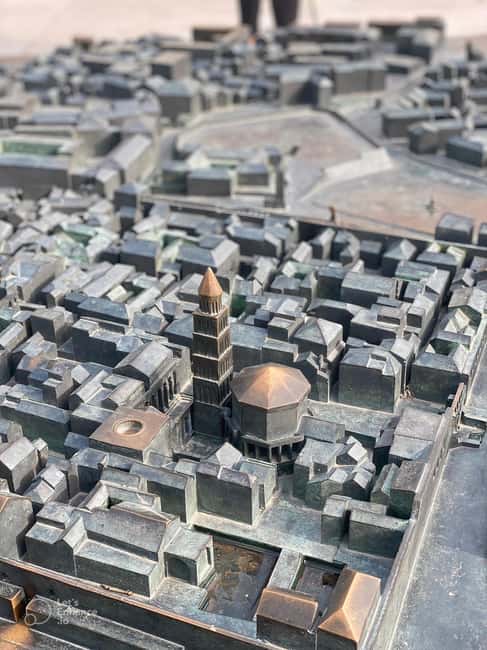
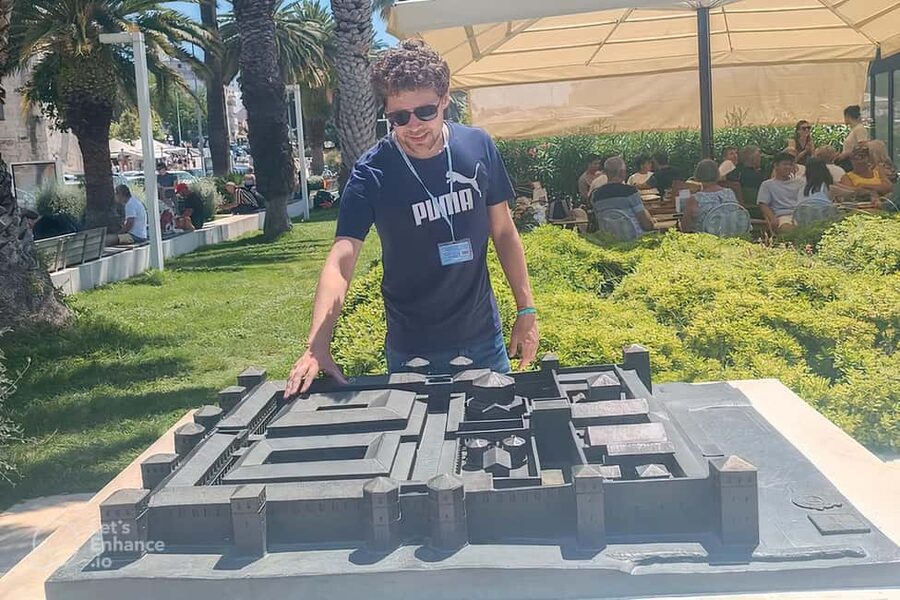
The meeting point is next to the Brass Gate of Diocletian’s Palace. The tour begins near the Riva Harbor, using a model of Split’s historic core to help you get your bearings.
This is a smart opening. Before entering the palace, you see the shape of the old center and learn how its parts relate to one another. The model gives you a basic map in your head, which is useful once you move into the tight lanes and courtyards.
The Riva itself also helps frame the city. It is not simply a waterfront promenade. It is the public face of Split, a place where the old city meets daily life. Beginning here lets Mario explain the relationship between the palace, the harbor, and the city that grew around the imperial complex.
You spend about 10 minutes at this first point. That is enough for orientation without using up too much of the tour before the main sights.
The palace substructures and the Peristyle
The first major stop is the substructures of Diocletian’s Palace. These underground spaces are among the clearest ways to understand the original Roman plan.
The lower chambers supported the rooms above and preserved the palace’s layout. When you see them, the upper palace becomes easier to picture. Rather than treating the ruins as isolated walls, you can understand the building as a carefully planned imperial residence and fortified complex.
The stop here is listed at about five minutes, so expect a concise explanation rather than a long underground visit. That is worth noting if you want extended time inside every paid or enclosed site. The tour is designed to give you a broad framework, not to linger at one location for half an hour.
From there, you reach the Peristyle, the palace’s grand central court. This is where the scale and ceremony of Diocletian’s project become clear. The space connects several major parts of the complex and gives Mario a natural place to explain imperial display, religious authority, and the movement from public court to private palace.
You spend around 10 minutes here. Look up as well as around. The surrounding stone, columns, and architectural lines make this one of the tour’s most important visual stops, but the meaning is what makes it useful. Mario can help you understand why this was more than an attractive square.
The Vestibule and Split’s living Roman core
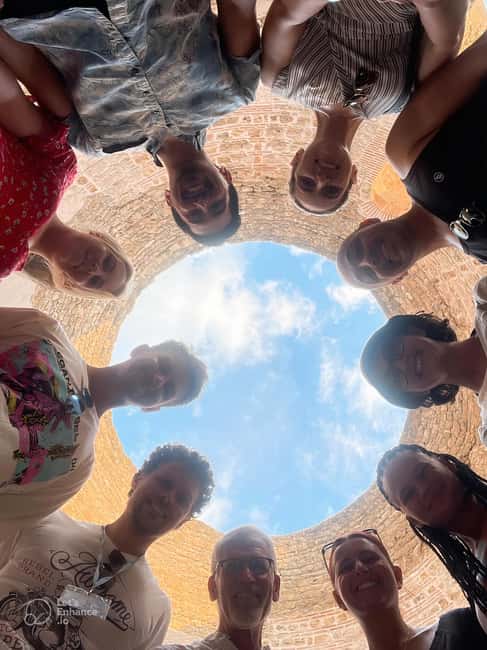
The Vestibule follows with another 10-minute stop. This circular entrance space once led toward the private quarters of the emperor. Its form and position show how movement through the palace was controlled and staged.
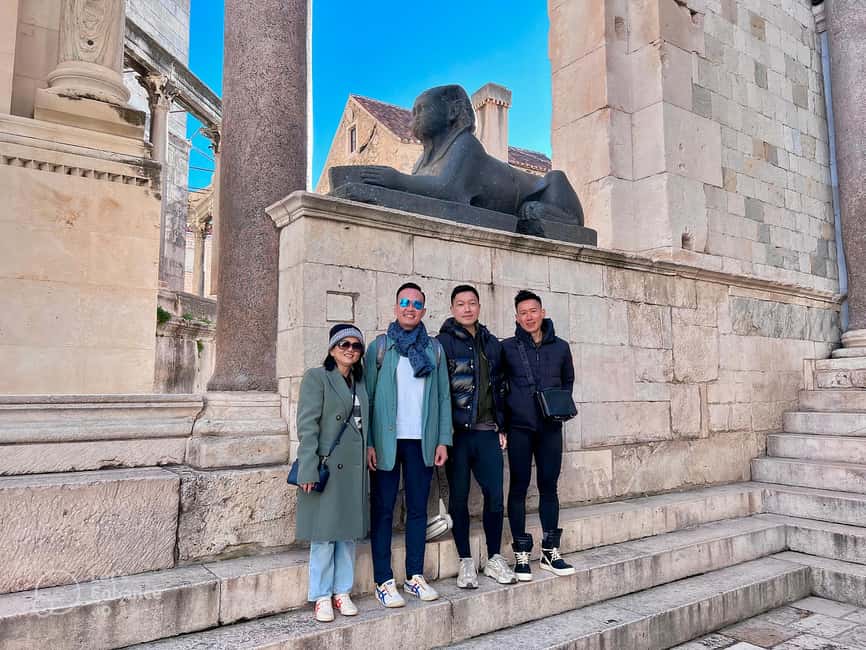
The Vestibule is also a good place to think about the difference between a ruin and a living city. Split did not preserve the palace as a frozen museum. People adapted it, built into it, and made it part of ordinary urban life. You may be standing in an ancient ceremonial space while modern Split carries on nearby.
That blend is the central lesson of the tour. The Roman past is not kept at a distance. It is built into the streets you walk through.
More walking tours in Split:
- Walking Tour of Split and Diocletian’s Palace
★ 5.0 · 2,588 reviews - Krka Waterfalls tour with Trogir Walking tour and Krka panoramic boat cruise
★ 5.0 · 1,659 reviews - Split & Diocletian’s Palace Walking Tour
★ 5.0 · 1,125 reviews - Split: Diocletian Palace & Old Town Guided Walking Tour
★ 4.7 · 882 reviews
Saint Domnius and the Temple of Jupiter
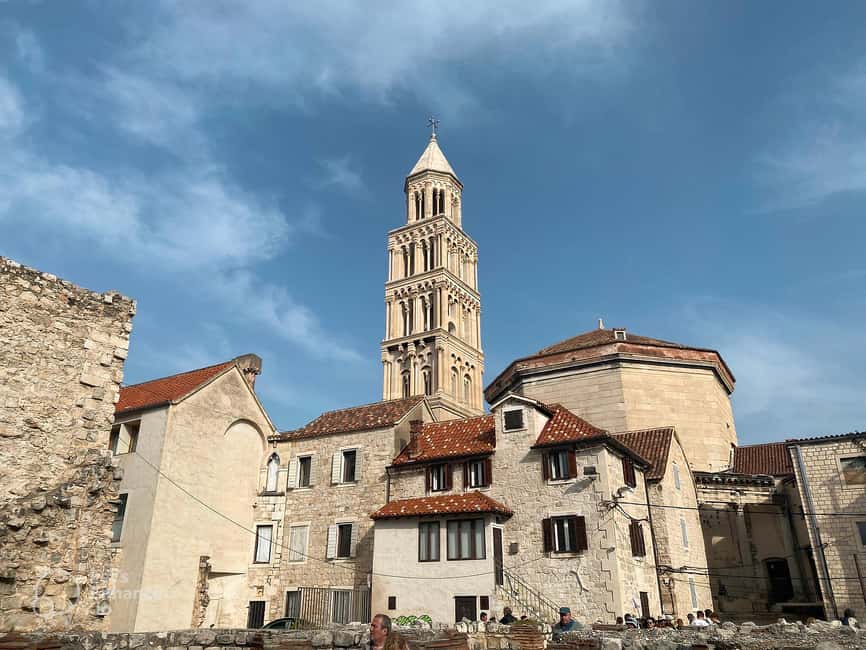
The Cathedral of Saint Domnius is one of the tour’s major stops, with about 20 minutes set aside. Admission is not included, so you should be prepared to pay separately if the route enters the cathedral.
The building is especially important because it shows how later Christian Split used an imperial Roman structure. The cathedral occupies the mausoleum of Diocletian, linking the ruler who ordered the palace with the Christian city that developed after the Roman period.
That connection gives the stop unusual force. You are not seeing an unrelated church near Roman ruins. You are seeing later history take over one of the palace’s most important buildings.
The Temple of Jupiter receives about 10 minutes, and admission is also excluded. This smaller site adds another religious layer to the palace complex. Together, the cathedral and temple help you compare Roman religious practice with the Christian use of the same urban center.
Because entry fees are separate, the $23 tour price should be understood as the cost of the guiding and walking experience, not a complete ticket bundle. That still makes it a good value for someone who wants context across the whole center, but you should budget for any optional admissions.
The Golden Gate and Grgur Ninski
The Golden Gate is one of the most recognizable entrances to Diocletian’s Palace. The 10-minute stop helps you understand the defensive and ceremonial role of the palace walls.
A gate can look like a simple photo stop, but its position tells you about Roman planning. It marked a key approach to the palace and connected the imperial complex with routes beyond it. Mario’s wider historical approach should help you see the gate as part of a system rather than a single stone façade.
Nearby, the Grgur Ninski Statue gets another 10 minutes. The statue honors Gregory of Nin, a medieval bishop associated with the use of the Croatian language in church services. The monument is also a familiar part of Split’s public life.
You may notice the statue’s polished toe. Local custom holds that touching it brings good luck. That small detail gives the stop a welcome change of pace. After Roman emperors, palace plans, and church history, you get a local tradition that people can take part in.
This is one of the advantages of having a local guide. A monument can carry an official story and a popular story at the same time. Both are worth hearing.
Marmontova, Prokurative, and the city after Rome
Marmontova Ulica moves the tour beyond the oldest Roman core. The street reflects the later development of Split and carries the name of Marshal Marmont, linked with the Napoleonic period in Dalmatia.
The stop lasts about 10 minutes. Here, the tour’s wider promise becomes clear. You are not just tracing the walls of Diocletian’s residence. You are seeing how Split expanded, modernized, and responded to outside powers.
Prokurative, formally known as Trg Republike, offers another look at the city’s later public architecture and civic life. Its name and design point toward Venetian influence, a useful reminder that Split’s identity was shaped by long periods of contact with the wider Adriatic world.
The tour also brings in Ottoman influence and local legends. The supplied route does not assign a separate stop for every historical period, so these themes appear as part of Mario’s explanations while you move through the city. That broad context is valuable because Split can otherwise feel like a collection of disconnected eras.
Fruit’s Square and the final modern view
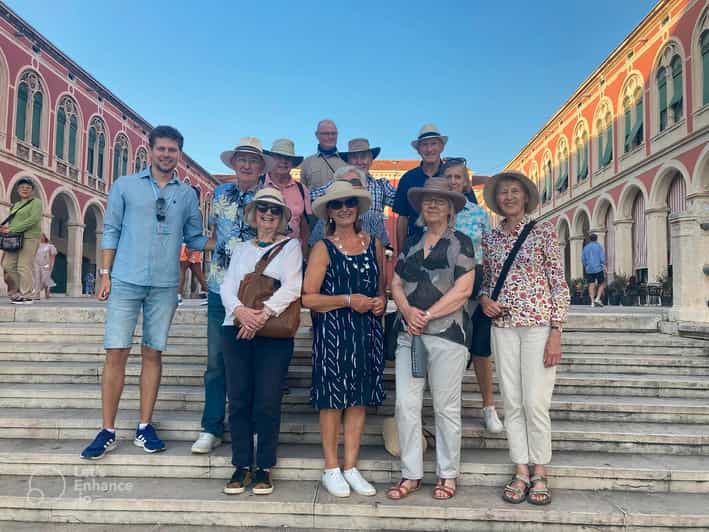
The route ends at Fruit’s Square, or Trg Brace Radic, with about 15 minutes. This is a fitting final stop because it brings together old architecture, later urban life, and the feel of present-day Split.
The square helps show how the city’s center works today. Ancient and medieval elements sit beside later façades and active public spaces. You can look back at the route and see that the palace was not the end point of Split’s story. It was the foundation for a city that kept changing.
This final stop is also where the Game of Thrones connection fits naturally. Split has appeared on screen, and the tour includes filming locations alongside more serious historical material. The television reference adds a familiar hook, but it does not replace the history. You get it as one part of the city’s modern identity.
If you are a fan of the series, Mario can help place those locations within the actual streets. If you are not, the stops still work because the main subject remains Split itself.
How Mario’s teaching style affects the experience
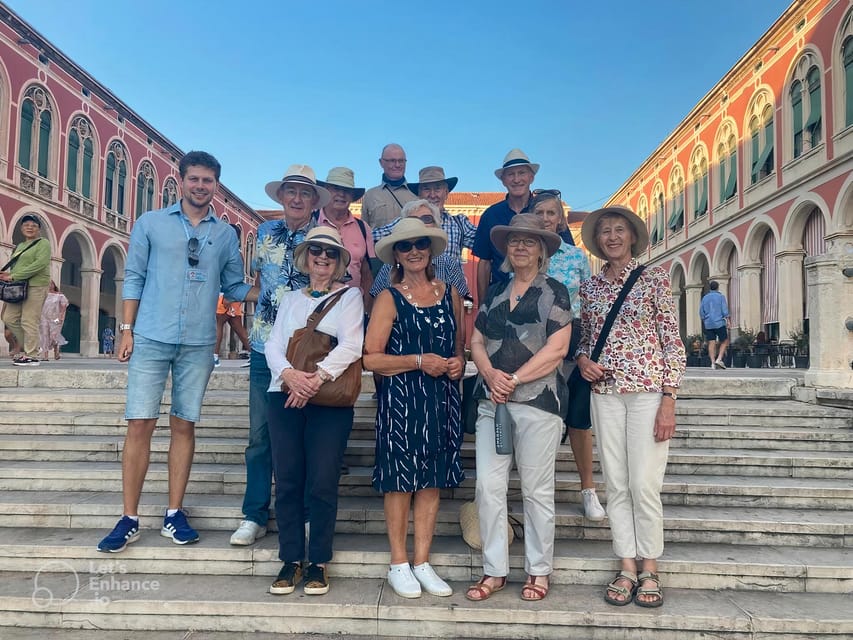
A history professor can make a walking tour excellent or exhausting. The difference is delivery. Mario’s approach appears to favor conversation, questions, and humor rather than a long uninterrupted lecture.
That matters when the subject includes emperors, religious change, foreign rulers, architecture, legends, and modern pop culture. You need a guide who can shift gears without losing the main thread.
The strongest fit is for you if you enjoy asking questions or want more than a quick list of dates. Mario encourages participation and makes his explanations accessible at different levels. You can listen for the main story, or ask for more detail when a particular period catches your interest.
The possible drawback is simple: a professor-led tour may feel more information-heavy than a casual orientation walk. If you want only a short introduction and a few photo stops, this may offer more history than you need. If you like to understand why a place looks and functions as it does, the extra substance is a benefit.
The tour is in English, and the guide’s personality is an important part of the experience. The available feedback repeatedly highlights his warmth, humor, enthusiasm, and ability to keep the group engaged. Those qualities are particularly useful in a two-hour walk, where a flat delivery can make even a great city feel tiring.
Timing, walking, and value at $23
The tour is advertised as lasting about two hours, while the highlights refer to a duration of two hours and 15 minutes. Plan on roughly two hours, with a little flexibility depending on the group and the pace at each stop.
The route includes many stops, but most are short. That means you see a lot of Split without spending the whole morning in one building. It also means you should wear comfortable shoes and clothes. Old-city walking can involve hard, uneven surfaces, and the tour is not suitable for wheelchair users.
At $23 per person, the price is reasonable for a guided introduction that covers Roman, medieval, and modern Split rather than Diocletian’s Palace alone. The value is strongest if you are visiting for the first time, want a historical framework, and plan to explore more on your own afterward.
The price is less compelling if you want every interior included or a long archaeological visit. Cathedral and Temple of Jupiter admission are excluded, and the short stop lengths favor range over detailed examination.
Small private groups are highlighted, and private tours can be requested by contacting [email protected]. The standard experience is a small-group walk, while a private option may suit families or companions who want a more tailored pace.
Free cancellation up to 24 hours before the tour and reserve-now, pay-later booking make it easier to fit the walk into a changeable schedule. Those policies are useful, but the real booking decision comes down to your interest in history and your comfort with walking.
Who should book this Split walking tour?
I would choose this tour as an early activity in Split. The opening model and the route through the palace give you a city map, while the later stops explain what happened after the Roman period. You can then return to the palace or nearby squares with a much clearer sense of what you are seeing.
It suits history fans, first-time visitors, people curious about local legends, and Game of Thrones fans who also want real historical context. It also works well for anyone who prefers a guide who teaches and asks questions instead of simply pointing out buildings.
Families can join because the tour is suitable for all ages, though younger children may need help staying focused during the historical explanations. The interactive style and statue tradition may help keep the walk approachable.
You may want a different option if you require step-free access, dislike uneven walking, or want all admissions covered in one price. You should also consider a private booking if your group needs a slower pace or a more personal route.
Should you book it?
Book this walk if you want Split to make sense as a whole city, not just as Diocletian’s Palace. Mario brings a professor’s command of the subject but uses humor, questions, and local stories to keep the experience human.
At $23, the tour offers strong value for a broad English-language introduction. Just wear sturdy, comfortable shoes, allow for separate entry fees, and expect a history-focused walk with plenty of ground covered. For most first visits, it is a smart way to get oriented before exploring Split on your own.
FAQ
Where does the Split walking tour meet?
The guide waits next to the Brass Gate of Diocletian’s Palace.
How long does the tour last?
The activity information gives a duration of two hours. The highlights also refer to two hours and 15 minutes, so allow roughly two hours with some flexibility.
What language is the tour in?
The live tour guide leads the experience in English.
How much does the tour cost?
The listed price is $23 per person.
Is the tour suitable for all ages?
Yes. The tour is described as appropriate for all ages.
Is the tour suitable for wheelchair users?
No. The tour is not suitable for wheelchair users.
Are entrance fees included?
Admission to the Cathedral of Saint Domnius and the Temple of Jupiter is excluded.
What should I wear?
Bring comfortable shoes and comfortable clothes for walking through Split’s historic center.
Can I book a private tour?
Yes. Private tours are available on request by contacting [email protected].
Can I cancel the tour for a full refund?
Yes. You can cancel up to 24 hours in advance for a full refund. You can also reserve now and pay later.
Just added around Split
- Kayaking & Zipline Šibenik – Čikola Canyon★ 5.0 · 3 reviews
- Krka National Park & Zipline Šibenik – Čikola Canyon★ 5.0 · 3 reviews
- From Split: Krka National Park & Waterfalls Private Day Trip★ 5.0 · 3 reviews
- Split: Small-Group Half Day Sailing Trip★ 5.0 · 3 reviews
- Rafting River Cetina from Makarska Riviera including transfer★ 5.0 · 3 reviews
- Split and Salona Cultural Heritage Day Tour from Trogir★ 4.0 · 3 reviews
- Split Bike and Wine Experience★ 5.0 · 3 reviews
- Split: Jewish Heritage & Diocletian’s Palace Walking Tour★ 5.0 · 3 reviews
Old Town & History Tours, compared.


Walking Tour of Split with a ‘Magister’ of History
Read our review →

Diocletian Palace & Old Town Guided Walking Tour
Read our review →

Diocletian’s Palace and Old Town SMALL GROUP Walking Tour
Read our review →

Split History and Gastro Small-Group Tour with Food and Drinks
Read our review →Browse the lists this tour appears in