
Reviewed · OLD TOWN & HISTORY TOURS
Split Walking Tour with Professor of History
Split’s old center is not a museum behind glass. It is a living city built inside and around a Roman emperor’s palace. This walking tour makes that unusual setting easier to read, with a history professor guiding you from the harbor through Diocletian’s Palace, medieval lanes, grand squares, and modern Split.
I like the professor-led storytelling, especially when Mario guides, and I like the small-group format, capped at 17 people. You also get useful local advice on food, banks, and what to see next. The main drawback is pace: the advertised 2 hours 20 minutes may stretch closer to three hours, especially when the guide adds extra stories.
In This Review
- Key points to know before booking
- Why a history professor changes the walk
- Starting beside the Riva at the Brass Gate
- Beneath Diocletian’s Palace
- The Peristyle and the emperor’s stage
- The Vestibule and imperial access
- Saint Domnius, a building with three identities
- Jupiter’s Temple and Let Me Pass Street
- The Golden Gate and Gregory of Nin
- Marmontova Street and the Prokurative
- Finishing at Fruit’s Square
- Price, group size, and what you actually receive
- Who should book this Split walk
- Should you book the Split Walking Tour with Professor of History?
- FAQ
- How long does the Split walking tour last?
- What language is the tour offered in?
- Where does the tour begin?
- Where does the tour end?
- Are cathedral and Temple of Jupiter admission fees included?
- How large is the tour group?
Key points to know before booking

- A Roman palace that became a city: You walk through streets, squares, homes, shops, and cafés built into and around Diocletian’s enormous palace complex.
- Mario brings history and humor: His talks mix dates, local stories, questions, myth-busting, and practical advice for the rest of your stay.
- Most major sights are viewed from outside: The cathedral and Temple of Jupiter do not include interior admission, so plan extra time and money if you want to go in.
- The route covers the full old center: It links the Riva, palace substructures, Peristyle, Golden Gate, Marmontova Street, Prokurative, and Fruit’s Square.
- The group stays manageable: A maximum of 17 people gives you a better chance to hear and ask questions than on a large city tour.
- Good value at $24.19: For an English-language orientation lasting more than two hours, the price is modest, though paid entrances and drinks are extra.
Why a history professor changes the walk
Many Split tours can point out Roman stones. This one aims to explain how those stones shaped the city you see today. Diocletian’s Palace is not simply a single ancient building. It is a huge Roman complex that later absorbed homes, churches, lanes, businesses, and public spaces.
That shift matters. You are not only looking at ruins. You are watching different periods of Split occupy the same ground. A column may belong to imperial Rome, while the wall beside it may come from the Middle Ages. A square built for an emperor may now be a place for people to meet.
Mario is the guide most often singled out for his command of the subject, comic timing, and ability to keep a group involved. He asks questions, challenges popular myths, and adds stories about daily life. He also shares practical suggestions about restaurants, local food, banks, and onward travel.
Anita is another guide associated with the tour. She is described as warm, attentive, proud of her Croatian background, and careful with a group of around 14 people. The exact guide can vary, but the format is clear: English commentary, a strong focus on Split’s past, and an effort to make the walk feel like a conversation rather than a lecture.
More old town history walks in Split:
- Split: Old Town and Diocletian Palace Walking Tour
★ 4.9 · 4,727 reviews - Walking Tour of Split with a ‘Magister’ of History
★ 5.0 · 1,122 reviews - Split: Diocletian Palace & Old Town Guided Walking Tour
★ 4.7 · 882 reviews
Starting beside the Riva at the Brass Gate
The meeting point is at the Brass Gate, or Porta Aenea, at Obala Hrvatskog narodnog preporoda 22. The walk begins beside the Riva harbor promenade, one of the best places to get your bearings in Split.
The Riva is not just a pretty waterfront strip. It is where local life gathers for coffee, sunshine, and conversation. Starting here gives you a useful contrast: the relaxed modern promenade outside the palace, followed by the dense old streets inside it.
You spend about 15 minutes here. Admission is free, and the opening talk helps set up the rest of the walk. Bring water and sensible shoes. The tour is not a hard hike, but old-center paving can be uneven, and much of the experience involves standing while the guide talks.
Beneath Diocletian’s Palace
The palace substructures are one of the strongest parts of the route. These lower halls are unusually well preserved, and they help you understand the layout of the imperial complex above.
You spend about 15 minutes here. The rooms once supported the upper palace, and their plan gives you a clearer sense of how the Roman structure was organized. Without this stop, it is easy to see the palace as a scattered collection of columns and walls. Below ground, its scale becomes easier to grasp.
Admission is listed as free for the tour. The guide explains the importance of the substructures, but this is not a separate paid museum visit. If you want a longer look at the underground halls afterward, you should check the available entrance arrangements separately.
The lower rooms can also be cooler and darker than the streets above. That makes this a welcome break on a hot day, but it can be harder to hear if the space is crowded.
The Peristyle and the emperor’s stage
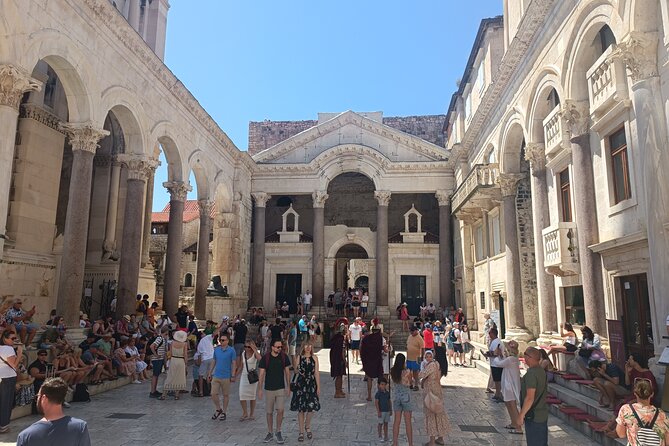
The Peristyle is the palace’s central square and one of Split’s most powerful spaces. This was the ceremonial heart of Diocletian’s residence, where the emperor presented himself as the living son of Jupiter.
The guide explains the ritual surrounding an imperial appearance. Subjects might approach on their knees, kiss the edge of the emperor’s scarlet cloak, or lower themselves fully before him. That detail turns the square from a photogenic courtyard into a stage built for power.
The stop lasts about 10 minutes. It is short, but the setting does much of the work. Look upward at the surrounding stone, columns, and architrave while you listen. The square is compact, so the guide can connect the architecture with Roman ceremony without requiring a long walk.
Because this is one of Split’s most photographed spots, the square may be busy. A small group helps, but do not expect a private setting. The guide’s ability to find a spot where everyone can hear is important here.
More walking tours in Split:
- Walking Tour of Split and Diocletian’s Palace
★ 5.0 · 2,588 reviews - Krka Waterfalls tour with Trogir Walking tour and Krka panoramic boat cruise
★ 5.0 · 1,659 reviews - Split & Diocletian’s Palace Walking Tour
★ 5.0 · 1,125 reviews - From Split: Krka Waterfalls Cruise & Trogir Walking Tour
★ 4.7 · 681 reviews
The Vestibule and imperial access
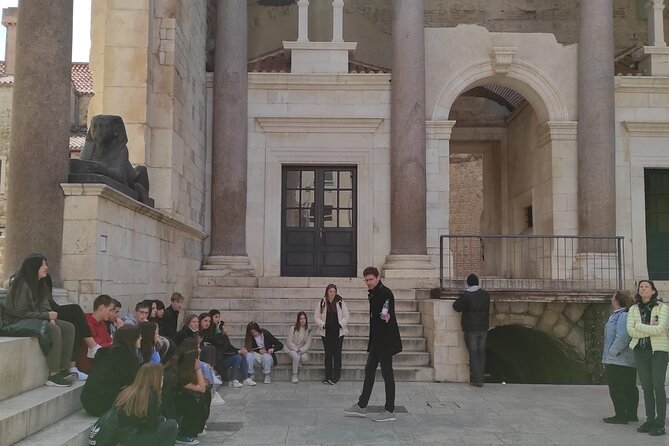
From the Peristyle, the walk continues to the Vestibule, also called the Rotonda. This circular hall formed part of the imperial route toward the private apartments.
The original structure dates to the beginning of the fourth century. It once had a dome and measured about 17 meters high and 12 meters across. The room was designed for formal meetings with selected audiences, including ambassadors.
You spend around 10 minutes here. The Vestibule is a good example of how a relatively simple shape can feel grand when it controls access to an emperor. The guide can help you picture the original roof and the procession through the palace.
This stop also shows why a walking explanation is useful in Split. Much of the original palace is open to the sky or blended into later buildings. A guide provides the missing links between what remains and what the Romans intended.
Saint Domnius, a building with three identities
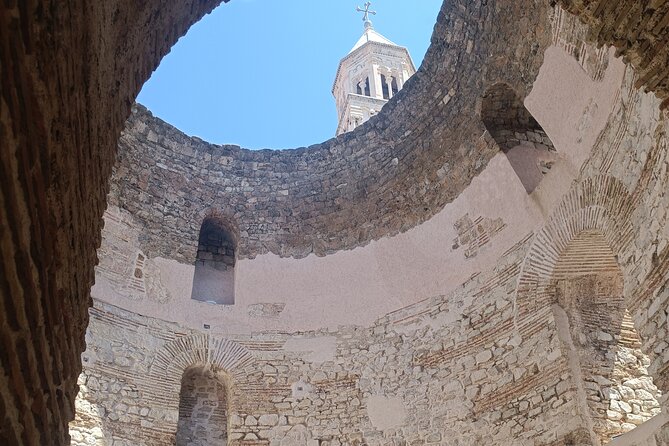
The Cathedral of Saint Domnius is viewed from the outside, with about 20 minutes devoted to the stop. The building began as Diocletian’s mausoleum, was connected to the Roman imperial complex, and later became a Christian church.
Calling it simply a cathedral misses the layered story. You can look at it as a Roman mausoleum, a former temple setting, and a functioning church shaped by later centuries. The guide explains these changes without including the interior entrance.
That limitation is worth noting. If you want to see the cathedral inside, climb the bell tower, or examine the interior details, you will need to return on your own and pay the applicable admission. The tour gives you context first, which can make a later visit more rewarding.
Jupiter’s Temple and Let Me Pass Street
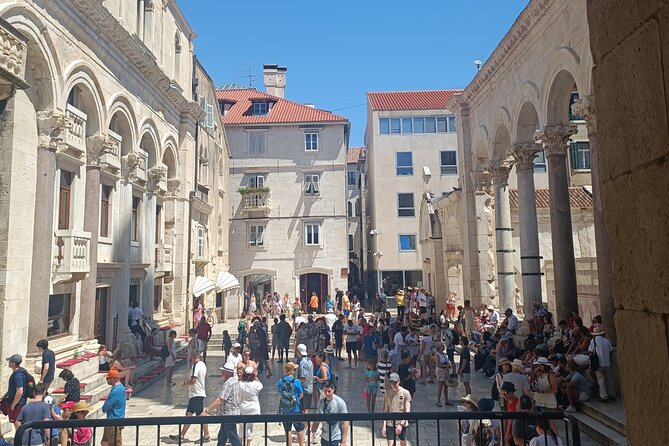
The next stop is the Temple of Jupiter, viewed from outside for about 10 minutes. Jupiter was the Roman sky and thunder god, and the temple was later converted into a baptistery dedicated to Saint John the Baptist.
This is a compact site, so the change from Roman worship to Christian use is especially easy to discuss. The stop also includes one of Split’s playful local claims. On the way to the Golden Gate, you pass a narrow lane called Let Me Pass Street. Local people consider it one of the narrowest streets in the world.
Do not expect a long temple visit. The value here comes from the historical shift and the guide’s explanation, not from extended time inside a monument. As with the cathedral, entry is not included.
The Golden Gate and Gregory of Nin
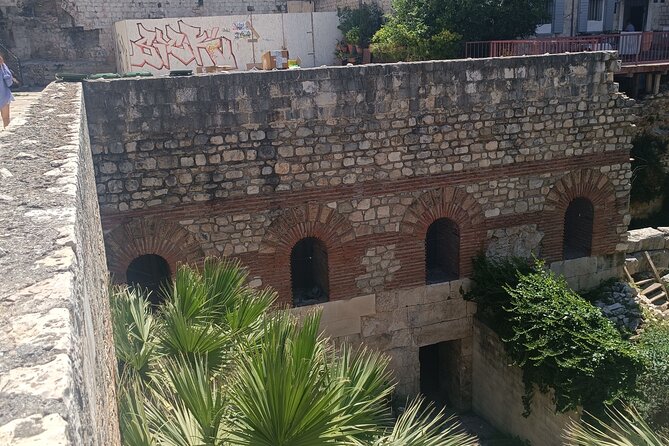
The Golden Gate was the principal northern entrance to Diocletian’s Palace. It was built for the emperor’s arrival and decorated to signal its importance.
Over the centuries, the gate lost columns and statues and was sealed for a time. It was later reopened and repaired. About 15 minutes here gives you time to study the gate as both a Roman entrance and a structure altered by later generations.
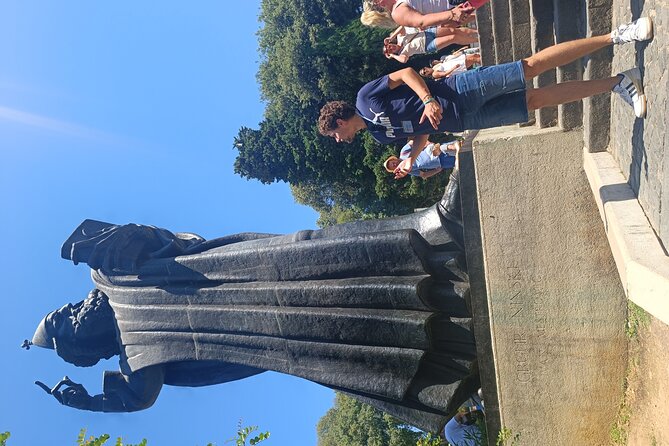
Nearby is the 8.5-meter statue of Gregory of Nin by Croatian sculptor Ivan Meštrović. You spend about 10 minutes at the statue. The shiny toe is impossible to miss. Rubbing it is said to bring good luck, and repeated contact has polished the bronze.
This is a quick, lighthearted stop after the formal Roman sites. It also introduces an important Croatian cultural figure. Gregory of Nin was a medieval bishop associated with the use of the Croatian language in church services, though the supplied tour details focus mainly on the statue and its famous toe.
Marmontova Street and the Prokurative
Marmontova Ulica adds a later chapter to the walk. It is named for Napoleon’s marshal Marmont, who helped urbanize Dalmatian cities during the French period.
The street is described as one of Split’s most beautiful. You spend about 10 minutes here, looking beyond the Roman palace to the city’s later urban design. This is one of the reasons I like the route: it does not stop once the ancient stones are covered.
The walk then reaches the Prokurative, or Republic Square. About 10 minutes is set aside for this large open space, surrounded on three sides by elaborate neo-Renaissance buildings.
The square has a different feel from the tight palace lanes. Its broad shape and decorative façades show how Split’s public image changed over time. It is also a useful place to pause, reset your sense of direction, and understand how the old center connects to the waterfront and newer streets.
Finishing at Fruit’s Square
The final stop is Fruit’s Square, officially Trg Braće Radić. The small square was once associated with women selling fruit, and it now provides a pleasant place to finish the tour.
You spend around 15 minutes here. The guide discusses monuments such as the statue of Marko Marulić, often called the father of Croatian literature, along with local food and Croatian culture.
This is a smart ending because it moves the tour away from emperors and formal monuments. You finish with literature, food, and everyday city life. It is also a useful spot for restaurant suggestions and ideas for what to do next.
The activity ends back at the original meeting point. The listed stop times add up to about 2 hours 20 minutes, but the actual experience can run longer. Mario is known for adding stories and local recommendations, sometimes extending the walk toward three hours. If you have a ship departure, dinner booking, or another timed visit, leave extra room.
Price, group size, and what you actually receive
At $24.19 per person, this is a reasonable price for an English walking tour lasting more than two hours. You receive the guide’s time, historical interpretation, and an organized route through the main old-center sights. All tour fees and taxes are included.
The value is strongest if you are new to Split and want a clear framework before exploring alone. A good explanation can save you from treating the palace as a pile of disconnected ruins. It can also help you decide which paid interiors deserve a second visit.
The price does not include alcoholic drinks or admission to the cathedral and Temple of Jupiter. The listed stops at those two sites are outside visits, so budget separately if you want to enter. The tour also offers a private upgrade for people who want more individual attention, though no private-tour price is provided here.
Groups can include up to 17 people. That is small enough for a more personal feel, but not so small that everyone gets a private guide. The strongest value comes when the group stays engaged and the guide positions everyone well in crowded spaces.
Who should book this Split walk
I would choose this tour for a first visit to Split, especially if you enjoy history but do not want a dry academic talk. It suits people who like dates and architecture, as well as people who learn better through stories, humor, and questions.
It is also useful for cruise passengers and short-stay visitors because the route covers a lot of the old center in one sitting. You get a practical orientation to the Riva, palace, gates, squares, and main streets before deciding how to spend the rest of your time.
Families and mixed-age groups may appreciate the variety. The route includes imperial ceremony, underground halls, a temple, a narrow lane, a giant statue, and food talk. The walking is steady rather than strenuous, but anyone who dislikes standing for explanations should know that the tour is not continuous sightseeing on the move.
You should choose a different option if your priority is entering every monument. This experience is primarily an outdoor history walk, with paid interiors left for later. Also think twice if you need a strict finish time. The guide may add so much material that the walk runs longer than the stated duration.
Confirmation arrives when you book. Service animals are allowed, public transportation is nearby, and most people can take part. The tour depends on good weather. If poor weather cancels it, you are offered another date or a full refund. Free cancellation is available up to 24 hours before the start time.
Should you book the Split Walking Tour with Professor of History?
Yes, if you want to understand how Roman, medieval, French-period, and modern Split fit together. The tour gives you a solid first look at the palace and old town for a modest price, with a route that keeps moving and a guide who can add real context.
Book it early if your schedule is fixed. The experience is often reserved about 33 days ahead, which suggests that popular dates can fill before your arrival.
My main advice is to treat the tour as your orientation, not your complete monument visit. Listen closely at the cathedral and Temple of Jupiter, then return later if you want to pay for entry. If you can spare extra time and enjoy a guide who may run over to tell one more story, Mario’s style should suit you well.
FAQ
How long does the Split walking tour last?
The advertised duration is approximately 2 hours 20 minutes. It may run longer, sometimes close to three hours, when the guide adds extra stories and recommendations.
What language is the tour offered in?
The tour is offered in English.
Where does the tour begin?
It begins at the Brass Gate, also called Porta Aenea, at Obala Hrvatskog narodnog preporoda 22 in Split.
Where does the tour end?
The activity ends back at the original meeting point.
Are cathedral and Temple of Jupiter admission fees included?
No. Both are visited from the outside only, and admission is not included. The guide provides information for anyone who wants to return later.
How large is the tour group?
The maximum group size is 17 people. A private-tour upgrade is also available for a more personalized experience.
Just added around Split
- Kayaking & Zipline Šibenik – Čikola Canyon★ 5.0 · 3 reviews
- Krka National Park & Zipline Šibenik – Čikola Canyon★ 5.0 · 3 reviews
- From Split: Krka National Park & Waterfalls Private Day Trip★ 5.0 · 3 reviews
- Split: Small-Group Half Day Sailing Trip★ 5.0 · 3 reviews
- Rafting River Cetina from Makarska Riviera including transfer★ 5.0 · 3 reviews
- Split Bike and Wine Experience★ 5.0 · 3 reviews
- Split and Salona Cultural Heritage Day Tour from Trogir★ 4.0 · 3 reviews
- Private transfer from Split to Dubrovnik with 2h sightseeing stop in Ston★ 5.0 · 3 reviews
Old Town & History Tours, compared.


Walking Tour of Split with a ‘Magister’ of History
Read our review →
Diocletian Palace & Old Town Guided Walking Tour
Read our review →

Diocletian’s Palace and Old Town SMALL GROUP Walking Tour
Read our review →

Split History and Gastro Small-Group Tour with Food and Drinks
Read our review →
PREMIUM Emperor’s Walking Tour for History Lovers + Museum
Read our review →Browse the lists this tour appears in