
Reviewed · DIOCLETIAN PALACE TOURS
SPLIT-PRIVATE Walking Tour of Diocletian’s Palace & Old Town
Diocletian’s Palace is not a quiet ruin sitting apart from modern life. It is the working heart of Split, with homes, cafés, shops, lanes, and churches fitted into the Roman emperor’s former retirement residence. This private walk helps you read those layers instead of simply passing through them.
I like two things right away: your group gets a private licensed local guide, and the route moves beyond the palace to the Old Town’s squares, gates, markets, and harbor. Guides such as Joško are praised for making long stretches of Roman and Croatian history easy to follow, often with a well-timed joke. The main consideration is that the advertised tour lasts about two hours, so the many stops are brief, and the most important interior, the palace cellars, costs extra.
In This Review
- Key points to know before booking
- Why Diocletian’s Palace feels different
- Starting beside Split’s Riva Harbor
- Entering the palace through its layers
- The cellars, the tour’s most important extra
- From Roman square to cathedral
- Jupiter’s Temple and the palace’s Roman gods
- Walking through Old Split’s public squares
- The Golden Gate and Grgur Ninski
- What the guide’s style adds
- Timing, pace, and what to bring
- Is $240 good value?
- Who should book this Split walking tour?
- Should you book it?
- FAQ
- How long does the private Split walking tour last?
- How much does the tour cost?
- What language is the tour offered in?
- Are palace and attraction admission fees included?
- Where does the tour begin and end?
- Can I cancel the tour for a refund?
Key points to know before booking
- A private tour for up to 12 people: The $240 price covers the group, not each person, making it far better value for a family or small party than for one or two people.
- Joško is the guide name most often associated with the experience: His approach combines dates, architecture, local stories, and humor rather than delivering a dry lecture.
- The Roman cellars are the paid highlight: Entry to the Museum of Diocletian’s Cellars costs €10 per person and is not included.
- The route covers more than the palace: You’ll see the Riva, Peristyle, Golden Gate, medieval Old Town, Fruit’s Square, People’s Square, the cathedral exterior, and Jupiter’s Temple.
- Optional small-entry visits cost extra: The Cathedral of Saint Domnius is €3.50 per person, and Jupiter’s Temple is €1.50 per person if you choose to go inside.
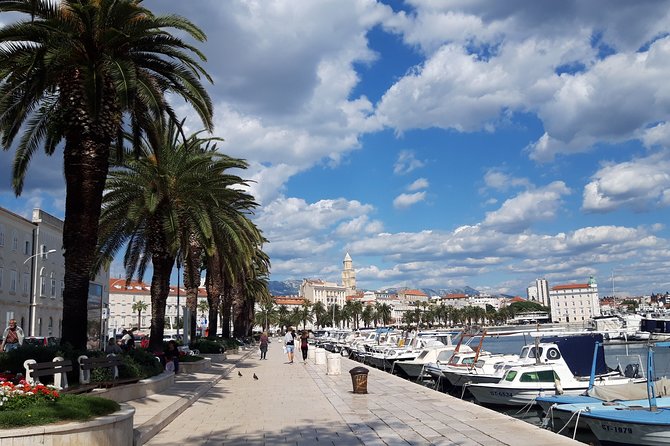
- The walk begins and ends on the Riva: The meeting point is Obala Hrvatskog narodnog preporoda 22, on Split’s main waterfront promenade.
Why Diocletian’s Palace feels different
The emperor began building this enormous residence around AD 305. It was part palace, part military camp, and part private retreat. But the crucial point for you is that Split grew inside and around it. The palace did not remain a sealed archaeological site. Its stone walls became the framework for a living city.
That is why a guide matters here. Without context, you may see a narrow lane and a weathered Roman column. With a good explanation, you begin to notice how Roman planning, medieval building, Venetian influence, and present-day life occupy the same few streets.
This tour is especially strong for first-time visitors. Joško and the other guides associated with the experience are praised for setting events in order and explaining how the palace changed across more than 1,700 years. The history is not presented as a list of rulers. It is tied to the rooms, gates, courtyards, and streets directly in front of you.
You should also know what this is not. It is not mainly a photo stop tour with long pauses at every viewpoint. One piece of feedback specifically notes that it is an historical tour rather than a general sightseeing walk, with substantial time in the palace cellars. If you want extensive wandering through every Old Town lane, you may want extra time afterward.
More ways into Diocletian’s Palace:
- Split: Old Town and Diocletian Palace Walking Tour
★ 4.9 · 4,727 reviews - Walking Tour of Split and Diocletian’s Palace
★ 5.0 · 2,588 reviews - Split & Diocletian’s Palace Walking Tour
★ 5.0 · 1,125 reviews
Starting beside Split’s Riva Harbor
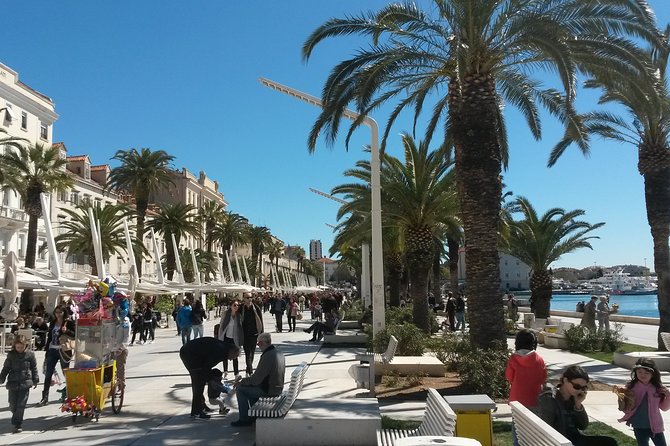
The walk starts and finishes at the main Riva Promenade, Split’s broad waterfront. This is a useful meeting point because it puts you right beside the old center, and the tour does not require a separate transfer or complicated meeting arrangement.
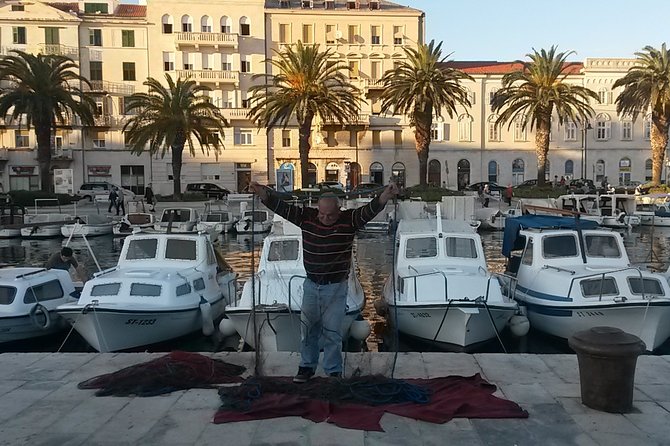
The Riva itself receives only a short scheduled stop, but its role is practical. It gives you an immediate sense of Split as a port city before you turn inland toward the palace. The route returns here at the end, which makes it easy to continue to lunch, a café, or another part of town.
Since the experience depends on good weather, keep the cancellation terms in mind when planning. You can cancel for a full refund up to 24 hours before the local start time. If bad weather cancels the walk, you’ll be offered another date or a full refund.
Entering the palace through its layers
The palace portion is the center of the experience. You’ll learn about its construction in AD 305 and about Emperor Diocletian, whose decision to retire here shaped the city you see today.
The route does not treat the palace as one single building. It breaks the complex into meaningful parts, including the Vestibule, Peristyle, Golden Gate, Jupiter’s Temple, cathedral, and underground substructures. That approach helps you understand the palace as a planned compound rather than a collection of unrelated stones.
The Peristyle is the natural centerpiece. This former imperial square was the ceremonial core of the palace, and the guide explains how the emperor’s authority was displayed through its arrangement and architecture. It is one of those places that can look simple at first glance, so the explanation adds real value.
You’ll also visit the Vestibule, the main entrance toward the emperor’s private residence. Its position helps clarify the division between public ceremony and private imperial life. The stop is short, but it gives you a useful mental map of the palace.
The cellars, the tour’s most important extra
The Diocletian Palace Substructures are described as the best-preserved part of the palace. This is the section I would prioritize if you are deciding how to spend your extra time and admission money.
Entry to the Museum of Diocletian’s Cellars costs €10 per person and is not included in the tour price. The paid admission is important to understand before booking, since the cellars are not simply an incidental stop. The guide’s explanation of why the underground rooms survived and how they relate to the upper palace is a central part of the experience.
One practical point: the overall schedule lists about 20 minutes for the substructures, while the full experience lasts approximately two hours. That means you should not expect an unhurried museum visit with time to inspect every corner. The guide gives the cellars meaning, then keeps the route moving.
If you are mainly interested in archaeology, Roman building methods, or palace design, pay the extra fee. If your priority is free outdoor sightseeing, you can still see a great deal without purchasing every optional entry, but you’ll miss the section most directly tied to the palace’s original plan.
More old town history walks in Split:
- Walking Tour of Split with a ‘Magister’ of History
★ 5.0 · 1,122 reviews - Split Walking Tour with Professor of History
★ 5.0 · 926 reviews - Split: Diocletian Palace & Old Town Guided Walking Tour
★ 4.7 · 882 reviews - Split: History and Heritage Walking Tour
★ 4.9 · 650 reviews
From Roman square to cathedral
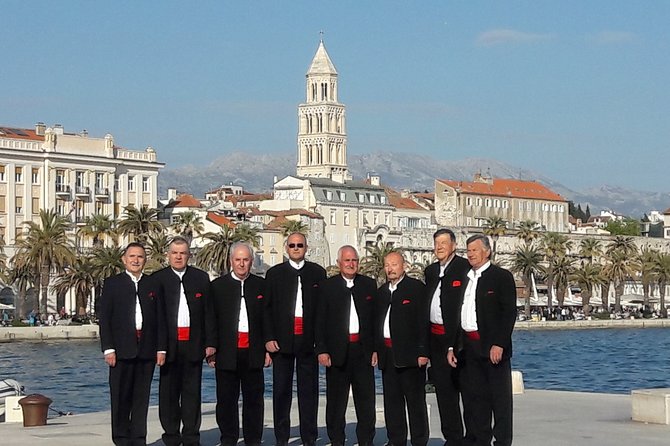
The Cathedral of Saint Domnius is visited from the outside, with an optional interior visit costing €3.50 per person. The cathedral is especially useful in the story of Split because it occupies part of the former palace complex, showing how later religious life was fitted into Roman imperial architecture.
The scheduled stop is only about five minutes, so the exterior explanation is brief. If you want to go inside, budget the additional fee and recognize that the visit remains optional rather than a major included part of the tour.
This is a good example of the tour’s balance. You get a broad introduction to many key places, but you are not paying one all-inclusive admission for every attraction. The arrangement keeps the base price clear, though the final cost rises if your group enters the cathedral, Jupiter’s Temple, and the cellars.
Jupiter’s Temple and the palace’s Roman gods
Jupiter’s Temple is seen from outside, with interior entry available for €1.50 per person. The stop connects the palace to Roman religion and to the role of temples within the emperor’s residence.
Again, five minutes is enough for orientation, not an extended examination. The guide’s value is in explaining what you are seeing and how it fits the imperial compound. If you have already visited several Roman sites on your trip, you may be satisfied with the exterior. If this is your first close look at a Roman temple, the small extra charge may be worthwhile.
The tour also includes the city clock, described as a 500-year-old 24-hour clock. It is a quick stop, but details like this keep the walk from becoming only an ancient-history lesson. Split’s story continues through later centuries, and the clock is a compact reminder of that.
Walking through Old Split’s public squares
After the palace, the route moves through the medieval Old Town. This portion helps you see how Split’s residents adapted the ancient structure over time.
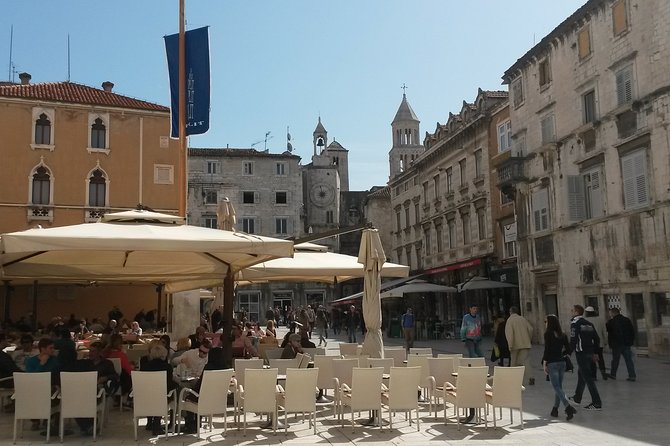
At Fruit’s Square, also called Trg Brace Radic, you’ll hear about its former role as a green market and see the statue of Marko Marulić, often called the father of Croatian literature. The stop adds a Croatian cultural figure to a tour that might otherwise focus too heavily on Roman emperors.
People’s Square, or Narodni Trg, is the largest and liveliest piazza in the Old Town. It gives you a different sense of the city, with public life organized around a later urban square rather than an imperial courtyard.
These are short stops, but they are useful for getting your bearings. Several people who enjoyed the tour also valued guidance on what to see after the walk. I would treat this portion as an introduction, then return on your own if a particular square or lane catches your eye.
The Golden Gate and Grgur Ninski
The Golden Gate is the main and most impressive entrance into Diocletian’s Palace. It is one of the clearest places to understand the scale and defensive logic of the original complex.
The route also includes the statue of Grgur Ninski, an important Croatian historical figure. The guide uses this stop to move from Roman history into Croatia’s later national story. That shift is helpful because Split is not only an ancient monument. It is also a Croatian city with its own cultural figures and memories.
The combination of gates, statues, squares, and palace interiors gives the walk a clear rhythm. You are not standing in one place for two hours listening to dates. You move through the city while the guide explains why each location matters.
What the guide’s style adds
The strongest feature of this experience is the guiding. Joško is repeatedly described as funny, personable, professional, and able to explain a large amount of material without losing the group.
That matters in Split because the facts can pile up quickly. Diocletian, Roman architecture, medieval changes, later rulers, Croatian culture, and modern city life all appear in a compact area. A guide who can turn that material into short, memorable stories makes the walk easier to enjoy, especially if you have just arrived after a long journey.
Families should take note. The guiding style has kept teenagers and younger children interested, and one family appreciated the flexibility when rain required a rescheduled visit. Another family valued the guide’s help taking photographs. Those details are not guaranteed on every departure, but they suggest a warm, attentive style rather than a rigid script.
The private format also matters. Only your group participates, up to 12 people. You can ask questions without competing with a large crowd, and the guide can adjust explanations to your interests. The tradeoff is price: $240 is a lot for two people, but reasonable for a full group of six to twelve.
Timing, pace, and what to bring
The tour is advertised at approximately two hours. The stops range from five minutes to 25 minutes, with the longest time devoted to the palace and Old Town sections and about 20 minutes planned for the cellars.
The compact schedule is useful if you are in Split for a short stay or arriving from a cruise. It gives you a strong orientation before you explore alone. It can feel quick if you want detailed time inside every building, and one person specifically wished for more walking around the Old Town on a pleasant day.
I would book this near the beginning of your stay. You’ll leave with a map of the center in your head and ideas for where to return. Wear comfortable shoes for the historic streets, and consider the weather when choosing your time, since the experience can be canceled in poor conditions.
The tour is offered in English and uses a mobile ticket. Confirmation arrives at booking, and the meeting point is near public transportation. Most people can participate, according to the supplied activity information, but no detailed accessibility notes are provided, so ask the operator directly if your group has specific mobility needs.
Is $240 good value?
The price is $240 per group of up to 12, not $240 per person. For a family, reunion, or group of friends, the value is strong because you receive a private licensed resident guide and a custom-designed route through Split’s most important central sights.
For two people, the calculation is different. You are paying for privacy, flexibility, and focused attention rather than a low-cost group walk. If you care about history and want to ask questions, that may be worthwhile. If you only want a quick introduction and photographs, a less expensive shared tour may suit you better.
Remember to add optional admission fees:
- Diocletian’s Cellars: €10 per person
- Cathedral of Saint Domnius: €3.50 per person
- Jupiter’s Temple: €1.50 per person
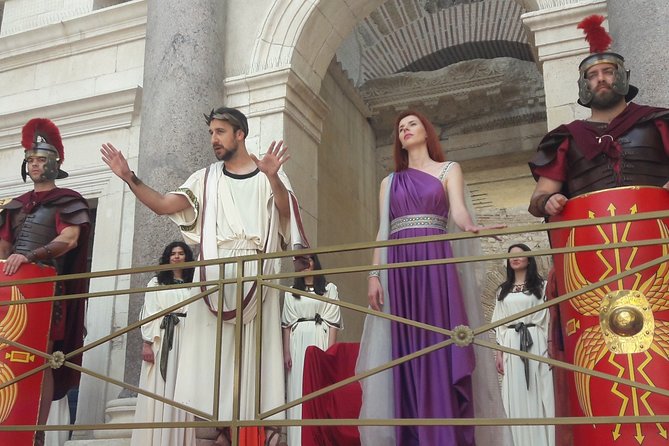
Gratuities are not included. The tour also does not include a costumed theatre show or similar performance, so book it for historical storytelling and local interpretation, not staged entertainment.
Who should book this Split walking tour?
I would choose this tour if you want to understand how Split grew from a Roman palace into a living Old Town. It is a particularly good fit for first-time visitors, families, history fans, and anyone who prefers a private pace.
It also works well for people who enjoy stories more than silent sightseeing. Joško’s style, as described in the supplied material, combines humor with careful explanation, and the guide has been able to hold the attention of children, teenagers, and adults.
You may want something else if you prefer a long, leisurely stroll with plenty of free time at every stop. The route covers a lot in about two hours. The Old Town portion is an introduction, not a full afternoon of wandering.
Should you book it?
Book it if Diocletian’s Palace is the main reason you are visiting Split and you want the stones to make sense. The private format, strong English guiding, short transfer-free route, and access to the palace cellars create a useful first look at the city.
I would especially recommend it for a group large enough to share the $240 cost. Add the €10 cellar admission if you want the fullest palace experience, and reserve time afterward to revisit the squares and lanes that interest you most.
Skip it only if you dislike guided history walks or want to spend your entire visit exploring at your own pace. For everyone else, this is a practical, engaging way to meet Split, with enough local character to make the ancient palace feel like part of a real city rather than a museum exhibit.
FAQ
How long does the private Split walking tour last?
The tour lasts approximately two hours. Individual stops range from about five minutes to 25 minutes, with the main palace and Old Town sections receiving the most time.
How much does the tour cost?
The price is $240 per group, for up to 12 people. It is not priced per person.
What language is the tour offered in?
The tour is offered in English.
Are palace and attraction admission fees included?
The tour includes the service of a private licensed resident guide and the custom-designed itinerary. Admission to the Museum of Diocletian’s Cellars costs €10 per person and is not included. The optional Cathedral of Saint Domnius visit costs €3.50 per person, and Jupiter’s Temple costs €1.50 per person.
Where does the tour begin and end?
It begins at Obala Hrvatskog narodnog preporoda 22, 21000 Split, Croatia, on the main Riva Promenade. It ends back at the same meeting point.
Can I cancel the tour for a refund?
You can cancel at least 24 hours before the experience start time for a full refund. Cancellations or changes made less than 24 hours before the start time are not refunded or accepted. If poor weather or an insufficient minimum number of participants causes cancellation, you’ll be offered another date, another experience, or a full refund.
More Walking Tours in Split
- Krka Waterfalls tour with Trogir Walking tour and Krka panoramic boat cruise
★ 5.0 · 1,659 reviews - From Split: Krka Waterfalls Cruise & Trogir Walking Tour
★ 4.7 · 681 reviews - Diocletian’s Palace and Old Town SMALL GROUP Walking Tour
★ 5.0 · 502 reviews - SPLIT-PREMIUM Emperor’s Walking Tour for History Lovers + Museum
★ 5.0 · 333 reviews
Just added around Split
- Kayaking & Zipline Šibenik – Čikola Canyon★ 5.0 · 3 reviews
- Krka National Park & Zipline Šibenik – Čikola Canyon★ 5.0 · 3 reviews
- From Split: Krka National Park & Waterfalls Private Day Trip★ 5.0 · 3 reviews
- Split: Small-Group Half Day Sailing Trip★ 5.0 · 3 reviews
- Rafting River Cetina from Makarska Riviera including transfer★ 5.0 · 3 reviews
- Split Bike and Wine Experience★ 5.0 · 3 reviews
- Split and Salona Cultural Heritage Day Tour from Trogir★ 4.0 · 3 reviews
- Private transfer from Split to Dubrovnik with 2h sightseeing stop in Ston★ 5.0 · 3 reviews
Diocletian Palace Tours, compared.


Walking Tour of Split and Diocletian’s Palace
Read our review →

Diocletian Palace & Old Town Guided Walking Tour
Read our review →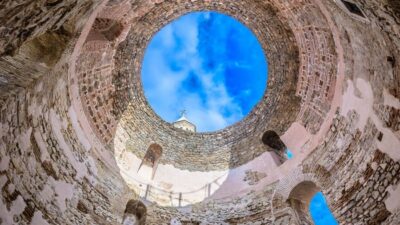
Game of Thrones Tour with Diocletian’s Palace Cellar
Read our review →
Diocletian’s Palace and Old Town SMALL GROUP Walking Tour
Read our review →

Browse the lists this tour appears in