
Reviewed · MUSEUMS
SPLIT-PREMIUM Emperor’s Walking Tour for History Lovers + Museum
Diocletian’s Palace is not a museum cut off from daily life. It is the heart of Split, with homes, cafés, shops, churches, and narrow lanes built into the old Roman walls. This tour helps you read that living monument, from the Emperor’s Square to the medieval Old Town and the waterfront Riva.
I like the small maximum of 15 people, which makes it easier to hear the guide and ask questions. I also like the strong focus on history, especially the way guides such as Joško, Daniela, and Joseph connect Roman Split with the city’s later centuries. The main drawback is that the tour is built for adults, and the €10 admission to Diocletian’s Cellars is extra.
In This Review
- Key points to know before booking
- Why Diocletian’s Palace needs a guide
- Starting at the Riva waterfront
- Entering the palace through its Roman plan
- The Cathedral and Temple of Jupiter
- The palace cellars and the extra €10
- From Roman walls to medieval Split
- Split’s lively squares and Croatian culture
- What the $30 price includes
- Timing, heat, and mobility
- History focus, not a costume show
- Who should book this Split walking tour?
- Should you book it?
- FAQ
- How long does the Emperor’s Walking Tour last?
- Where does the tour start and finish?
- Is the tour offered in English?
- How large is the group?
- Are children allowed on the group tour?
- Is admission to Diocletian’s Cellars included?
- Does the tour include the Cathedral of Saint Domnius and Temple of Jupiter?
- Can I cancel for a full refund?
Key points to know before booking
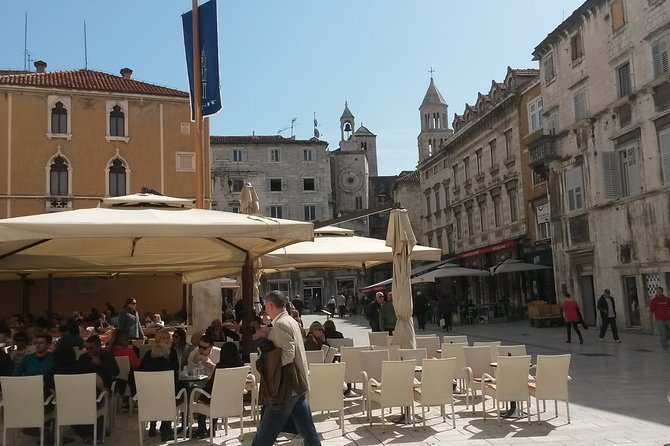
- Roman palace turned modern city: Diocletian’s Palace is still part of everyday Split, not an isolated ruin.
- Local guides with personality: Joško, Daniela, and Joseph are praised for clear explanations, humor, and personal knowledge of Split.
- Small-group format: The group tour has a maximum of 15 people and requires at least four participants to operate.
- History first: You will see Game of Thrones locations, but the tour does not focus on filming scenes or costumed entertainment.
- Optional cellar visit: The best-preserved part of the palace can be visited for an additional €10 per person.
- Good cruise-port introduction: The meeting point is on the Riva promenade, within walking distance of the cruise port.
Why Diocletian’s Palace needs a guide
At first glance, Split’s Old Town can feel like a maze of pale stone alleys. That is part of its charm, but it also makes the place hard to understand on your own. The palace was built in 305 AD as Emperor Diocletian’s retirement residence, yet only parts of it look like a conventional palace today.
The key is to understand the original plan. The palace had defensive walls, ceremonial entrances, private imperial quarters, religious buildings, and underground areas. Later generations built over and into those Roman foundations. The result is a city where Roman columns can sit beside medieval homes and modern restaurants.
I find that this kind of setting rewards a good guide more than a quick photo stop does. A guide can point out how a Roman doorway was reused, explain why a square mattered, and show how Split grew inside the old walls. The tour is designed for that kind of historical reading.
The guides also bring a local point of view. Joško is described as a Split native with a strong interest in the city’s past. Daniela is praised for explaining Dalmatian and Split history in a clear, engaging way. Joseph is also a local guide who combines humor with a strong command of the subject. The exact guide depends on the departure, but the format is consistent: serious history, personal stories, and room for questions.
More old town history walks in Split:
- Split: Old Town and Diocletian Palace Walking Tour
★ 4.9 · 4,727 reviews - Walking Tour of Split with a ‘Magister’ of History
★ 5.0 · 1,122 reviews - Split Walking Tour with Professor of History
★ 5.0 · 926 reviews
Starting at the Riva waterfront
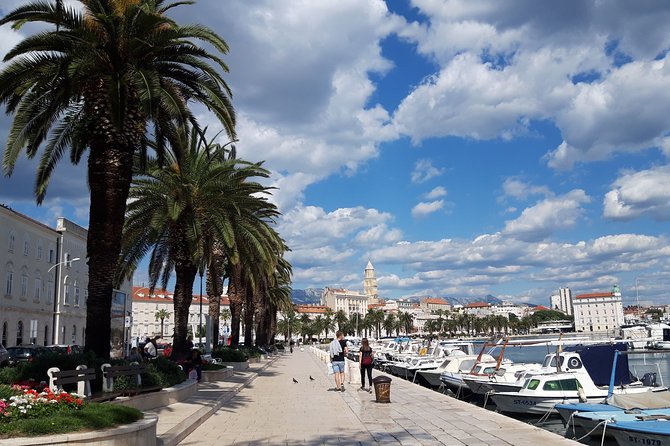
The tour starts and ends at the Main Stage on the Riva promenade, at Obala Hrvatskog narodnog preporoda 22. This is a useful meeting point because the waterfront is easy to reach from central Split and within walking distance of the cruise port.
The Riva is more than a place to gather. It gives you an immediate sense of Split as a coastal city, with the palace rising just behind the waterfront. The route begins here and returns here, so you do not need to arrange a separate pickup or find your way back through unfamiliar streets.
The listed duration is about two hours. In practice, some outings have lasted closer to two and a half or even three hours, especially when the group had questions, a mobility concern, or a tight cruise schedule to manage. You should still plan around the stated two-hour duration, but allow extra time if you have a ship departure or another fixed appointment.
Entering the palace through its Roman plan
The first major stop is Diocletian’s Palace, a UNESCO World Heritage Site. The tour spends about 25 minutes introducing the palace and its role in Split’s development.
This part matters because the palace is not one single building. It is a large fortified complex that became the foundation for the modern city. As you walk, the guide helps separate the original Roman structure from later additions. That context turns scattered walls and columns into parts of a clear plan.
The route also includes the Vestibule, the main entrance to the Emperor’s private residence. The circular form and strong stone construction give you a sense of the ceremonial approach to Diocletian’s apartments. It is a short stop, but it helps explain how the palace shifted from public and military spaces toward the Emperor’s private quarters.
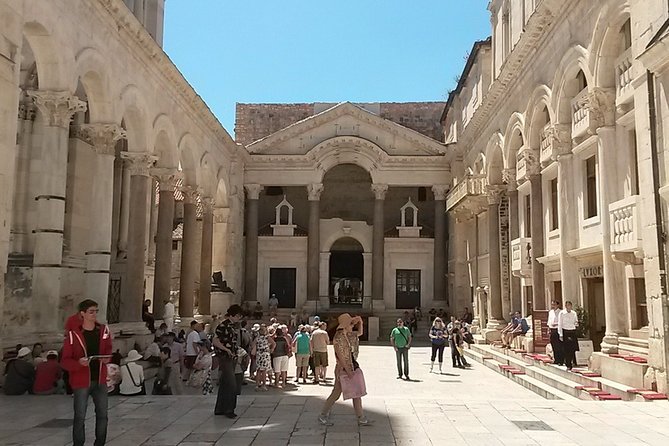
The Peristyle, or Emperor’s Square, is another central moment. This was the formal heart of the palace, and it remains one of Split’s most memorable public spaces. You can expect the guide to explain its ceremonial purpose and show how later buildings and present-day activity have grown around the Roman setting.
The Cathedral and Temple of Jupiter

The Cathedral of Saint Domnius is seen from the outside during the standard route. The cathedral occupies the former mausoleum of Diocletian, which creates one of the tour’s most striking historical contrasts. The Emperor who ordered severe measures against Christians was later commemorated within a Christian cathedral.
The exterior visit lasts only about five minutes, so this is not a cathedral interior tour. Admission to the cathedral is not included. If you want to enter the cathedral and its Treasury, you will need to do that separately after the walking tour.
The Temple of Jupiter is also viewed from outside, with an optional interior visit. This small Roman temple helps fill out the religious side of the palace plan. It is easy to pass without noticing, especially in the tight streets of the Old Town, so the guide’s explanation gives the stop more weight than its short duration suggests.
The listed route does not include admission for either the cathedral or the Temple of Jupiter. That is worth noting if you want a full interior visit. The tour is mainly about orientation and interpretation, not bundled entry to every historic building.
More walking tours in Split:
- Walking Tour of Split and Diocletian’s Palace
★ 5.0 · 2,588 reviews - Krka Waterfalls tour with Trogir Walking tour and Krka panoramic boat cruise
★ 5.0 · 1,659 reviews - Split & Diocletian’s Palace Walking Tour
★ 5.0 · 1,125 reviews - Split: Diocletian Palace & Old Town Guided Walking Tour
★ 4.7 · 882 reviews
The palace cellars and the extra €10
The Diocletian Palace Substructures are described as the best-preserved part of the palace. This is the one optional paid addition that deserves serious consideration, especially if Roman construction interests you.
The cellars reveal the shape of the imperial apartments above and show how the palace was supported and organized. They also make it easier to picture the original Roman building, since later changes have not altered these underground spaces as much as they changed the upper levels.
Admission to the Museum of Diocletian’s Cellars costs €10 per person and is not included in the $30 tour price. The tour information identifies the cellars as a stop, while the admission note makes clear that entry requires an extra payment. Confirm with the guide how the visit is handled on your departure, then decide if you want to add it.
For a history-focused outing, I consider the cellar fee reasonable, but it changes the true cost from $30 to $40 per person. If you are watching your budget or mainly want a city orientation, you can still get plenty from the free outdoor route.
From Roman walls to medieval Split
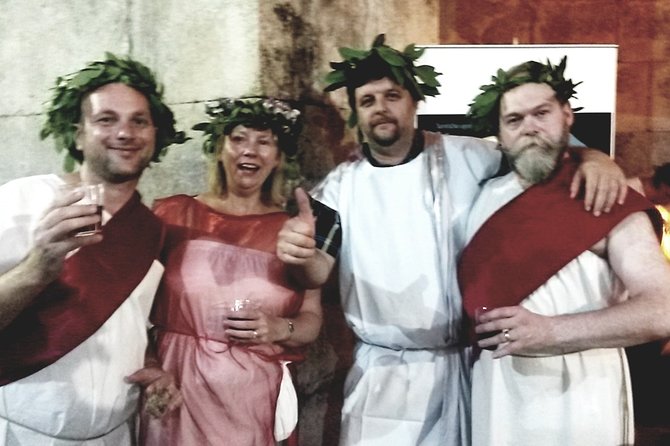
The tour then moves through Old Split, where the Roman plan became a medieval and later urban neighborhood. This is where the experience differs from a simple Roman archaeology walk. You are not only looking at ancient remains. You are seeing how people kept adapting the same spaces over many centuries.
The Golden Gate is presented as the main and most beautiful entrance to Diocletian’s Palace. It gives you a strong sense of the palace as a fortified complex, with controlled access and formal gateways. The guide can also explain how the gates relate to the palace’s original layout.
The City Clock adds a later layer to the walk. This 500-year-old, 24-hour clock is a compact reminder that Split’s story continued long after the Roman period. It is the kind of detail you might miss when exploring alone, but it helps connect the major monuments with ordinary city life.
At the Grgur Ninski Statue, you learn about one of Croatia’s important historical figures. The stop also gives the guide a chance to discuss Croatian identity and the country’s cultural past. Visitors often rub the statue’s toe for luck, though the supplied tour details focus on the historical explanation rather than promising a particular ritual or activity.
Split’s lively squares and Croatian culture
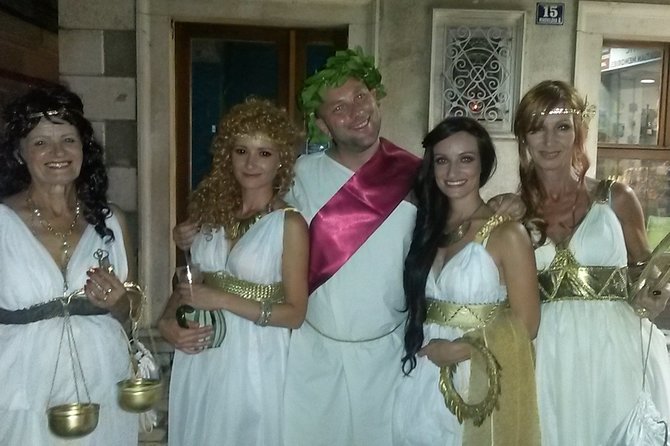
Fruit’s Square, officially Trg Brace Radic, was once the Green Market. It is also associated with a statue of Marko Marulić, often called the father of Croatian literature. This brief stop broadens the tour beyond emperors and buildings. You get a link to Croatian language and culture, not just Roman architecture.
Narodni Trg, or People’s Square, is the largest and liveliest piazza in the Old Town. It shows how Split’s public life shifted away from the palace’s imperial center and developed its own civic spaces. The stop is short, but the square works well as a visual counterpoint to the Peristyle.
The route’s many five-minute stops may sound rushed on paper. In reality, they function as short explanations at key points, with the walking between them providing the broader story. If you prefer to spend 20 minutes inside each monument, this is not that sort of tour. If you want a clear framework for exploring on your own afterward, the pace makes sense.
What the $30 price includes
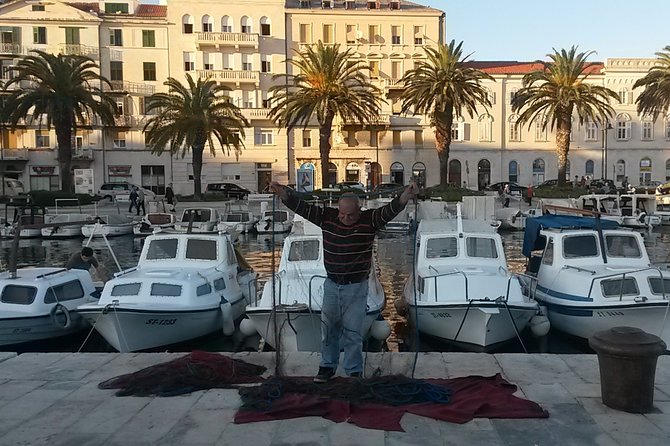
At $30 per person, the tour sits in a sensible range for a guided two-hour introduction to Split. Your fee covers a licensed resident guide, the planned route, and the organization of the group. It does not cover the cellars, cathedral, Temple of Jupiter, or gratuity.
The strongest value comes from the guide’s interpretation. Split’s historic center is free to walk through, but the price buys explanation, direction, and local context. You can see the Golden Gate or Peristyle without paying for a tour. The question is how much more clearly you will understand them after someone explains the original palace and its later changes.
The small-group limit improves that value. A maximum of 15 people is far easier to manage than a large crowd, especially in narrow lanes or busy squares. One particularly useful feature is the chance to ask about food and local places after the formal tour. Guides have helped visitors find restaurants and bakeries, including places suited to specific dietary needs.
Group discounts are available, and mobile tickets are accepted. The group tour is offered in English. Private tours are open to all ages, while the group version is for adults only and is not recommended for anyone under 18.
Timing, heat, and mobility
Split can be very hot in summer. One useful planning tip is to choose an early departure when possible, especially in August. Stone streets and open squares offer limited shade, and the route includes steady walking through the Old Town.
Wear comfortable shoes and carry water. The tour is not described as physically demanding, and most people can participate, but this is still a walking experience over historic streets. If someone in your party has limited mobility, tell the guide in advance. Daniela has been praised for adjusting the pace sensitively and giving extra time when needed.
The tour is also useful for cruise visitors. The meeting point is on the Riva and the route returns there. Still, do not schedule your return to the ship too tightly. The stated time is approximately two hours, and a guide may extend the walk to answer questions or accommodate the group.
Bad weather can cancel the experience. If that happens, you are offered another date or a full refund. The activity also requires a minimum of four participants to run, although the exact operating decision is subject to the provider’s confirmation.
History focus, not a costume show
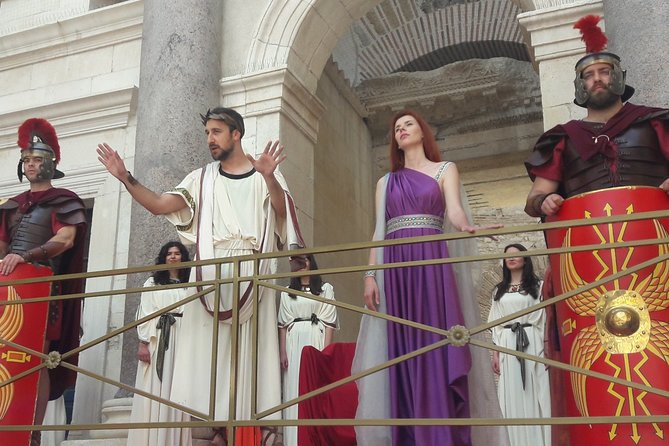
This is a real history tour. You should expect Roman architecture, medieval Split, Croatian culture, and the city’s changing political story. You should not expect costumed actors, a theatrical performance, or a staged imperial appearance.
You will see locations associated with Game of Thrones, but the tour does not explain the television scenes as its main purpose. If filming locations are important to you, research the scenes separately and use this walk for the historical setting beneath them.
That focus is a strength for anyone who wants substance. It may be less suitable if you are looking mainly for photo stops, entertainment, or pop-culture trivia. The guide’s humor keeps the history lively, but the subject remains the palace and the city around it.
Who should book this Split walking tour?
I would choose this tour as a first activity in Split if I wanted to understand the Old Town before exploring it alone. It suits adults who enjoy history, architecture, local stories, and a guide who can answer questions rather than simply recite dates.
It is especially useful for:
- First-time visitors to Split
- Cruise visitors needing a compact city introduction
- History fans interested in Roman and medieval sites
- Visitors who prefer small groups
- People who want local restaurant or bakery suggestions
- Anyone who wants to combine a guided walk with independent monument visits afterward
I would look elsewhere if you need a child-focused outing, a full interior tour of the cathedral, or a Game of Thrones-centered experience. Families can consider the private version, since private tours are open to all ages.
Should you book it?
Book it if you want Split’s famous palace to make sense, not just look impressive. The strongest reasons are the small group, the local guides, the clear history focus, and the route’s mix of Roman, medieval, and Croatian cultural sites.
Allow $10 extra if you plan to enter the cellars, and leave some flexibility in your schedule. Choose an early time in hot weather, wear good shoes, and tell the guide about mobility needs or a cruise departure.
For $30, this is a good-value introduction to Split, especially when you want a thoughtful local guide rather than a quick walk past monuments.
FAQ
How long does the Emperor’s Walking Tour last?
The advertised duration is approximately two hours. Some tours may run longer, depending on questions, group needs, and the guide’s pace.
Where does the tour start and finish?
It starts at the Main Stage on the Riva promenade, at Obala Hrvatskog narodnog preporoda 22 in Split. It ends back at the same meeting point.
Is the tour offered in English?
Yes. The group tour is offered in English.
How large is the group?
The activity has a maximum of 15 travelers. The small-group tour requires a minimum of four participants to operate.
Are children allowed on the group tour?
The group tour is for adults only and is not recommended for anyone under 18. Private tours are available for all ages.
Is admission to Diocletian’s Cellars included?
No. Admission to the Museum of Diocletian’s Cellars costs €10 per person and is paid separately.
Does the tour include the Cathedral of Saint Domnius and Temple of Jupiter?
The standard route views the Cathedral of Saint Domnius and Temple of Jupiter from outside. Admission to those sites is not included.
Can I cancel for a full refund?
Yes, if you cancel at least 24 hours before the experience start time. Cancellations or changes made within 24 hours are not refunded. If bad weather or an insufficient number of participants cancels the tour, you are offered another date or a full refund.
More Museums in Split
- Blue Lagoon & Underwater Museum from Split with Lunch & Drinks
★ 4.5 · 1,122 reviews - Split: Game of Thrones Museum Entrance Ticket
★ 3.8 · 385 reviews - Split: Klis Fortress GOT and Olive Museum Entry Tickets
★ 4.6 · 283 reviews - Trogir: Boat tour to Unique underwater museum
★ 4.5 · 229 reviews
Just added around Split
- Kayaking & Zipline Šibenik – Čikola Canyon★ 5.0 · 3 reviews
- Krka National Park & Zipline Šibenik – Čikola Canyon★ 5.0 · 3 reviews
- Split: Small-Group Half Day Sailing Trip★ 5.0 · 3 reviews
- Rafting River Cetina from Makarska Riviera including transfer★ 5.0 · 3 reviews
- From Split: Krka National Park & Waterfalls Private Day Trip★ 5.0 · 3 reviews
- Split Bike and Wine Experience★ 5.0 · 3 reviews
- Split and Salona Cultural Heritage Day Tour from Trogir★ 4.0 · 3 reviews
- Krka Waterfalls, Lake Cruise & Skradin★ 5.0 · 3 reviews
Museums, compared.
Blue Lagoon & Underwater Museum from Split with Lunch & Drinks
Read our review →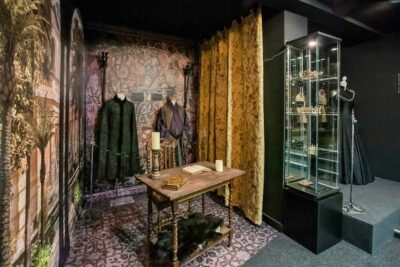
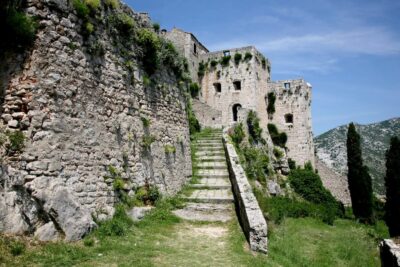
Klis Fortress GOT and Olive Museum Entry Tickets
Read our review →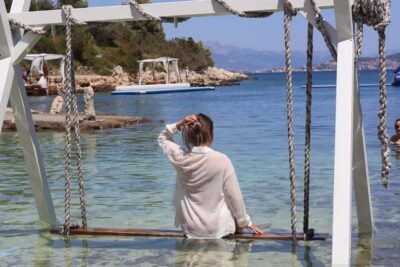
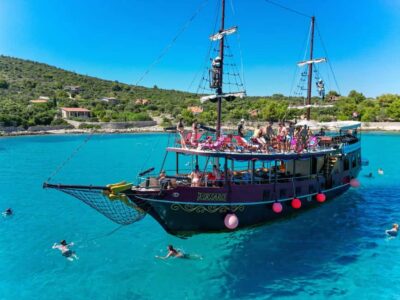
Blue Lagoon Underwater Museum Tour w/Lunch & Drinks
Read our review →

Olive museum Klis with educational olive oil tasting
Read our review →
Browse the lists this tour appears in