
Reviewed · OLD TOWN & HISTORY TOURS
Split and Salona Cultural Heritage Day Tour from Trogir
Split’s old town is not a museum behind glass. It is a living Roman palace, with cafés tucked into ancient walls and daily life flowing through spaces built for Emperor Diocletian. This tour pairs that remarkable city walk with Salona’s Roman ruins, giving you two very different views of Dalmatian history in one outing.
I like the efficient pairing of Diocletian Palace and Salona, and I like that an air-conditioned vehicle and Salona admission are included. The main caution is timing: the tour is described as four hours in some details and six hours in the itinerary description, so check the exact departure and return time before booking.
A second consideration is the pace. One guide was praised for patience and for checking that everyone understood the English explanations, while another participant found the walk rushed and felt there was too little time for shopping or lunch. This is best for someone who wants a history-focused introduction, not a slow afternoon of browsing.
In This Review
- Key points to know before booking
- Why Split’s palace makes such a strong first stop
- Peristil, Vestibul, and the palace’s grand spaces
- The Golden Gate and Gregory of Nin
- Riva and your time to eat or shop
- Salona, Croatia’s major Roman archaeological site
- How the two stops work together
- Transport, group size, and the $170 price
- The pace and guide style you should expect
- Who should book this cultural heritage day
- Should you book the Split and Salona tour?
- FAQ
- How long does the tour last?
- Where does the tour start?
- Where does the tour end?
- Is transportation included?
- Is a guide included?
- What language is the tour offered in?
- Is admission to Salona included?
- Are meals and drinks included?
- Is free time provided in Split?
- Can I book a private group?
- Can I cancel for a full refund?
- Do I have to pay when I reserve?
Key points to know before booking
- Split’s Roman center: Walk through Diocletian Palace, Peristil, the Golden Gate, Vestibul, Riva, and other central sights with an English-speaking guide.
- Salona admission included: Your ticket covers Croatia’s major Roman archaeological site, including the basilica, amphitheater, coliseum, and sarcophagi.
- Free time is part of the plan: You are meant to have time for lunch, shops, and old-town wandering, though the amount of time may feel limited.
- Transport from Trogir: An air-conditioned vehicle with a driver connects the two destinations.
- Private option available: You can book a private group, and hotel pickup may be possible depending on the option selected.
- Check the duration carefully: The supplied details give both four hours and six hours, so confirm the schedule before paying.
Why Split’s palace makes such a strong first stop
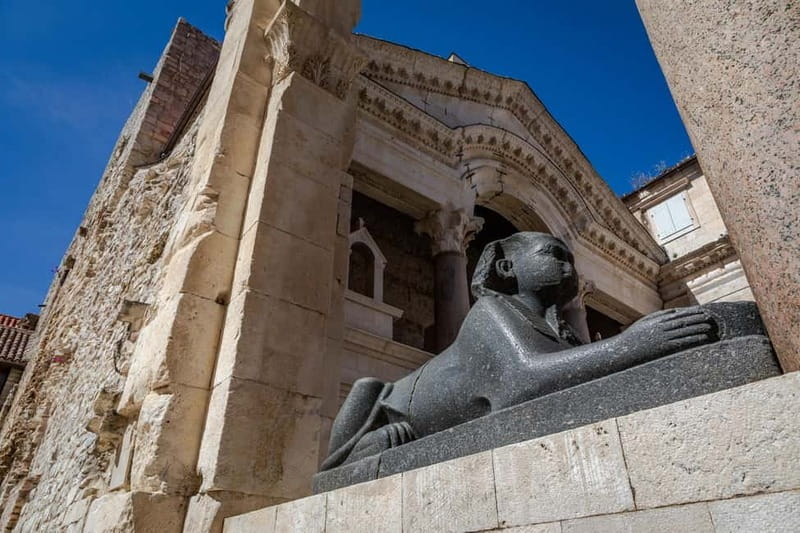
The best part of this experience is the way Split’s center compresses centuries into a short walk. Diocletian Palace dates from the 4th century, yet it is not an isolated ruin. Streets, shops, restaurants, homes, and public squares occupy the old palace area.
That changes how you read the place. You are not simply looking at a Roman wall and moving on. You are walking through an old imperial complex that still functions as the heart of the city. A guide helps you spot the difference between surviving Roman structure, later additions, and modern life fitted into the same stone framework.
The tour covers the main sights in the city center. That makes it useful if you are visiting Split for the first time or have only a short window in port. You will not need to work out the route yourself, and the walk gives you a clear introduction before you use your free time independently.
The Diocletian Palace is the central attraction. Its age is impressive, but the setting is even more interesting. The palace does not sit apart from Split. It forms much of Split’s old town, so the guide’s explanation gives meaning to the streets you are already using.
More old town history walks in Trogir:
- Trogir: Old Town Guided Walking Tour
★ 4.6 · 76 reviews - Split Old Town Walking Tour
★ 5.0 · 25 reviews - Discover Trogir: Guided Walking Tour of a Medieval Gem
★ 5.0 · 13 reviews
Peristil, Vestibul, and the palace’s grand spaces
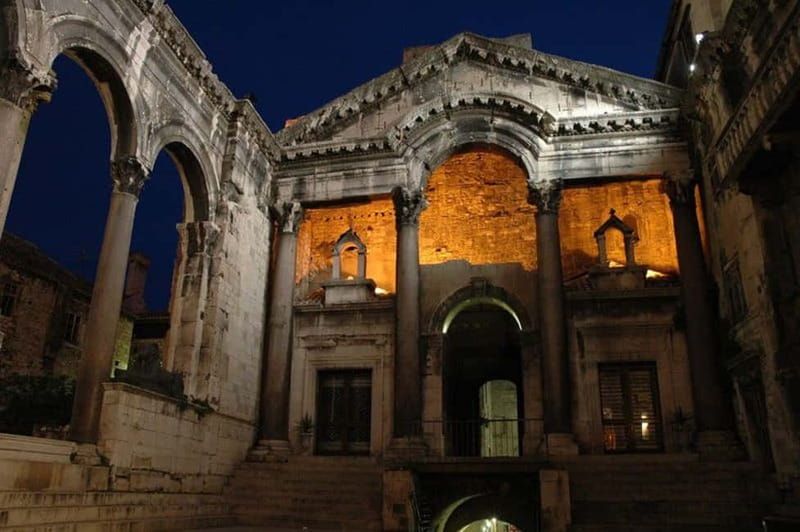
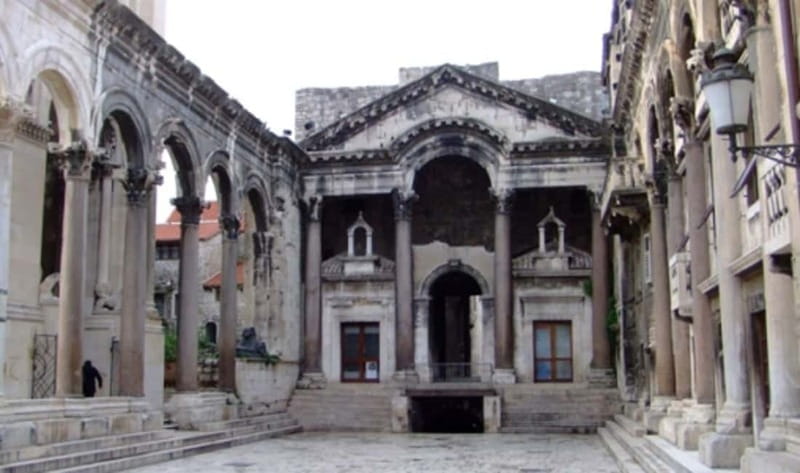
Peristil is one of the key stops on the walk. This formal square helps you understand the scale and purpose of the palace. It was designed as a ceremonial space, and its columns and surrounding stonework give the area a powerful sense of order.
You will also visit Vestibul, another important palace feature. These spaces are easier to appreciate with someone pointing out their original role, since a modern visitor could otherwise see only an attractive stone courtyard or passage.
The route includes St. Duje Cathedral, known locally as the Cathedral of Saint Domnius. Its presence within the palace area is one of Split’s most striking examples of old and new layers sharing the same setting. The tour is not limited to Roman remains. It also shows how the city’s religious and civic identity developed around them.
Expect the guide to spend much of the walk explaining architecture and history. That will suit you if you enjoy dates, buildings, and historical connections. If you prefer a casual stroll with occasional commentary, the pace may feel too focused.
One practical point matters here: the historic center is best understood on foot, but a walking tour can become tiring if the guide moves quickly. One participant described a guide who ran between sights and explained each building well but did not leave much room for questions. If you need more time for photographs or want frequent stops, a private group may give you a better chance to set the pace.
The Golden Gate and Gregory of Nin
The Golden Gate is another major stop. It is one of the recognizable entrances to the palace and helps you picture how people once moved into and out of this fortified complex. The tour also visits the statue of Gregory of Nin, a well-known Split landmark.
These stops add variety to the route. You are not only seeing grand interiors and formal squares. You are also moving through the old city’s public spaces and learning which monuments matter to local identity.
The route includes the statue of Marko Marulic and the city clock as well. Marko Marulic is associated with Croatian literature, while the clock is a small but memorable feature of the old town. The value of including these places is that you get more than a palace-only tour. You see some of the everyday symbols that help define Split.
The guide’s role is important. The strongest part of the experience can be the explanation connecting each location to the next. An English-speaking guide is provided, but the quality of the day depends on how well that person balances facts with questions and walking speed.
One particularly useful strength is patience with language differences. A guide was praised for taking care to check that the group understood the explanations and had not missed anything. That matters if English is not your first language, especially during a history-heavy walk.
Riva and your time to eat or shop
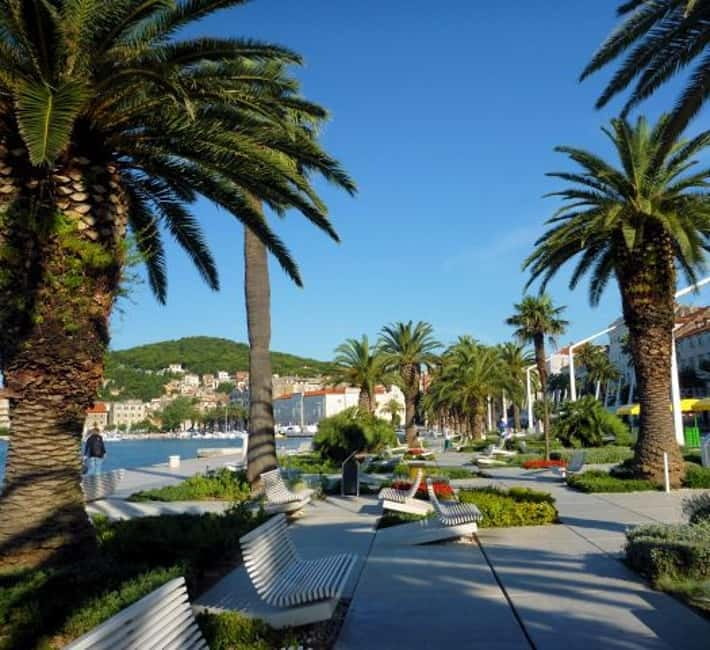
The route includes Riva, Split’s waterfront promenade. This gives you a change from the enclosed palace streets and lets you see the city’s public face beside the water.
After the guided part, the plan allows free time to relax, have lunch, and visit shops in the old town. This is an important part of the day because a guided walk can give you the facts, but independent time lets you choose your own rhythm.
You might use this break for a meal, a coffee, photographs, or a closer look at places that caught your attention during the walk. The details do not specify a restaurant or provide meals, so lunch and drinks are your responsibility.
Do not assume the break will feel generous. The stated itinerary promises free time, but one participant felt there was no real lunch or shopping opportunity. That may reflect the actual timing on that departure, the pace of the guide, or the difference between the advertised duration and the day delivered.
For that reason, I would ask at booking how much free time is planned in Split and when it occurs. If you care more about browsing and eating than about a fast overview of monuments, this question could determine whether the tour suits you.
A few more Trogir half-days to weigh up
- Blue cave, Mama Mia and Hvar, 5 island speedboat tour from Trogir
★ 5.0 · 2,861 reviews - From Trogir: Three Islands Half-Day Speedboat Tour
★ 4.8 · 804 reviews - From Trogir or Split: Full-Day Blue Cave & Hvar Island Tour
★ 4.7 · 413 reviews - Half Day Speedboat Tour to Three Islands from Trogir
★ 5.0 · 401 reviews
Salona, Croatia’s major Roman archaeological site
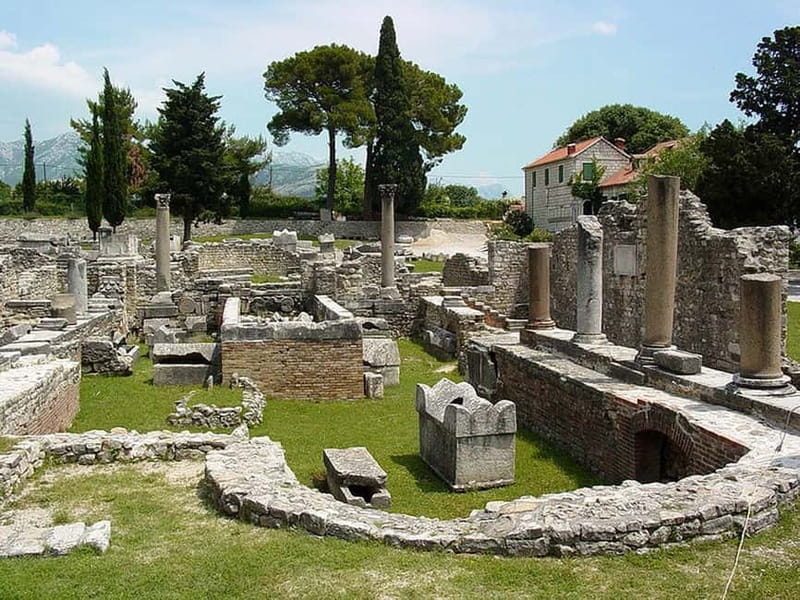
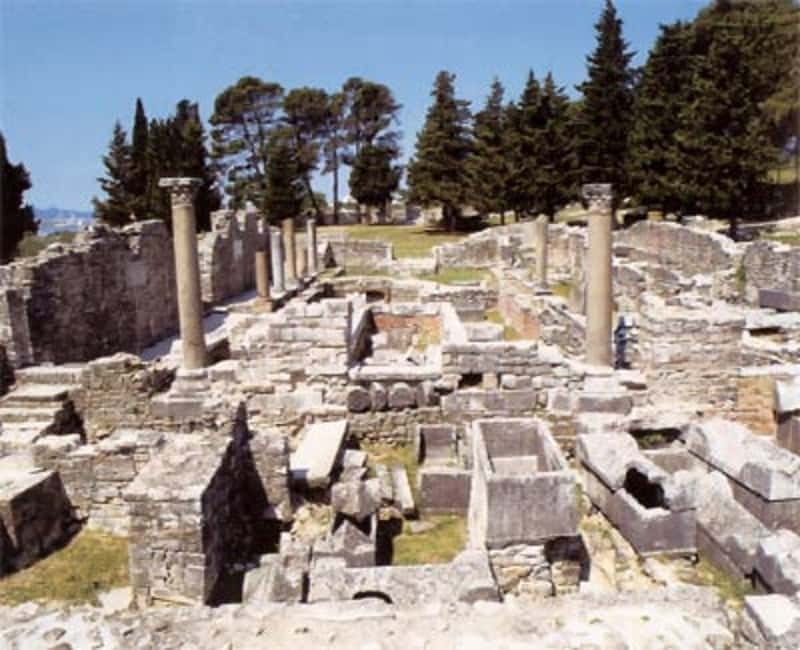
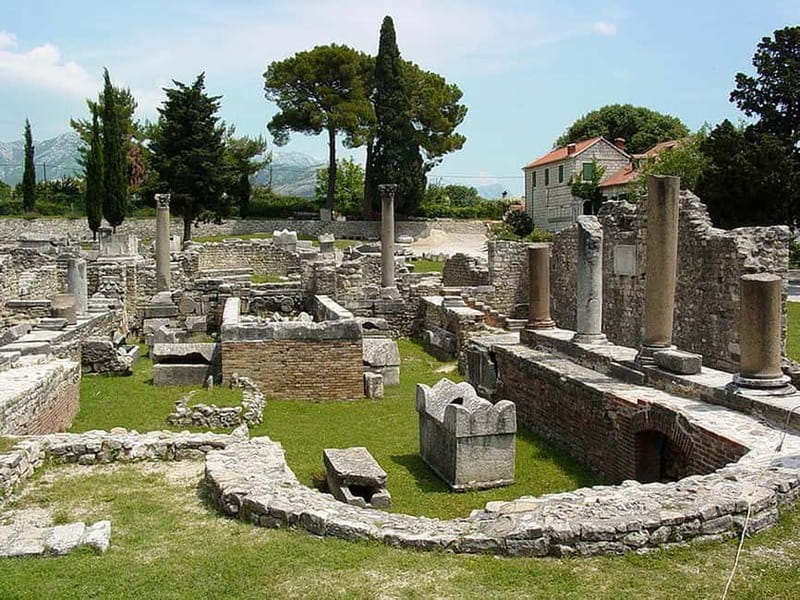
The second major stop takes you outside modern Split to ancient Salona. Salona is described as the largest site of antiquity-era monuments in Croatia and is often called Croatia’s Pompeii.
The comparison gives you a useful idea of the site’s appeal, but Salona should be approached on its own terms. The attraction is the spread of Roman remains and the chance to see a major ancient settlement beyond the better-known palace in Split.
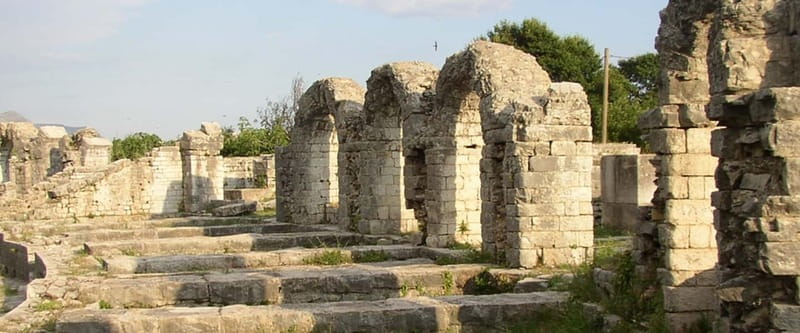
You will see a Roman basilica, the amphitheater, the coliseum, and fine marble sarcophagi. Salona admission is included, which makes the transition from the city walk simple. You do not need to arrange a separate ticket for the archaeological site.
The basilica is one of the most important remains on the visit. It gives you a sense of the religious life connected with Salona and adds a different historical layer to the Roman architecture seen in Split.
The amphitheater and coliseum provide the more immediately visual part of the stop. Large public structures help you imagine how entertainment and civic life worked in the ancient city. A guide can make these stones more legible by explaining their purpose and relationship to the wider site.
The marble sarcophagi are associated with the Archaeological Museum of Split in the supplied tour details. Since the exact museum visit arrangement is not fully explained, ask whether the museum collection is part of your scheduled route or is being referenced as context for Salona’s archaeological finds.
How the two stops work together
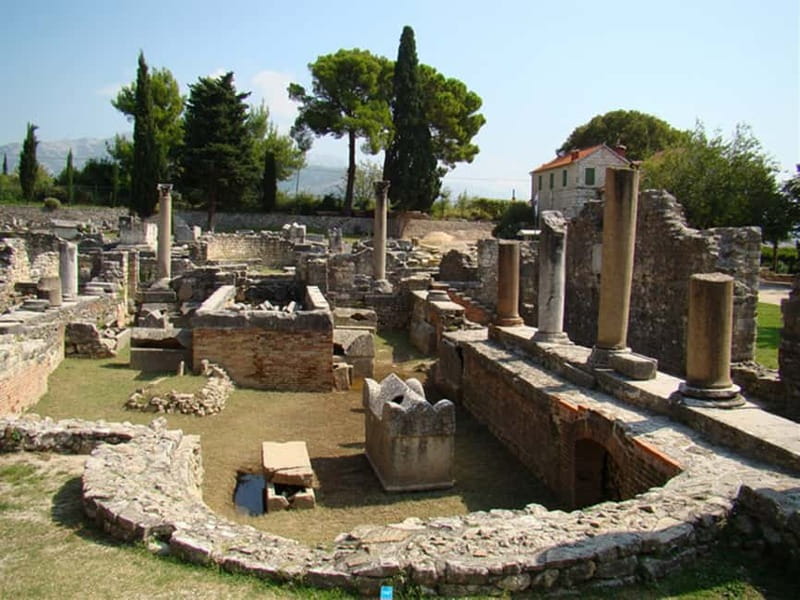
Split and Salona are not duplicates. Split shows a Roman palace absorbed into a living Croatian city. Salona gives you a more open archaeological setting, where the remains themselves are the main focus.
That contrast is the reason I find the itinerary appealing. You begin with streets that are active and easy to connect with, then move to a site where the Roman past is more visible as ruins. The two stops help you understand that Dalmatia’s Roman story is larger than Diocletian Palace alone.
The trade-off is time. A short tour covering both Split and Salona cannot offer a slow, detailed study of every monument. The itinerary gives you breadth rather than long visits at a small number of places.
If you already know Split well, Salona may be the more valuable part of the day. If you have never visited Split, the city walk provides a useful orientation, while Salona adds historical depth. For a first visit, the combination is practical.
Transport, group size, and the $170 price
The price is $170 per person. That is not a small amount for a four-hour experience, and it remains a meaningful price even if your departure follows the longer six-hour description.
The value depends on what is included. You receive an air-conditioned vehicle with a driver, an experienced tour leader, and admission to Salona. You also get a guided walking tour of Split rather than having to arrange separate transport and site visits yourself.
For a solo visitor or a couple, $170 can feel expensive if the day is short and the group moves too quickly. It becomes easier to justify if you value door-to-door convenience, a guided historical route, and the chance to see both destinations without managing the connection yourself.
A private group is available. That option may be especially useful if you want to ask questions, need a calmer pace, or are traveling with family or friends. The information does not state the private-group price, so compare that cost before assuming it is the better deal.
Hotel pickup is possible, but it depends on the option booked. The meeting point may vary, and the activity ends back at the meeting point. Confirm both details in advance, especially if you are staying outside central Trogir or need to coordinate with another departure.
The pace and guide style you should expect
This is a history-led tour. The guide is expected to explain the buildings and monuments as you walk, and the central route covers a great deal in a limited period.
That format can work very well when the guide is patient and responsive. One guide received strong praise for checking that the group understood the English explanations. For anyone who finds historical tours difficult because of language, that kind of attention is a real advantage.
The experience may be less satisfying if your guide treats the route like a race. A separate account described a guide who explained the buildings well but moved too fast and did not answer many questions. That is the clearest warning in the available feedback.
I would make your expectations clear at the start. Tell the guide if you need time for photographs, if you want to ask questions, or if lunch and shopping are important to you. You cannot guarantee a slower route, but stating your priorities may help.
The private-group option is worth considering for visitors who dislike fixed pacing. It can also suit anyone with a strong interest in Roman architecture or Croatian history, since a smaller setting may leave more room for discussion.
Who should book this cultural heritage day
I would recommend this tour to you if you want a broad introduction to Split and Salona in one organized outing. It is also a good fit if you are staying in Trogir and do not want to arrange transport, tickets, and a city route separately.
History fans will get the most from it. The itinerary focuses on Roman buildings, churches, monuments, archaeological remains, and explanations from an English-speaking guide.
You may also like it if you have limited time in Dalmatia. The route gives you a useful first look at Split, includes the city’s major central sights, and adds Salona rather than stopping after the palace.
I would be cautious if your priority is a long lunch, unhurried shopping, or a flexible photography walk. The tour tries to fit a lot into one day, and the free-time portion may be shorter than you expect.
I would also hesitate to book without clarification if the duration matters to you. The supplied information says four hours in one place and describes a six-hour outing elsewhere. Ask for the exact schedule, including travel time, guided walking time, free time, and the Salona visit.
Should you book the Split and Salona tour?
Book it if you want Roman history, organized transport, and a compact overview of two important Dalmatian sites. The combination of living Split and archaeological Salona is the strongest reason to choose it, and included Salona admission adds practical value.
Before booking, confirm the real duration and the amount of free time in Split. If possible, choose a private group when a relaxed pace and questions matter to you.
Skip it if you mainly want an easygoing city afternoon. For that kind of visit, a self-guided Split walk may give you more freedom and less pressure. This tour is best understood as a focused cultural outing, not a leisurely shopping trip.
FAQ
How long does the tour last?
The activity details state four hours, while the itinerary description refers to a six-hour cultural heritage tour. Check availability and confirm the exact schedule for your selected option.
Where does the tour start?
The meeting point may vary depending on the option you book. Hotel pickup may be available.
Where does the tour end?
The activity ends back at the meeting point.
Is transportation included?
Yes. An air-conditioned vehicle with a driver is included.
Is a guide included?
Yes. An experienced tour leader and live English-speaking guide are included.
What language is the tour offered in?
The listed tour language is English.
Is admission to Salona included?
Yes. Admission tickets for Salona are included.
Are meals and drinks included?
No. Meals and drinks are not included, so you should budget separately for lunch and refreshments.
Is free time provided in Split?
Yes. The itinerary includes free time for relaxing, lunch, and shopping in the old town. Ask how much time is planned, since the available details do not give a precise length.
Can I book a private group?
Yes. A private group option is available, depending on the booking choice.
Can I cancel for a full refund?
Yes. You can cancel up to 24 hours in advance for a full refund.
Do I have to pay when I reserve?
A reserve-now, pay-later option is available, allowing you to book your place without paying immediately.
Just added around Trogir
- Split and Trogir private tour *ideal for cruise ship guests*★ 5.0 · 3 reviews
- Trogir; Private walking tour of higlights of Trogir★ 4.7 · 3 reviews
- Trogir to Krka Waterfalls – Full Day Private Tour Including Free Detour★ 5.0 · 3 reviews
- From Trogir Day sailing (private tour)★ 5.0 · 4 reviews
- Private Transfer from Split Croatia Airport to Hotel★ 5.0 · 4 reviews
- Split (airport) – Hvar (town) sea transfer★ 5.0 · 4 reviews
- Private speedboat tour to Blue Cave and visit Island Hvar★ 4.0 · 4 reviews
- Kastela: Wine & Olive Tasting Tour w/Delicacies & Live Music★ 5.0 · 5 reviews
Old Town & History Tours, compared.


Walking Tour of Split with a ‘Magister’ of History
Read our review →

Diocletian Palace & Old Town Guided Walking Tour
Read our review →

Diocletian’s Palace and Old Town SMALL GROUP Walking Tour
Read our review →

Split History and Gastro Small-Group Tour with Food and Drinks
Read our review →Browse the lists this tour appears in