
Reviewed · OLD TOWN & HISTORY TOURS
Split: History and Heritage Walking Tour
Split’s old town is not a museum behind a gate. It is a living city built inside a 1,700-year-old Roman palace, where laundry hangs above ancient stone and modern shops occupy former imperial rooms. I like that this tour explains both the grand story of Emperor Diocletian and the small details that are easy to miss while wandering alone. The guides, including Antonella, Antonela, Nikolas, and Doris, are praised for making complex history clear and fun.
I also like the low price, $18, and the useful orientation it gives you early in a Split visit. The main consideration is group size: although advertised as small-group, one outing reached nearly 30 people, which meant waiting for the group in crowded lanes. Bring good shoes, and remember that this is an outdoor walking tour in all weather.
In This Review
- Key points at a glance
- Why Diocletian’s Palace is the right place to begin in Split
- Meeting the guide on Peristil Square
- Roman remains and the making of a city
- Romanesque churches, Gothic palaces, and medieval defenses
- A guide-led story instead of a list of dates
- What the Game of Thrones connection adds
- What the $18 price really covers
- Weather, shoes, and practical comfort
- Who will get the most from this walk
- Should you book the Split History and Heritage Walking Tour?
- FAQ
- How much does the Split History and Heritage Walking Tour cost?
- What is included in the tour?
- Are hotel pickup and drop-off included?
- Where does the tour begin?
- Where does the tour end?
- Which languages are available?
- Does the tour operate in bad weather?
- Can I cancel the booking?
Key points at a glance
- Start beneath the Roman arch on Peristil Square: Look for the yellow T-shirt or yellow umbrella beside the Tourist Information Office.
- See a palace that became a city: Roman architecture, medieval buildings, churches, fortifications, and present-day shops all share the same compact area.
- Get more than dates and names: The tour follows Diocletian’s rise from an obscure soldier to the most powerful man in the Roman world.
- Expect a lively local guide: Antonella and Antonela receive especially warm praise for their energy, storytelling, and clear explanations.
- Game of Thrones facts come as a bonus: Fans can connect parts of Split’s old center with locations used in the series.
- Budget-friendly, but not all-inclusive: The $18 fee covers the walking tour and guide, not admission tickets, meals, drinks, or hotel transport.
Why Diocletian’s Palace is the right place to begin in Split
The most useful thing to understand about Split is that Diocletian’s Palace is not simply one building. It is the core of the city, a Roman complex altered over many centuries and still used every day.
That makes a guided walk worthwhile. Without context, you may see stone walls, narrow lanes, columns, and old doorways without understanding how the pieces fit together. With a guide, the old town becomes a layered story: Roman imperial power, Christian churches, medieval defenses, Gothic homes, Venetian influence, and modern Croatian life all occupy the same few blocks.
The palace dates from around the year 300, built for Emperor Diocletian after his retirement from imperial rule. The tour explains how he rose from an obscure background to become the most powerful man in the Roman world. That personal story gives the ruins a human center. You are not only looking at old stone. You are learning why one ruler built this enormous home and how his decision shaped Split for the next 1,700 years.
I would book this near the start of your stay. It gives you a mental map before you set off to explore on your own, and it helps you recognize which parts of the old center are ancient, medieval, or much newer.
More old town history walks in Split:
- Split: Old Town and Diocletian Palace Walking Tour
★ 4.9 · 4,727 reviews - Walking Tour of Split with a ‘Magister’ of History
★ 5.0 · 1,122 reviews - Split Walking Tour with Professor of History
★ 5.0 · 926 reviews
Meeting the guide on Peristil Square
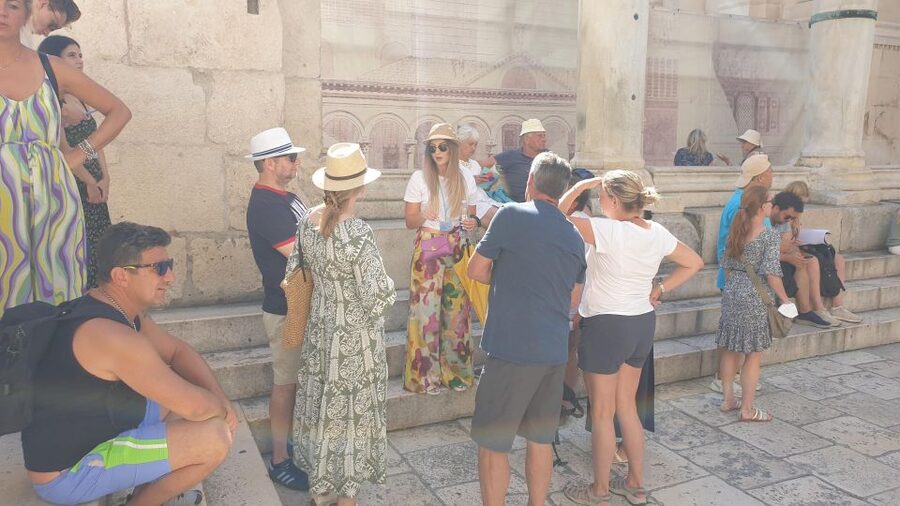
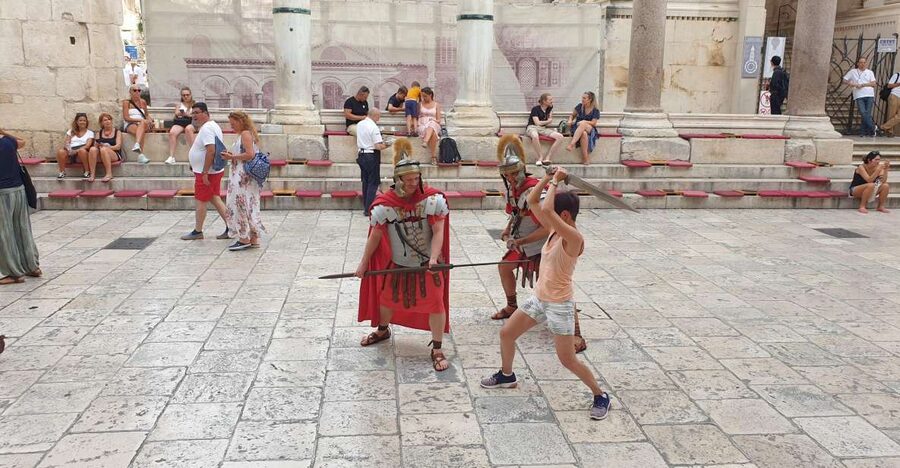
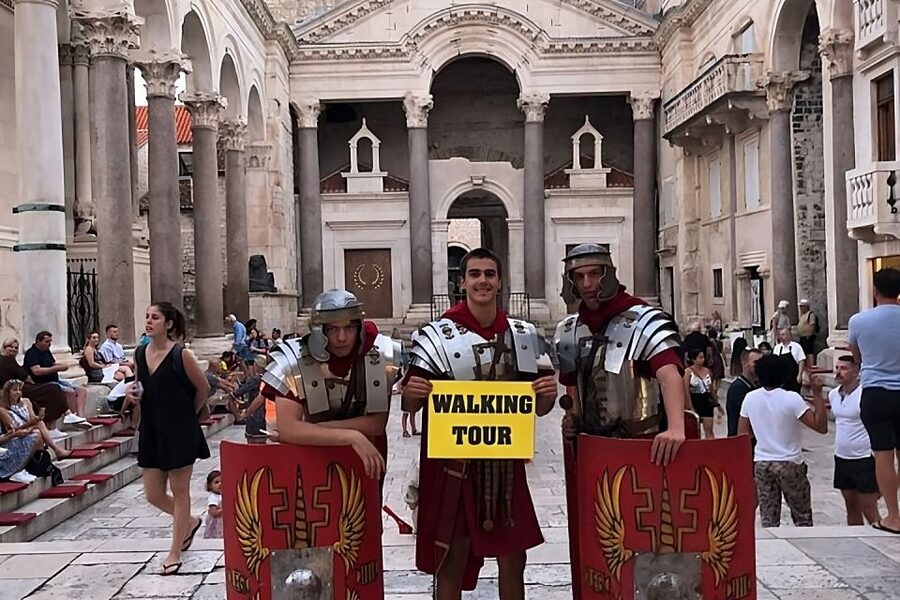
The tour begins on Peristil Square, under the old Roman arch on the north side of the square, next to the Tourist Information Office. Look for the guide in a yellow T-shirt or holding a yellow umbrella.
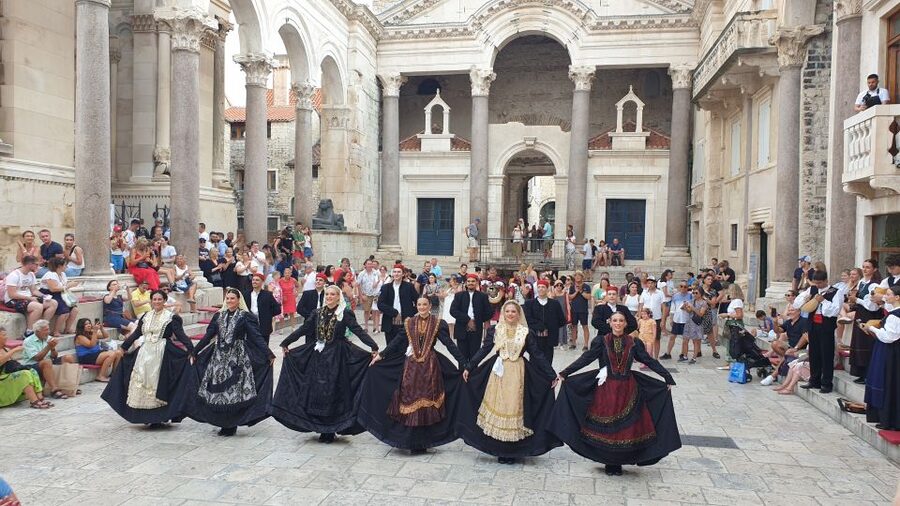
Peristil is an excellent starting point because it immediately puts you in the middle of Split’s most dramatic space. Roman columns and stonework surround the square, while everyday city life carries on around them. This is also where you begin to see the tour’s central theme: ancient remains are not isolated from modern life.
Arrive with enough time to identify the meeting point. The old center can feel confusing at first, especially if you approach through the narrow lanes rather than from the waterfront. The bright yellow clothing or umbrella should make the guide easier to spot.
The walk ends back at the same meeting point. That is handy if you want to continue exploring from there, return to your hotel, or use the tour as a simple introduction before finding lunch and other sights.
Roman remains and the making of a city
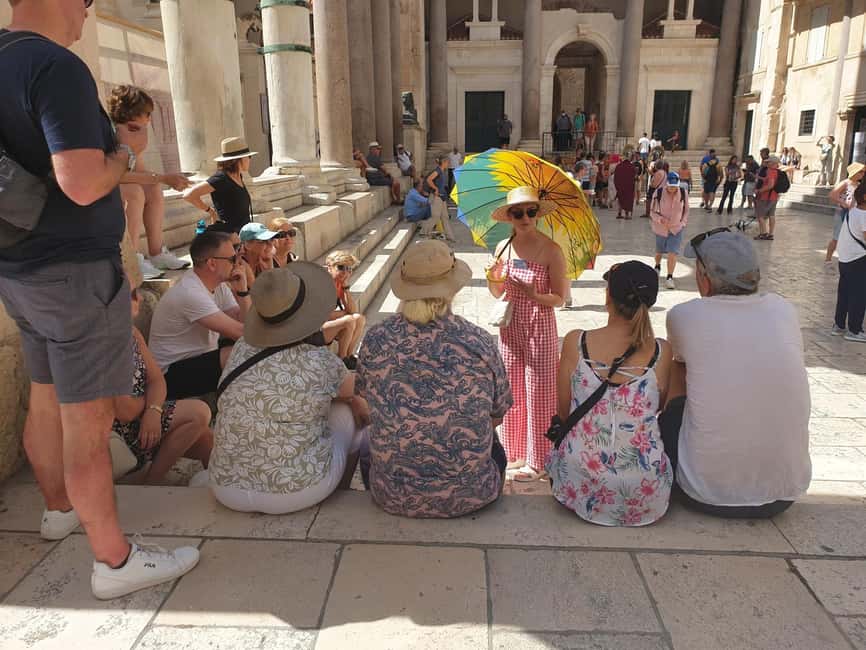
The walk focuses on the important highlights of Diocletian’s Palace and the history of Split. You will hear what the palace was designed to do, how it was organized, and what remains from the Roman period.
The value here is the explanation of change. The palace was not frozen in its original form. Later residents reused Roman spaces, altered buildings, and built new structures against old walls. That is why Split feels so unusual. You can move from a Roman feature to a medieval church and then pass a modern shop without leaving the old center.
Expect to see a combination of well-preserved Roman architecture and later medieval construction. The tour also covers Romanesque churches, medieval fortifications, and Gothic palaces. These later buildings matter because they show how Split continued to grow after the Roman era rather than fading away with it.
A guide can point out the difference between the periods more effectively than a quick solo walk. You may find it difficult to tell Roman stonework from a medieval adaptation, especially where buildings have been repaired or reused. The explanations help you read the walls.
Romanesque churches, Gothic palaces, and medieval defenses
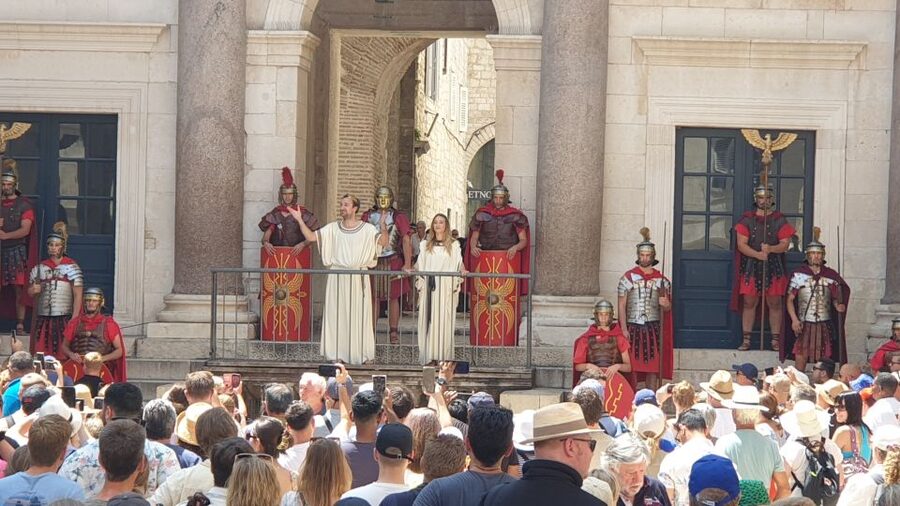
Split’s old town is not only about Roman emperors. The walking route brings in the city’s medieval chapters, including Romanesque churches, Gothic palaces, and fortifications.
These details broaden the experience. If you only focus on Diocletian, you miss how the city developed under later rulers and local families. Gothic palaces show the wealth and status of later residents, while fortifications point to periods when protection mattered as much as ceremony.
Romanesque churches add another layer. Their presence reflects the changing role of the old palace after the Roman period. Imperial spaces were adapted for religious and civic use, helping create the city that exists today.
The route is especially useful for anyone who likes architecture but does not already know how to identify different periods. The guide’s job is to connect the design to the people and politics behind it. Several guides, especially Antonella and Antonela, are praised for explaining complicated subjects in plain language and keeping the pace lively.
More walking tours in Split:
- Walking Tour of Split and Diocletian’s Palace
★ 5.0 · 2,588 reviews - Krka Waterfalls tour with Trogir Walking tour and Krka panoramic boat cruise
★ 5.0 · 1,659 reviews - Split & Diocletian’s Palace Walking Tour
★ 5.0 · 1,125 reviews - Split: Diocletian Palace & Old Town Guided Walking Tour
★ 4.7 · 882 reviews
A guide-led story instead of a list of dates
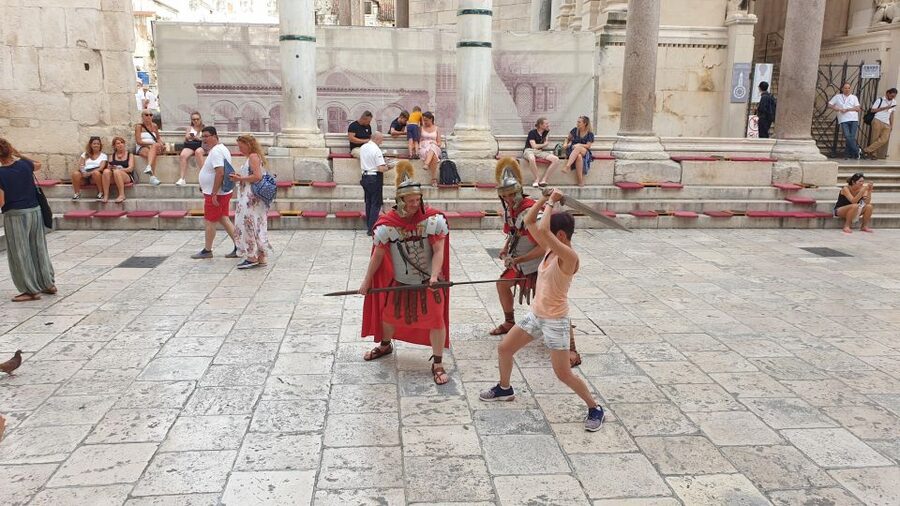
This tour’s strongest feature is its storytelling. The guides are licensed and educated, and the feedback repeatedly points to clear explanations, enthusiasm, humor, and a local connection to Split.
Antonella and Antonela are singled out often for their energy and ability to make history easy to follow. Nikolas is praised for explaining the city’s influences and showing corners that are easy to miss while wandering. Doris is remembered for helping with umbrellas during rain. Those details suggest a guiding style that is personal rather than mechanical.
You should expect more than a sequence of dates. The tour covers the Roman period, the arrival of the Croats, Venetian influence, and the city’s later development. It also brings the past into the present by explaining how Split’s old buildings still shape daily life.
That approach suits people who like history but do not want a formal lecture. It also works for the person in your group who normally loses interest when a guide starts listing rulers and building dates. Several comments describe the walk as entertaining enough to hold the attention of people who are not history fans.
The pace is described as comfortable, with enough time to take in the sights. Still, the old center can be crowded. One group grew to nearly 30 people, and the guide noted the size several times. In a large group, you may spend time waiting for people to catch up, and it can be harder to hear at the back. Stay near the guide and pay attention to the meeting points during the walk.
What the Game of Thrones connection adds
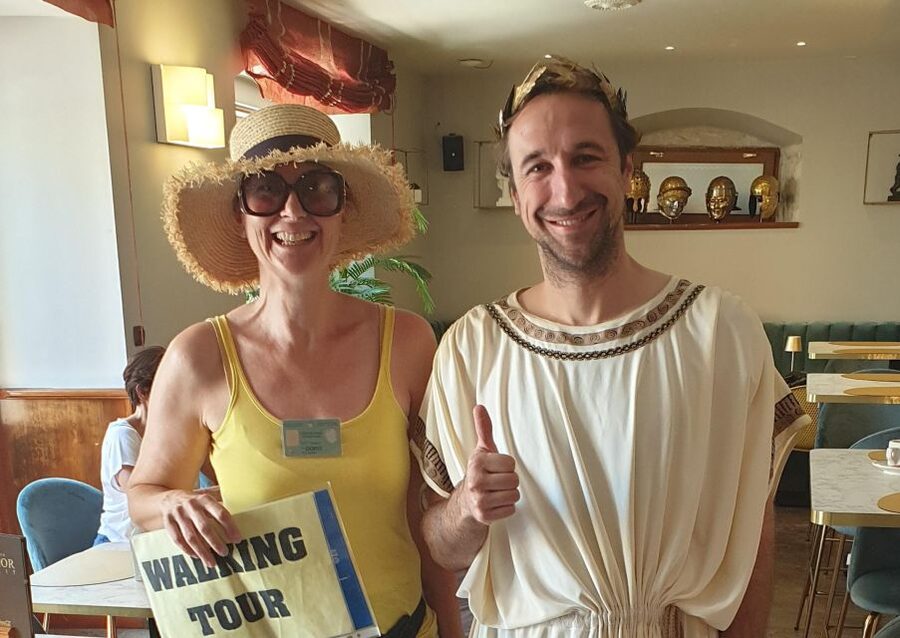
Game of Thrones information is included as bonus material. It is not the main purpose of the tour, which remains focused on Split’s history and architecture.
For fans of the show, this adds a fun modern connection to the Roman and medieval setting. You can see the old center with two viewpoints at once: as a real Croatian city with centuries of history, and as a filming location recognized from television.
If you are not interested in the series, this part should not dominate the experience. The core tour still centers on Diocletian’s Palace, the city’s historic influences, and the buildings around the old center. That balance makes the tour suitable for mixed groups, since one person can enjoy the imperial history while another looks for screen locations.
What the $18 price really covers

At $18 per person, this is a fairly easy tour to justify, particularly if you are visiting Split for the first time. The fee includes a small-group walking tour and a guide. It does not include hotel pickup, hotel drop-off, food, drinks, or admission tickets.
The main value is the time you save trying to work out the old center by yourself. Split’s historic core is compact, but its layers are not always obvious. A local guide can explain the meaning of what you are seeing while you are standing in front of it.
You should budget separately for any admission fees if the route includes a site where a ticket is required. The supplied details do not specify which ticketed interiors are visited or the cost of those tickets, so check the booking information before you go if entering paid sites matters to you.
There is also a reserve-and-pay-later option. That lets you hold a place without paying immediately, which is useful if your Croatia plans are still moving around. You can cancel up to 24 hours ahead for a full refund.
Weather, shoes, and practical comfort
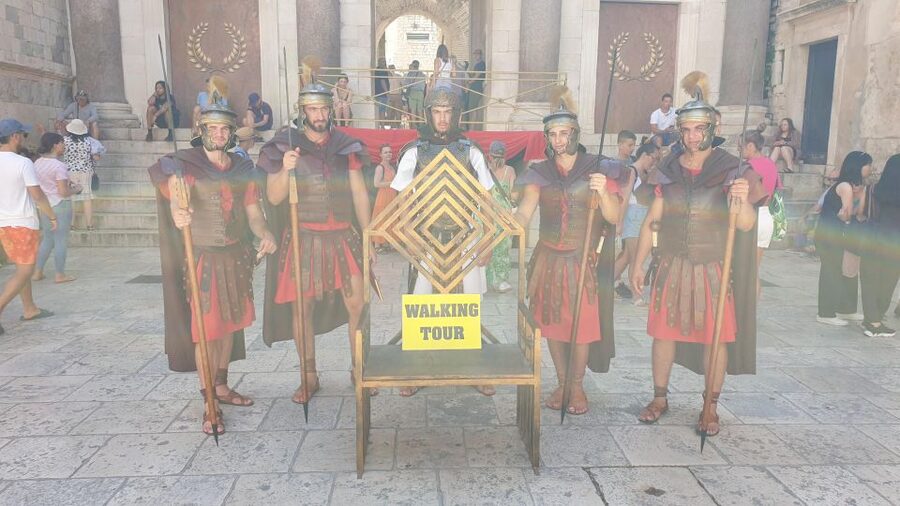
The tour runs in rain or sunshine. That makes clothing a real part of the decision, not a footnote.
Wear comfortable shoes with a secure sole. The route takes place on old streets and through historic lanes, where smooth or uneven stone can make flimsy footwear tiring. A hat is useful in strong sun, and comfortable clothing will help during the walk.
Bring rain protection if the forecast is uncertain. The guide may provide an umbrella in some situations, but you should not rely on that for your whole group. The tour operates regardless of weather, so prepare for the conditions you are likely to meet.
The experience is listed as suitable for all ages. However, it is not suitable for people with high blood pressure or for people with hearing impairments. Since this is a guided outdoor walk, staying close to the guide is especially important in crowded areas.
Costumes are not allowed. That rule is simple, but it may matter to anyone planning a themed outfit for the Game of Thrones connection.
Who will get the most from this walk
I would recommend it most strongly to first-time visitors, short-stay visitors, and anyone who wants the old center explained before exploring alone. It is also a good match for couples or families with different interests, since the guide mixes architecture, politics, local stories, and popular culture.
If you have only 48 hours in Split, this is a practical use of your time. One walk gives you the basic story of the palace and points out areas you may want to revisit later.
History lovers should appreciate the Roman and Venetian context, as well as the explanation of how Croatian and medieval influences shaped the city. People who prefer stories to technical detail should like the lively delivery reported from guides such as Antonella and Antonela.
The tour may be less appealing if you want a private experience, silence, or a highly controlled pace. The group can be larger than expected, and crowds in the old center can slow things down. You also need to accept that admission tickets and refreshments are your responsibility.
The tour is offered in English, German, French, and Russian. Choose the language in which you can most easily follow spoken explanations, since much of the value comes from the guide’s storytelling.
Should you book the Split History and Heritage Walking Tour?
At $18, this is a strong-value introduction to Split’s old center. The setting does much of the work, but the guide supplies the context that turns a beautiful collection of stones into a clear story about emperors, churches, fortifications, palaces, and city life.
I would book it if you are visiting Split for the first time, have limited time, or want a local guide who can make history entertaining. The 4.9 rating from 650 reviews also fits the repeated praise for clear explanations, friendly energy, and guides who bring the past to life.
I would pause only if you need a private group, have difficulty hearing outdoors, or are not comfortable walking in rain or sun. For everyone else, meet beneath the Roman arch on Peristil Square, wear sensible shoes, and stay close to the yellow umbrella.
FAQ
How much does the Split History and Heritage Walking Tour cost?
The tour costs $18 per person.
What is included in the tour?
The price includes a small-group walking tour and a tour guide.
Are hotel pickup and drop-off included?
No. Hotel pickup and drop-off are not included.
Where does the tour begin?
The meeting point is under the old Roman arch on the north side of Peristil Square, next to the Tourist Information Office. Look for a yellow T-shirt or yellow umbrella.
Where does the tour end?
The activity ends back at the meeting point on Peristil Square.
Which languages are available?
The tour is available in Russian, English, German, and French.
Does the tour operate in bad weather?
Yes. The tour takes place in rain, sunshine, and other weather conditions. Bring comfortable clothing, a hat, and suitable shoes.
Can I cancel the booking?
Yes. You can cancel up to 24 hours in advance for a full refund. A reserve-and-pay-later option is also available.
Just added around Split
- Kayaking & Zipline Šibenik – Čikola Canyon★ 5.0 · 3 reviews
- Krka National Park & Zipline Šibenik – Čikola Canyon★ 5.0 · 3 reviews
- Split: Small-Group Half Day Sailing Trip★ 5.0 · 3 reviews
- Rafting River Cetina from Makarska Riviera including transfer★ 5.0 · 3 reviews
- From Split: Krka National Park & Waterfalls Private Day Trip★ 5.0 · 3 reviews
- Split Bike and Wine Experience★ 5.0 · 3 reviews
- Split and Salona Cultural Heritage Day Tour from Trogir★ 4.0 · 3 reviews
- Krka Waterfalls, Lake Cruise & Skradin★ 5.0 · 3 reviews
Old Town & History Tours, compared.


Walking Tour of Split with a ‘Magister’ of History
Read our review →

Diocletian Palace & Old Town Guided Walking Tour
Read our review →
Diocletian’s Palace and Old Town SMALL GROUP Walking Tour
Read our review →

Split History and Gastro Small-Group Tour with Food and Drinks
Read our review →
PREMIUM Emperor’s Walking Tour for History Lovers + Museum
Read our review →Browse the lists this tour appears in