
Reviewed · DIOCLETIAN PALACE TOURS
Walking Tour of Split and Diocletian’s Palace
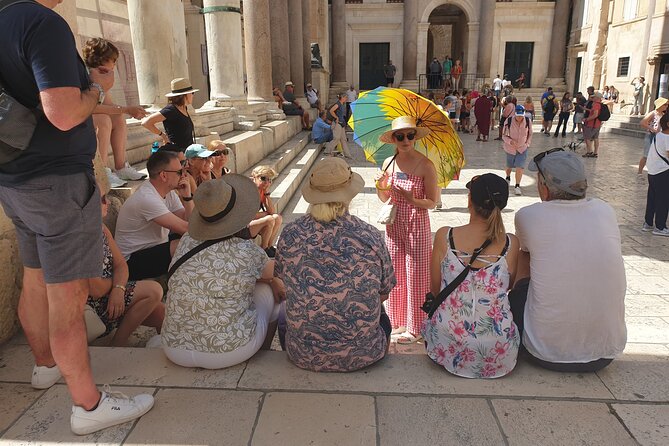
Diocletian’s Palace is not a ruin sitting apart from town. It is the town. Homes, shops, cafés, churches, and narrow lanes occupy the old Roman complex, so this 90-minute walking tour gives you a useful first map of Split as you walk through its living center.
I like the route for two reasons: it covers the major sights without wasting time, and strong guides such as Antonella, Anton, Mario, and Professor Marino bring dates and stones to life with humor and personal insight. The main drawback is sound. With up to 20 people and several tours nearby, a soft-spoken guide can be hard to hear, and no headsets are provided.
In This Review
- Key points to know before booking
- Why this short tour works in Split
- Starting at the Peristyle: Split’s best history lesson
- The Vestibule and the sound of Dalmatia
- The substructures: the palace beneath the palace
- The Golden Gate and Gregory of Nin
- Riva Harbor: a change of pace
- Fruit’s Square and the Venetian chapter
- The old synagogue and Split’s Jewish story
- Guide quality, group size, and hearing the story
- Is $48.37 a fair price?
- Who should book this walk?
- Should you book the Diocletian’s Palace walk?
- FAQ
- How long does the walking tour last?
- Where does the tour start?
- Where does the tour end?
- Is the tour offered in English?
- Are admission tickets included?
- How many people can join the tour?
- Is the tour suitable for people with mobility concerns?
- What is the cancellation policy?
Key points to know before booking
- Peristyle is the natural starting point: You begin at the palace’s central square, the best place to understand how the complex fits together.
- The route mixes Roman, medieval, Venetian, and modern Split: You see far more than the emperor’s palace, including Riva, Fruit’s Square, the Golden Gate, and the old synagogue.
- The guide makes the difference: Antonella, Anton, Mario, Marino, Maggie, and Antonio receive especially warm praise for clear explanations, humor, and enthusiasm.
- Paid sections are not included: The tour passes through the palace substructures, but the museum area and other admission sites require separate payment.
- Expect uneven steps: High and irregular stairs make sturdy shoes and a reasonable level of mobility important.
- The meeting point takes attention: Look for Peristil ulica and the Peristyle in the palace center, since the starting point can be tricky to locate.
Why this short tour works in Split

At $48.37 per person, this is not the cheapest way to walk around Split. You are paying for a guide, not a long list of included tickets. The value comes from getting a clear introduction to a confusing old center in a short amount of time, especially if Split is one stop on a cruise or part of a tight Croatia itinerary.
I would use this tour early in your stay. Once you understand where the palace walls, gates, harbor, and central squares sit, it is easier to return on your own. You can also decide which paid areas deserve extra time after the guided walk.
The tour is offered in English and has several start times, which helps if you are fitting Split around a cruise arrival or another activity. The group can reach 20 people, though some departures may be much smaller. One small group had only four participants, while other departures felt crowded enough that people had to move close to the guide to hear.
The overall rating is 4.9 from 2,588 ratings, and 99 percent of customers recommend it. That is a very strong record, but the weaker experiences point to practical issues rather than a bad route: occasional booking problems, a delayed start, a guide who was difficult to understand, or a group without audio equipment.
More ways into Diocletian’s Palace:
- Split: Old Town and Diocletian Palace Walking Tour
★ 4.9 · 4,727 reviews - Split & Diocletian’s Palace Walking Tour
★ 5.0 · 1,125 reviews - Split: Diocletian Palace & Old Town Guided Walking Tour
★ 4.7 · 882 reviews
Starting at the Peristyle: Split’s best history lesson
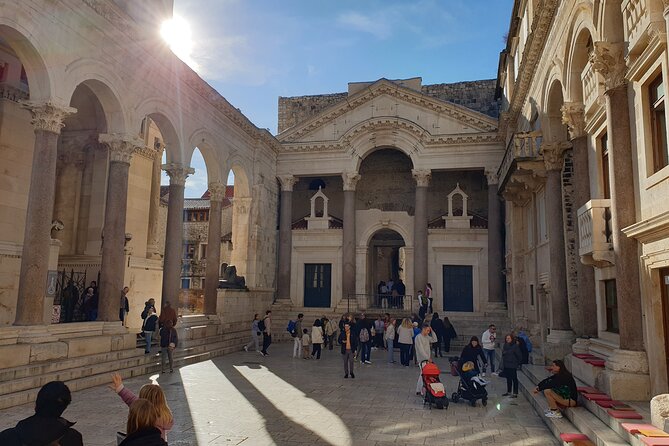
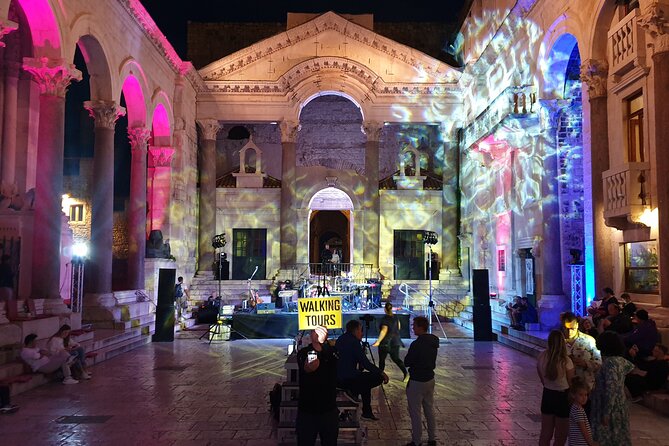
Meet at the Peristyle, the palace’s central square. This is the smartest place to begin because you can reach almost every major part of Diocletian’s Palace from here.
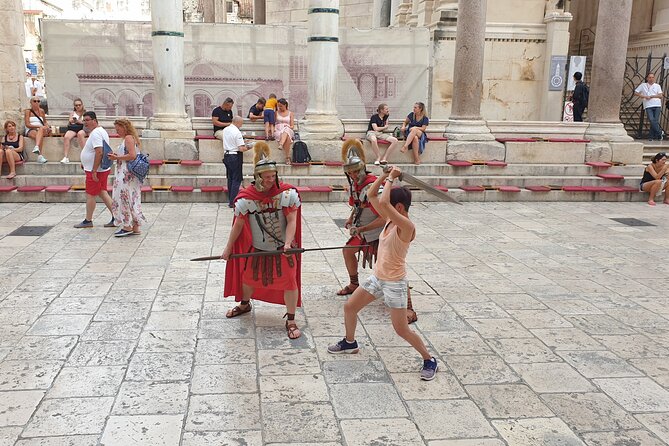
The square gives your guide room to explain the basic plan of the palace before the group moves into tighter lanes. You begin to see why Split feels unusual: ancient columns and Roman walls are woven into everyday life rather than fenced off from it.
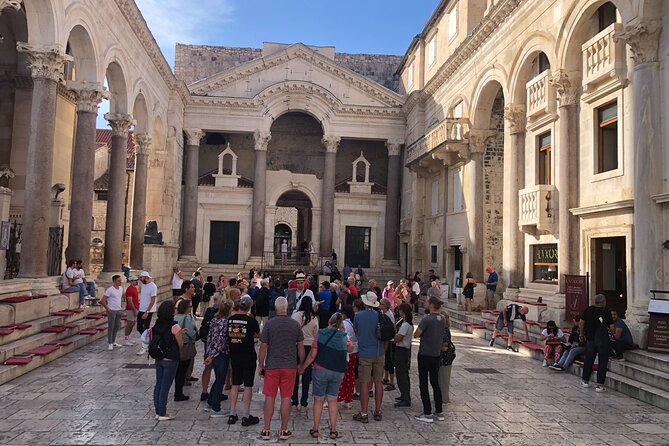
The stop lasts about 15 minutes and is free. Take a moment to look around before the explanation begins. The Peristyle is also one of the places where several walking groups may gather, so stay alert for your guide and keep close enough to hear.
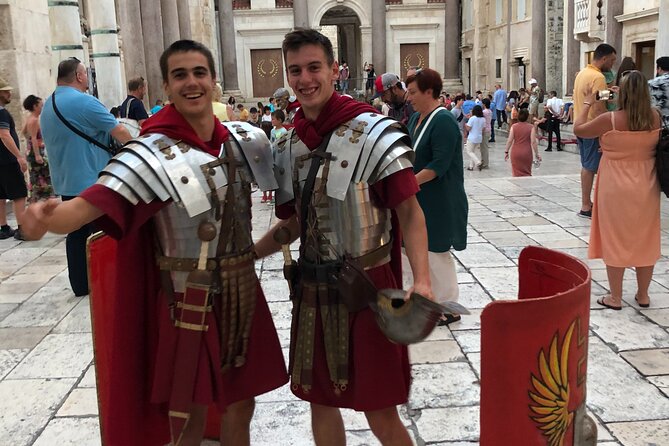
A good guide can make this opening especially effective. Antonella is praised for being organized, funny, and clear, while Anton and Mario are singled out for energy and willingness to answer questions. Professor Marino is described as having a strong personal connection to Split. The route itself is fixed, but the experience can feel quite different depending on who leads it.
The Vestibule and the sound of Dalmatia
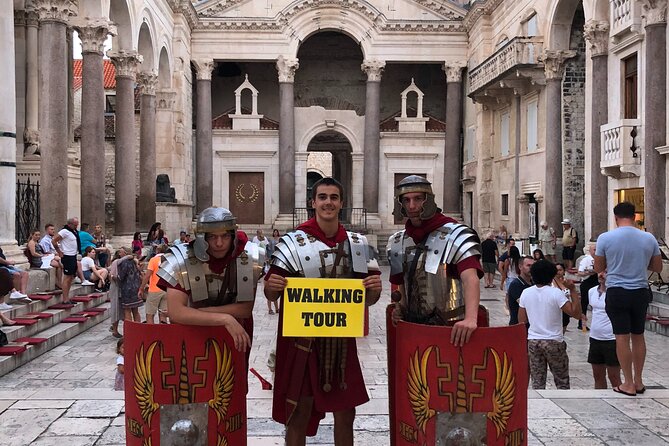
From the Peristyle, you visit the Vestibule, the former entrance area associated with Emperor Diocletian. The stop is brief, about five minutes, but it adds another piece to the palace’s original design.
You might also hear traditional Dalmatian singing here. The wording for this part is cautious, so treat it as a possibility rather than a guaranteed performance. Even without singing, the Vestibule is a useful pause between the broad central square and the more enclosed parts of the palace.
Your guide explains its past and its place within the imperial complex. This is where clear delivery matters. One highly rated guide was praised for weaving facts and anecdotes into a story, while another guide received low marks because the group struggled to follow a soft voice and unfocused presentation.
The substructures: the palace beneath the palace
The palace substructures are one of the more useful stops on the route. You walk through the lower levels and hear how they were built and how their function changed over time.
The substructures also help you understand the rooms above. Their layout reflects the plan of the palace, so this is not simply a walk through dark old corridors. It shows how the Roman complex was supported and organized.
The guided visit lasts about 10 minutes. Admission to the museum portion is not included, and the group does not visit that museum section. You can return afterward and pay separately if you want a longer look.
That distinction matters when you compare the $48.37 price with other Split tours. This experience gives you orientation and commentary, but it does not cover entry tickets. If you want to see every paid section, budget for those separately.
The substructures may also be where the walking conditions become more noticeable. The tour information warns about high steps, and one participant specifically advises preparing for uneven stairs. This is not a flat promenade. If you have trouble with high steps, this activity is not recommended.
More walking tours in Split:
- Krka Waterfalls tour with Trogir Walking tour and Krka panoramic boat cruise
★ 5.0 · 1,659 reviews - Walking Tour of Split with a ‘Magister’ of History
★ 5.0 · 1,122 reviews - Split Walking Tour with Professor of History
★ 5.0 · 926 reviews - From Split: Krka Waterfalls Cruise & Trogir Walking Tour
★ 4.7 · 681 reviews
The Golden Gate and Gregory of Nin

The Golden Gate is the main entrance to Diocletian’s Palace and one of the route’s most memorable outdoor stops. Your guide explains the gate and points out the statue of Gregory of Nin.
Gregory of Nin matters to Croatian history and language, and the guide uses the statue to explain why. This is a good example of the tour’s wider purpose. You are not only looking at Roman architecture. You are also learning how later Croatian identity and local memory became part of the old palace center.
The stop lasts about 10 minutes and is free. It is also a useful place to regain your bearings because the gate connects the palace with the wider city. The route does not treat Diocletian’s Palace as a sealed archaeological site. It shows you how the palace works as part of Split today.
Riva Harbor: a change of pace
The walk continues to Riva Harbor, Split’s famous promenade along the water. Here you see a bronze model of Diocletian’s Palace and hear about the story of the Riva.
The 15-minute stop gives your legs a break from narrow lanes and stairs. It also lets you look back at the palace as a whole through the bronze model, which can make the earlier explanations easier to picture.
Riva is not another enclosed palace room, and that is part of its value. The stop widens the story from one Roman building to Split as a port city and public meeting place. You get a better sense of how the old center relates to the waterfront.
The tour ends back at the original meeting point, so Riva is part of the loop rather than the final destination. If you want to linger by the harbor afterward, you can do so on your own, but the formal activity returns to Peristil ulica.
Fruit’s Square and the Venetian chapter
Fruit’s Square, or Trg Brace Radic, adds a later layer to the route. Here you learn about a 15th-century Venetian citadel and about Marko Marulic, regarded as the father of Croatian literature.
This stop is about 10 minutes and admission is free. It helps prevent the tour from becoming a narrow lesson about Emperor Diocletian alone. Split’s old center changed hands, purposes, and styles over many centuries, and Fruit’s Square gives you a quick look at that later urban story.
The square is also a reminder that the palace area is a real neighborhood. You are moving between historic walls and ordinary city life, not from one isolated monument to another.
If you enjoy literature and local culture, this may be one of the more interesting stops. If you want only Roman remains, it may feel like a detour, but the route’s broader view is a strength for first-time visitors.
The old synagogue and Split’s Jewish story
The final listed stop is the Split Synagogue, a 16th-century synagogue. The group passes by and learns about the history of Jewish people in Split.
The tour does not include admission, and the information provided does not promise an interior visit. Think of this as a short historical introduction while walking through the old center, not a full synagogue tour.
That brief stop adds another voice to the city’s past. It also shows the guide’s effort to cover communities and traditions beyond imperial architecture, military gates, and grand squares.
Guide quality, group size, and hearing the story
Guide quality is the biggest variable. Several guides receive strong praise for clear English, humor, and enthusiasm. Antonella is repeatedly described as friendly, funny, and well organized. Anton and Anthony are praised for lively presentations of the palace, while Mario is noted for answering questions beyond the planned subject. Maggie and Antonio also receive warm mentions.
A history-teacher guide can be a real asset if the presentation stays focused. One guide was praised for turning facts into an entertaining story. Another was criticized for speaking too softly, wandering away from the subject, and discussing unrelated topics. That contrast tells you what to watch for: the route has plenty to offer, but you need a guide who can manage both the material and the group.
Sound is the recurring concern. Several people had trouble hearing because multiple tours were using the same spaces, and no earbuds or headsets are supplied. Try to stay near the guide, especially in the Peristyle and other crowded areas. A small group improves the odds, but the maximum is 20.
The advertised length is about 1 hour and 30 minutes. One departure reportedly lasted less than that, while another stretched to roughly two and a half hours because of the guide’s presentation. A delayed start of about 20 minutes has also occurred after a booking problem. If you have a train, ferry, or cruise departure immediately afterward, leave a generous buffer.
Is $48.37 a fair price?
The price makes the most sense for visitors who want interpretation, not just access. Almost all listed outdoor stops are free, and no admission tickets are included. You are paying to have someone explain how the palace, city gates, waterfront, Venetian fortifications, literature, and Jewish history fit together.
For a solo visitor, the cost is easier to justify because hiring a private guide would cost more, while wandering alone can leave you unsure what you are seeing. For a family or group, group discounts may improve the value. The tour’s short length also keeps the commitment manageable.
The price is less attractive if you plan to spend several hours inside the paid museum areas or want a fully private experience. In that case, you will need to add admission costs and may prefer a longer or more specialized tour.
Who should book this walk?
I would recommend it for a first visit to Split, especially if you have only one day or are arriving by cruise. It gives you a practical framework before you explore cafés, markets, churches, and the palace lanes on your own.
It also suits history fans who like a guide to connect Roman, Croatian, Venetian, and local stories. The strongest guides use humor and personal feeling rather than reciting dates, which makes the material easier to remember.
Families can benefit from the compact route, but children and anyone uneasy on stairs should be prepared. The group walks through historic spaces with high and uneven steps, and the lack of headsets may make it harder for younger participants to follow in a noisy crowd.
If you value quiet, detailed listening, book a time when you expect fewer tour groups if possible, stay close to the guide, and keep your schedule flexible. If hearing a guide clearly is essential, the absence of headsets is a real consideration.
Should you book the Diocletian’s Palace walk?
Book it if you want a strong first look at Split and prefer a guide’s explanation to wandering without context. The route is well chosen, the price is reasonable for a guided introduction, and the best guides, especially Antonella, Anton, Mario, Anton, and Marino, can make the city’s layered past easy to follow.
Skip it if you want admission to every palace area, a private tour, or a guaranteed quiet setting. You will need to pay separately for the museum sections, and a group of up to 20 can make listening difficult.
For most first-time visitors, I would book this near the start of a Split stay, then return to the palace afterward for the paid sites and places that caught your interest. Free cancellation is available up to 24 hours before the start time, but changes or cancellations inside that window are not refunded. The tour requires a minimum number of participants, so a cancellation by the operator may result in another option or a full refund.
FAQ
How long does the walking tour last?
The advertised duration is approximately 1 hour and 30 minutes. One recorded departure lasted less than 90 minutes, while another ran much longer, so allow extra time if your schedule is tight.
Where does the tour start?
The tour starts at Peristil ulica, at the Peristyle in Split, Croatia. The meeting point can be hard to find, so allow time to locate it inside the palace area.
Where does the tour end?
The activity ends back at the original meeting point.
Is the tour offered in English?
Yes. The tour is offered in English.
Are admission tickets included?
No admission tickets are included. The tour does not visit the museum portion of the palace substructures, and you can visit that area separately afterward.
How many people can join the tour?
The maximum group size is 20 people. Some departures may be smaller.
Is the tour suitable for people with mobility concerns?
Most people can participate, but the tour is not recommended for anyone who has trouble with high steps. You should also expect uneven historic steps.
What is the cancellation policy?
You can cancel up to 24 hours before the local start time for a full refund. Cancellations or changes made less than 24 hours before the start time are not refunded. If the operator cancels because the minimum number of participants is not reached, you will be offered another date or experience, or a full refund.
Just added around Split
- Kayaking & Zipline Šibenik – Čikola Canyon★ 5.0 · 3 reviews
- Krka National Park & Zipline Šibenik – Čikola Canyon★ 5.0 · 3 reviews
- Split: Small-Group Half Day Sailing Trip★ 5.0 · 3 reviews
- Rafting River Cetina from Makarska Riviera including transfer★ 5.0 · 3 reviews
- From Split: Krka National Park & Waterfalls Private Day Trip★ 5.0 · 3 reviews
- Split Bike and Wine Experience★ 5.0 · 3 reviews
- Split and Salona Cultural Heritage Day Tour from Trogir★ 4.0 · 3 reviews
- Krka Waterfalls, Lake Cruise & Skradin★ 5.0 · 3 reviews
Diocletian Palace Tours, compared.



Diocletian Palace & Old Town Guided Walking Tour
Read our review →
Game of Thrones Tour with Diocletian’s Palace Cellar
Read our review →
Diocletian’s Palace and Old Town SMALL GROUP Walking Tour
Read our review →

Browse the lists this tour appears in