
Reviewed · OLD TOWN & HISTORY TOURS
Split Old Town History Walking Tour
Diocletian’s Palace is not a fenced-off ruin. It is Split’s city center, with cafés, homes, shops, churches, and laundry tucked into Roman walls. This 90-minute walking tour gives you a quick, useful introduction to that living monument, then carries you through nearby squares and streets.
I like the route for two clear reasons: you get the big Roman sights without giving up half a day, and a local guide can point out details you would likely miss alone. I also like the choice of two departure times, with the evening option offering a cooler, quieter walk.
The main drawback is pace. Ten stops in an hour and a half leaves limited time for long historical explanations, and the tour is not suitable for wheelchairs. A small number of past bookings also ran into cancellation and meeting-point problems, so confirm the tour status before setting out.
In This Review
- Key points to know before booking
- Why Diocletian’s Palace is the right place to start
- Under the palace in Diocletian’s cellars
- The Peristyle and Cathedral of Saint Domnius
- The Vestibule, with a chance of klapa singing
- Temple of Jupiter and Triklinij
- The Golden Gate and Gregory of Nin
- Pjaca and Fruit’s Square
- Ending back on the Riva
- How the guides shape the experience
- Is $30.23 a fair price?
- Timing, shoes, and practical details
- Who should book this Split walk?
- Should you book it?
- FAQ
- How long does the Split Old Town History Walking Tour last?
- Where does the tour start and finish?
- What sights are included on the route?
- Is the tour offered in English?
- Are food and drinks included?
- Can I cancel for a full refund?
Key points to know before booking
- Roman palace turned modern city: Walk through Diocletian’s Palace while daily Split life carries on around you.
- A compact route: Cover the Riva, palace cellars, Peristyle, cathedral, Vestibule, Temple of Jupiter, Golden Gate, and two historic squares in about 90 minutes.
- Local guides make the difference: Anita, Petra, Toni, Iva, Katarina, and Rocco have all led this tour, with praise for their local insight, humor, and clear English.
- Two departure times: Pick a schedule that fits your day, and consider the evening departure for cooler temperatures and fewer people.
- Good value at $30.23: You get a licensed local guide and a useful first look at Split’s core sights without committing to a full-day activity.
- Plan for walking: Wear secure, non-slip shoes, dress for the weather, and remember that food and drinks are not included.
Why Diocletian’s Palace is the right place to start
The best feature of this tour is its setting. Diocletian’s Palace is often described as a palace, but that can give you the wrong picture. You are not walking through one isolated royal building. You are moving through a network of lanes, courtyards, stone passages, and squares that still form the center of Split.
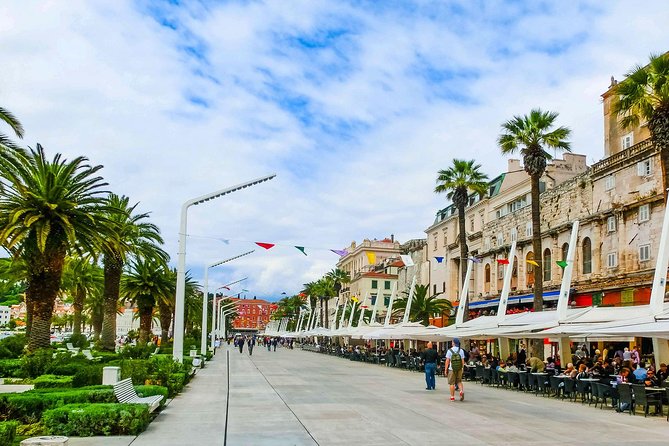
The tour begins on the Riva, Split’s waterfront promenade. This is a smart meeting point because the sea, boats, cafés, and long line of palm trees give you an immediate sense of the city’s layout. Your guide introduces Split’s past and explains where the palace sits in relation to the waterfront and old town.
You spend about 10 minutes here, enough to get your bearings without using up much of the tour. Find the meeting point at Obala Hrvatskog narodnog preporoda 21, and arrive ready to walk. The activity returns to this same location at the end.
More old town history walks in Split:
- Split: Old Town and Diocletian Palace Walking Tour
★ 4.9 · 4,727 reviews - Walking Tour of Split with a ‘Magister’ of History
★ 5.0 · 1,122 reviews - Split Walking Tour with Professor of History
★ 5.0 · 926 reviews
Under the palace in Diocletian’s cellars
The route then heads into the palace cellars, where you see the sturdy substructures that supported the imperial residence above. These underground rooms are among the most useful places in Split for understanding how the palace was built.
Your guide can connect the stone chambers below with the rooms and streets above. That physical link matters. Instead of hearing a loose list of Roman facts, you can see how the lower level helped support the emperor’s complex.
The cellar stop lasts about 15 minutes, the longest single visit on the route. That tells you where the tour places its emphasis: on the Roman core of Split rather than on every corner of the later medieval town.
The pace can feel brisk if you want detailed archaeology. Still, for a first visit, this is an efficient introduction. You see the scale of the palace and gain a clearer picture before stepping back into the open air.
The Peristyle and Cathedral of Saint Domnius
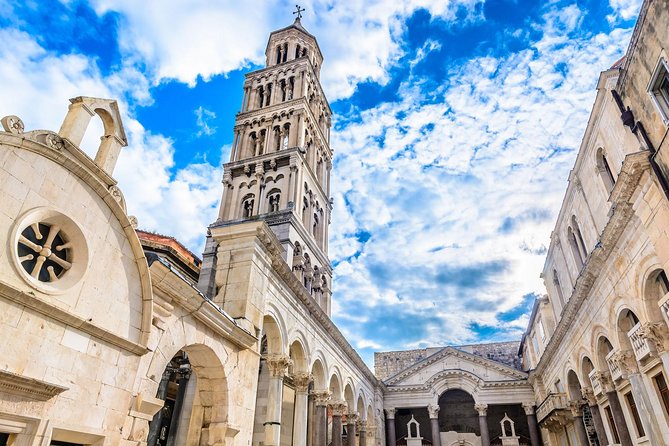
At the Peristyle, you reach the ceremonial heart of Diocletian’s Palace. Roman columns frame the open square, and the Cathedral of Saint Domnius occupies a building that began as the emperor’s mausoleum.
This is one of the tour’s strongest history lessons because several periods meet in one place. Roman imperial power, Christian worship, and modern city life all share the same stones. Your guide explains how a Roman structure became part of Split’s later religious and civic life.
The stop lasts about 10 minutes. You have time to look up at the columns, study the cathedral’s form, and hear the basic story, but you should not expect a full cathedral visit or a detailed art lecture. The activity is designed as an overview, not as a specialist tour.
I would pay close attention here, even if you have already read about Diocletian. The guide’s explanation helps you see why the palace is more interesting than a simple set of Roman ruins.
The Vestibule, with a chance of klapa singing
The Vestibule is a short stop, only about five minutes, but it has a distinct character. You stand beneath a circular open dome with striking acoustics. If timing works out, you might hear traditional klapa singers performing nearby.
Klapa is a Croatian style of group singing, and the sound carries especially well in stone spaces. There is no promise of a performance, so treat it as a possible bonus rather than a scheduled part of the tour.
This stop also shows why a walking guide can be more useful than a map. A map tells you that a circular chamber exists. A local guide can tell you to listen, look up, and notice how the space works.
More walking tours in Split:
- Walking Tour of Split and Diocletian’s Palace
★ 5.0 · 2,588 reviews - Krka Waterfalls tour with Trogir Walking tour and Krka panoramic boat cruise
★ 5.0 · 1,659 reviews - Split & Diocletian’s Palace Walking Tour
★ 5.0 · 1,125 reviews - Split: Diocletian Palace & Old Town Guided Walking Tour
★ 4.7 · 882 reviews
Temple of Jupiter and Triklinij
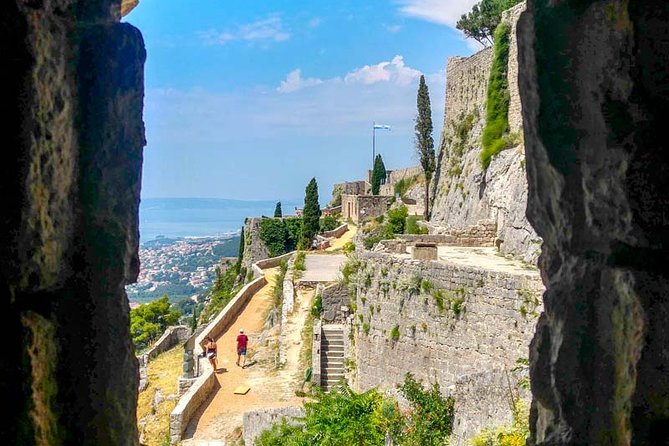
The former Temple of Jupiter is another compact stop. It later became a baptistery, and you can see ancient sculptures and a preserved sarcophagus. The building offers a clear example of how old structures changed purpose over time.
You spend about five minutes here. That is enough to understand the basic transition from Roman temple to Christian baptistery, but not enough for a detailed discussion of every carved feature. If you enjoy inscriptions, sculpture, or religious history, keep your own questions ready.
Next comes Triklinij, the place associated with Diocletian’s formal banquets. Your guide explains Roman dining customs and the scale of imperial luxury. This makes a useful contrast with the narrow lanes outside. The palace was not only a military or political center. It was also a home for ceremony, meals, and court life.
Both stops are brief, yet they add texture to the imperial story. The Temple of Jupiter shows religious change. Triklinij gives you a glimpse of how power was displayed through food and formal gatherings.
The Golden Gate and Gregory of Nin
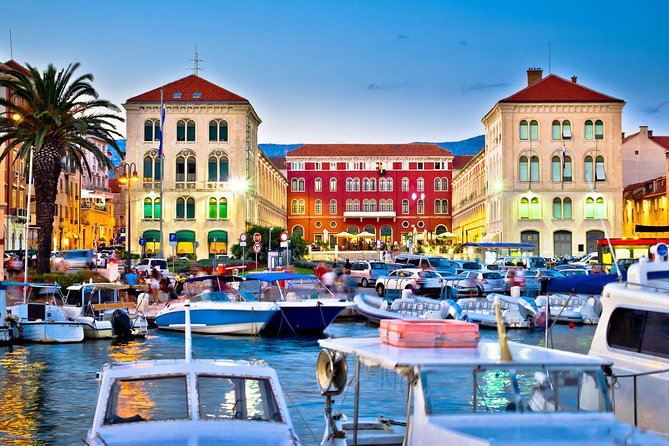
The Golden Gate is the grandest of the palace’s four gates. Passing through it gives you a strong sense of the palace boundary, even though modern Split now flows directly around it.
Outside the gate, you stop at the towering statue of Gregory of Nin. Rubbing the statue’s toe is a local good-luck tradition. It is a small, playful moment after the heavier Roman material, and it gives the walk a connection to present-day Split.
The gate and statue stop lasts about 10 minutes. Take a moment to look back toward the palace after exiting. From outside, the gate helps you imagine how controlled and imposing the imperial complex once felt.
This part of the route also works well for orientation. You are no longer only inside the palace. You begin to see how its walls shaped the later town around them.
Pjaca and Fruit’s Square
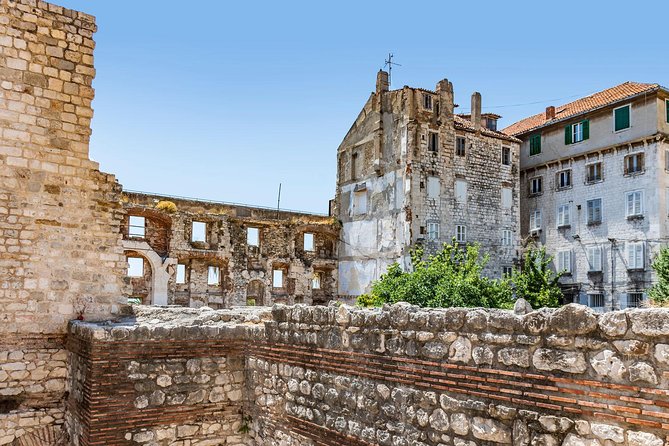
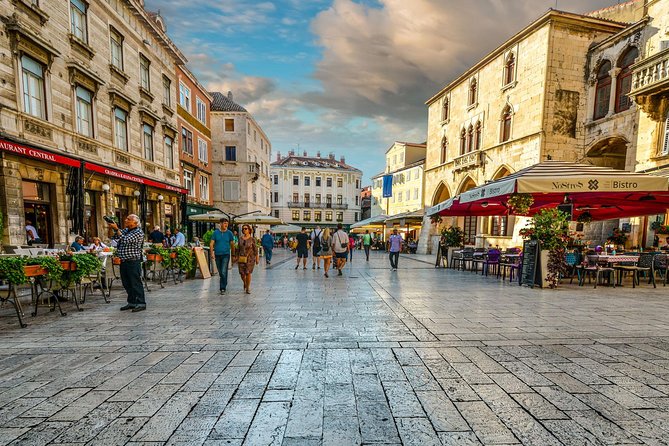
Narodni trg, usually called Pjaca, brings you into a later chapter of Split’s story. Venetian-era buildings frame the square, along with an old city clock and cafés. It is a good place to notice the shift from Roman planning to the social life of a later European town.
The stop takes about 10 minutes. Your guide can point out architectural details while explaining how the square functions as part of the old town today. I like this pause because it prevents the tour from becoming only a Roman history lesson.
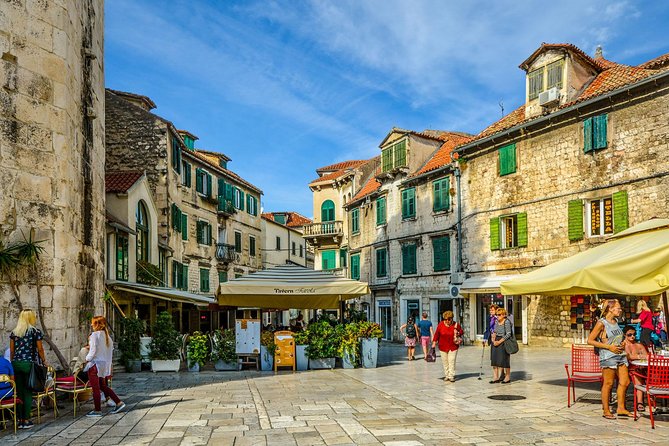
Fruit’s Square, or Trg Brace Radic, follows for about five minutes. Its name recalls the fruit markets once held there, while baroque palaces now frame the space. The square gives you another quick look at how ordinary trade and grand architecture have shared the same streets.
These two squares are easy to pass through on your own. With a guide, you get a better sense of their role in Split’s daily life and a few useful landmarks for returning later.
Ending back on the Riva
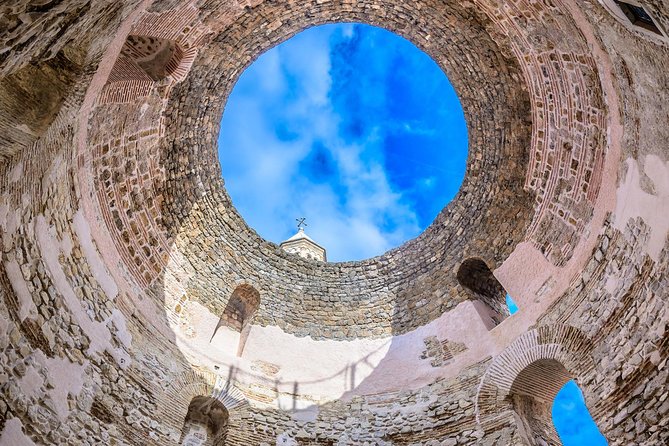
The tour finishes where it began, on the Riva. After the tight lanes and stone interiors, the open waterfront makes a pleasant finish.
The final five minutes are not a formal sightseeing stop so much as a chance to place everything you have seen. You return with a clearer understanding of how the Roman palace, medieval lanes, Venetian buildings, cafés, and sea-facing promenade fit together.
This is also the right time to ask your guide for practical suggestions. One of the tour’s stated aims is to give you local advice on places to eat, drink, and continue exploring. Guides such as Toni and Rocco have been praised for adding personal local detail, while Anita, Petra, Iva, and Katarina have been noted for clear explanations and friendly answers.
How the guides shape the experience
The guide is the key variable on a short city walk. There is not enough time for the route itself to carry the whole experience, so clear storytelling matters.
Anita has been described as especially warm and passionate about Croatia. Petra is noted for answering many questions, and Iva for an efficient, friendly approach that covers the highlights in the allotted time. Katarina has led the palace section with strong English and a clear grasp of Split’s past.
Toni’s style includes humor and stories about local life. That can make the walk feel like a friend is showing you around, though you may need to ask for clarification if a joke and a historical point run together. Rocco has led an evening departure with local insight, good English, and a relaxed sense of humor.
These details point to a useful expectation: you should get an engaging local introduction, but the exact tone may vary by guide. If you want a formal academic lecture, this is probably not the right format. If you want a personable guide who can explain the main sights and answer questions, it fits well.
Is $30.23 a fair price?
At $30.23 per person, the tour offers reasonable value if you are new to Split and want a compact orientation. You receive about 90 minutes with a licensed local guide and visit the city’s main historic points without paying for a longer excursion.
The value comes less from the number of stops than from the connections between them. A map can take you to the Golden Gate, Peristyle, and Temple of Jupiter. A guide can explain how an emperor’s residence became the core of a living city, why the cathedral occupies a Roman mausoleum, and how later squares developed around the palace.
You do not get food, drinks, or a separate meal break. You also should not book this expecting every sight to receive a long visit. The price makes the most sense as an opening tour on your first day, followed by independent time in the places that interest you most.
The small maximum of 20 people is another plus. Groups may be smaller, with one past group numbering only seven and another 10. That makes it easier to hear the guide and ask questions, though group size can change.
Timing, shoes, and practical details
You can choose between two departure times. If you are visiting during hot weather, the evening option may be more comfortable. It can also feel quieter than the middle of the day, based on the way the route has worked for past bookings.
The tour operates in all weather, so dress for the conditions. Wear good shoes with non-slip soles. Split’s old-town paving can be uneven and smooth in places, and comfortable footwear will make the experience much easier.
Most people can take part, but the route is not suitable for wheelchairs. Children must stay with an adult, and pets are not allowed. The meeting point is near public transportation, and the walk ends at the starting point, which keeps your onward plans simple.
The activity is offered in English and uses a mobile ticket. Confirmation is provided when you book. Free cancellation is available up to 24 hours before the start time, while later cancellations and changes are not refunded or accepted.
One practical caution deserves attention. A small number of bookings have had problems involving a cancellation not reaching the customer or a guide not appearing at the agreed time. Those incidents are not the normal shape of the tour, but they are a reason to keep your booking confirmation and check for any last-minute change before leaving your accommodation.
Who should book this Split walk?
I would recommend it for a first day in Split, especially if you want the basic layout before exploring alone. It suits couples, families with older children, solo visitors, and anyone arriving with only a short window in the old town.
It is also a good choice if you prefer a human guide over an audio guide. You can ask about restaurants, drinks, local customs, and which parts of the palace deserve a second look.
I would be more cautious if you want a long archaeological lecture, a slow photography walk, or step-free access. The itinerary is compact, the historical explanations are necessarily selective, and the old-town route requires walking over traditional paving.
Should you book it?
Book this tour if you want a friendly, efficient introduction to Split’s Roman center for $30.23. The strongest reasons are the well-chosen route, the chance to hear local stories, the small group cap, and the practical advice you can use for the rest of your stay.
Choose the evening departure if heat or crowds concern you. Wear secure shoes, keep your phone confirmation handy, and allow time to listen rather than simply race from stop to stop. You will leave with enough context to explore Diocletian’s Palace on your own, which is exactly what a good short city tour should provide.
FAQ
How long does the Split Old Town History Walking Tour last?
The tour lasts approximately 1 hour and 30 minutes.
Where does the tour start and finish?
It starts at Obala Hrvatskog narodnog preporoda 21, 21000 Split, Croatia, on the Riva promenade. The activity ends back at the same meeting point.
What sights are included on the route?
The walk includes the Riva, Diocletian’s Palace cellars, the Peristyle and Cathedral of Saint Domnius, the Vestibule, Temple of Jupiter, Triklinij, Golden Gate, Gregory of Nin statue, Pjaca, and Fruit’s Square.
Is the tour offered in English?
Yes. The tour is offered in English and includes a professional licensed local guide.
Are food and drinks included?
No. Food and drinks are not included in the tour price.
Can I cancel for a full refund?
Yes. You can cancel up to 24 hours before the experience start time for a full refund. Cancellations or changes made less than 24 hours before the start are not accepted or refunded.
Just added around Split
- Kayaking & Zipline Šibenik – Čikola Canyon★ 5.0 · 3 reviews
- Krka National Park & Zipline Šibenik – Čikola Canyon★ 5.0 · 3 reviews
- Rafting River Cetina from Makarska Riviera including transfer★ 5.0 · 3 reviews
- From Split: Krka National Park & Waterfalls Private Day Trip★ 5.0 · 3 reviews
- Split: Small-Group Half Day Sailing Trip★ 5.0 · 3 reviews
- Split and Salona Cultural Heritage Day Tour from Trogir★ 4.0 · 3 reviews
- Split Bike and Wine Experience★ 5.0 · 3 reviews
- Split: Jewish Heritage & Diocletian’s Palace Walking Tour★ 5.0 · 3 reviews
Old Town & History Tours, compared.


Walking Tour of Split with a ‘Magister’ of History
Read our review →

Diocletian Palace & Old Town Guided Walking Tour
Read our review →

Diocletian’s Palace and Old Town SMALL GROUP Walking Tour
Read our review →

Split History and Gastro Small-Group Tour with Food and Drinks
Read our review →Browse the lists this tour appears in