
Reviewed · OLD TOWN & HISTORY TOURS
Split: Walking tour of Split with a ‘Magister’ of History
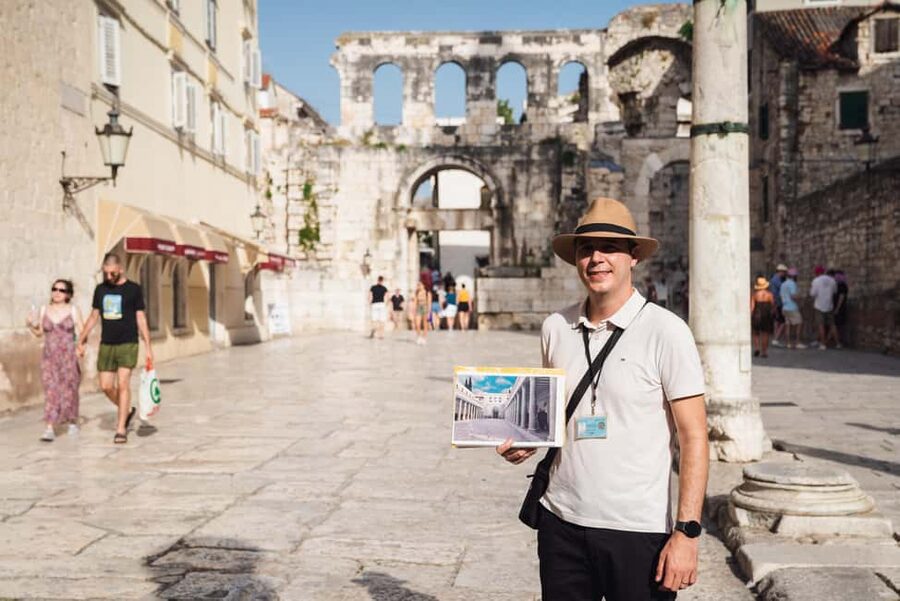
The most useful thing about this Split walk is that it treats Diocletian’s Palace as a living city, not a single Roman monument. Historian and former teacher Toni Šare leads you from the Riva through the Bronze Gate, palace cellars, Peristyle, medieval streets, and the Golden Gate, showing how each era built on the last.
I like the 3D reconstructions, which help you picture the palace before centuries of change, and I like the open question-and-answer style. Toni’s lifelong connection to Split adds local texture, while his teaching background keeps the story clear. The main consideration is that $33 costs more than some basic old-town walks, and the tour does not include entry to paid sites or museums.
In This Review
- Key points to know before you book
- Why Diocletian’s Palace makes the right starting point
- Entering through the Bronze Gate and palace cellars
- Reading the palace at Peristyle Square
- Vestibul, Triklinij, and the emperor’s private world
- Cathedral of Saint Domnius and Jupiter’s Temple
- Silver Gate, North Wall, and the route toward the Golden Gate
- How the 3D images change the experience
- Toni’s teaching style and local point of view
- Is $33 a fair price for 110 minutes?
- Timing, comfort, and who should book
- Should you book Toni’s Split history walk?
- FAQ
- Where does the walking tour begin?
- Where does the tour finish?
- How long does the tour last?
- What language is the tour conducted in?
- Who guides the tour?
- Does the tour enter Diocletian’s Palace?
- Are museum and paid-site tickets included?
- Are food and drinks included?
- Does the tour run in bad weather?
- Is the tour wheelchair accessible?
Key points to know before you book
- A historian leads the walk: Toni Šare has a Master’s degree in history and previously worked as a teacher.
- The palace is treated as a city: You follow its Roman design, medieval houses, Venetian traces, and present-day life.
- The past is shown, not only described: Toni uses printed 3D reconstructions of important structures.
- Questions are part of the format: The walk is built around dialogue rather than a fixed speech.
- The route lasts 110 minutes: It covers the Riva, Bronze Gate, palace interior, Peristyle, Vestibul, cathedral area, gates, and Piazza Square.
- Early starts are wise: Split’s old core can become much busier as the morning or day goes on, and shade is limited in some areas.
Why Diocletian’s Palace makes the right starting point
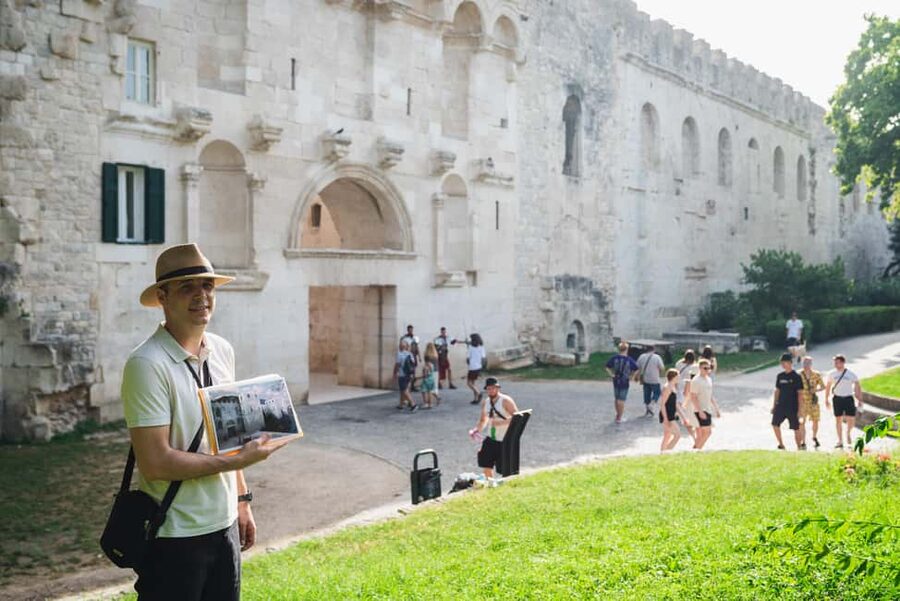
Split’s Old Town is unusual because the Roman palace is not preserved as an isolated ruin outside the city. It became the city. Homes, shops, lanes, restaurants, churches, and public squares occupy the old imperial complex, so you are walking through a place where ancient walls still serve everyday purposes.
That is the central idea Toni brings out. You do not simply hear about Emperor Diocletian and then look at a few stones. You see how a Roman residence changed function over many centuries, how new buildings fitted into old ones, and how Split developed around the palace rather than leaving it behind.
The tour begins at the Riva, Split’s seafront promenade, at the southern Bronze Gate. This is a practical meeting point because the promenade is easy to find. Search for Obala Hrvatskog narodnog preporoda 22 if you are using a map, then look for the entrance from the waterfront into the palace.
The opening location also gives you a useful orientation. You can see the relationship between the sea and the palace before entering, a detail that matters because the southern side was designed with direct access to the waterfront.
More old town history walks in Split:
- Split: Old Town and Diocletian Palace Walking Tour
★ 4.9 · 4,727 reviews - Walking Tour of Split with a ‘Magister’ of History
★ 5.0 · 1,122 reviews - Split Walking Tour with Professor of History
★ 5.0 · 926 reviews
Entering through the Bronze Gate and palace cellars
The Bronze Gate, also called the Brass Gate, leads into the palace from the sea. Toni gives a short introduction here before taking you into the basement halls, often called Diocletian’s Cellars.
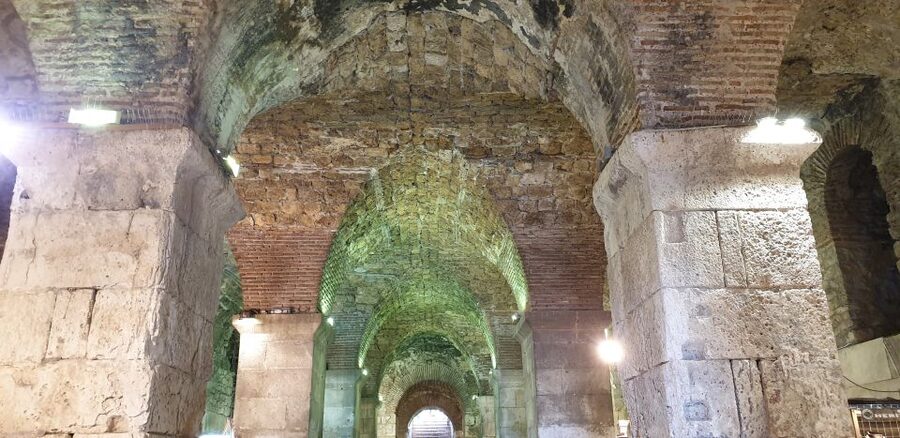
The cellars are one of the best places to understand the palace plan. They preserve the shape of the rooms above and help explain how the emperor’s private residence was organized. The route only pauses here briefly, so do not expect a long museum visit or an extended exploration of every underground passage.
That limitation is also part of the value. The cellars are used as a visual and structural key for the rest of the walk. Once you understand what was built below, the rooms and squares above make more sense.
No admission is needed to enter Diocletian’s Palace itself. However, the tour does not include paid entrances to museums or other sites. That keeps the $33 price focused on Toni’s guiding, interpretation, and visual material rather than bundled tickets.
Reading the palace at Peristyle Square
The main stop is Diocletian’s Palace, with about an hour devoted to walking and guided explanation. The route reaches Peristyle, the palace’s best-known square, where several major features come together.
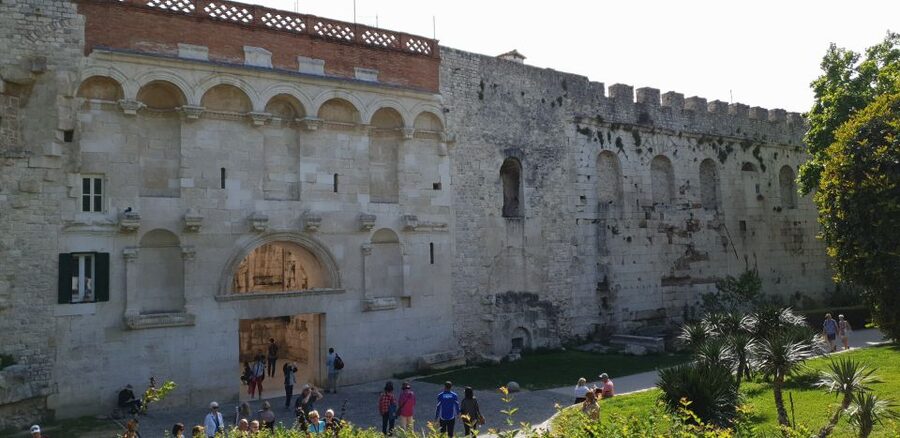
Here you can see the Mausoleum of Diocletian, now connected with the Cathedral of Saint Domnius, as well as the Temple of Jupiter and the Vestibul. The square is visually striking, but its importance is easier to grasp with an explanation of how the different parts related to the imperial complex.
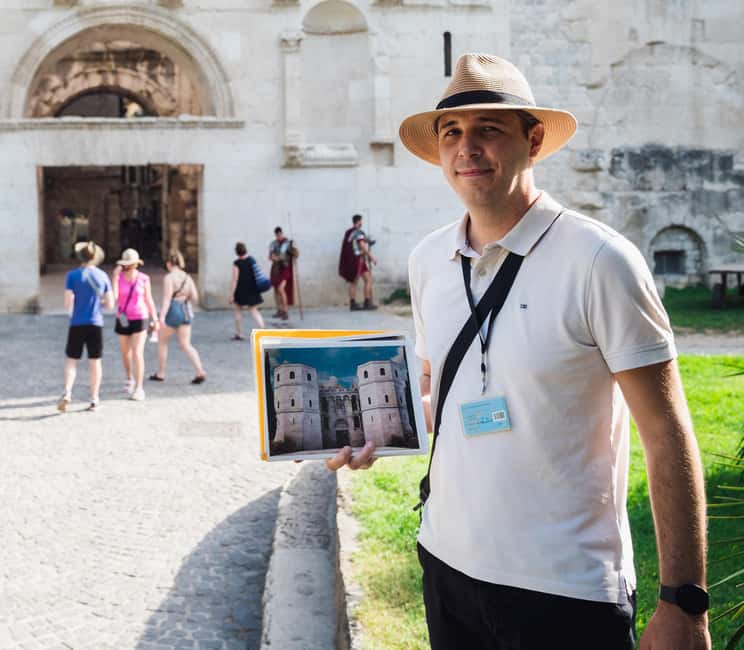
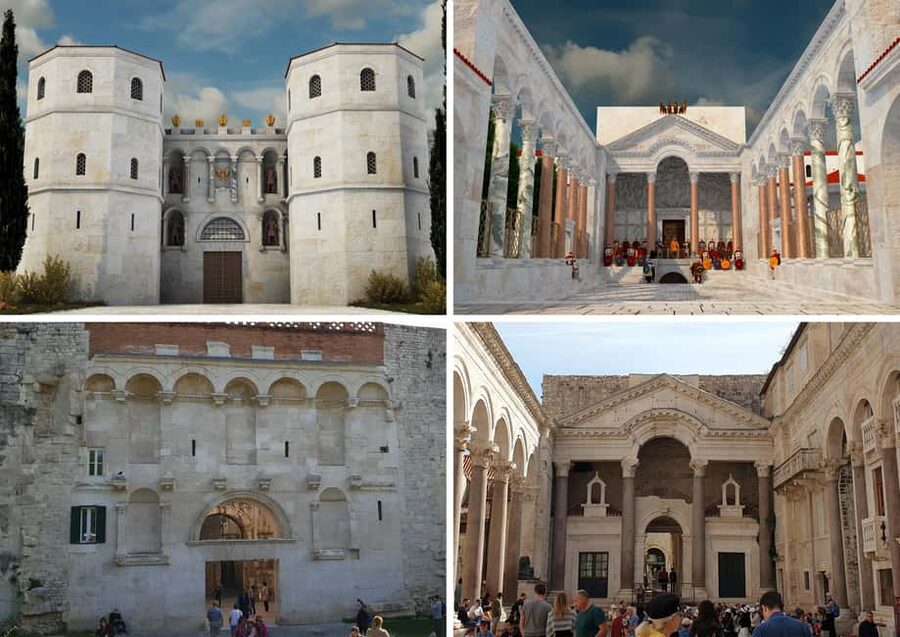
Toni’s approach is especially useful for visitors who look at Roman remains and struggle to picture the original setting. His 3D reconstructions show how important structures may have appeared in Roman times. These printed images give you something to compare with the surviving columns, walls, and openings in front of you.
The images are not just decoration. They help you understand what has disappeared, what has survived, and how later construction altered the palace. One of the best reasons to choose this walk over a simple orientation tour is that you receive both the physical view and a visual suggestion of the earlier form.
The square can be crowded, particularly later in the day. Toni has been praised for trying to use quieter areas and shade when possible, but the old center remains a busy public place. If you want the clearest views and a calmer start, choose the earliest available time.
Vestibul, Triklinij, and the emperor’s private world
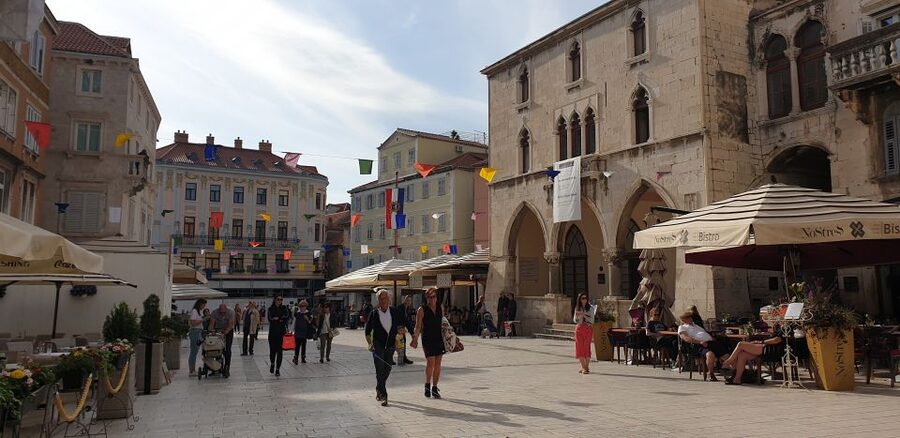
The Vestibul receives a short guided stop. Its rounded form and formal position help show the difference between public ceremonial spaces and the more private sections of the palace.
From there, the walk continues toward Triklinij, another brief stop tied to the emperor’s residential area. The tour does not attempt to turn every room into a separate lecture. Instead, Toni uses these places to explain how the palace functioned as a residence, administrative setting, and symbol of imperial power.
This is where his teaching experience matters. The palace can become a jumble of names, dates, and architectural terms. A good guide has to decide what is worth remembering and connect each detail to the space around you. Toni’s style, based on the available descriptions of his tours, is to focus on clear stories and invite questions rather than recite a script.
You should also expect a broad time span. The main emphasis is Roman Split, but the story moves through the Middle Ages, Venetian rule, and modern Croatian history. If you are curious about more recent events, local customs, or the way past events still affect Split, ask. The tour is designed to allow that exchange.
More walking tours in Split:
- Walking Tour of Split and Diocletian’s Palace
★ 5.0 · 2,588 reviews - Krka Waterfalls tour with Trogir Walking tour and Krka panoramic boat cruise
★ 5.0 · 1,659 reviews - Split & Diocletian’s Palace Walking Tour
★ 5.0 · 1,125 reviews - Split: Diocletian Palace & Old Town Guided Walking Tour
★ 4.7 · 882 reviews
Cathedral of Saint Domnius and Jupiter’s Temple
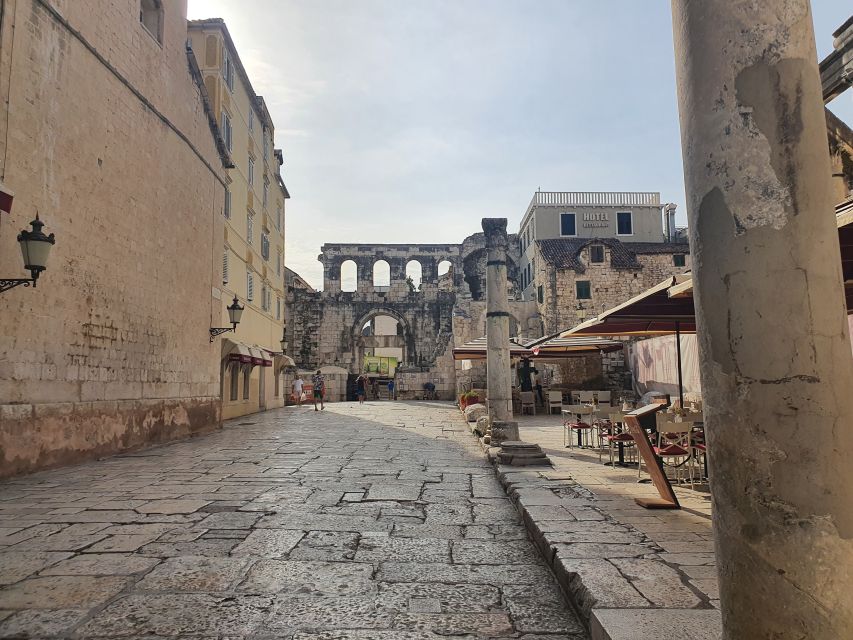
The cathedral is passed rather than entered. That distinction matters if you are hoping for an interior visit. You will receive context from outside, but admission to paid sites is not part of the experience.
The same applies to Jupiter’s Temple. You see the site as part of the palace walk and learn how it fitted into the Roman complex, but the tour does not include a separate paid entry. This is a good arrangement for visitors who want a strong first orientation and plan to return later to visit interiors at their own pace.
The cathedral area also illustrates one of Split’s defining features: older Roman buildings were reused and adapted rather than cleared away. The result is not a perfectly preserved ancient site. It is a layered urban center, with different periods visible in the same few steps.
I would treat this tour as a foundation for further exploring Split. After Toni explains the layout, you can return to the cathedral, temple, cellars, or museums with a better sense of what you are looking at. The walk is not meant to replace every paid attraction.
Silver Gate, North Wall, and the route toward the Golden Gate
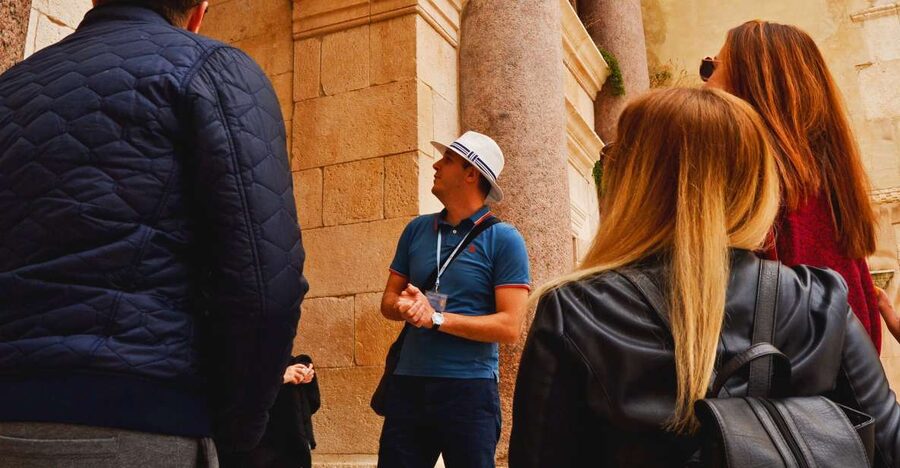
The route continues to the Silver Gate, where Toni gives a short guided explanation. Then it moves toward the Golden Gate, the northern entrance and the final stop.
On the way, you can see the statue of Bishop Gregory of Nin beside the palace’s north wall. The statue is one of Split’s most recognizable public landmarks, and its location creates a natural bridge from the Roman palace to the city’s medieval and later identity.
The Golden Gate is a sensible ending point. It opens the way toward Piazza Square and the northern side of the old center, giving you a different feel from the waterfront starting point. You finish with a clearer sense of the palace’s scale and its position within modern Split.
The route is not a long-distance hike, but it is still a walking tour through uneven historic streets and crowded public areas. You should wear comfortable shoes, bring a drink, and be ready to walk in changing weather. The tour runs rain or shine.
How the 3D images change the experience
Ancient ruins often ask you to do too much mental work. You see fragments, but the original building is gone. Toni’s reconstructions reduce that problem by giving you a visual reference for the palace’s Roman appearance.
This is especially helpful at Peristyle and around the residential sections. Instead of hearing only that the palace was grand, you can compare the reconstruction with the remains and see how the structure may have looked as a whole.
The images also support honest interpretation. Historic reconstructions are models, not time machines, and one useful feature of Toni’s approach is the attention to what is known and what remains uncertain. That keeps the presentation from becoming a polished but misleading story.
For children and teenagers, the images may be the feature that holds attention when a long explanation might not. A 12-year-old was specifically described as enjoying the experience, and families who want history presented visually should consider this tour.
Toni’s teaching style and local point of view

Toni is a Split local who was born and has lived his entire life in the city. He also has a Master’s degree in history and a background as a teacher. That combination gives the tour two useful qualities: academic grounding and familiarity with the place as a real home.
His strongest asset appears to be explanation. You are not only given dates and building names. The tour connects Roman, medieval, Venetian, Croatian, and modern periods, then shows how those changes remain visible in the streets.
The question-friendly format is important. You can ask about the palace, Croatia, later historical events, local sayings, or the development of the city. Toni has been described as funny, patient, easy to hear, and willing to involve the entire group.
That does not mean every minute is informal. The tour covers a lot in 110 minutes, and the material is substantial. If you prefer a quiet walk with little commentary, this will feel talkative. If you want to understand what you are seeing, the steady explanation is the point.
Is $33 a fair price for 110 minutes?
At $33 per person, this is not the cheapest way to walk around Split. You can enter the public streets and see many palace exteriors without paying for a guide.
The value comes from the interpretation. You are paying for a historian who can place the buildings in several periods, answer questions, and use custom 3D images to make the Roman layout easier to understand. If you were already planning to explore the palace on your own, the tour can save you from missing the connections between its parts.
The price also makes more sense for a first visit than for someone who has already studied Diocletian’s Palace in detail. Several people with prior familiarity still found that Toni added useful context, but repeat visitors should decide how much new interpretation they want.
The tour does not include food, drinks, museum tickets, or paid interior visits. Bring your own water, and budget separately if you want to return to chargeable sites afterward.
Timing, comfort, and who should book
The first time slot is the best practical choice if your schedule allows it. The old center can become more crowded as the day progresses, and an early start gives you a better chance of hearing clearly and finding shade.
This is a rain-or-shine activity, so check the forecast and dress for walking rather than sightseeing from a bus. The meeting point is near the Riva, and the finish is at the Golden Gate, so you should not expect to return to the starting point automatically.
I would recommend the tour to:
- First-time visitors who want a clear introduction to Split
- People interested in Roman, medieval, Venetian, and modern history
- Families with older children or teenagers who respond well to visual material
- Visitors who enjoy asking questions rather than listening to a fixed speech
- Anyone who wants local context before exploring the palace alone
It is not suitable for wheelchair users according to the activity information, and it is not intended for people over 95. The route through an old urban center may also be tiring for anyone uncomfortable with extended walking or hot weather.
Should you book Toni’s Split history walk?
Book it if you want more than a quick look at Roman walls. The strongest reasons are Toni’s teaching background, his local connection, the open discussion, and the 3D reconstructions that give shape to ruins and altered buildings.
Skip it if you want paid interiors included, prefer to explore silently, or are comparing tours only by price. For most first-time visitors, though, the $33 fee is reasonable because it gives you a working map of Split’s past and present in less than two hours.
Choose an early start, bring water, and keep time afterward to revisit the places that catch your interest. This is the kind of walk that makes independent sightseeing easier, because you leave knowing not just what you saw, but why it matters.
FAQ
Where does the walking tour begin?
It begins at the Bronze Gate, also called the Brass Gate, on the southern seaside entrance to Diocletian’s Palace. The address is Obala Hrvatskog narodnog preporoda 22, near the Riva Promenade.
Where does the tour finish?
The walk finishes at the Golden Gate of Diocletian’s Palace.
How long does the tour last?
The tour lasts 110 minutes.
What language is the tour conducted in?
The live tour is conducted in English.
Who guides the tour?
The guide is Toni Šare, a Split local with a Master’s degree in history and experience as a teacher.
Does the tour enter Diocletian’s Palace?
Yes. The route goes through the Bronze Gate and includes parts of the palace, its cellars, Peristyle, Vestibul, Triklinij, and other areas. Entering the palace itself does not require admission.
Are museum and paid-site tickets included?
No. The tour does not include entry to paid sites or museums.
Are food and drinks included?
No. Food and drinks are not included. You should bring your own drink.
Does the tour run in bad weather?
Yes. The tour takes place rain or shine.
Is the tour wheelchair accessible?
No. The activity is not suitable for wheelchair users.
Just added around Split
- Kayaking & Zipline Šibenik – Čikola Canyon★ 5.0 · 3 reviews
- Krka National Park & Zipline Šibenik – Čikola Canyon★ 5.0 · 3 reviews
- From Split: Krka National Park & Waterfalls Private Day Trip★ 5.0 · 3 reviews
- Split: Small-Group Half Day Sailing Trip★ 5.0 · 3 reviews
- Rafting River Cetina from Makarska Riviera including transfer★ 5.0 · 3 reviews
- Split Bike and Wine Experience★ 5.0 · 3 reviews
- Split and Salona Cultural Heritage Day Tour from Trogir★ 4.0 · 3 reviews
- Private transfer from Split to Dubrovnik with 2h sightseeing stop in Ston★ 5.0 · 3 reviews
Old Town & History Tours, compared.


Walking Tour of Split with a ‘Magister’ of History
Read our review →

Diocletian Palace & Old Town Guided Walking Tour
Read our review →

Diocletian’s Palace and Old Town SMALL GROUP Walking Tour
Read our review →

Split History and Gastro Small-Group Tour with Food and Drinks
Read our review →Browse the lists this tour appears in