
Reviewed · OLD TOWN & HISTORY TOURS
Split Walking Tour: History, Legends & Tales
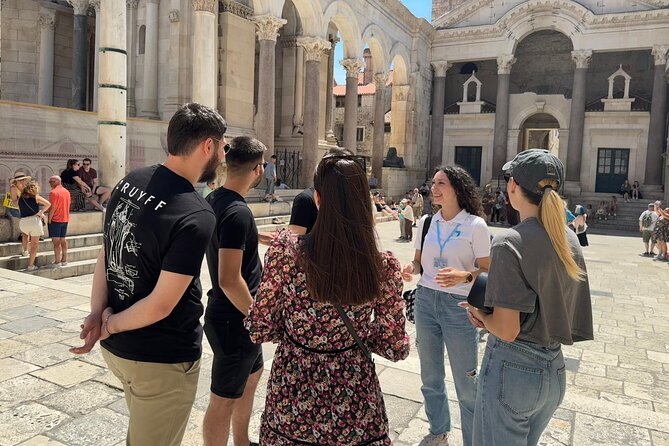
Diocletian’s Palace is not a fenced-off ruin. It is the working heart of Split, with homes, cafés, shops, and narrow lanes tucked inside Roman walls. This 90-minute walk gives you a clear route through that living monument, from Riva Harbor to the Palace’s ancient center and back again.
I like the small maximum of 12 people, which leaves room for questions, and I like the guide Lucija’s mix of Roman history, local legends, and practical advice. Her tips on restaurants, pasticada, bars, gelato, and other things to do can help you plan the rest of your stay. The main limitation is that no museum or paid site entry is included, so this is a guided orientation walk rather than a ticketed palace tour.
In This Review
- Key points to know before booking
- Why this is a smart first look at Split
- Riva Harbor sets the scene
- The Palace Substructures reveal Roman engineering
- The Vestibule connects private life with ceremony
- Peristyle brings Roman and Egyptian symbols together
- Golden Gate and Gregory of Nin add a little luck
- People’s Square shows Split growing beyond the Palace
- Fruit Square layers Venetian and Dalmatian design
- Back to Riva, with a better map of the city
- What the $30.17 price really buys
- Who will get the most from this Split walk
- Should you book Split Walking Tour: History, Legends & Tales?
- FAQ
- How long does the Split walking tour last?
- What language is the tour offered in?
- Where does the tour begin?
- Where does the tour end?
- Are admission tickets included?
- What is the maximum group size?
Key points to know before booking
- A compact route through Split’s Roman core: Riva, Diocletian’s Palace, Peristyle, Golden Gate, People’s Square, and Fruit Square all fit into one walk.
- Lucija brings local context: Expect stories about Split, Diocletian, city customs, food, and modern life, not only dates and architectural terms.
- The underground substructures add depth: You’ll pass through the Palace’s cellar level and hear how its Roman engineering supported the imperial residence above.
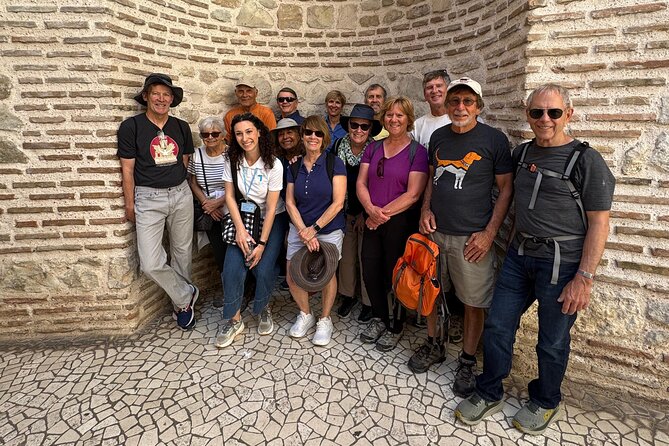
- The group is capped at 12 people: That is a more personal setup than a large city tour, with a better chance to hear and ask questions.
- The walk costs $30.17 per person: The price pays for a licensed guide and a useful first look at Split, but not museum or other paid-site admission.
- An early start can help: One morning group found the cooler, quieter conditions especially useful for walking and listening.
Why this is a smart first look at Split
I would put this tour near the beginning of a Split visit. The old center can feel confusing at first because Roman walls, medieval homes, Venetian towers, cafés, and modern shops all share the same few streets. A guide gives those layers an order.
The route also avoids the common mistake of treating Diocletian’s Palace as one isolated building. The Palace forms much of Split’s old town, and the walk shows how the imperial complex expanded into a city. You begin beside the sea, move through the southern portion of the Palace, reach its ceremonial heart, then continue outside the western walls into later urban squares.
At $30.17, this is not the cheapest way to simply wander around. You can see many of these places without paying an admission fee. The value comes from having the route explained as you go, with a local guide pointing out details you could easily miss and helping you understand what to do next.
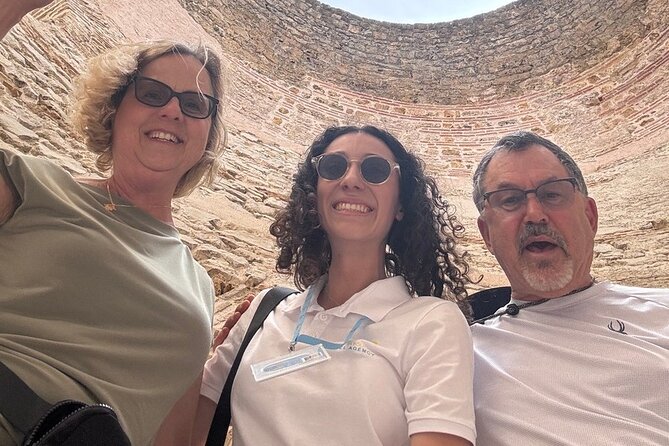
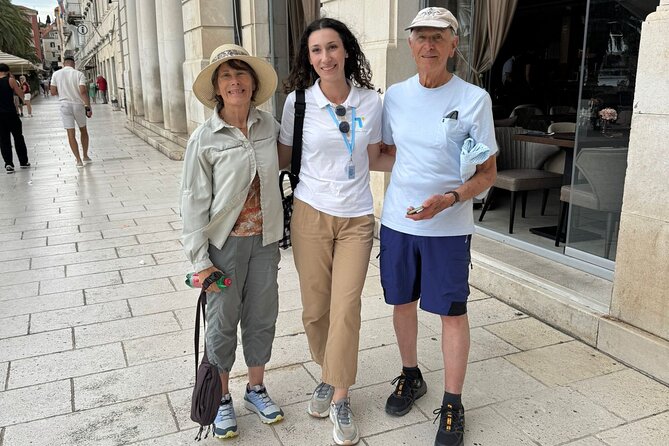
Lucija is the guide most closely associated with this experience. She is described as personable, patient, and lively, with a knack for answering questions without making the walk feel like a lecture. She also adapts well to families, including children, and has led very small departures when bookings are light.
More old town history walks in Split:
- Split: Old Town and Diocletian Palace Walking Tour
★ 4.9 · 4,727 reviews - Walking Tour of Split with a ‘Magister’ of History
★ 5.0 · 1,122 reviews - Split Walking Tour with Professor of History
★ 5.0 · 926 reviews
Riva Harbor sets the scene
The meeting point is at Obala Hrvatskog narodnog preporoda 22, along Riva Harbor, Split’s main waterfront promenade. This is a practical place to begin because the sea, the Palace walls, and the modern city are all visible at once.
The opening section lasts about 15 minutes. You’ll look at a model of Split and get an introduction to Emperor Diocletian, his Palace, and the city’s broad story. That model matters. It gives you a basic map before you enter the narrow lanes, where it is easy to lose your sense of direction.
Riva is also a useful place to get oriented if you arrive by cruise ship or public transport. The meeting point is near public transportation, and the route returns here at the end. If you are arriving from a ship, allow time to walk to the waterfront meeting point and identify the exact address before the start.
The guide’s opening explanation helps answer a key question: why is an emperor’s retirement palace now the center of a Croatian city? You will begin to see the Palace not as a single preserved monument, but as the framework around which Split grew.
The Palace Substructures reveal Roman engineering
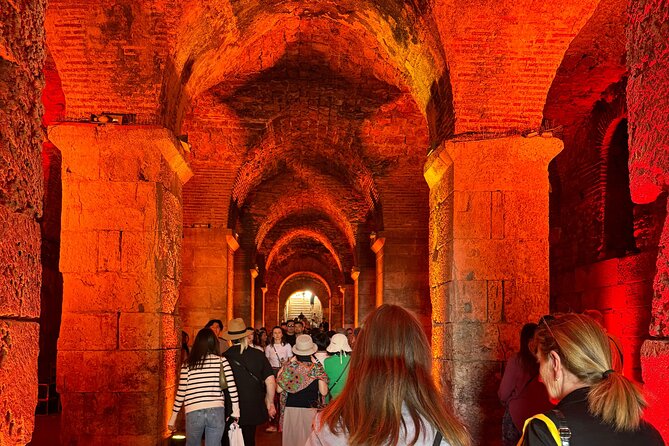
From Riva, the walk moves into the Diocletian Palace Substructures. This section lasts about 10 minutes and introduces a maze of underground corridors and rooms beneath the former imperial residence.
The substructures are valuable because they show the practical side of Roman construction. They supported the rooms above and reveal the planning needed to build a large palace on the shore. Instead of looking only at grand columns and ceremonial spaces, you get a sense of foundations, storage areas, passageways, and structural design.
The underground setting changes the pace of the walk. It is darker and more enclosed than Riva, and the route may feel more atmospheric than the open squares. You can picture the palace as a functioning complex rather than a collection of photogenic ruins.
There is an important booking detail here. No admission tickets are included, and the activity does not enter museums or paid sites. The route description includes passing through the substructures, but you should not expect a separate ticketed museum visit as part of the price. If entering a paid section is essential to you, confirm the current route before booking.
The Vestibule connects private life with ceremony
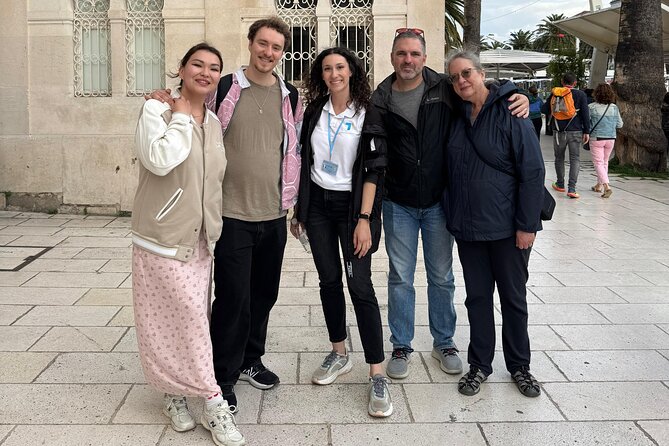
The next 10-minute section leads through the southern parts of the Palace, where Diocletian’s apartments, a dining hall called the Triclinium, and gardens once occupied the imperial quarter. The destination is the Vestibule, the grand entrance hall of the Palace.
This stop helps you understand the divide between public ceremony and private imperial life. Diocletian did not build a simple seaside home. He created a residence with formal entrances, grand gathering areas, gardens, and spaces designed to control movement and status.
The southern part of the Palace is also a good reminder that much of what you see today is incomplete. The original apartments and gardens have changed over time, and modern Split now fills the spaces. A good guide is useful here because the bare walls alone cannot show how the rooms once connected.
I like this part of the route because it gives the Palace human scale. You are not only hearing about an emperor and his building program. You are considering how meals, gardens, private rooms, and formal arrivals worked together inside a place designed for power.
More walking tours in Split:
- Walking Tour of Split and Diocletian’s Palace
★ 5.0 · 2,588 reviews - Krka Waterfalls tour with Trogir Walking tour and Krka panoramic boat cruise
★ 5.0 · 1,659 reviews - Split & Diocletian’s Palace Walking Tour
★ 5.0 · 1,125 reviews - Split: Diocletian Palace & Old Town Guided Walking Tour
★ 4.7 · 882 reviews
Peristyle brings Roman and Egyptian symbols together
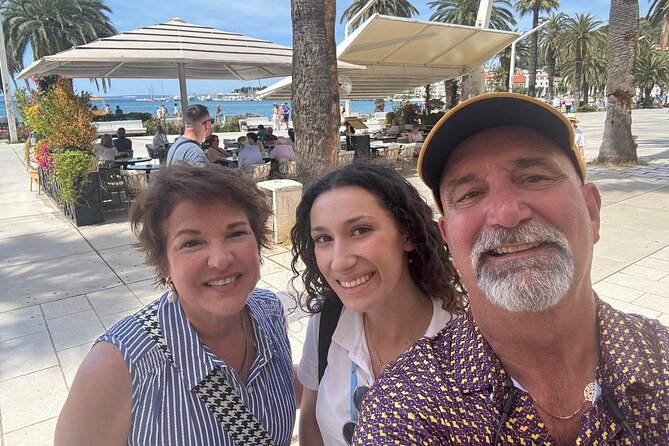
The Peristyle receives about 20 minutes, making it the longest stop. That is appropriate. This is the central ceremonial square and one of the most memorable spaces in Split.
The square brings together Roman architecture, later Christian use, medieval changes, and Egyptian imagery. Its most famous ancient detail is the sphinx, said here to be about 3,500 years old and remarkably preserved. The sphinx links Diocletian’s palace to Egypt, a reminder that Roman emperors borrowed symbols from across the ancient world to express authority.
The Peristyle is where the tour’s title, history, legends, and tales, makes the most sense. There is formal architecture to read, but also a long sequence of human uses. You might notice how modern life occupies an ancient setting, with people moving through the same space for daily errands, meetings, and sightseeing.
This is also a place where a guide earns the fee. Without context, you may see steps, columns, stone, and a sphinx. With Lucija’s explanation, those pieces become part of a larger story about imperial power, religion, city life, and the survival of old buildings inside a modern town.
The square can be busy, so stay close enough to hear. The small group limit helps, but an early morning departure may still be the best choice if you prefer cooler temperatures and fewer people around.
Golden Gate and Gregory of Nin add a little luck
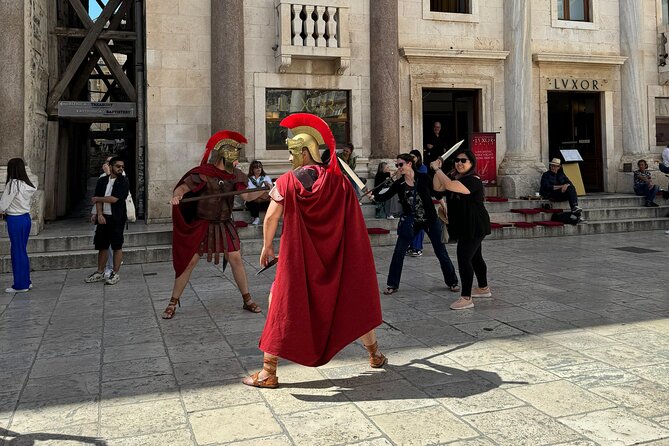
The walk then heads to the Golden Gate, one of the grand entrances into Diocletian’s Palace. The gate shows how carefully the Palace controlled access and how impressive it must have looked to people arriving in the imperial period.
From here, you continue to the statue of Gregory of Nin. The local custom is simple: rub the statue’s large toe and make a wish. It is a light moment after the heavier Roman material, and it gives you a small tradition to take part in rather than only another fact to remember.
This stop also helps you see how Split’s identity moved beyond Diocletian. The Palace may dominate the old center, but later Croatian religious and cultural figures also belong to the city’s story. The route does not treat the Roman period as the only era worth seeing.
Take a moment for a photograph if the group allows, but listen for the explanation before moving on. The value of the stop is not only the statue’s polished toe. It is the way a modern custom sits beside ancient walls.
People’s Square shows Split growing beyond the Palace
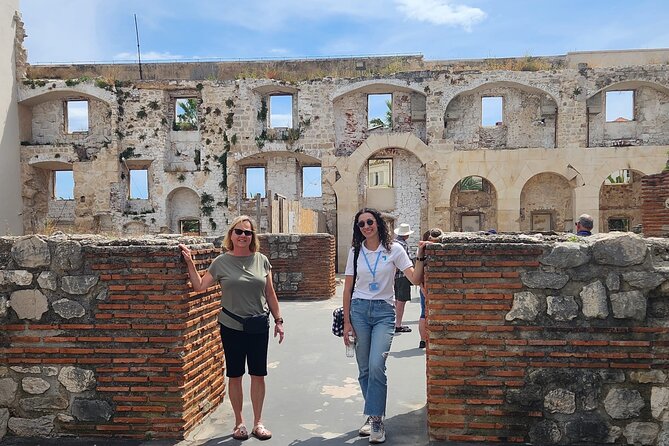
Just outside the western wall is Narodni Trg, commonly called Pjaca or People’s Square. The walk spends about 10 minutes here.
This square marks an important change in the city. As Split’s population grew, the Palace could no longer contain daily urban life. Pjaca became the first area developed beyond the walls in the 14th century, showing how a private imperial complex gradually became the core of a larger town.
The former 15th-century city hall is one of the key buildings here. The square has served as a gathering place for centuries and still works as a social center, with cafés and a pleasant setting for a stroll after dark.
I find this stop especially useful for understanding urban growth. The Palace is not frozen in Roman time. Its walls shaped later streets, and the square outside them shows what happened when the city needed more room.
Fruit Square layers Venetian and Dalmatian design
The final major stop is Fruit Square, officially Trg Braće Radić. It is a smaller square, but it brings several later periods into view.
The octagonal Venetian tower is the most obvious landmark. It is the remaining part of a 15th-century fortress built when this was still a small town. Across from it is the former Milesi family palace, with a striking 17th-century Baroque façade described as one of the finest examples of that style in Dalmatia.
This is a good contrast with the Peristyle. There, the eye goes to ancient columns and the Egyptian sphinx. Here, Venetian defense and Dalmatian Baroque design take over. Bars, restaurants, shops, and occasional fairs show how these historic spaces still serve everyday purposes.
The stop is short, about 10 minutes, but it rounds out the tour. You get more than a Roman sightseeing route. You see how Split continued to change under different rulers and families, while keeping its old streets in use.
Back to Riva, with a better map of the city
The walk returns to Riva Harbor, where it began. The total duration is about an hour and a half, and the circular route makes practical sense. You finish where you can continue along the waterfront, find lunch, return to a ship, or use the promenade as a base for further exploring.
That final location is another reason to book this near the start of your stay. Lucija’s suggestions can shape the rest of your plans. Specific recommendations from the experience include local restaurants, pasticada, bars, gelato places, and other excursions. Pasticada, a traditional Dalmatian meat dish, is one useful food lead if you want to try something tied to the region.
The guide has also given advice about what to do after the walk, not only where to take a picture next. That can save you from eating at the first convenient place near the Palace.
What the $30.17 price really buys
The $30.17 cost covers a licensed English-speaking guide. It does not cover entrance tickets, and no museums or paid sites are part of the experience.
That makes the price fair if you want structure, local explanations, and a chance to ask questions. It is less attractive if you prefer to walk independently or plan to pay for several sights separately and want one tour to include admission.
The group cap of 12 is important. A small group can stop in narrow lanes without taking over the street, and you have a better chance of hearing the guide near the Peristyle or Golden Gate. The group may be smaller still, and some departures have worked almost like private walks when only two people booked.
The tour is offered in English only. Most people can participate, and service animals are allowed. Since it is a walking tour through old streets and underground areas, wear comfortable shoes and be ready to remain with the group, though the provided information does not specify a full accessibility assessment.
Free cancellation is available up to 24 hours before the local start time for a full refund. The activity requires good weather, so a cancellation caused by poor conditions brings the choice of another date or a full refund.
Who will get the most from this Split walk
I recommend it most for first-time visitors who want a clear introduction before exploring alone. It suits couples, families, cruise passengers, and anyone who likes history explained in plain language rather than delivered as a long academic talk.
Families may appreciate Lucija’s patient approach and her ability to respond to children. The 90-minute length is also manageable if you want a useful overview without giving up half a day.
It is a good match for food-minded visitors too. Restaurant, bar, gelato, and local dish suggestions add value after the formal route ends. If you are staying longer, the guide’s advice can help you use Split as a base for more outings.
You may want something else if your main goal is a long visit inside museums or paid monuments. This experience is about orientation, stories, public spaces, and seeing how the Palace fits into modern Split. It is not a ticket package.
Should you book Split Walking Tour: History, Legends & Tales?
Book it if you want to understand Split quickly, keep the group small, and hear both ancient stories and modern local advice. The route covers the city’s essential core, Lucija receives repeated praise for her warmth and clear explanations, and the return to Riva makes the walk easy to fit into a first day.
Choose a morning departure if you can. The cooler air and calmer streets can make the Peristyle, narrow lanes, and outdoor stops easier to enjoy.
Skip it if you are happy to explore without guidance or need included admission to museums and paid monuments. For most first-time visitors, though, $30.17 is a sensible price for a focused start to Split, especially when you want the old town to make sense before you wander off on your own.
FAQ
How long does the Split walking tour last?
The tour lasts approximately 1 hour and 30 minutes.
What language is the tour offered in?
The tour is offered in English.
Where does the tour begin?
The meeting point is Obala Hrvatskog narodnog preporoda 22, 21000 Split, Croatia, at Riva Harbor.
Where does the tour end?
The activity ends back at the meeting point at Riva Harbor.
Are admission tickets included?
No. Admission tickets are not included, and the activity does not enter museums or paid sites.
What is the maximum group size?
The tour has a maximum of 12 participants.
Just added around Split
- Kayaking & Zipline Šibenik – Čikola Canyon★ 5.0 · 3 reviews
- Krka National Park & Zipline Šibenik – Čikola Canyon★ 5.0 · 3 reviews
- From Split: Krka National Park & Waterfalls Private Day Trip★ 5.0 · 3 reviews
- Split: Small-Group Half Day Sailing Trip★ 5.0 · 3 reviews
- Rafting River Cetina from Makarska Riviera including transfer★ 5.0 · 3 reviews
- Split Bike and Wine Experience★ 5.0 · 3 reviews
- Split and Salona Cultural Heritage Day Tour from Trogir★ 4.0 · 3 reviews
- Private transfer from Split to Dubrovnik with 2h sightseeing stop in Ston★ 5.0 · 3 reviews
Old Town & History Tours, compared.


Walking Tour of Split with a ‘Magister’ of History
Read our review →

Diocletian Palace & Old Town Guided Walking Tour
Read our review →

Diocletian’s Palace and Old Town SMALL GROUP Walking Tour
Read our review →

Split History and Gastro Small-Group Tour with Food and Drinks
Read our review →Browse the lists this tour appears in