
Reviewed · OLD TOWN & HISTORY TOURS
Split: Private Walking Tour in the Historical Town Center
Split’s old town is not a museum behind ropes. It is a living neighborhood built inside a Roman emperor’s palace, with laundry, cafés, medieval homes, and ancient stone sharing the same narrow lanes. This private walking tour makes that odd and wonderful mix easier to read in just 105 minutes, beginning at the Riva and ending by the sea.
I like the private format, especially for a small family or group of friends. You can hear Sanja clearly, ask questions without holding up a large crowd, and shape the conversation around the places you care about. I also like the historical sweep, from Diocletian and Roman Split to Venetian, French, Austro-Hungarian, and Yugoslav rule. The main consideration is the extra fee for the Palace Substructures, and $153 is much better value for a group than for one or two people.
In This Review
- Key points to know before booking
- Why Diocletian’s Palace makes this walk different
- Inside the Palace: walls, gates, and Roman foundations
- Peristil and the Cathedral of Saint Domnius
- Jupiter’s Temple and the Golden Gate
- Medieval Split inside and outside the Palace
- Fruit Square and Prokurative: the city beyond the ruins
- Riva is both meeting point and ending point
- What $153 means for value
- Who should book this Split walking tour?
- My booking advice
- FAQ
- Where does the Split private walking tour begin?
- How long does the tour last?
- What languages are available?
- Is this a private tour?
- Is the entrance fee to the Palace Substructures included?
- Does the tour enter Jupiter’s Temple?
- Is the tour suitable for wheelchair users?
- Can I cancel the booking for a refund?
Key points to know before booking
- Roman palace at the center: Walk through Diocletian’s fourth-century residence, which forms the oldest core of Split.
- Sanja leads in four languages: Choose English, Italian, French, or Spanish with a licensed local guide who holds a master’s degree.
- A compact route with major sights: The 105-minute walk covers Peristil, the cathedral, Jupiter’s Temple, Golden Gate, People’s Square, Fruit Square, and Riva.
- Private groups up to 15: The flat $153 price can work well for families and groups traveling together.
- Basements cost extra: The Substructures are part of the experience, but their entrance fee is not included.
- Useful early-trip orientation: Book this near the start of your stay if you want historical context and practical ideas for exploring on your own.
Why Diocletian’s Palace makes this walk different
Most city tours move from one monument to the next. Split works differently. The Roman palace is the city center, and modern life runs through its former ceremonial spaces, corridors, and gates.
The palace was built for Emperor Diocletian in the fourth century. You will not simply look at an isolated ruin. You will walk through streets that developed inside its walls, where Roman stone meets medieval houses and later additions. That layering is the main reason a guide helps. Without context, the old town can feel like a handsome maze. With Sanja’s explanations, the maze becomes a sequence of political and architectural changes.
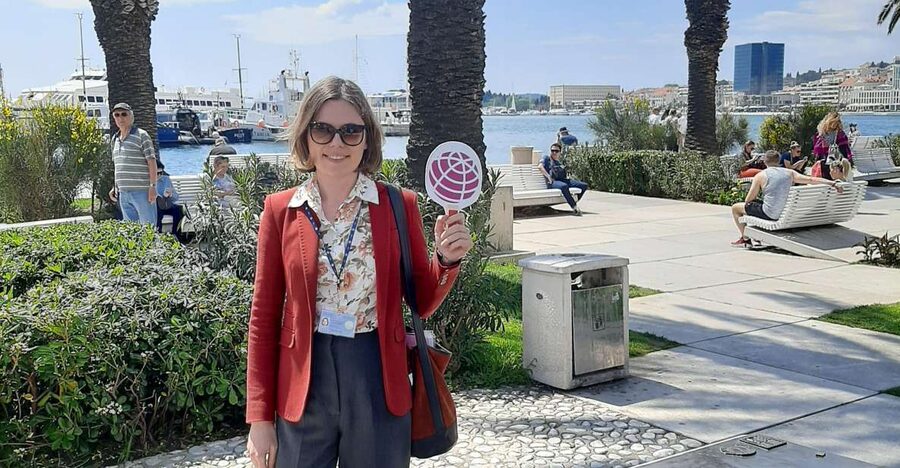
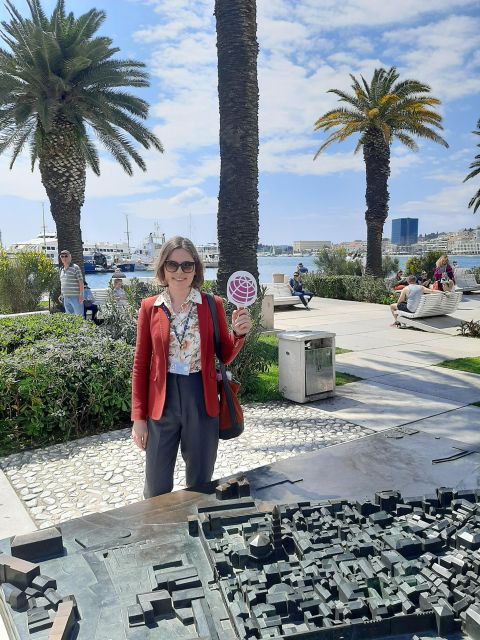
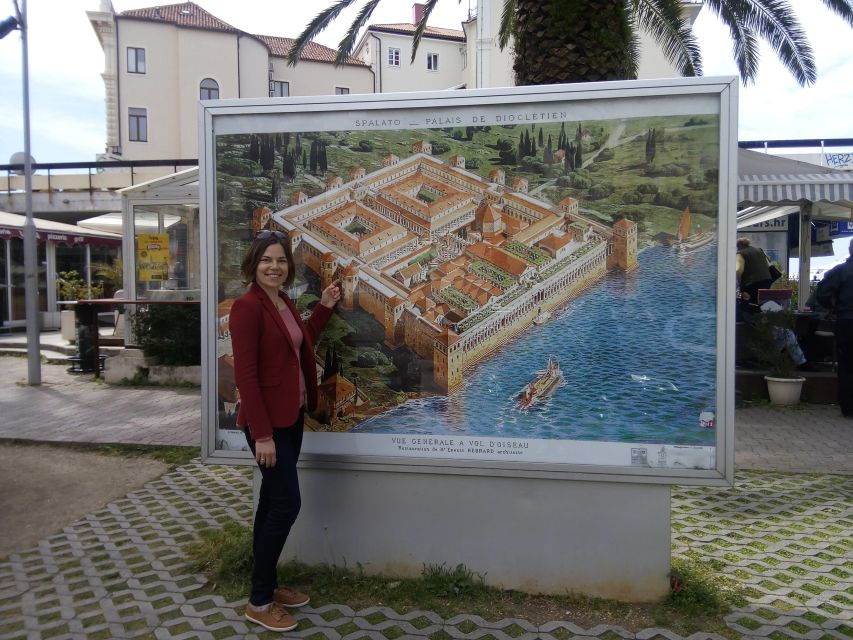
The tour starts beside the bronze model of Split’s historic core on the Riva promenade. This is a practical meeting point, directly in front of the south entrance to Diocletian’s Palace. You begin with a view of the whole old town before walking into its details, a sensible way to get your bearings.
The route takes about 1 hour and 45 minutes. That is long enough to cover the essential sights but short enough to fit into a busy day, especially if you are arriving by cruise ship or using Split as a base for nearby excursions. You will be walking on old streets and through compact squares, so comfortable shoes matter.
More old town history walks in Split:
- Split: Old Town and Diocletian Palace Walking Tour
★ 4.9 · 4,727 reviews - Walking Tour of Split with a ‘Magister’ of History
★ 5.0 · 1,122 reviews - Split Walking Tour with Professor of History
★ 5.0 · 926 reviews
Inside the Palace: walls, gates, and Roman foundations
The first major part of the walk focuses on Diocletian’s Palace, the oldest section of town. Sanja’s role here is not just to point out stones. She explains how a Roman imperial residence became a medieval urban quarter and how the buildings around you changed over time.
The Palace walls and four gates help you understand the original plan. Each gate connected the complex with a different direction, and walking through them gives the Roman layout a practical sense of scale. The Golden Gate receives its own stop later in the route, but the broader discussion of the walls helps connect it with the other entrances.
A useful feature of this tour is the chance to visit the Palace Substructures, often called the Basements. An entrance fee is required, so budget for that separately. These lower rooms help explain the shape of the Palace above, since parts of the upper plan follow the structure below.
The Substructures are also a good example of why Split needs interpretation. A basement can sound like a minor stop, but here it is tied directly to the design of the imperial residence and to the later growth of the city. If your time or budget is tight, you can ask about the cost before entering. If you want the clearest picture of the Palace’s original arrangement, it is the extra visit most worth considering.
Peristil and the Cathedral of Saint Domnius
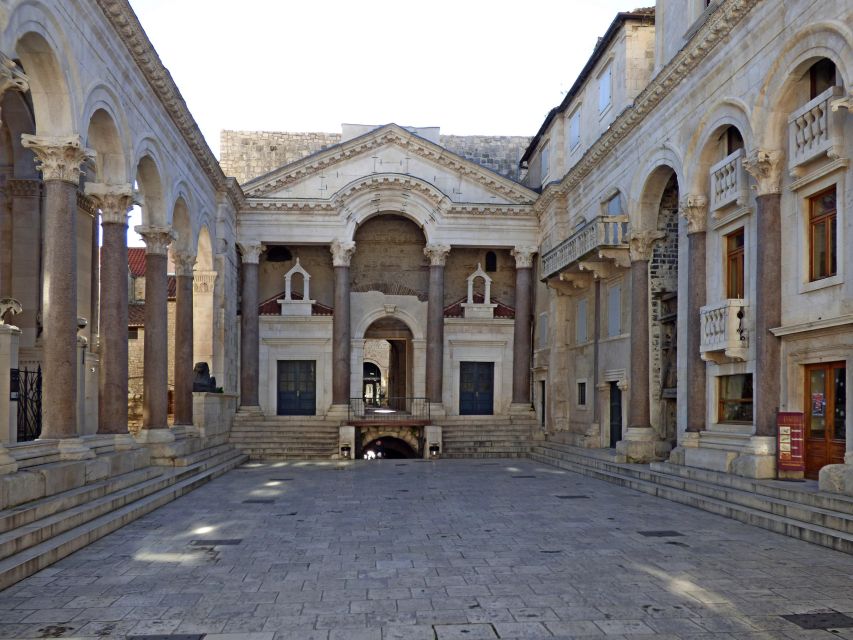
Peristil is the Palace’s main square and one of the most memorable spaces on the route. Its stone columns and formal proportions show the power the complex was meant to project. This is where the emperor’s residence feels most ceremonial rather than residential.
The square also shows how Split’s past remains part of daily life. You are not looking at a reconstruction separated from the town. The surrounding old buildings and active streets make the Roman setting easier to grasp, even if they also mean the square can feel crowded at busy times.
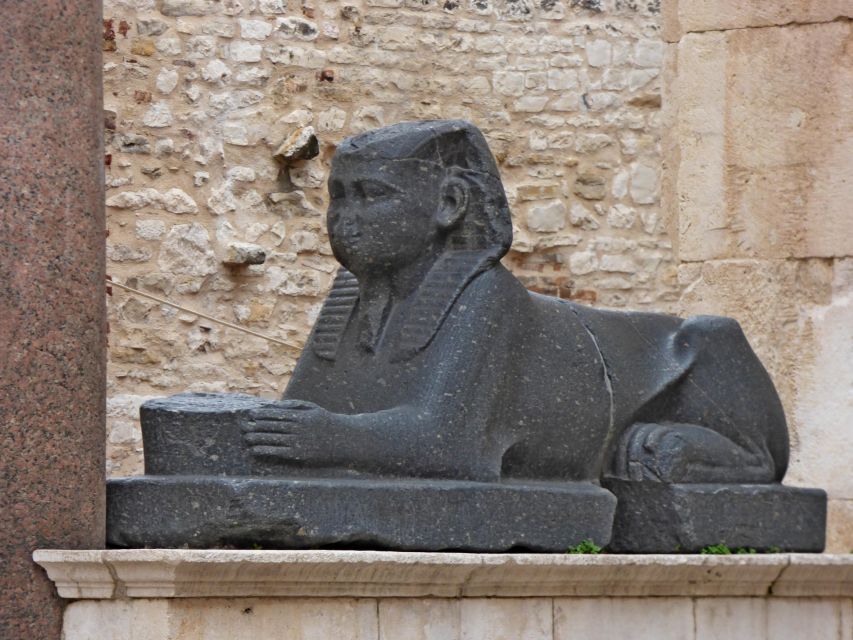
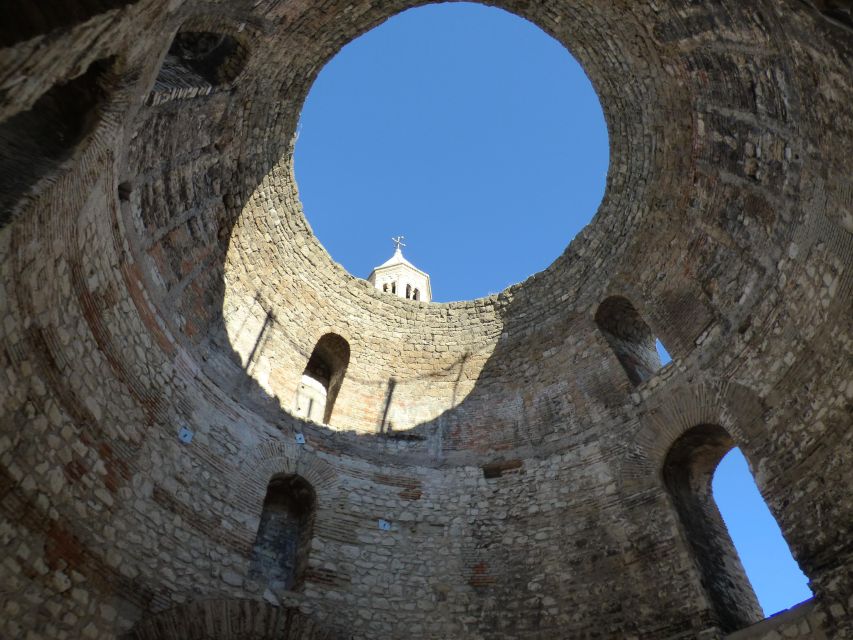
From Peristil, the tour continues to the Cathedral of Saint Domnius, originally the mausoleum of Diocletian. That change in function tells you a great deal about Split. A building created for a Roman emperor later became a Christian cathedral, and the structure now carries both identities.
The stop includes guided sightseeing and passing by the cathedral. The description does not promise a full interior visit, so you should not book this expecting an extended cathedral tour or included admission. The value here is the connection between the mausoleum, the Palace, and the later Christian city.
Jupiter’s Temple and the Golden Gate
Jupiter’s Temple is another reminder that the Palace was designed as an imperial complex, not just a private retirement home. The tour includes an external visit, with no entrance fee listed for this stop. Sanja explains the temple’s place in the Roman setting and its later role as the Baptistery.
That Roman-to-Christian shift is one of the strongest themes in Split. You see how old buildings were reused rather than simply cleared away. It is a more interesting story than a neat timeline of one civilization replacing another.
The Golden Gate gives you another view of the Palace’s defensive and ceremonial design. It is one of the key entrances into the old town and a useful point for seeing how monumental Roman construction blends into the medieval neighborhood around it.
The itinerary allows about 10 minutes here, so expect a focused explanation rather than a long architectural study. That is typical of the tour as a whole. You get the essential story at each stop, then keep moving through the compact center.
More walking tours in Split:
- Walking Tour of Split and Diocletian’s Palace
★ 5.0 · 2,588 reviews - Krka Waterfalls tour with Trogir Walking tour and Krka panoramic boat cruise
★ 5.0 · 1,659 reviews - Split & Diocletian’s Palace Walking Tour
★ 5.0 · 1,125 reviews - Split: Diocletian Palace & Old Town Guided Walking Tour
★ 4.7 · 882 reviews
Medieval Split inside and outside the Palace
The Palace is only the beginning of the town’s story. Medieval homes of noble families developed within its walls, and the route also touches on a small former Jewish quarter with an active synagogue.
That detail gives the walk a more human scale. You are not just following emperors and rulers. You are also learning how different communities lived in the tight urban fabric that grew around the Roman core. The synagogue is still active, but the tour description indicates a walk through the area rather than a promised interior visit.
The second part of the tour moves outside the Palace into the medieval neighborhood. This change is easy to miss if you only follow the main tourist lanes, yet it helps explain why Split feels like several towns joined together.
People’s Square, known as Pjaca, is the first major square in this section. It offers a broader urban setting after the narrow Palace streets. Here the discussion turns toward the political and social life of Split under Venetian, French, Austro-Hungarian, and Yugoslav rule.
This is where Sanja’s historical approach becomes especially useful. The city’s identity was shaped by long periods under different governments, and each period left marks in the architecture and public spaces. You get a sense of how Split changed without losing the older Roman plan beneath it.
Fruit Square and Prokurative: the city beyond the ruins
Fruit Square, or Voćni trg, is another compact public space with a different feel from Peristil. It belongs to the later city rather than the imperial Palace, and the tour uses it to show how Split expanded beyond the Roman walls.
The name and setting offer a glimpse into the practical life of the old town. The square is not presented as a grand Roman monument. Its importance comes from how it fits into the everyday medieval and later city.
The route also includes Prokurative, a square associated with the city’s later architectural development, though the timed itinerary specifically lists People’s Square and Fruit Square as stops. You should expect Prokurative to be part of the wider discussion and walk rather than a long, separate sightseeing session.
This section is valuable because it keeps the tour from becoming a Palace-only experience. If you already know something about Roman architecture, the later squares may be the part that adds the most to your understanding of Split as a living city.
Riva is both meeting point and ending point
The walk finishes on the Riva promenade, where it began. That makes the route easy to follow and removes the need to find your way back through unfamiliar lanes.
The Riva is also a useful place to pause after the old town’s tight streets. The tour’s ending by the sea gives you a clear point from which to continue your day, though no specific follow-on activity is included.
A private guide is particularly useful at the end because you can ask for suggestions for your own exploration. The experience promises tips, and the timing makes sense: after seeing the main historic center, you can ask which places deserve a second look or how to spend the rest of your time in Split.
Several people who booked with Sanja praised her French, and English was also described as excellent. Her ability to explain the city’s history and architecture across several periods is a central part of the experience. Tours are available in English, Italian, French, and Spanish.
What $153 means for value
The price is $153 per group of up to 15 people, not per person. For a full group, that is strong value for a private tour with a licensed local guide and a route covering the central sights. A family of four or a group of friends can divide the cost and gain the advantages of a private format.
For one or two people, the calculation is less favorable. A shared walking tour may cost less, but it will not offer the same control over questions, pace, or language. The private price makes the most sense if you are traveling with several people, want a guide in French, Italian, or Spanish, or care about having a quieter explanation than a large group allows.
The Palace Substructures entrance fee is not included. You should treat that as a separate cost when comparing this tour with other options. The main walking tour itself includes the guide and private arrangement, but not every paid site in the old town.
Free cancellation up to 24 hours before the start and reserve-now, pay-later booking add flexibility. The duration is fixed at 105 minutes, and you need to check available start times when booking.
Who should book this Split walking tour?
I would choose this experience for a first visit to Split, especially if you want the historic center explained before exploring it on your own. It also suits families and small groups who can share the flat fee.
It is a good match if you care about history but do not want a full-day lecture. The route moves from Roman imperial power to medieval neighborhoods and later political rule without asking you to commit an entire morning or afternoon.
French-speaking visitors have a particularly strong reason to consider it, since Sanja has been praised for clear, natural French. English, Italian, and Spanish are also available.
The tour is not suitable for wheelchair users. The historic center includes old streets, steps, and uneven surfaces, and the activity specifically excludes wheelchair access. You should also be ready to walk for nearly two hours, with most of that time spent outdoors.
My booking advice
Book this near the start of your stay, not on your final morning. The route gives you a working map of Split and explains why the Palace, cathedral, temple, gates, squares, and Riva belong to different chapters of the city’s story.
The strongest reason to book is the combination of private attention and broad historical context. Sanja’s explanations cover Roman, medieval, Venetian, French, Austro-Hungarian, and Yugoslav periods, while the route stays compact and practical.
I would think twice if you are traveling alone on a tight budget or want extensive interior visits. The cathedral and Jupiter’s Temple are not presented as full interior tours, and the Substructures cost extra. But for a group that wants a clear introduction to Split, useful local guidance, and a route that covers the major sights without wasting time, this is a sensible choice.
FAQ
Where does the Split private walking tour begin?
It begins beside the bronze model of Split’s historic core on the Riva promenade by the sea, in front of the south entrance to Diocletian’s Palace.
How long does the tour last?
The tour lasts 105 minutes, or about 1 hour and 45 minutes.
What languages are available?
The live guide is available in English, Italian, French, and Spanish.
Is this a private tour?
Yes. It is a private group tour, with a price of $153 for a group of up to 15 people.
Is the entrance fee to the Palace Substructures included?
No. The entrance fee to Diocletian’s Palace Substructures, also called the Basements, is not included.
Does the tour enter Jupiter’s Temple?
The tour includes an external visit to Jupiter’s Temple, also known as the Baptistery. No entrance fee is listed for this external stop.
Is the tour suitable for wheelchair users?
No. The activity is not suitable for wheelchair users.
Can I cancel the booking for a refund?
Yes. You can cancel up to 24 hours in advance for a full refund. Reserve-now, pay-later booking is also available.
Just added around Split
- Kayaking & Zipline Šibenik – Čikola Canyon★ 5.0 · 3 reviews
- Krka National Park & Zipline Šibenik – Čikola Canyon★ 5.0 · 3 reviews
- From Split: Krka National Park & Waterfalls Private Day Trip★ 5.0 · 3 reviews
- Split: Small-Group Half Day Sailing Trip★ 5.0 · 3 reviews
- Rafting River Cetina from Makarska Riviera including transfer★ 5.0 · 3 reviews
- Split Bike and Wine Experience★ 5.0 · 3 reviews
- Split and Salona Cultural Heritage Day Tour from Trogir★ 4.0 · 3 reviews
- Private transfer from Split to Dubrovnik with 2h sightseeing stop in Ston★ 5.0 · 3 reviews
Old Town & History Tours, compared.


Walking Tour of Split with a ‘Magister’ of History
Read our review →

Diocletian Palace & Old Town Guided Walking Tour
Read our review →

Diocletian’s Palace and Old Town SMALL GROUP Walking Tour
Read our review →

Split History and Gastro Small-Group Tour with Food and Drinks
Read our review →Browse the lists this tour appears in