
Reviewed · OLD TOWN & HISTORY TOURS
Split Palace & Old Town -Private walking tour- Entrance included
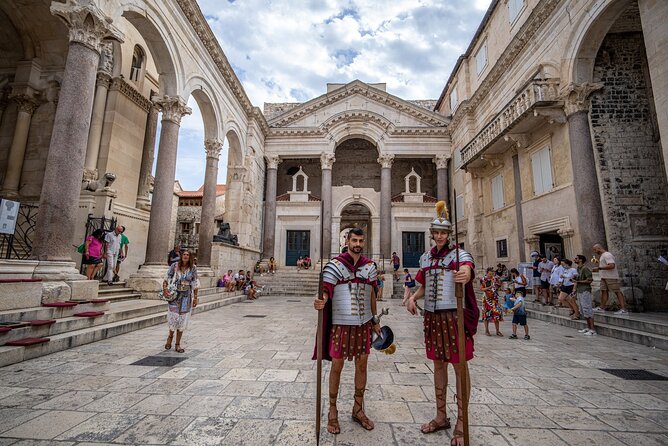
Diocletian’s Palace is not a fenced-off ruin. It is the working center of Split, with homes, cafés, shops, churches, and narrow lanes built into a Roman complex more than 1,700 years old. This private walk helps you read that layered city, from the Riva waterfront to the palace cellars and the later Venetian squares.
I like the private format, since your guide can adapt the pace and explain details that are easy to miss in a larger group. I also like that entry to the palace cellars, Cathedral of Saint Domnius, and Temple of Jupiter is included, giving you access to the key interiors rather than only the outdoor lanes.
The main consideration is the $203.95 per-person price, which is high for a 2.5-hour walking tour unless you are traveling with a small group that values personal attention. Church services, events, or poor weather can also change the route or prevent access to some sights.
In This Review
- Key points to know before booking
- Why this private Split tour works
- From the Riva to Diocletian’s Palace
- The cellars reveal the palace’s original scale
- Peristyle, Jupiter, and the old imperial center
- Cathedral of Saint Domnius, a Roman mausoleum turned church
- The Golden Gate and the road to Salona
- Medieval squares and Venetian Split
- The fish market and Marmontova Street
- Finishing at Prokurative
- What the $203.95 price means
- Who should book this walking tour?
- Should you book the Split Palace and Old Town tour?
- FAQ
- Where does the tour start?
- Where does the tour end?
- How long does the tour last?
- What language is the tour offered in?
- Is this a private tour?
- Are entrance fees included?
- Can every interior be visited on every departure?
- How much does the tour cost?
- Is the tour suitable for most people?
- What is the cancellation policy?
Key points to know before booking
- A private walk through a living Roman palace: The tour moves through streets and courtyards that remain part of daily life in Split.
- Three important entries included: The palace cellars, Cathedral of Saint Domnius, and Temple of Jupiter are covered when they are open.
- Strong guide focus: Dana and Jana are named guides, both praised for clear explanations and useful advice for exploring after the walk.
- A full cross-section of Split: You see Roman remains, medieval squares, Venetian buildings, French-era streets, a fish market, and the Riva.
- A useful downhill-style route through the center: The walk begins beside the waterfront and finishes at Republic Square, near cafés and restaurants.
- Good for travelers who want context: The tour explains not just what each building is, but how the Roman palace became the modern city.
Why this private Split tour works
The best reason to book this tour is the way it connects separate sights into one story. Diocletian’s Palace can feel confusing at first. Roman walls form the core, but later homes and streets have grown into them. A church occupies the former mausoleum of a Roman emperor. A temple became a baptistery. Markets and shopping streets sit beside ancient stone.
You start at the model of Split’s historic core, at Obala Hrvatskog narodnog preporoda 23 along the Riva. This is a sensible meeting point because the waterfront gives you a quick view of the old center before you enter its tighter lanes.
The tour lasts about two hours and 30 minutes. That is long enough to cover the major sights without turning into an all-day walking commitment. Still, you should expect a steady walk with frequent stops, not a leisurely café stroll.
Because this is private, you can ask questions as you go. That matters in Split, where a simple doorway may belong to a Roman structure, a medieval house, or a later renovation. Guides Dana and Jana are specifically named for their strong command of the city’s past and for helping with ideas and directions after the tour.
More old town history walks in Split:
- Split: Old Town and Diocletian Palace Walking Tour
★ 4.9 · 4,727 reviews - Walking Tour of Split with a ‘Magister’ of History
★ 5.0 · 1,122 reviews - Split Walking Tour with Professor of History
★ 5.0 · 926 reviews
From the Riva to Diocletian’s Palace
The first ten minutes take place on the Riva, Split’s waterfront promenade. Your guide gives general information about the city and explains how the tour will unfold.
This short opening is useful. You get your bearings before entering the palace, and you can look back toward the waterfront as a modern reference point. The Riva itself is free to visit, so the value here comes from orientation and explanation rather than admission.
From there, you move toward Diocletian’s Palace. Emperor Diocletian built the complex as a retirement residence and fortress, and its scale becomes easier to understand once you see the preserved lower levels.
The palace is not presented as one isolated monument. It is the foundation of central Split. That is the key idea to grasp early, since the rest of the walk makes more sense once you understand that the old town grew inside and around this Roman plan.
The cellars reveal the palace’s original scale
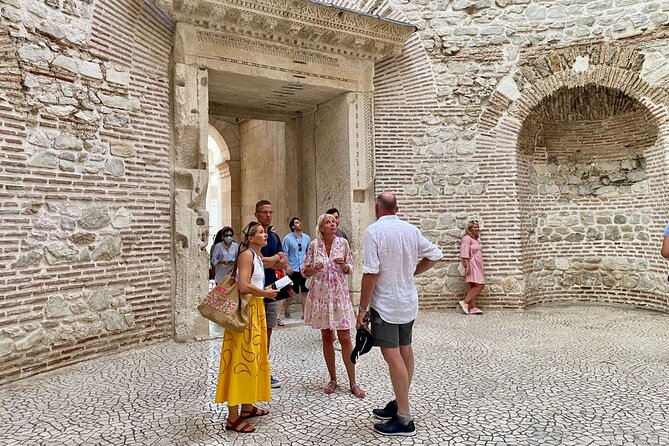
You enter through the South Gate and visit Diocletian’s Cellars. These lower rooms are among the clearest places to understand the palace’s size and construction.
The cellars were built more than 1,700 years ago and remain well preserved. Their proportions give you a better sense of the rooms and corridors that once supported the imperial residence above. If you only walk through the upper streets, the palace can seem like a patchwork of later buildings. Down here, its Roman structure is easier to read.
The entrance fee is included. That is important because this is one of the tour’s main paid stops, not simply a quick look at an exterior gate.
The cellar visit is scheduled for about 15 minutes. That is enough for an introduction and a look around, but not a long archaeological study. If you want a slow examination of every stone, you may find the timing brisk. The private setting gives you a chance to ask questions, though the guide still has several other areas to cover.
Peristyle, Jupiter, and the old imperial center
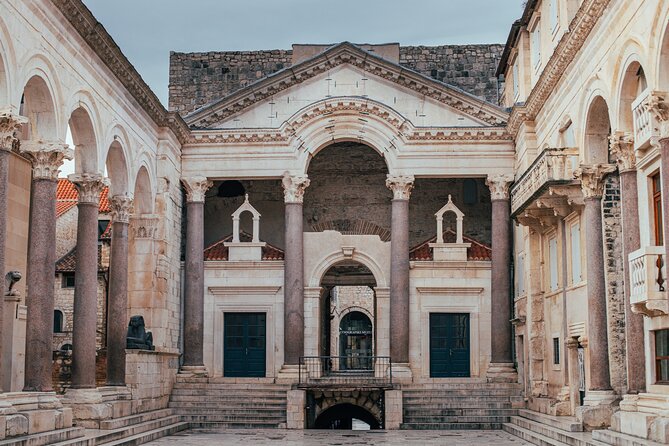
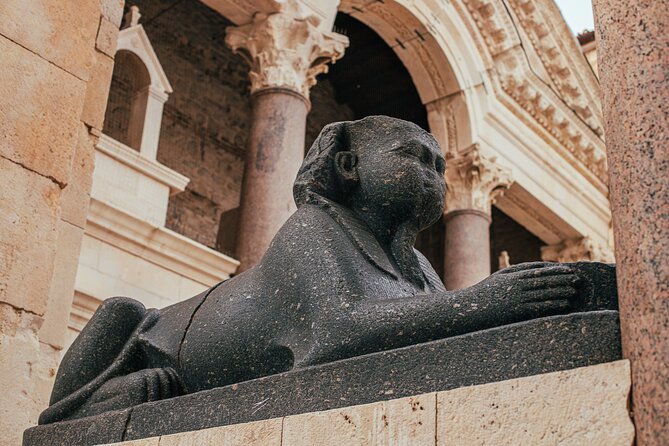
The Peristyle is one of the most impressive outdoor spaces in the palace. In Diocletian’s time, it was a ceremonial and religious meeting place. The emperor appeared here before his subjects and was worshipped as the son of Jupiter.
Your guide spends about ten minutes explaining the square. The stop is free, but its importance is substantial. This is where the palace’s political and religious functions come together, and it helps you picture the emperor not simply as a resident but as a ruler staging ceremonies.
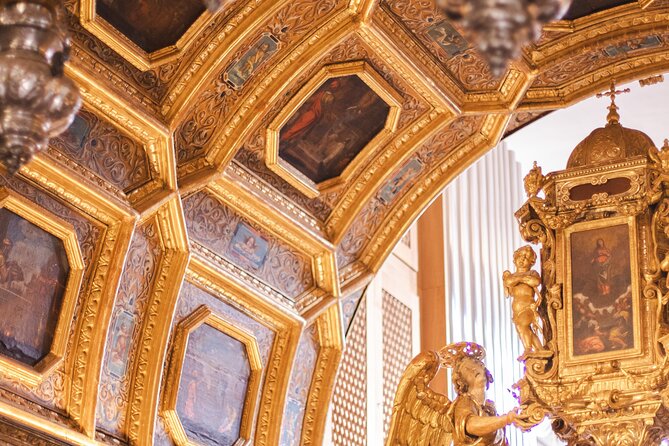
Next comes the Temple of Jupiter, now used as a baptistery. Its casket ceiling is a detail worth watching for. The design influenced Renaissance architects in Dalmatia, giving this small interior a place in the wider story of local building traditions.
The entry fee is included. The visit is planned for about ten minutes, so you should not expect an extended church service or architectural lecture. You get a focused explanation and a chance to see how a pagan Roman space was given a Christian purpose.
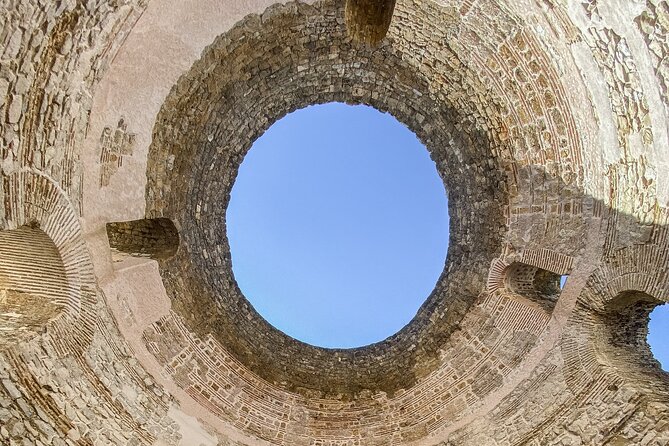
The Vestibule follows. This circular entrance area once led toward Diocletian’s private chambers. It is a brief stop, but it helps separate the public ceremonial parts of the palace from the emperor’s personal quarters.
That contrast is one of the tour’s strengths. You are not simply ticking off monuments. You are seeing how the palace was arranged for power, worship, and private life.
More walking tours in Split:
- Walking Tour of Split and Diocletian’s Palace
★ 5.0 · 2,588 reviews - Krka Waterfalls tour with Trogir Walking tour and Krka panoramic boat cruise
★ 5.0 · 1,659 reviews - Split & Diocletian’s Palace Walking Tour
★ 5.0 · 1,125 reviews - Split: Diocletian Palace & Old Town Guided Walking Tour
★ 4.7 · 882 reviews
Cathedral of Saint Domnius, a Roman mausoleum turned church
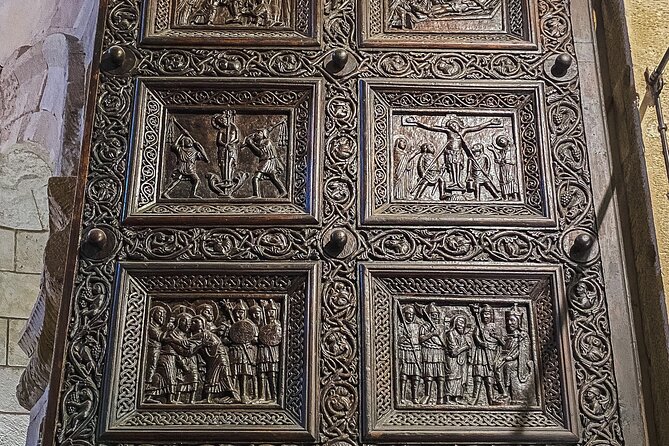
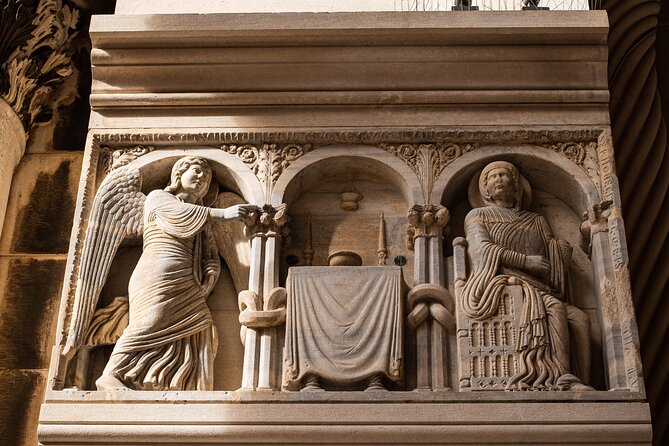
The Cathedral of Saint Domnius occupies what was originally Diocletian’s mausoleum. During the Christianization of the city, the pagan mausoleum became a Christian cathedral, while the emperor’s coffin and remains disappeared.
The cathedral visit takes about 15 minutes, with admission included. The building’s importance comes from this sharp change in purpose. You are looking at a Christian place of worship inside the former tomb of a Roman emperor who had been hostile to Christianity.
Access is not guaranteed at every departure. Church services or events can close the interior, and the tour may need to adjust its order or replace part of the program. That is normal for an active cathedral, but it is worth keeping in mind if seeing the interior is your main reason for booking.
The tour also visits the palace attractions only when they are open and when no worship or event is taking place. The guide can explain the exterior and surrounding area even if an interior visit is not possible, but the experience will be slightly different.
The Golden Gate and the road to Salona
At the north side of the palace, you reach the Golden Gate. In Roman times, this was the most important entrance, and the road from here led toward Salona, the capital of the Roman province.
The gate is a free outdoor stop lasting about ten minutes. It is a good place to see how the palace connected to the wider Roman road system rather than functioning as a sealed residence.
The route then follows the palace walls toward the medieval center. This change in setting is one of the most useful parts of the walk. You move from imperial Roman planning into the city that developed west of the palace during the Middle Ages.
The guide can help you notice where the Roman core ends and the later town begins. Without that explanation, the transition can seem like just another narrow street.
Medieval squares and Venetian Split
Narodni Trg, or People’s Square, has served as a city center since the Middle Ages. The square contains old Venetian palaces and a former city hall in neo-Gothic style.
The stop is short, about five minutes, but it gives you a clear look at the later political and commercial life of Split. The square is not Roman, and that is precisely why it belongs on this tour. Split is a city of overlapping periods, not a single archaeological site.
You continue to Fruit’s Square, officially Trg Brace Radic. It was once a fruit market and now contains a monument to Marko Marulić, one of Split’s important Renaissance writers.
This ten-minute stop provides a quick link between daily trade and local culture. It also shows how old market spaces have been given new uses while keeping their names and basic role in the city’s public life.
The tour does not rush from Roman monument to Roman monument. It gives you a working map of the old town, including places where people gathered, sold food, governed, and walked long after Diocletian’s era ended.
The fish market and Marmontova Street
The Split Fish Market is another practical stop, not just a photo opportunity. It remains an attraction in its own right, and the sulfur baths next door add a curious local detail.
The sulfur smell is said to keep flies away from the fish market. Diocletian also understood the supposed relief sulfur baths could provide for rheumatism and other ailments. The stop lasts around ten minutes and is free.
This is the kind of detail that makes a walking tour more useful than a map. You see how the city’s natural features, markets, and old bathing traditions fit into everyday life.
From the fish market, the route continues along Marmontova ulica. This pedestrian shopping street was built by the French during Napoleon’s rule at the start of the 19th century.
Marmontova shows yet another layer of Split. The palace began as a Roman imperial complex, the old town expanded in the Middle Ages, Venetian buildings shaped later squares, and French rule left its mark on the street plan.
The ten-minute visit is mainly about orientation and urban history. If you want time to shop, stop for coffee, or inspect the market at length, plan to return after the tour.
Finishing at Prokurative
The walk ends at Republic Square, known as Prokurative. Its design recalls St. Mark’s Square in Venice, with cafés and restaurants around the open space.
This is a useful end point because you are not left at an isolated monument. You finish in an area suited to a meal, a drink, or further walking through the center.
The final stop takes about ten minutes. The tour’s total route gives you a natural introduction to Split: waterfront, Roman palace, church interiors, city gates, medieval squares, markets, French streets, and a Venetian-style finish.
You can also use the final location to continue exploring on your own. One of the named guides, Jana, is specifically noted for giving ideas about what to see afterward and helping with directions. That kind of practical follow-up can save time, especially if Split is one stop in a larger Croatian trip.
What the $203.95 price means
At $203.95 per person, this is not a budget walking tour. The price makes the most sense if you are traveling as a small private group and want a guide focused only on your party.
The included entries improve the value. You are not paying only for an outdoor orientation around the palace. The price covers access to the palace cellars, the Temple of Jupiter, and the cathedral when those spaces are open.
Still, the tour lasts about 2.5 hours, so the cost per hour is high compared with a shared group walk. I would choose it for personal attention, flexible pacing, and the chance to ask detailed questions. I would skip it if you mainly want a quick introduction or are comfortable reading signs and exploring independently.
The private format is also useful for special needs. The route can be adapted if you tell the provider in advance. Service animals are allowed, and the meeting area is near public transportation. Most people can participate, but the walk still involves moving through an old city with historic streets and frequent stops.
Who should book this walking tour?
I would recommend it to first-time visitors who want Split explained in one sitting. It suits couples, families, and small groups who prefer a private guide over a fixed group schedule.
It is also a good choice if you care about the difference between Roman, medieval, Venetian, and French parts of the city. The route covers enough ground to give you a useful mental map before you explore alone.
You should be comfortable with a 2.5-hour walking program. The information does not specify seating, rest breaks, or a reduced-mobility route, so tell the provider about your needs in advance if those details matter to you.
The tour is offered in English and uses a mobile ticket. Confirmation arrives when you book. Free cancellation is available up to 24 hours before the local start time, but cancellations or changes inside that window are not refunded or accepted.
Should you book the Split Palace and Old Town tour?
Book this tour if you want a private, guided introduction to Split’s Roman core and later old town, with key entrance fees included. The combination of the palace cellars, cathedral, Jupiter’s temple, markets, and old squares gives you more than a basic palace walk.
I would be especially inclined to book if Dana or Jana is available, since both are praised for strong historical explanations, friendly guidance, and useful advice for the rest of your time in Split.
Think twice if $203.95 per person feels steep for a short walking tour, or if you mainly want to wander at your own pace. Also keep the possible closures in mind. Services, events, opening hours, and bad weather can affect the exact route.
FAQ
Where does the tour start?
It starts at the model of the historical core of Split, at Obala Hrvatskog narodnog preporoda 23, 21000 Split, Croatia.
Where does the tour end?
The tour ends at Republic Square, also called Prokurative, at 21000 Split, Croatia.
How long does the tour last?
The walking tour lasts approximately two hours and 30 minutes.
What language is the tour offered in?
The tour is offered in English.
Is this a private tour?
Yes. Only your group participates in the private activity.
Are entrance fees included?
Yes. Entry to the palace cellars, Temple of Jupiter, and Cathedral of Saint Domnius is included when those attractions are open.
Can every interior be visited on every departure?
No. Some sights may be unavailable because of church services or events. The program may change slightly in those cases.
How much does the tour cost?
The stated price is $203.95 per person.
Is the tour suitable for most people?
Most travelers can participate. The route can also be adapted to special needs if you inform the provider in advance.
What is the cancellation policy?
You can cancel up to 24 hours before the local start time for a full refund. Cancellations or changes made less than 24 hours before the start are not refunded or accepted. If poor weather causes the tour to be canceled, you can receive a different date or a full refund.
Just added around Split
- Kayaking & Zipline Šibenik – Čikola Canyon★ 5.0 · 3 reviews
- Krka National Park & Zipline Šibenik – Čikola Canyon★ 5.0 · 3 reviews
- Split: Small-Group Half Day Sailing Trip★ 5.0 · 3 reviews
- Rafting River Cetina from Makarska Riviera including transfer★ 5.0 · 3 reviews
- From Split: Krka National Park & Waterfalls Private Day Trip★ 5.0 · 3 reviews
- Split Bike and Wine Experience★ 5.0 · 3 reviews
- Split and Salona Cultural Heritage Day Tour from Trogir★ 4.0 · 3 reviews
- Krka Waterfalls, Lake Cruise & Skradin★ 5.0 · 3 reviews
Old Town & History Tours, compared.


Walking Tour of Split with a ‘Magister’ of History
Read our review →

Diocletian Palace & Old Town Guided Walking Tour
Read our review →

Diocletian’s Palace and Old Town SMALL GROUP Walking Tour
Read our review →

Split History and Gastro Small-Group Tour with Food and Drinks
Read our review →Browse the lists this tour appears in