
Reviewed · OLD TOWN & HISTORY TOURS
Split: History Walking Tour of the Old Town
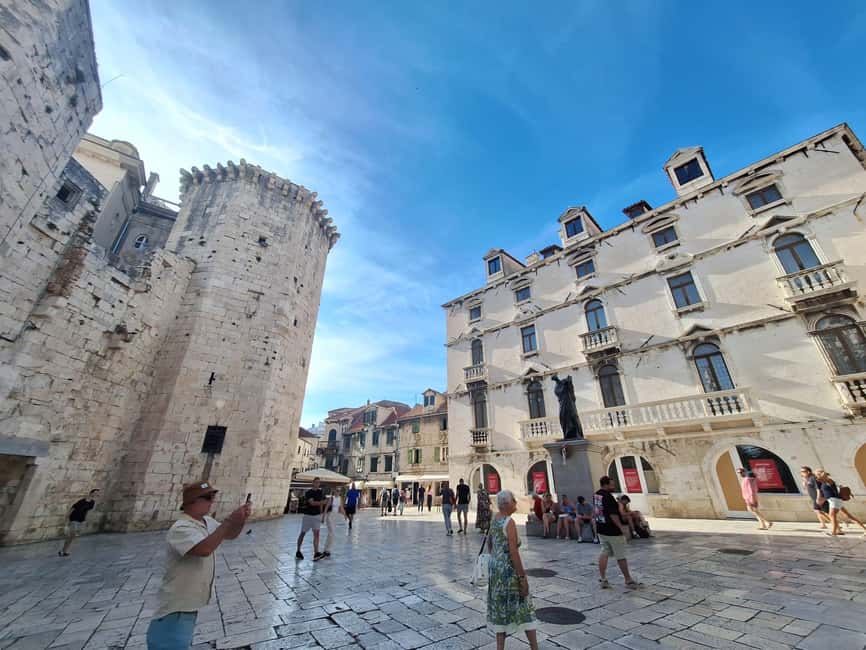
The most striking part of this Split walking tour is that the old town is not simply built beside a Roman monument. It is built inside one. Diocletian’s Palace still forms the bones of daily life, with homes, shops, cafés, squares, and narrow lanes filling spaces once made for an emperor.
I like the clear route through the Golden Gate, Peristyle, and palace cellars, and I like the way the guides connect Roman history with modern Croatian food, habits, and island trips. Guides including Maya, Nina, Marc, and Marko have brought maps and photos, used riddles and jokes, and helped small groups find shade when the summer heat rises. The main consideration is pace: 90 minutes gives you a strong introduction, but not a slow, detailed look at every corner.
In This Review
- Key points at a glance
- Why Split’s Roman palace makes such a good walking tour
- Starting at the Golden Gate and Đardin Park
- Peristyle and the Mausoleum: Split’s grand Roman center
- Jupiter’s Temple and the headless Sphinx
- The Vestibule and the palace’s human mousetrap
- Diocletian’s Cellars and the Game of Thrones connection
- People’s Square and Fruit Square: where old Split becomes everyday Split
- Ending on the Riva beneath the palm trees
- Guide style, group size, and languages
- Is $41 a fair price for 90 minutes?
- Who should book this Split walking tour?
- Should you book it?
- FAQ
- How long does the Split history walking tour last?
- What sights are included?
- Is the tour available in English?
- Does the tour visit Game of Thrones filming locations?
- How much does the tour cost?
- Can I book a private group?
- What should I bring?
Key points at a glance
- Roman Split is still a living city: The Palace of Diocletian is not a fenced-off ruin. You walk through streets and courtyards that locals still use.
- The palace cellars add a Game of Thrones angle: See spaces used for Daenerys Targaryen’s dragons and the fight between the Unsullied and the Sons of the Harpy.
- The guide keeps the history lively: Expect questions, riddles, jokes, photos, maps, and stories about emperors, Venetians, and daily life.
- The route covers Split’s essential sights: Visit the Golden Gate, Peristyle, Mausoleum, Jupiter’s Temple, Vestibule, People’s Square, Fruit Square, and Riva.
- Local advice is part of the tour: You can get tips on Dalmatian food, ice cream, beaches, fresh water, and islands to visit next.
- Small or private groups are possible: The experience runs in English or Spanish, with private options and optional hotel or cruise pickup depending on the booking.
Why Split’s Roman palace makes such a good walking tour
Split is about 1,700 years old, and its center rewards a guide because the story is layered rather than neatly separated. Roman stone sits beside medieval streets. A cathedral occupies an imperial mausoleum. Ancient passageways lead toward squares where people meet for coffee.
Without context, you may see attractive stonework and assume the palace is one large archaeological site. The useful lesson here is that Diocletian’s Palace changed purpose over time. It began as the retirement home and fortified residence of Emperor Diocletian, then became the core of the later city.
I find that this makes Split easier to understand than a standard ruin. You are not only looking at the past. You are seeing how later generations adapted it, reused it, and built ordinary life around it.
The tour lasts 90 minutes, a practical length for a first look. It is long enough to cover the central sights without taking over your day, yet short enough to fit before a beach visit, ferry departure, or evening meal. The tradeoff is that most stops are introductions. If a particular monument catches your attention, plan to return on your own.
More old town history walks in Split:
- Split: Old Town and Diocletian Palace Walking Tour
★ 4.9 · 4,727 reviews - Walking Tour of Split with a ‘Magister’ of History
★ 5.0 · 1,122 reviews - Split Walking Tour with Professor of History
★ 5.0 · 926 reviews
Starting at the Golden Gate and Đardin Park
The walk begins at the Golden Gate, with the exact meeting point depending on the option you choose. The gate is one of the most recognizable entrances into the old town, and it gives the guide an easy way to explain the palace walls and the four main directions through the complex.
The nearby Đardin Park provides a useful first pause before the route moves into tighter streets. This early section is less about checking off a monument and more about getting your bearings. A good guide can show you how the palace was arranged and why the entrance mattered.
This is also where the tour’s interactive style can help. One guide has used riddles, including a playful prompt about replacing your head with the Sphinx’s and answering the Sphinx’s question. That kind of humor will not suit someone seeking a formal lecture, but it makes the Roman details easier to remember.
If you are meeting during the hot months, wear a hat and use sunscreen before you arrive. Comfortable shoes matter more than stylish ones. The old town route includes stone surfaces, steps, and uneven passages, so thin sandals may become tiresome.
Peristyle and the Mausoleum: Split’s grand Roman center
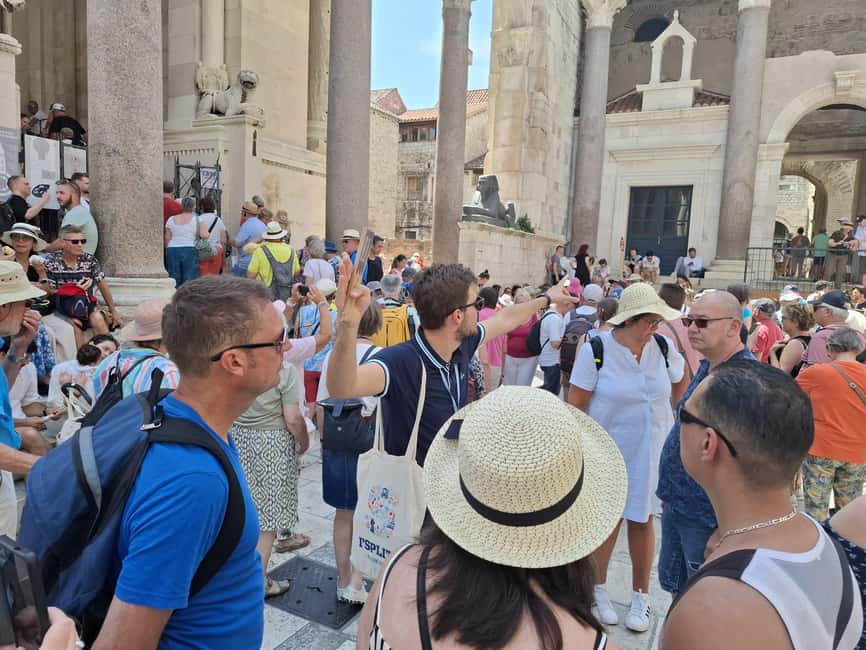
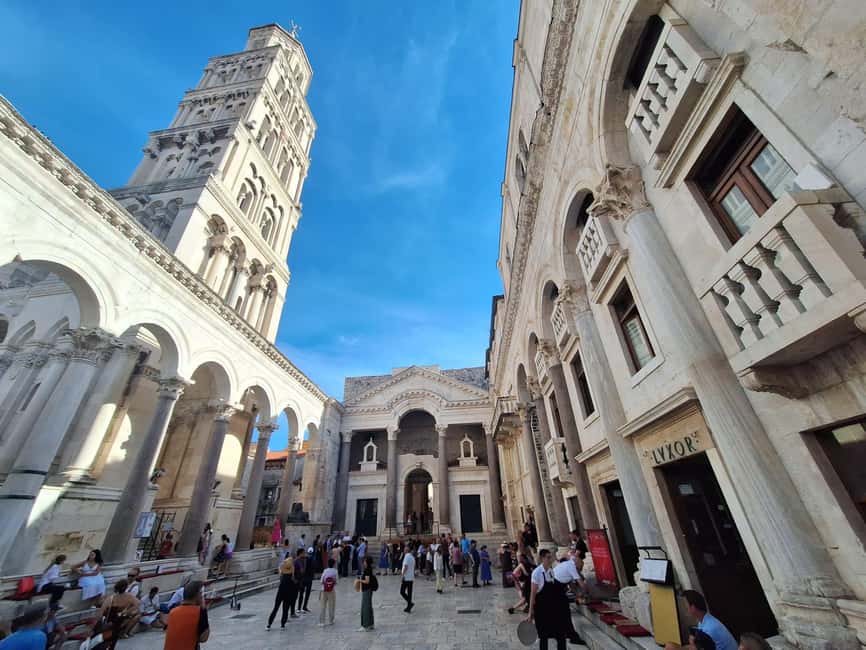
The Peristyle is the tour’s main visual hit. This open court once formed the ceremonial heart of the palace, and the surrounding columns and stonework make it easy to picture the emperor’s public world.
Your guide explains the relationship between the Peristyle and Diocletian’s Mausoleum, now associated with the cathedral. The striking point is the change in meaning. A structure made for an emperor who strongly opposed Christianity later became part of one of the world’s oldest cathedrals.
The tour also discusses Diocletian as one of the greatest persecutors of Christians. That contrast gives the site more force than a simple description of columns and walls. You are looking at a place where political power, religion, and later city life overlap.
The guide may also explain the lighter side of palace life, including why Diocletian vomited after dinner. It is an odd detail, but it helps move the emperor away from a marble statue and into the world of meals, excess, illness, and human habits.
Allow yourself a moment to look up at the bell tower and around the court. The Peristyle can feel crowded, especially at busy times, and the 15-minute stop may pass quickly. A guide who manages the group well can make a major difference here. One guide, Maya, has used a folder with photos and maps to clarify what you are seeing when the stones alone are hard to read.
Jupiter’s Temple and the headless Sphinx

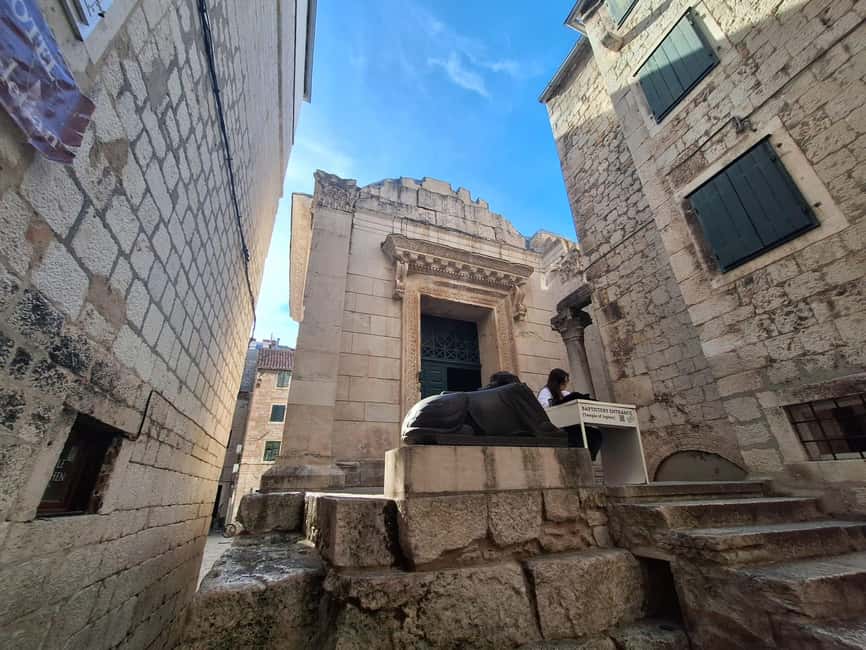
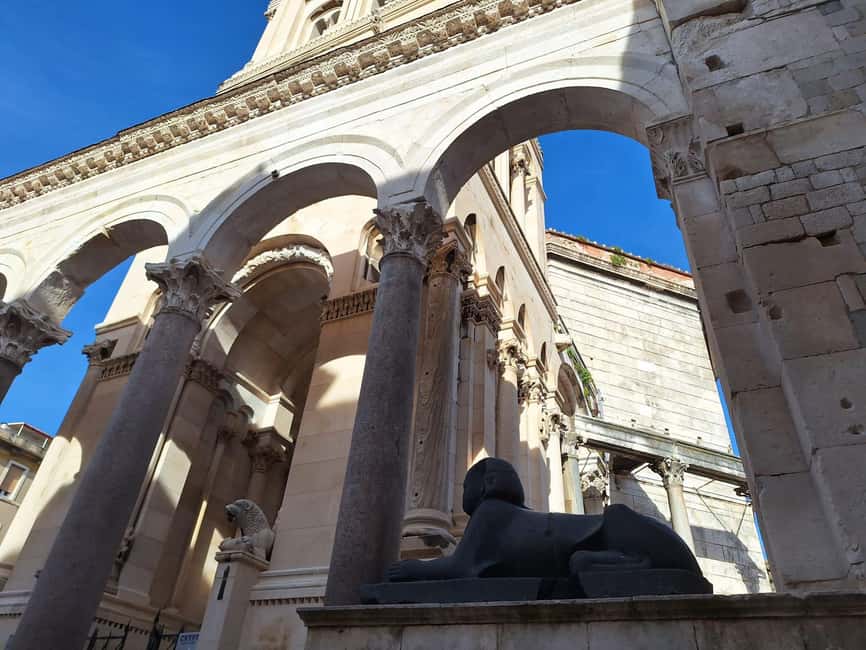
The Temple of Jupiter is a short stop, listed at about five minutes, but it carries some of the tour’s best details. The guide explains the temple’s place within the palace and points out the headless Sphinx guarding its entrance.
That Sphinx invites the sort of question that makes a walking tour useful. Why is it headless? What did it represent? How did an Egyptian sculpture end up in a Roman emperor’s palace? The tour gives you the story rather than leaving you with a photograph and a name.
The short timing means you should not expect a long examination of every carved surface. Instead, you get a sharp explanation that fits the broader palace story. I like this approach for a first visit, especially if you want an engaging overview rather than a specialist archaeology walk.
More walking tours in Split:
- Walking Tour of Split and Diocletian’s Palace
★ 5.0 · 2,588 reviews - Krka Waterfalls tour with Trogir Walking tour and Krka panoramic boat cruise
★ 5.0 · 1,659 reviews - Split & Diocletian’s Palace Walking Tour
★ 5.0 · 1,125 reviews - Split: Diocletian Palace & Old Town Guided Walking Tour
★ 4.7 · 882 reviews
The Vestibule and the palace’s human mousetrap
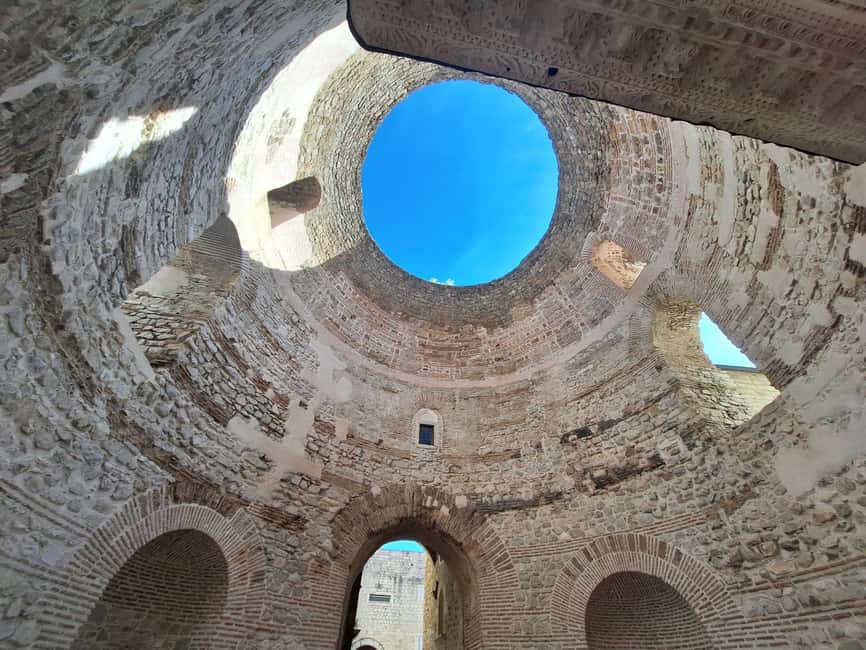
The Vestibule once served as an entry space leading toward the emperor’s apartments. Its rounded form and acoustics make it one of the more memorable interiors on the route.
The guide also introduces the human mousetrap, a nickname connected with the palace’s defensive layout and narrow movement through its entrances. This is a good example of how the tour uses an image you can remember. Rather than hearing a list of architectural terms, you learn how the palace could control who entered and where people moved.
The Vestibule is also a welcome break from the sun. Several sections of the palace offer shade, and the cellars later provide an even cooler stretch. One guide, Marko, has led groups through the underground areas so that the heat becomes less of a problem. Still, bring water. You should not rely on finding a fountain during the walk, even though one guide has pointed out a source of fresh water brought through a roughly 2,000-year-old aqueduct.
Diocletian’s Cellars and the Game of Thrones connection
The cellars are among the tour’s most accessible surprises. You descend below the streets into the lower level of the palace, where the rooms help show how the structure was supported and organized.
For Game of Thrones fans, this is the obvious crowd-pleaser. The tour visits the places used as the setting where Daenerys Targaryen’s dragons were chained and where the Unsullied fought the Sons of the Harpy. You can enjoy the television connection without letting it replace the Roman story.
I think the cellars work best when you treat the show as an extra layer. Their real value is architectural. They reveal a less polished side of the palace, with heavy stone walls and dim passages that make the scale of the imperial residence easier to grasp.
The underground portion is also practical in summer. Fifteen minutes is enough to understand the space, but you may want more time if you are keen on filming locations. The tour keeps moving, so take your photographs promptly and listen for the guide’s explanation before the group heads back into the old town.
People’s Square and Fruit Square: where old Split becomes everyday Split
After the palace, the route moves into People’s Square, or Pjaca. This is a useful transition from imperial architecture to the later city. The square helps you see how Split expanded and how public life moved beyond the original palace walls.
Fruit Square, known locally as Voćni trg, adds another layer. These squares are not just scenic stops. They are places where you can begin to notice how stone buildings, cafés, shops, and foot traffic fit together.
The guide also gives practical advice on local food and habits. You can ask where to find Dalmatian specialties and what locals eat, rather than choosing a restaurant only because it has a good view. Food guidance is especially helpful after a history walk because it turns the rest of your day into a continuation of the tour.
The route can also be a good place to ask about beaches and islands. At the end, guides offer suggestions for how to spend the remaining hours and which islands to visit. That makes the experience more useful on a short stay, when a single local conversation can save you from wasting half a day.
Ending on the Riva beneath the palm trees
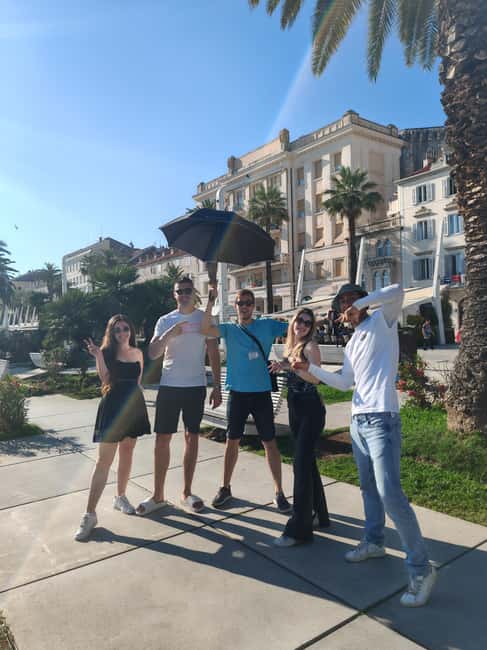
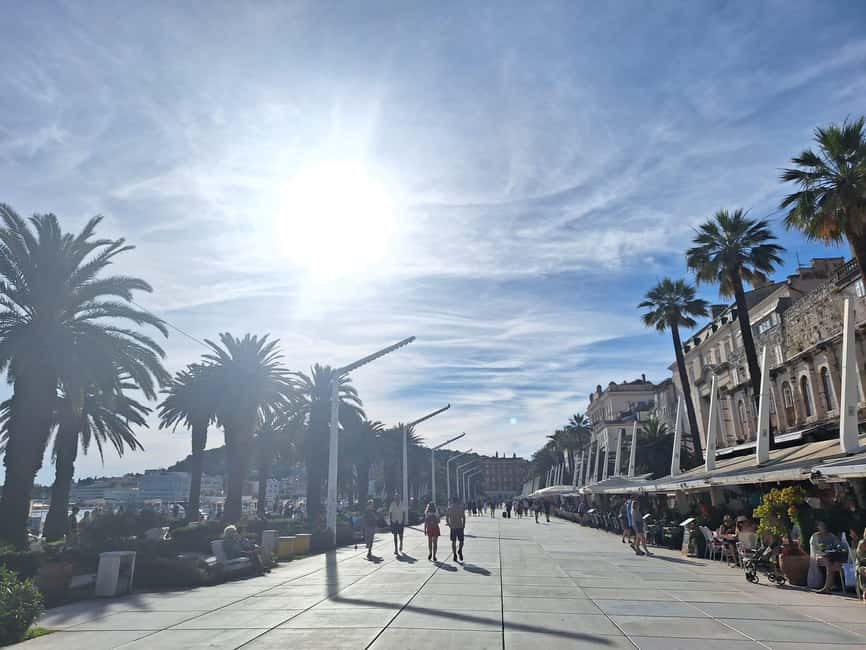
The tour ends on the Riva, Split’s seafront promenade lined with tall palm trees. This is a satisfying finish because the route moves from the enclosed Roman palace to the open waterfront.
The Riva is a natural place to pause, have a drink, or decide what comes next. The two listed drop-off points are the historical core of Split and Split Riva, so you finish in a central area rather than being taken away from the sights.
The ending also gives the guide a chance to offer tailored advice. You can ask about beaches, islands, food, or the best use of your remaining time. The tour does not include a full meal or a boat trip, but the local recommendations add value beyond the 90-minute walk.
Guide style, group size, and languages
The tour is offered in English and Spanish. That matters in a place where the names, dates, and layers of Roman and Croatian history can become confusing when explained too quickly.
The guide style is informal and participatory. Marko has used questions, riddles, and jokes. Maya has brought maps and photographs. Nina has been praised for making the history fun, while Marc has handled a one-person tour and answered questions in detail. These examples suggest that the experience can feel personal, but the exact guide and group size depend on the date and option selected.
Private groups are available. If you want to ask many questions, have family members with different interests, or prefer a slower pace, the private option may be worth considering. A shared group is likely the better value if you mainly want the main story and sights.
Optional pickup is available with some choices. You can provide a hotel name and street, or note that you are arriving by cruise ship. Since the meeting point varies by option, check the precise details before booking rather than assuming every departure begins at the same place.
Is $41 a fair price for 90 minutes?
At $41 per person, this is not the cheapest way to walk around Split. You can enter the old town for free and see many of the exterior sights without paying for a guide.
The value comes from the explanation and the route. In 90 minutes, you get a structured introduction to the Golden Gate, Peristyle, Mausoleum, Jupiter’s Temple, Vestibule, cellars, People’s Square, Fruit Square, and Riva. You also receive practical food and day-trip advice, which can be useful if Split is one stop on a larger Croatian trip.
The price makes the most sense if you are visiting for the first time, have limited time, or want the palace to make sense rather than simply look impressive. It is less compelling if you already know Roman architecture well or prefer to wander without a schedule.
The consistently perfect rating from the supplied feedback also points to the aspects that matter most: friendly guides, clear explanations, small groups, shade management, and useful local tips. I would not book it only because of the rating. I would book it because the format addresses the main problem with Split: the old town is easy to walk through but harder to interpret.
Who should book this Split walking tour?
I recommend it for first-time visitors, cruise passengers, couples, families with older children, and anyone with only a morning or afternoon in the city. The Game of Thrones locations add fun for fans, while the Roman and Croatian material gives the walk substance for people who have never watched the show.
It also suits you if you want advice for the rest of your stay. The guides can point you toward Dalmatian food, beaches, ice cream, fresh water, and islands, all useful subjects that a standard monument visit may not cover.
You should think twice if you need step-free access, though the supplied information does not give accessibility details. The route includes old stone spaces and palace cellars, so ask the provider about your specific needs before booking.
Book comfortable shoes, a hat, sunscreen, and water. Summer shade can help, but do not count on the whole walk being cool. Free cancellation up to 24 hours before the start and the reserve-now, pay-later option make it easier to fit the tour around changing plans.
Should you book it?
Book this tour if you want Split’s old town to become a connected story rather than a string of attractive stones. The best parts are the Roman palace setting, the cellars, the lively guide style, and the practical advice at the end.
Skip it if you prefer to explore alone and are willing to research Diocletian’s Palace yourself. At $41, the cost pays for interpretation, questions, orientation, and local help, not transport or a long museum visit. For a first visit, that is a fair exchange, especially when you can use the Riva finish to continue exploring on your own.
FAQ
How long does the Split history walking tour last?
The tour lasts 90 minutes.
What sights are included?
The route includes the Golden Gate, Đardin Park, Peristyle, the Mausoleum, Jupiter’s Temple, the Vestibule, Diocletian’s Cellars, People’s Square, Fruit Square, and the Riva.
Is the tour available in English?
Yes. The live guide options include English and Spanish.
Does the tour visit Game of Thrones filming locations?
Yes. The tour visits palace cellars used as the location where Daenerys Targaryen’s dragons were chained and where the Unsullied fought the Sons of the Harpy.
How much does the tour cost?
The listed price is $41 per person.
Can I book a private group?
Yes. A private group option is available, depending on the choice you book.
What should I bring?
Bring comfortable shoes, a hat, sunscreen, and water.
Just added around Split
- Kayaking & Zipline Šibenik – Čikola Canyon★ 5.0 · 3 reviews
- Krka National Park & Zipline Šibenik – Čikola Canyon★ 5.0 · 3 reviews
- Split: Small-Group Half Day Sailing Trip★ 5.0 · 3 reviews
- Rafting River Cetina from Makarska Riviera including transfer★ 5.0 · 3 reviews
- From Split: Krka National Park & Waterfalls Private Day Trip★ 5.0 · 3 reviews
- Split and Salona Cultural Heritage Day Tour from Trogir★ 4.0 · 3 reviews
- Split Bike and Wine Experience★ 5.0 · 3 reviews
- Krka Waterfalls, Lake Cruise & Skradin★ 5.0 · 3 reviews
Old Town & History Tours, compared.


Walking Tour of Split with a ‘Magister’ of History
Read our review →

Diocletian Palace & Old Town Guided Walking Tour
Read our review →

Diocletian’s Palace and Old Town SMALL GROUP Walking Tour
Read our review →

Split History and Gastro Small-Group Tour with Food and Drinks
Read our review →Browse the lists this tour appears in