
Reviewed · OLD TOWN & HISTORY TOURS
Private Walking Tour in Split Old Town (ENG, FRA, ITA, ESP)
Split’s Old Town is not a museum behind glass. It is a living city built inside a Roman emperor’s palace, with laundry, cafés, shops, homes, and church bells tucked among ancient stone. This private walk with Sanja gives you the story and the street plan in one well-paced outing.
I like the private format, especially for families or groups who want to ask questions without keeping up with strangers. I also like the route’s range: you move from Roman ruins to Venetian squares, a French-era street, and the Austro-Hungarian Prokurative.
The main consideration is that the €10 entrance fee for the palace substructures is extra, and the tour is non-refundable unless poor weather forces cancellation. The listed language information also needs checking: the title names English, French, Italian, and Spanish, while the booking details specifically say English.
In This Review
- Key points to know before you book
- Why this walk makes sense in Split
- Beginning on the Riva with the palace in view
- The substructures reveal the palace below street level
- Inside the emperor’s ceremonial spaces
- The Peristyle is the visual center of the walk
- From Roman walls to medieval Split
- Markets and 19th-century Split
- Sanja’s guiding style and pace
- Timing, comfort, and practical value
- Who will get the most from this tour
- Should you book the Split private walk?
- FAQ
- Where does the tour begin?
- What time does the tour start?
- How long does the walking tour last?
- Is the tour private?
- Is entrance to the palace substructures included?
- What language is the tour offered in?
- What happens if the weather is bad?
Key points to know before you book
- A Roman palace turned city: Diocletian’s Palace is not a single isolated sight. You walk through roughly nine acres of streets, courtyards, shops, and homes.
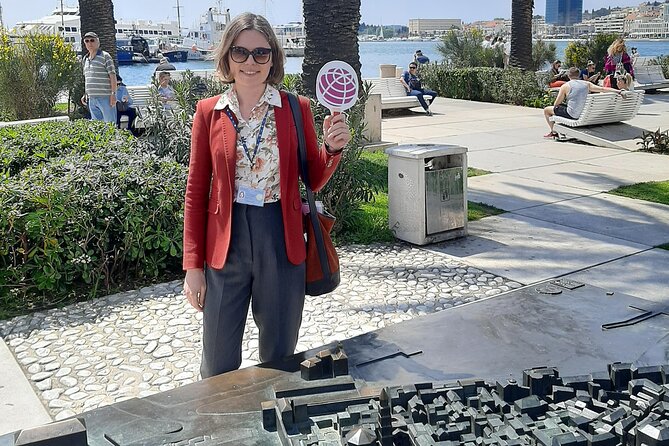
- Sanja leads the walk: She is a licensed local guide with a master’s degree, and her clear English and child-friendly pace are repeatedly praised.
- The substructures cost extra: Plan on €10 per person if you want to enter the best-preserved part of the palace.
- Private groups up to 15: The $156.19 price is for the group, not each person, so the value improves with several people sharing it.
- A full tour of Split’s eras: The route includes Roman, medieval, Venetian, French, and Austrian landmarks.
- Morning is useful: The walk starts at 9 a.m., and the fish market is open only in the morning.
Why this walk makes sense in Split
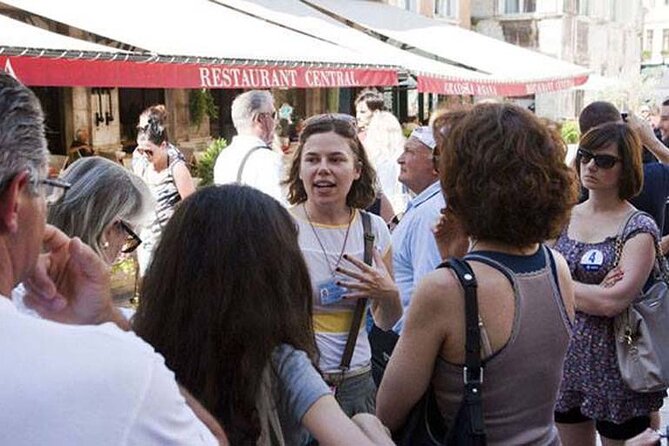
Split can feel confusing at first. The Roman palace walls are mixed into the later town so thoroughly that you may pass an ancient column on the way to breakfast without realizing what you are seeing. A local guide helps you separate the emperor’s residence from the medieval additions and shows how both continue to function today.
This is not just a palace tour. The route covers the Riva harbor, Diocletian’s Palace, the cathedral, medieval squares, the fish market, Marmontova Street, and Prokurative. In about one hour and 45 minutes, you get a useful map of central Split and a timeline that runs from the Roman Empire to the 19th century.
The tour works best at the start of your stay. You finish where you began on the Riva, with a better sense of which lanes lead inland, where the old center ends, and which areas you may want to revisit on your own.
The $156.19 charge covers a private group of up to 15 people. For one or two people, that is a substantial cost compared with a shared walk. For a family or a larger group, the amount can be quite reasonable, especially since the guide can adjust her pace and answer your own questions.
More old town history walks in Split:
- Split: Old Town and Diocletian Palace Walking Tour
★ 4.9 · 4,727 reviews - Walking Tour of Split with a ‘Magister’ of History
★ 5.0 · 1,122 reviews - Split Walking Tour with Professor of History
★ 5.0 · 926 reviews
Beginning on the Riva with the palace in view
The meeting point is at Obala Hrvatskog narodnog preporoda 22 on the Riva promenade. This is a smart place to begin because you can see several layers of Split at once: the waterfront, the Roman palace, the medieval town, and Marjan hill and park beyond.
The opening stop is brief, about five minutes, but it gives the rest of the walk a visual frame. The tour also ends here, which makes the meeting point easy to remember and convenient for continuing along the waterfront afterward.
At the palace, expect a short orientation rather than a long stop. The main value comes from learning how the roughly nine-acre complex is organized and how Roman construction has been absorbed into modern Split.
You are walking on city streets, not moving through a quiet archaeological park. That is part of the appeal, but it also means the experience depends on your guide’s ability to point out details that you might otherwise miss.
The substructures reveal the palace below street level
The palace substructures are the most important paid stop. Entrance is not included, and the fee is €10 per person. If you are deciding where to spend extra money in Split, this is the added visit I would consider most carefully.
These underground rooms are the best-preserved part of Diocletian’s Palace. Their layout helps explain how the palace above was built, how its rooms were supported, and what purpose different spaces served.
The internal visit is scheduled for about 20 minutes. That is enough for an informed introduction, though not a long archaeological study. If you are interested in Roman engineering, architecture, or the way later city life developed over ancient foundations, this portion gives the palace more meaning.
The extra fee is the clearest cost to remember. The rest of the listed stops are exterior or included in the walk, but the substructures require payment. If someone in your group prefers to avoid enclosed or underground spaces, ask about the route before booking, since this is a central part of the plan.
Inside the emperor’s ceremonial spaces
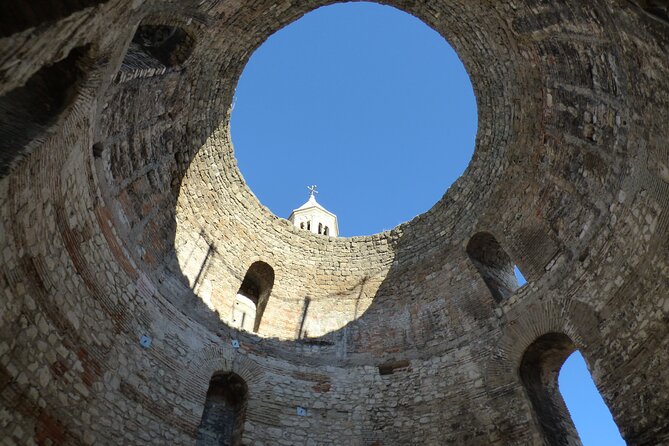
The Cathedral of Saint Domnius is viewed from outside. Its importance comes from the unusual way Roman and Christian history meet here: the cathedral occupies the emperor’s mausoleum, making Diocletian’s burial site part of a functioning Catholic landmark.
The stop lasts about five minutes, so you should not expect a full cathedral visit or a climb of the bell tower. Instead, Sanja explains what you are seeing and places the building within the palace plan.
The nearby Triklinij marks the former emperor’s apartment area, with particular attention to the dining hall complex. It is another short stop, but it helps you picture the palace as a residence and ceremonial setting rather than only a military or political structure.
At the Vestibulum, you hear about the importance of this part of the imperial chambers. Its shape also gives the site excellent acoustics. During summer, traditional Dalmatian singing may take place here, though that is a seasonal possibility rather than a guaranteed part of the tour.
More walking tours in Split:
- Walking Tour of Split and Diocletian’s Palace
★ 5.0 · 2,588 reviews - Krka Waterfalls tour with Trogir Walking tour and Krka panoramic boat cruise
★ 5.0 · 1,659 reviews - Split & Diocletian’s Palace Walking Tour
★ 5.0 · 1,125 reviews - Split: Diocletian Palace & Old Town Guided Walking Tour
★ 4.7 · 882 reviews
The Peristyle is the visual center of the walk
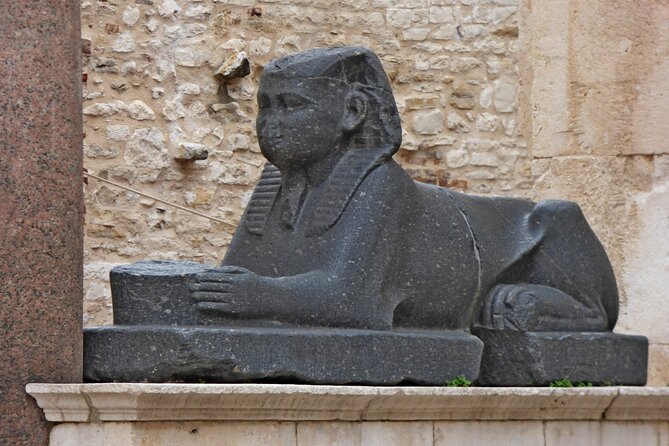
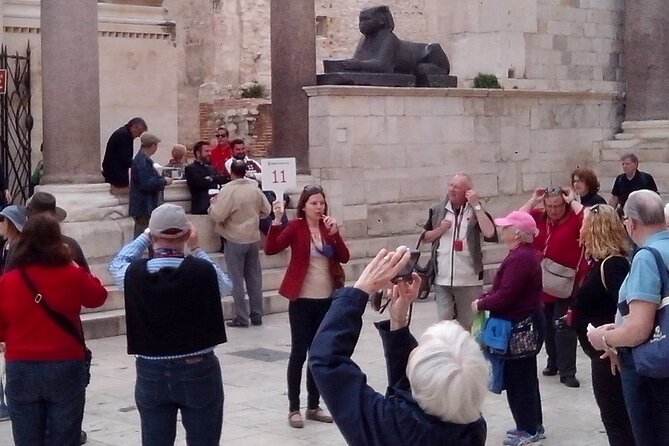
The Peristyle is the palace’s imperial square and one of the strongest moments on the route. Here you can look toward the former mausoleum, now the cathedral with its bell tower, and see an original Egyptian sphinx.
This stop lasts about ten minutes, enough time to understand the square’s role and take in the setting. It is also where the scale of Diocletian’s project becomes easier to grasp. The surrounding stone is not a reconstruction made for visitors. It is part of the city’s working center.
The Temple of Jupiter is viewed from outside. This was the place where the chief Roman god was worshipped, and its position helps explain the religious side of the palace complex.
The tour then moves through the Golden Gate, the palace’s main entrance. From outside, you can admire the fortifications and see how imposing the original approach must have been. The stop is short, about five minutes, so Sanja’s explanation matters more than a long period of free exploration.
From Roman walls to medieval Split
The Grgur Ninski statue is a quick stop, only about two minutes, but it is an iconic Split sight. The gigantic figure gives the route a change of scale after the compact palace streets.
From there, the walk moves into Narodni Trg, the main square of medieval Split. This is where the story shifts from imperial Rome to the later town that grew around and within the palace.
The Old Town Hall on Pjaca square represents the period when Split was under the Republic of Venice. Again, this is an exterior viewing stop, only about two minutes, but it helps you read the architecture as part of a changing political story.
Fruit’s Square, also called Trg Braće Radić, adds more medieval context. You see a large tower that once formed part of the town’s fortifications and hear about the noble families who shaped local life. The Marko Marulić sculpture is nearby, giving the square a literary connection as well as a historic one.
These stops are useful because they prevent the palace from taking over the entire story of Split. The city did not stop being Roman. It kept changing, with new rulers, new public spaces, and new buildings layered onto the old plan.
Markets and 19th-century Split
The Split Fish Market is visited or passed, depending on its opening hours. It has occupied the same location since the 19th century and is open only in the morning.
That makes the 9 a.m. start especially practical. You have a better chance of seeing the market as part of the city’s daily rhythm, rather than finding it closed later in the day. The tour does not promise a market tasting or shopping stop, so think of it as a cultural and local-life detail within the larger walk.
Marmontova Ulica brings you into the period when Split was under French rule in the 19th century. Walking along this street gives the tour another change in mood and urban design.
The final major stop is Prokurative, the famous square associated with Split’s time within the Austro-Hungarian monarchy. By this point, the route has carried you through Roman imperial power, medieval town life, Venetian rule, French administration, and Austrian influence.
That sweep is one of the tour’s best features. You are not simply ticking off monuments. You are learning how the same compact center changed hands and purpose over many centuries.
Sanja’s guiding style and pace

Sanja is described as a professional local guide with a master’s degree. The most useful praise concerns her clear English, strong command of local history, friendly manner, and ability to manage time well.
That matters on a route with 17 listed stops. A guide who gives too much detail can turn a short city walk into a lecture, while one who rushes can leave you with names but no understanding. Sanja’s approach appears to aim for the middle: enough context to make the buildings meaningful, with a pace that also works for children.
The private setup gives you room to ask about restaurants, drinks, and places to explore after the walk. Those tips may be more useful than another paragraph about dates and rulers, especially if this is your first time in Split.
The tour is offered for English, French, Italian, and Spanish according to its title, but the feature information specifically lists English. If you need French, Italian, or Spanish, confirm the language before paying. That small check can prevent a major disappointment.
Timing, comfort, and practical value
The walk begins at 9 a.m. and lasts approximately one hour and 45 minutes. That start time helps with the fish market and gives you the rest of the day for independent sightseeing.
The itinerary is tightly planned. Individual stops range from two to 20 minutes, and the total timing leaves little room for a long coffee break or extended shopping. You should arrive ready to walk and listen, not expecting a loose stroll with frequent pauses.
The experience is near public transportation, and most people can participate. Service animals are allowed. It is a private activity, so only your group joins the guide, with a maximum of 15 people.
The weather policy is worth noting. The tour requires good weather, and if the provider cancels because conditions are poor, you are offered another date or a full refund. If you cancel for your own reason or request a change, the booking is non-refundable and cannot be amended.
Who will get the most from this tour
I would recommend this walk to first-time visitors who want a clear introduction before exploring Split alone. It is also a strong choice for families because the route changes subject often, and the guide’s pace has been praised as suitable for children.
History-minded visitors will value the substructures, Peristyle, Temple of Jupiter, and mausoleum. Architecture fans will appreciate seeing how a Roman palace continues to function as part of a modern city.
A private group also makes sense for friends or relatives with different interests. One person can ask about Roman buildings, another can ask about food and evening plans, and nobody has to worry about slowing a large shared group.
I would be more cautious if you want a long visit inside every major sight. The cathedral, Temple of Jupiter, and Old Town Hall are external stops, and the substructures receive about 20 minutes. This is an orientation walk with selected visits, not a series of full museum tours.
Should you book the Split private walk?
Book it if you want a strong first look at Split, prefer a private guide, and value context over simply collecting photographs. Sanja’s clear explanations, local perspective, and well-managed pace are the main reasons to choose it.
The price is easiest to justify for a group of four or more, since $156.19 covers up to 15 people. Add €10 per person for the palace substructures, and confirm your preferred tour language in advance.
Skip it if you already know Split’s Old Town well, want a slow self-guided wander, or need a flexible booking that can be changed freely. For most first visits, though, this is a sensible way to understand why Split feels Roman, medieval, Venetian, French, and modern all at once.
FAQ
Where does the tour begin?
It begins at Obala Hrvatskog narodnog preporoda 22 on the Riva promenade in Split.
What time does the tour start?
The scheduled start time is 9 a.m.
How long does the walking tour last?
The tour lasts approximately one hour and 45 minutes.
Is the tour private?
Yes. Only your group participates, with up to 15 people included in the group price.
Is entrance to the palace substructures included?
No. Entrance costs €10 per person and is paid separately.
What language is the tour offered in?
The tour title lists English, French, Italian, and Spanish. The feature information specifically lists English, so confirm your preferred language before booking.
What happens if the weather is bad?
If the provider cancels because of poor weather, you can choose another date or receive a full refund. The experience is otherwise non-refundable and cannot be changed for personal cancellation or amendment requests.
Just added around Split
- Kayaking & Zipline Šibenik – Čikola Canyon★ 5.0 · 3 reviews
- Krka National Park & Zipline Šibenik – Čikola Canyon★ 5.0 · 3 reviews
- Split: Small-Group Half Day Sailing Trip★ 5.0 · 3 reviews
- Rafting River Cetina from Makarska Riviera including transfer★ 5.0 · 3 reviews
- From Split: Krka National Park & Waterfalls Private Day Trip★ 5.0 · 3 reviews
- Split Bike and Wine Experience★ 5.0 · 3 reviews
- Split and Salona Cultural Heritage Day Tour from Trogir★ 4.0 · 3 reviews
- Krka Waterfalls, Lake Cruise & Skradin★ 5.0 · 3 reviews
Old Town & History Tours, compared.


Walking Tour of Split with a ‘Magister’ of History
Read our review →

Diocletian Palace & Old Town Guided Walking Tour
Read our review →

Diocletian’s Palace and Old Town SMALL GROUP Walking Tour
Read our review →

Split History and Gastro Small-Group Tour with Food and Drinks
Read our review →Browse the lists this tour appears in