
Reviewed · OLD TOWN & HISTORY TOURS
Private History Split Walking Tour in Spanish
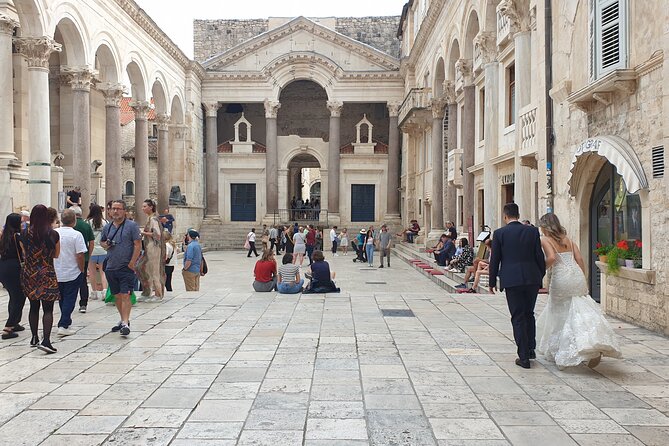
Split’s old center is not a museum set apart from modern life. It is a Roman palace still used as the heart of Split, with cafés, shops, homes, churches, and laundry tucked among ancient stones. This private Spanish-language walk gives you the story that links those pieces together, from Diocletian’s rise to power to the palace’s later life as a city.
I like the private format, since your group can ask questions without competing with a crowd. I also like the route’s range: you get the Roman core, medieval and Venetian Split, the Riva harbor, and the city’s Jewish heritage in one short walk. The main consideration is the price, $63.05 per person, plus the fact that high steps can be difficult for some visitors.
In This Review
- Key points
- Why Diocletian’s Palace Works Best With a Story
- Peristyle and the Roman Temple of Jupiter
- The Palace Substructures and What They Reveal
- Golden Gate and Gregory of Nin
- Riva Harbor and the View Beyond the Palace
- Fruit’s Square and Split’s Venetian Chapter
- The Split Synagogue and Jewish History
- Vestibule and Traditional Dalmatian Sound
- What $63.05 Means for the Value
- Timing, Walking Conditions, and Who Should Book
- Should You Book This Spanish Split Tour?
- FAQ
- Is this a private tour in Spanish?
- How long does the tour last?
- Where does the tour begin?
- Where does the tour end?
- Are admission tickets included?
- Can I cancel for a full refund?
Key points
- A 90-minute private tour in Spanish keeps the pace focused on your own group.
- Diocletian’s Palace is still a living city, not simply an archaeological site.
- The route connects Roman, Venetian, Croatian, and Jewish history in a compact area.
- The Substructures are explained but the museum section is not included, so you can visit it separately.
- The tour often sells about 115 days ahead, so early booking makes sense for a fixed date.
- A 4.9 out of 5 rating from 31 ratings and a 97 percent recommendation rate point to consistently strong guide performance.
Why Diocletian’s Palace Works Best With a Story
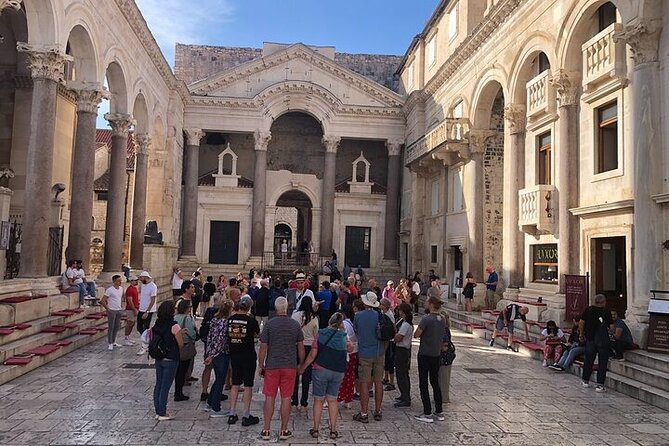
The palace can feel confusing at first. Streets twist through Roman walls, the Peristyle opens suddenly between narrow lanes, and modern buildings sit directly on ancient foundations. A guide helps you understand that this is not a collection of unrelated sights. It is one layered place.
The central story is Emperor Diocletian himself. The tour explains how a man who began with little status rose to become the most powerful man in the Roman world. That personal arc gives the palace a useful human focus. You are not just looking at columns and stone blocks. You are seeing the home and retirement project of an emperor who planned a fortified residence on the Adriatic.
The Spanish-speaking format matters if Spanish is the language in which you prefer to ask questions and absorb dates, names, and political details. Since this is a private activity, you can pause when a point catches your interest or ask for a clearer explanation without slowing down a large group.
Ancient Tours provides the guide, described as well educated and well liked, but no guide’s name is supplied in the tour details. One Spanish-language rating specifically praises the guide’s attentiveness, clear explanation of the palace and emperor, solid Spanish, and willingness to answer questions. That is exactly what you want in a short history walk.
More old town history walks in Split:
- Split: Old Town and Diocletian Palace Walking Tour
★ 4.9 · 4,727 reviews - Walking Tour of Split with a ‘Magister’ of History
★ 5.0 · 1,122 reviews - Split Walking Tour with Professor of History
★ 5.0 · 926 reviews
Peristyle and the Roman Temple of Jupiter
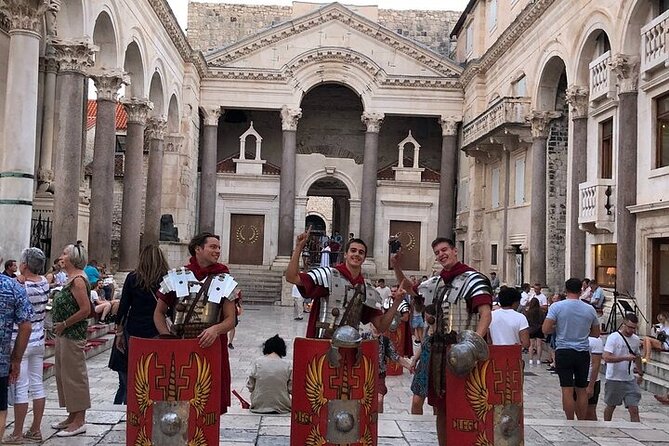
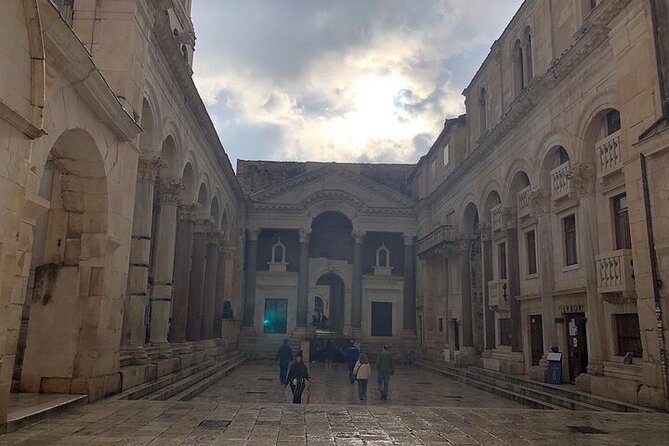
The tour begins on Peristil ulica, at the Peristyle, the main square of Diocletian’s Palace. Allow yourself a little extra time to find the meeting point, since the old center’s lanes can be hard to read on a first visit.
The Peristyle is the palace’s natural orientation point. From here, routes lead toward the emperor’s apartments, the cellars, the gates, and the Vestibule. The guide uses the square to explain the original layout and to show how the Roman plan still shapes Split today.
You spend about 15 minutes here. That may sound brief, but the square is a strong opening because it gives you the basic map before the walk moves into tighter spaces. Look up as well as around. The surrounding stonework and monumental proportions make more sense once you know this was the ceremonial center of an imperial residence.
The route also covers the Roman temple of Jupiter. Diocletian considered Jupiter his divine father, so the temple is not a random religious stop. It helps explain the emperor’s view of his own authority and the way Roman rulers tied political power to the gods.
The admission fee for this stop is listed as free. No separate ticket is included because the tour does not rely on paid entry here.
The Palace Substructures and What They Reveal
The Substructures are among the most useful stops for understanding the palace. You spend about 10 minutes walking through them while the guide explains how they were built and how their function changed over time.
These lower rooms mirror the layout above. That practical fact helps you picture the palace as an organized residence rather than a loose group of ruins. The substructure level also gives you a clearer sense of how much of the old complex remains beneath the present city.
There is an important limit. The tour passes through the substructures but does not include the museum section. You can visit that part after the walk if you want more time with the archaeological displays. This arrangement keeps the guided route within its 90-minute limit, but you should not assume that the museum is part of your ticket or schedule.
The substructures appear twice in the route description, but you should think of them as one main area rather than two separate museum visits. The practical value is the guide’s explanation of construction and later use, not a long independent stop among exhibits.
Golden Gate and Gregory of Nin
At the Golden Gate, the main entrance to the palace, you learn how people approached Diocletian’s residence and why the gate mattered. The stop lasts about 10 minutes, giving you time to take in the entrance without turning the visit into a long architectural lecture.
The gate is also where you see the statue of Gregory of Nin. The guide explains his importance to Croatian history and language, adding a national story to the Roman setting. This is a good change of pace. The palace is not only about an emperor from late antiquity. Its spaces have continued to carry meaning for Croatian identity.
The statue gives the stop a clear local connection. You may also find this section especially useful if you know little about Croatian history before arriving. Rather than treating Split as a Roman-only destination, the guide shows how later figures and cultural memory fit into the same streets.
More walking tours in Split:
- Walking Tour of Split and Diocletian’s Palace
★ 5.0 · 2,588 reviews - Krka Waterfalls tour with Trogir Walking tour and Krka panoramic boat cruise
★ 5.0 · 1,659 reviews - Split & Diocletian’s Palace Walking Tour
★ 5.0 · 1,125 reviews - Split: Diocletian Palace & Old Town Guided Walking Tour
★ 4.7 · 882 reviews
Riva Harbor and the View Beyond the Palace
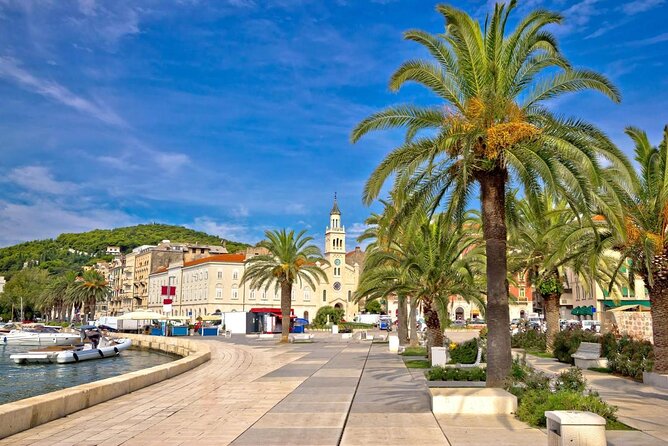
The walk continues to Riva Harbor, where you see a bronze model of Diocletian’s Palace and learn about the history of Split’s waterfront promenade. The stop lasts about 15 minutes, making it one of the longer pauses on the route.
The model is practical because it lets you see the palace as a whole. After walking through its lanes and rooms, you can step back and understand its relationship to the harbor. The waterfront also gives the tour a welcome change from enclosed stone passages.
I like this stop for orientation. The palace was built beside the sea, and the harbor remains part of Split’s daily life. You are not being pulled away from the historical center for a generic photo stop. You are seeing how the old imperial site connects to the city’s public waterfront.
The walk ends not far from where it starts, at Diocletian’s Palace. If you ask, the guide can take you back to the Peristyle. That is useful if you need to retrieve luggage, meet someone, or continue sightseeing from the original starting point.
Fruit’s Square and Split’s Venetian Chapter
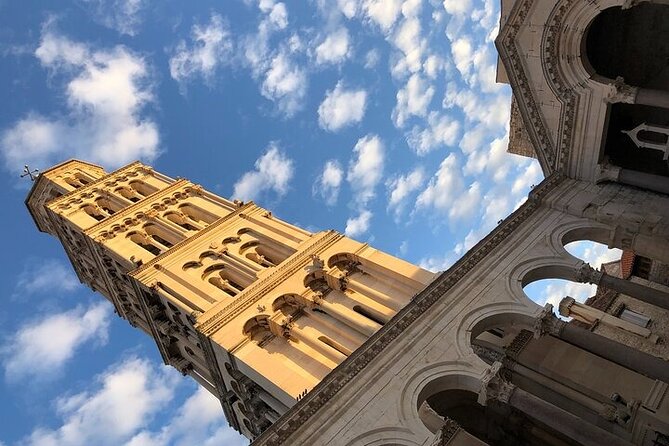
Fruit’s Square, officially Trg Braće Radić, adds a later chapter to the tour. Here you learn about a 15th-century Venetian citadel and the importance of Marko Marulić, often called the father of Croatian literature.
The stop lasts about 10 minutes. Its value is the contrast with the Roman material earlier in the walk. Split’s center did not stop changing after Diocletian. Venetian influence, local literature, trade, and civic life all left their mark.
Marko Marulić gives the square a strong cultural connection. If you are interested in how a country builds a literary identity, this is a useful introduction. The guide can place one of Croatia’s important writers within the physical setting of old Split rather than presenting him as a disconnected name.
The Venetian citadel also reminds you that the city’s defensive needs changed over time. The palace began as an imperial residence, but later generations adapted its spaces to new threats, governments, and daily uses.
The Split Synagogue and Jewish History
The tour passes by the 16th-century Split Synagogue and explains the history of the city’s Jewish community. About 10 minutes are devoted to this part of the route.
This stop broadens the story in a valuable way. Roman emperors and Venetian rulers are easy subjects for a city tour, but the lives of smaller communities can disappear unless someone points them out. The synagogue provides a direct link to the Jewish presence in Split and the changes that community experienced over time.
The synagogue is listed with no admission included. The route passes by it rather than promising a full interior visit, so you should treat this as an outside explanation and historical context, not a synagogue museum tour.
I appreciate the inclusion because it keeps the walk from becoming a parade of famous monuments only. Split’s past includes many communities, and this short stop gives one of them a place in the city’s story.
Vestibule and Traditional Dalmatian Sound
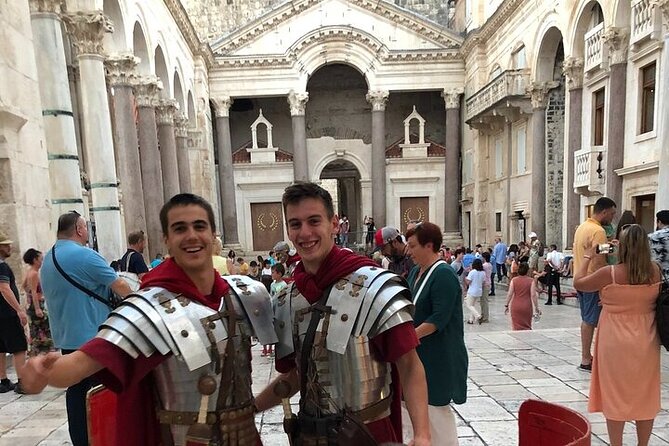
The Vestibule is the former entrance area to Diocletian’s apartments. You spend about five minutes here learning about its history.
The stop is short, but the space has a strong physical effect. Its shape and position help you picture how the emperor’s private quarters related to the ceremonial center. It also provides a chance to hear traditional Dalmatian singing, though that should be considered a possibility rather than a guaranteed performance.
That uncertainty is worth noting. If singing takes place during your visit, it can make the space feel closely tied to local culture. If it does not, the Vestibule remains an architectural stop within the palace story.
Because the tour covers many subjects in 90 minutes, the guide cannot spend long at every location. The benefit is variety. The tradeoff is that visitors who want detailed archaeology at each stop may prefer to return later on their own.
What $63.05 Means for the Value
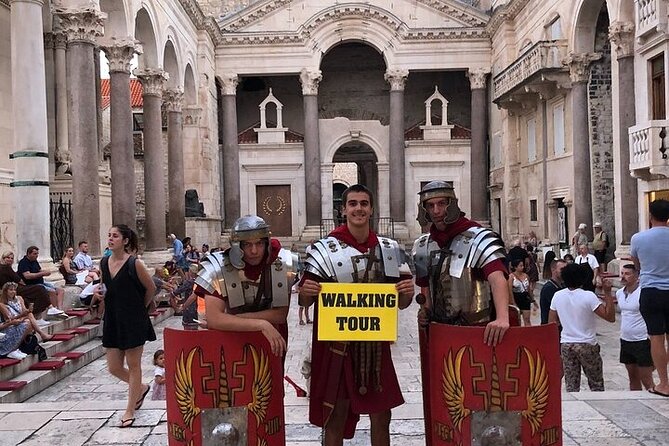
At $63.05 per person, this is not the cheapest way to see Split’s old center. The price makes the most sense for a small private group that wants Spanish-language explanation and the freedom to ask questions.
A standard group walk may cost less, but it can move at a set pace and give less room for personal interests. Here, your group has the guide to itself. That can be good value for couples, families, or friends who would rather pay more for a focused conversation than join a large crowd.
Group discounts are available, though the exact reduction is not specified. If several people are traveling together, check the final price before assuming the per-person figure tells the whole story.
The tour includes the guide but no gratuities and no admission tickets. Most listed stops are free, while the Substructures museum section is not part of the visit. You should budget separately only if you decide to enter a paid museum or attraction afterward.
The 4.9 out of 5 rating from 31 ratings, along with a 97 percent recommendation rate, suggests that the guide’s communication is the strongest part of the experience. The Spanish-language assessment is particularly useful: it highlights attentive service, clear history, good Spanish, and careful answers to questions.
Timing, Walking Conditions, and Who Should Book
The tour lasts about 1 hour and 30 minutes. That is enough time to get the main story and see the central sights, but not enough for a slow, detailed examination of every stone.
You should wear sensible shoes. The old center has uneven surfaces, and the tour information specifically warns that it is not recommended for people who have trouble with high steps. Most visitors can participate, and the route is near public transportation.
Service animals are allowed. The activity is private, so only your group participates. A mobile ticket is accepted, and confirmation is normally received within 48 hours, subject to availability.
The tour is a good fit for:
- Spanish-speaking visitors who want history explained in Spanish.
- First-time visitors who need a clear map of the palace.
- Families or couples who prefer a private guide.
- History-minded visitors who want more than Roman monuments.
- Groups willing to pay more for personal attention.
It may be a weaker fit if you want a long museum visit, a full interior tour of the synagogue, or a relaxed archaeological study of each site. It is also less suitable if high steps are a serious problem.
The experience often sells around 115 days ahead. That does not mean you must book four months early for every date, but it is a useful warning for summer trips and fixed itineraries. Free cancellation is available up to 24 hours before the start time. After that point, the payment is not refunded, and late changes are not accepted. The local time in Split controls the cutoff.
Should You Book This Spanish Split Tour?
I would book this tour if you want a short, private introduction to Split that moves beyond the Roman headline. The route covers the Peristyle, Jupiter’s temple, the Substructures, Golden Gate, Gregory of Nin, Riva, Fruit’s Square, the synagogue, and the Vestibule. That is a lot of ground in 90 minutes.
The strongest reason to choose it is the Spanish-speaking private guide. The high rating and the Spanish-language comments point to clear explanations and attentive answers, which matter more than fancy extras on a history walk.
I would skip it if you mainly want museum access or a long interior visit. In that case, use the walk as an orientation and plan extra time afterward for the Substructures museum.
For couples, families, and small groups who value personal attention, $63.05 can be fair. For solo visitors watching every kuna, euro, or dollar, the private-tour premium may be harder to justify. Book early if your Split schedule is fixed, wear shoes suited to steps, and ask the guide to return you to the Peristyle at the end if you need help finding your way.
FAQ
Is this a private tour in Spanish?
Yes. Only your group participates, and the tour is led by a Spanish-speaking guide.
How long does the tour last?
The walking tour lasts approximately 1 hour and 30 minutes.
Where does the tour begin?
It begins on Peristil ulica at the Peristyle of Diocletian’s Palace in Split.
Where does the tour end?
It ends at Diocletian’s Palace, not far from the starting point. The guide can take you back to the Peristyle if you ask.
Are admission tickets included?
No admission tickets or gratuities are included. The listed stops are generally free, and the museum section of the palace Substructures is not visited during the tour.
Can I cancel for a full refund?
Yes, if you cancel at least 24 hours before the experience start time. Cancellations made less than 24 hours before the start are not refunded, and late changes are not accepted.
Just added around Split
- Kayaking & Zipline Šibenik – Čikola Canyon★ 5.0 · 3 reviews
- Krka National Park & Zipline Šibenik – Čikola Canyon★ 5.0 · 3 reviews
- From Split: Krka National Park & Waterfalls Private Day Trip★ 5.0 · 3 reviews
- Split: Small-Group Half Day Sailing Trip★ 5.0 · 3 reviews
- Rafting River Cetina from Makarska Riviera including transfer★ 5.0 · 3 reviews
- Split and Salona Cultural Heritage Day Tour from Trogir★ 4.0 · 3 reviews
- Split Bike and Wine Experience★ 5.0 · 3 reviews
- Private transfer from Split to Dubrovnik with 2h sightseeing stop in Ston★ 5.0 · 3 reviews
Old Town & History Tours, compared.


Walking Tour of Split with a ‘Magister’ of History
Read our review →

Diocletian Palace & Old Town Guided Walking Tour
Read our review →

Diocletian’s Palace and Old Town SMALL GROUP Walking Tour
Read our review →

Split History and Gastro Small-Group Tour with Food and Drinks
Read our review →Browse the lists this tour appears in