
Reviewed · OLD TOWN & HISTORY TOURS
Private History Split Walking Tour in Italian – Small group
Diocletian’s Palace is not a silent ruin behind a fence. It is the working heart of Split, with homes, shops, cafés, lanes, and Roman walls folded into the modern city. This 90-minute private walk in Italian helps you read that complicated mix, from the emperor’s central square to the old harbor.
I like two things right away: the tour covers the main sights without wasting time on long transfers, and the private format lets your own group set the pace. I also like the human details, such as the story of Gregory of Nin, the old Jewish community, and the chance of hearing traditional Dalmatian singing in the Vestibule.
The main consideration is the short length. You will see many important places, but some stops last only five or ten minutes. The tour also does not include the museum section of the palace substructures, and high steps may be difficult for some people.
In This Review
- Key points at a glance
- Starting at the Peristyle, Split’s Roman front door
- The Vestibule and the sound of Dalmatia
- Seeing the palace from below in the substructures
- The Golden Gate and Gregory of Nin
- Riva Harbor and the city beyond the walls
- Venetian power and Croatian literature at Fruit’s Square
- The old Split Synagogue and a less familiar story
- What the Italian guiding adds
- Is $69.39 per person a fair price?
- Timing, walking conditions, and who should book
- Booking and cancellation details
- Should you book this Split walking tour?
- FAQ
- How long does the Private History Split Walking Tour last?
- Is the tour conducted in Italian?
- Where does the tour start and end?
- Does the tour include admission to the palace substructures museum?
- Are entrance tickets included?
- Can I cancel for a full refund?
Key points at a glance
- Italian-speaking private guide: Your group participates alone, with guides such as Maria and Doris among those praised for clear, warm presentations.
- Seven central stops: The route links the Peristyle, Vestibule, substructures, Golden Gate, Riva, Fruit’s Square, and Split Synagogue.
- A useful first look at Split: The walk gives you the city’s Roman, medieval, Venetian, literary, and Jewish layers in one compact outing.
- Ancient palace beneath a living city: You move through spaces that still function as part of everyday Split, rather than visiting an isolated archaeological site.
- Free cancellation up to 24 hours ahead: A full refund is available when you cancel at least 24 hours before the scheduled start.
- Good value for a private experience: At $69.39 per person, the price makes the most sense for couples, families, or small groups who want Italian explanations and a personal guide.
Starting at the Peristyle, Split’s Roman front door
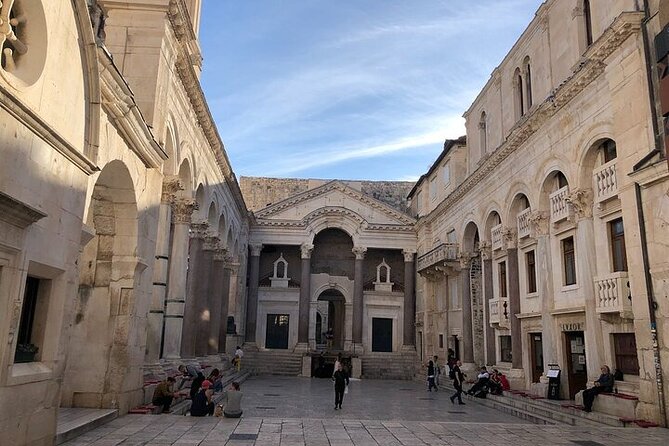
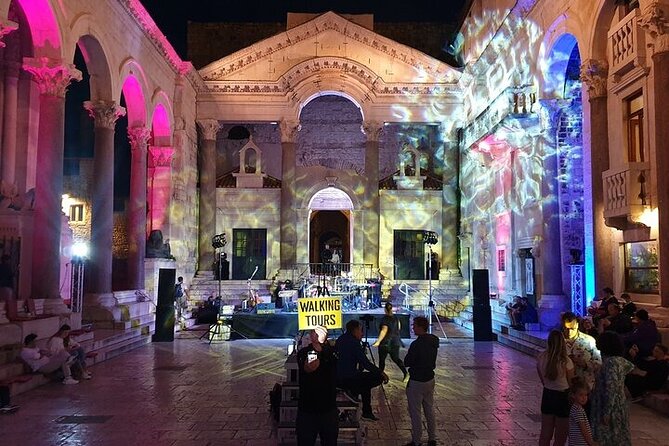
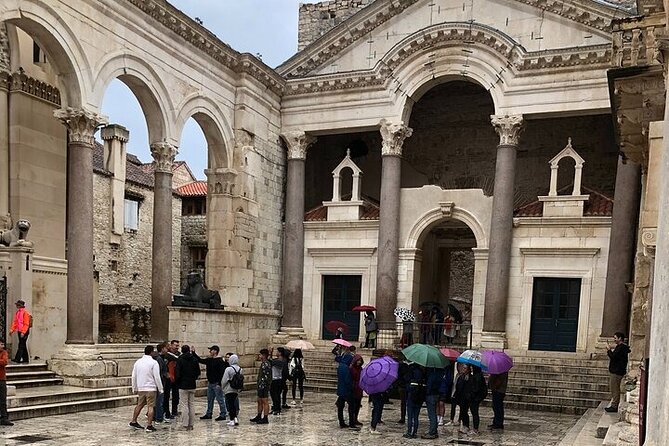
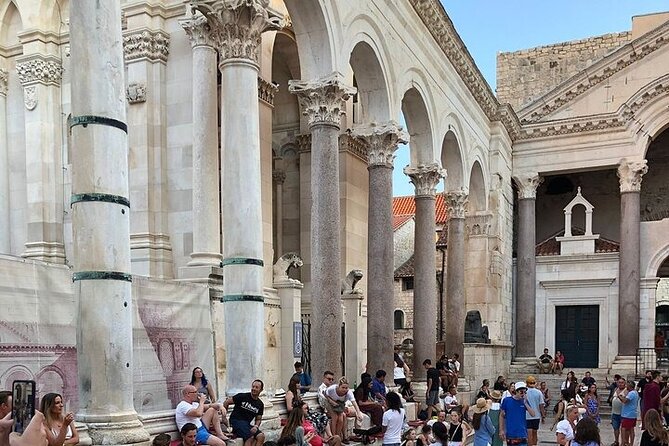
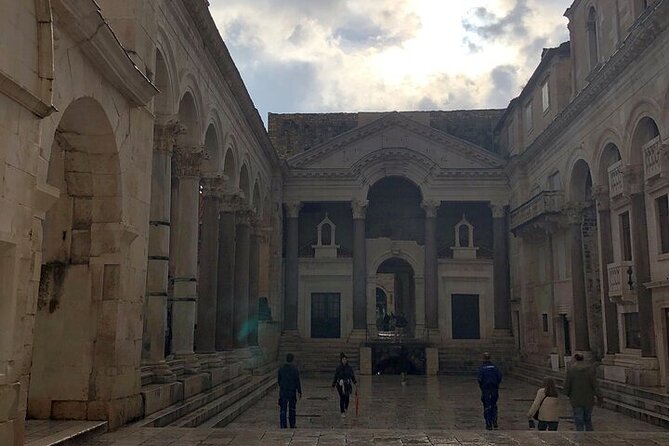
Meet on Peristil ulica at the Peristyle, the central square of Diocletian’s Palace. This is the right place to begin because the square acts as the palace’s main crossroads, with routes leading toward the emperor’s apartments, gates, cellars, and the modern streets of Split.
The Peristyle is also where the tour’s main story begins: how Diocletian rose from an obscure background to become one of the most powerful men in the Roman world. That personal rise gives the tour a useful thread. You are not just looking at columns and old stone. You are learning why this particular emperor built such a large residence and how his retirement palace helped shape the city that followed.
You will spend about 15 minutes here. That is enough time for an introduction and orientation, though it is not enough for every architectural detail. I would use this stop to ask your guide to point out the difference between the palace’s original Roman purpose and the later buildings that now fill its spaces.
Because the Peristyle is an open public square, admission is free. It can also be a busy place, so stay close to your guide and make sure you know the meeting point before the walk begins.
More old town history walks in Split:
- Split: Old Town and Diocletian Palace Walking Tour
★ 4.9 · 4,727 reviews - Walking Tour of Split with a ‘Magister’ of History
★ 5.0 · 1,122 reviews - Split Walking Tour with Professor of History
★ 5.0 · 926 reviews
The Vestibule and the sound of Dalmatia
The Vestibule sits inside the palace and once formed part of the approach to the emperor’s private quarters. The stop is brief, about five minutes, but it offers one of the tour’s more memorable possibilities: you may hear traditional Dalmatian singing.
That musical tradition matters because it connects the stone architecture to local life. A guide explaining the room in Italian can give you the basic history, while the singing, if it happens during your visit, adds a sense of place that a plaque cannot provide.
Do not expect a long concert or a formal performance. The information says you may hear singing, so treat it as a possible extra rather than a guaranteed feature. The Vestibule is also a place where a short explanation works better than a long lecture. Look up at the shape of the room, listen for the sound, and let the guide explain how the space fitted into the palace.
Seeing the palace from below in the substructures
The substructures are one of the most useful stops for understanding Diocletian’s Palace. You will pass through the lower levels and hear how they were built and how their function changed over time.
These rooms help explain the palace above. Ancient builders used the lower structure to support the emperor’s residence and create a stable base. Later generations used the spaces in other ways. That change is central to Split: the palace did not remain frozen after Diocletian. It became part of the town.
The visit here lasts about ten minutes. The important limitation is that this tour does not include the museum section of the substructures. You can visit that part after the walk, but you should plan separately if you want a longer archaeological visit.
This stop may include high steps, and the tour specifically warns that it is not a good choice for people with problems handling them. Wear shoes that give you a firm footing. The palace has uneven surfaces and old stone underfoot, so comfort matters more than fashion.
The Golden Gate and Gregory of Nin
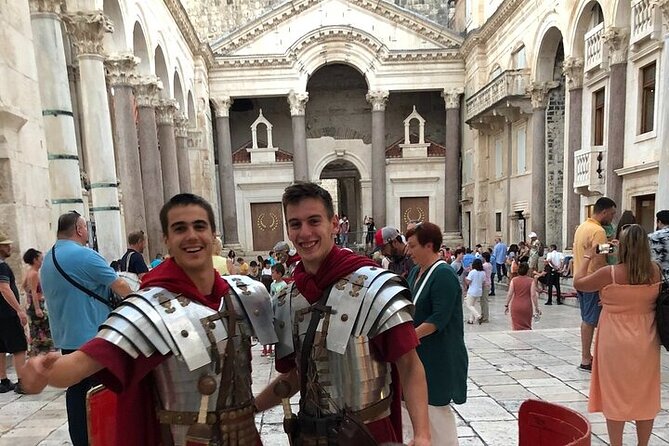
The Golden Gate was the palace’s main entrance. It is one of the best places to think about the palace as a fortified complex, not merely an imperial home.
Your guide will also introduce you to the statue of Gregory of Nin, an important figure in Croatian history and language. The stop adds a later national story to the Roman one. That is a strong feature of the route because Split’s identity was formed across many periods, not in a single Roman chapter.
You will spend about ten minutes here. The stop is free, and the gate is easy to connect with the modern city because people still pass through and around it. Pay attention to how the old entrance meets ordinary streets. That contact between ancient walls and daily life is one of the best reasons to take a walking tour rather than simply view the palace from a map.
More walking tours in Split:
- Walking Tour of Split and Diocletian’s Palace
★ 5.0 · 2,588 reviews - Krka Waterfalls tour with Trogir Walking tour and Krka panoramic boat cruise
★ 5.0 · 1,659 reviews - Split & Diocletian’s Palace Walking Tour
★ 5.0 · 1,125 reviews - Split: Diocletian Palace & Old Town Guided Walking Tour
★ 4.7 · 882 reviews
Riva Harbor and the city beyond the walls
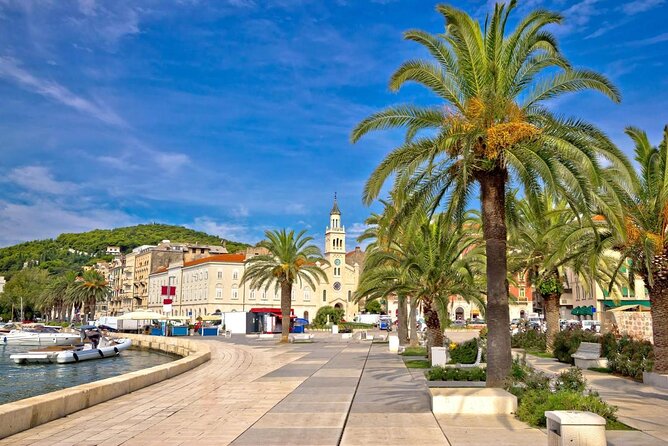
At Riva Harbor, the tour steps outside the palace core and places it beside Split’s waterfront. You will see a bronze model of Diocletian’s Palace and learn about the history of the Riva promenade.
The model is especially helpful after the interior stops. From ground level, the palace can feel like a puzzle of narrow lanes and partial walls. A three-dimensional view gives you a clearer sense of its overall shape and position beside the sea.
This stop lasts about 15 minutes, tied with the Peristyle for the longest part of the route. That extra time makes sense. Riva is not just a place for a quick photograph. It helps you understand how the palace relates to the wider city.
I would save a few questions for here. Ask your guide how the palace connects to the harbor and how Split grew around the Roman core. The tour’s value comes from these connections, not simply from collecting seven separate stops.
Venetian power and Croatian literature at Fruit’s Square
Fruit’s Square, officially Trg Brace Radic, brings in two more chapters of Split’s past. You will see a 15th-century Venetian citadel and learn about Marko Marulić, often called the father of Croatian literature.
The square is a good reminder that Split was shaped by later powers and local voices as well as Roman emperors. The Venetian fortification points to the city’s strategic importance, while Marulić connects the place to Croatian language and writing.
The stop lasts about ten minutes. It is a compact lesson, but it gives the walk a wider range than a palace-only tour. You move from imperial architecture to defense, literature, and civic life.
This is also a good point to notice how little of Split’s old center behaves like a conventional museum. The historical material is spread through public squares and working streets. A guide makes those connections visible without asking you to spend the whole day indoors.
The old Split Synagogue and a less familiar story
The final listed stop is the Split Synagogue, where you pass by a 16th-century synagogue and learn about the history of the city’s Jewish people.
The wording matters: you pass by the synagogue rather than enter it. Admission is not included, and the tour description does not promise an interior visit. Consider this a short introduction to a community that forms an important part of Split’s past, not a complete study of the synagogue itself.
The stop takes about ten minutes. It is valuable because many quick city walks focus only on emperors, churches, and Venetian defenses. This route makes room for a social history that is easier to miss when you explore alone.
The tour ends back at the meeting point. That makes it simple to continue your own visit afterward, perhaps by returning to the palace substructures museum or revisiting a square that caught your attention.
What the Italian guiding adds
The tour is designed for Italian speakers, and guide quality matters here. A history walk can become a list of dates if the explanation is stiff or hard to follow. The strongest feedback points to guides who speak Italian well, explain clearly, and bring humor and personality to the walk.
Maria and Doris are names associated with especially strong guide comments. Doris is praised for explaining both Split and Diocletian’s Palace in a professional and interesting way. Maria is noted for helping Italian-speaking visitors understand the city’s history. Guide assignments can vary, so you should not assume you will receive one particular person, but these names give you a sense of the standard the provider aims for.
The tone also seems important. Several comments describe the guide as kind, engaging, funny, and passionate about Split. That matters on a private walk because you have more room to ask questions than you would in a large public group.
Is $69.39 per person a fair price?
The cost is $69.39 per person, with group discounts available. For a standard group walk, that would be a high price for 90 minutes. For a private activity in Italian, the value is easier to defend, especially if two or more people can share the guide experience while keeping the group private.
You are paying for three things:
- A guide who can explain the sites in Italian
- A planned route through the major historic areas
- A private format with only your group participating
You are not paying for museum admission, a meal, transport, or a long archaeological visit. The substructures museum is outside the tour, the synagogue stop does not include admission, and gratuities are not included.
I would book this when language access and personal attention are important. If you are comfortable exploring in English or on your own, you can see much of the same central area without this expense. But if you want the history explained in Italian and prefer to ask questions as you go, the private setup gives the price a practical purpose.
Timing, walking conditions, and who should book
The stated operating period runs daily from 9:00 a.m. to 8:00 p.m., from December 31, 2023, through June 17, 2026. Your booking confirmation is issued within 48 hours, subject to availability.
The route is near public transportation, and most people can take part. Service animals are allowed. The main physical warning concerns high steps, so this is not the best choice if stairs or uneven old paving cause trouble.
At only about 90 minutes, the walk works well as a first orientation after arriving in Split. It also fits neatly into a day when you want time for the waterfront, restaurants, museums, or independent wandering.
I would choose it for:
- Italian-speaking couples and families
- Small groups who want a private guide
- First-time visitors who want the main Roman and later landmarks explained
- People who enjoy local stories as much as architecture
- Visitors with only part of a day in Split
I would look for a longer or more specialized visit if you want an extensive museum tour, detailed archaeology, or a full interior visit to the synagogue.
Booking and cancellation details
You receive confirmation within 48 hours, subject to availability. The tour requires a minimum number of participants, so if the provider cancels because that number is not reached, you will be offered another date or experience, or receive a full refund.
You can cancel for a full refund up to 24 hours before the local start time. Cancellations or changes made less than 24 hours before the start are not refunded or accepted.
Should you book this Split walking tour?
Book it if you want a short, private introduction to Split in Italian, with a guide who can explain the palace as part of a living city. The route has a sensible shape, the stops cover more than Roman ruins, and the guide’s storytelling is the main reason to choose it.
Skip it if you want to spend hours inside the substructures museum, enter every building, or avoid steps. At $69.39 per person, it is best value for a small party that wants personal Italian guiding, not for someone simply seeking the cheapest way to see the palace.
FAQ
How long does the Private History Split Walking Tour last?
The tour lasts approximately 1 hour and 30 minutes.
Is the tour conducted in Italian?
Yes. It is a private history walking tour in Italian.
Where does the tour start and end?
It starts at Peristil ulica, Peristil ul., 21000 Split, Croatia, and ends back at the same meeting point.
Does the tour include admission to the palace substructures museum?
No. The route passes through the palace substructures, but the museum section is not included. You can visit it separately after the tour.
Are entrance tickets included?
The listed stops are free except for the Split Synagogue, where admission is not included. The tour also does not include gratuities.
Can I cancel for a full refund?
Yes. You must cancel at least 24 hours before the experience start time for a full refund. Changes or cancellations made less than 24 hours before the start are not accepted or refunded.
Just added around Split
- Kayaking & Zipline Šibenik – Čikola Canyon★ 5.0 · 3 reviews
- Krka National Park & Zipline Šibenik – Čikola Canyon★ 5.0 · 3 reviews
- From Split: Krka National Park & Waterfalls Private Day Trip★ 5.0 · 3 reviews
- Split: Small-Group Half Day Sailing Trip★ 5.0 · 3 reviews
- Rafting River Cetina from Makarska Riviera including transfer★ 5.0 · 3 reviews
- Split Bike and Wine Experience★ 5.0 · 3 reviews
- Split and Salona Cultural Heritage Day Tour from Trogir★ 4.0 · 3 reviews
- Private transfer from Split to Dubrovnik with 2h sightseeing stop in Ston★ 5.0 · 3 reviews
Old Town & History Tours, compared.


Walking Tour of Split with a ‘Magister’ of History
Read our review →

Diocletian Palace & Old Town Guided Walking Tour
Read our review →

Diocletian’s Palace and Old Town SMALL GROUP Walking Tour
Read our review →

Split History and Gastro Small-Group Tour with Food and Drinks
Read our review →Browse the lists this tour appears in