
Reviewed · OLD TOWN & HISTORY TOURS
Private History and Trivia Walking Tour by a Local Guide
Split’s old town is not a museum behind ropes. It is a living city built inside and around Diocletian’s Palace, with cafés in Roman walls, narrow lanes, medieval squares, and laundry hanging above ancient stone. This private walking tour gives you the story while you move through that wonderfully jumbled center.
I like the private format, which lets your guide adjust the pace and answer your questions properly. I also like the route’s variety: Roman ruins, Christian monuments, noble palaces, Croatian literary history, and useful local advice all fit into 1 hour and 45 minutes. The main consideration is that this is a brisk overview, not an in-depth visit inside every monument, and admission tickets are not included.
In This Review
- Key points about this Split walking tour
- Why this is a smart first look at Split
- Riva Harbor gives you the city’s big picture
- Roman engineering under the Palace
- Peristyle, the Cathedral, and the Temple of Jupiter
- Narrow lanes and Split’s noble families
- Gates, the City Museum, and a Game of Thrones connection
- The Golden Gate and Grgur Ninski
- Finishing on Marmontova Street
- Guide style, languages, and group size
- Timing, access, and what the price covers
- Who should book this experience?
- Should you book the Split private history tour?
- FAQ
- How long does the walking tour last?
- What is the price?
- Is this a private tour?
- What languages can the guide speak?
- Who is the guide?
- Where does the tour start?
- What sights are included in the route?
- Are admission tickets included?
- Can I cancel for a refund?
Key points about this Split walking tour
- Roman Split in a compact route: See the Riva, Palace substructures, Peristyle, cathedral, Temple of Jupiter, and ancient gates without wasting time on transport.
- A genuinely private experience: Only your group participates, with a maximum group size of 15 people.
- A guide who welcomes questions: Ivan, also identified as Yvan in French-language feedback, is praised for humor, patience, and detailed answers.
- More than Diocletian: The walk includes Croatian sculptor Ivan Meštrović, Marko Marulić, noble palaces, the City Museum, and Marmontova Street.
- Good for families: The stories have held the attention of children as young as 5 and 7, as well as older children.
- Useful for a short stay: The tour covers the main old-town sights in less than two hours and offers advice for planning the rest of your time.
Why this is a smart first look at Split
The best reason to take this tour early in your stay is orientation. Split’s center can feel confusing at first because the palace is not set apart from modern life. The remains of the emperor’s residence form the bones of the old town, so you need a guide to explain what belongs to the Roman period, what came later, and what is simply part of daily life now.
The route starts beside the Riva, Split’s seafront promenade. From here, you can see the southern wall of Diocletian’s Palace, the harbor, and the promenades running east and west along the coast. That opening view gives you a useful map before you enter the tight lanes.
A private guide also gives you a chance to ask practical questions. The guide is specifically expected to discuss local customs and offer suggestions for further sightseeing. That matters in Split, where a good introduction can help you decide how to spend the rest of the day.
The tour is listed at $53.95 per person. For one person, that is not a bargain-priced city walk. For a couple, family, or small group, the value improves because you are paying for a private guide rather than joining a large public group. Group discounts are available, and the private setup means you are buying flexibility and conversation as much as information.
More old town history walks in Split:
- Split: Old Town and Diocletian Palace Walking Tour
★ 4.9 · 4,727 reviews - Walking Tour of Split with a ‘Magister’ of History
★ 5.0 · 1,122 reviews - Split Walking Tour with Professor of History
★ 5.0 · 926 reviews
Riva Harbor gives you the city’s big picture
At the Riva, your guide points out the palace’s southern wall and explains the harbor and the two coastal promenades. You spend about 10 minutes here, with no admission ticket required.
This is a short stop, but it does useful work. The palace wall can look like part of the waterfront until someone explains its purpose and scale. Starting outside also helps you understand that Split’s Roman center was closely tied to the sea.
The Riva is open and easy to reach, while much of the old town ahead is narrow and enclosed. If you have mobility concerns, this is one of the least complicated parts of the walk. The rest of the route includes tight lanes and historic paving, so sensible shoes are a practical choice.
Roman engineering under the Palace
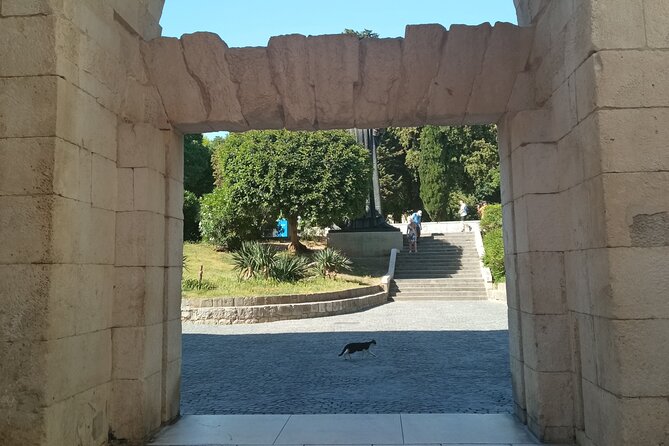
The walk enters the Palace through the Bronze Gate and continues into the substructures. You spend about eight minutes here, learning how these lower rooms served different purposes through the centuries.
The substructures are especially helpful for understanding the layout above. Roman builders created a strong lower level that supported the emperor’s apartments and ceremonial spaces. Later changes gave the rooms new uses, and the guide explains that shift as you pass through the main corridor.
This portion is valuable because a quick look at the upper walls alone can leave you with disconnected fragments. Below ground, the plan of the Palace becomes easier to read. The stop is brief, so do not expect a long archaeological lecture or a full visit to every underground room. It is a focused introduction.
Peristyle, the Cathedral, and the Temple of Jupiter
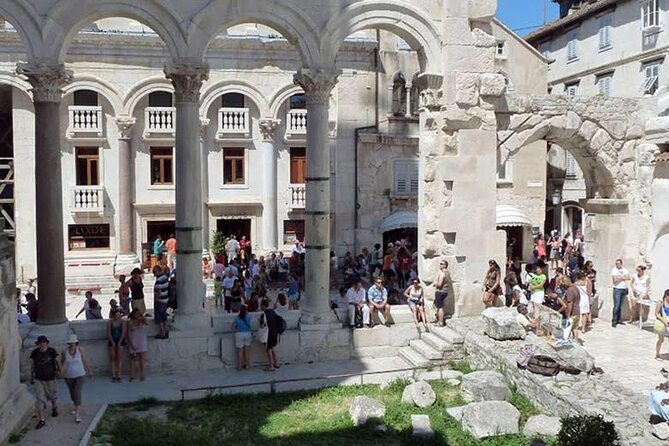
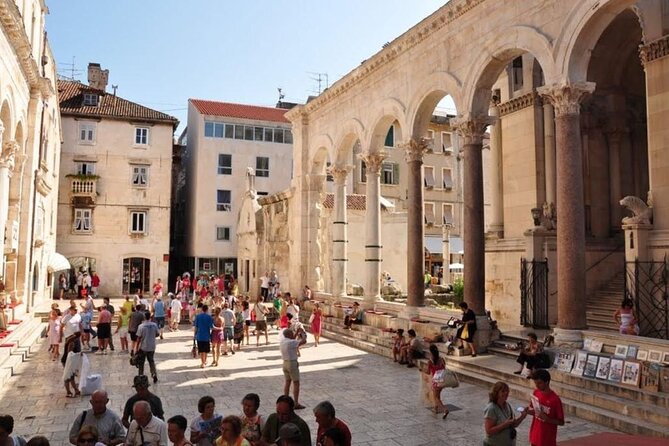
The Peristyle is the central ancient square of the Palace and one of the tour’s main moments. Your guide spends about 10 minutes here, explaining its cultural and historical role.
The square brings several eras together in one view. Roman columns and formal architecture frame a space now used by modern Split. This is where the guide’s storytelling matters most, since the stones alone cannot explain how the site changed from imperial setting to a working part of the city.
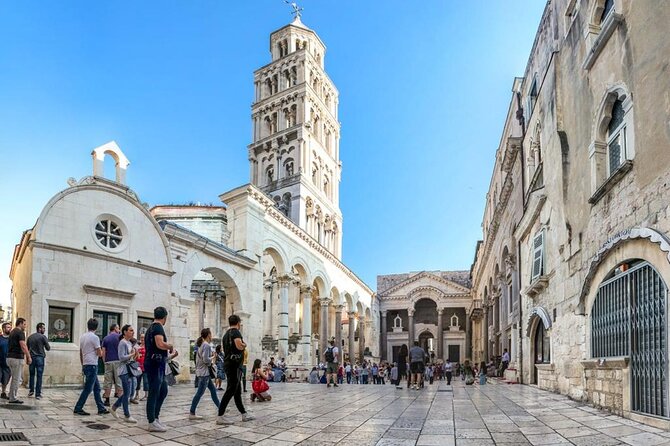
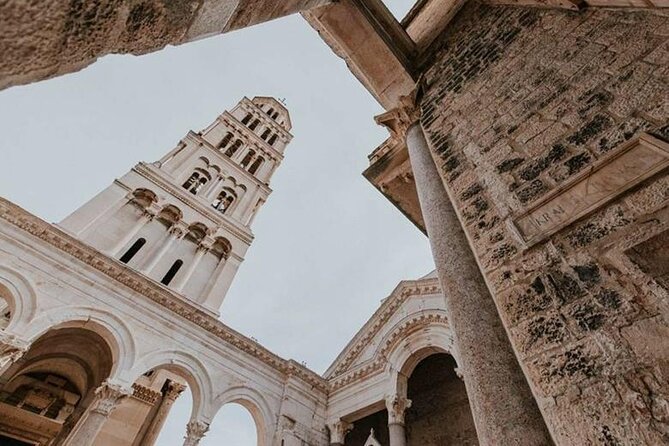
The next stop is the Cathedral of Saint Domnius, reached in about five minutes of explanation. The building began as Diocletian’s mausoleum and later became a cathedral. You also hear about the construction style of the cathedral and its adjacent bell tower.
This is one of Split’s clearest examples of reused architecture. The building’s original purpose and later Christian role are both essential to understanding the city. The stop lasts about five minutes, so the tour explains the transformation from outside rather than including a full paid visit to the cathedral or tower.
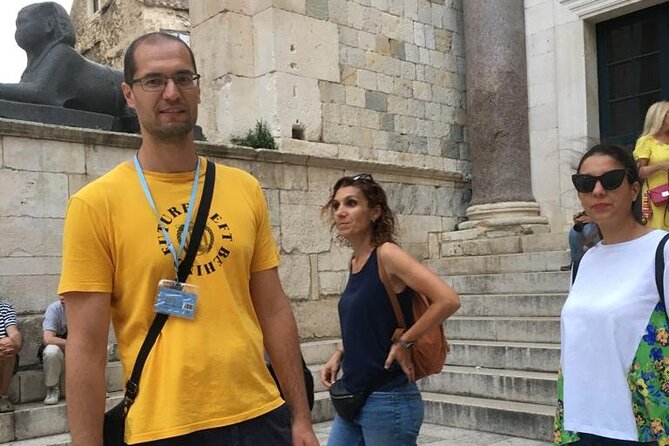
At the Temple of Jupiter, another five-minute stop shows how a Roman temple became a baptistery as Christianity spread through the Palace. The Egyptian sphinx in front adds a striking detail and gives the guide a chance to explain how objects from different cultures entered Diocletian’s world.
These three stops work well as a group: the imperial square, the emperor’s mausoleum turned cathedral, and the temple turned baptistery. You get a clear picture of how political and religious change reshaped the same buildings.
More walking tours in Split:
- Walking Tour of Split and Diocletian’s Palace
★ 5.0 · 2,588 reviews - Krka Waterfalls tour with Trogir Walking tour and Krka panoramic boat cruise
★ 5.0 · 1,659 reviews - Split & Diocletian’s Palace Walking Tour
★ 5.0 · 1,125 reviews - Split: Diocletian Palace & Old Town Guided Walking Tour
★ 4.7 · 882 reviews
Narrow lanes and Split’s noble families
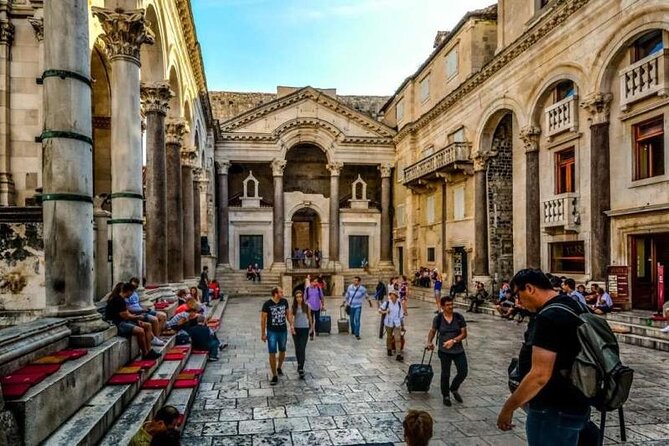
The route leaves the Peristyle through Pusti me Proć, described as the narrowest street in Split. It is a small but memorable change of scale. After the grand Roman square, you are suddenly walking through a lane where the old town feels close and personal.
Fruit’s Square, officially Trg Brace Radic, receives about seven minutes. Here the guide discusses Split’s development and the periods when the town expanded slowly. The stop also includes the statue of Marko Marulić, often called the father of Croatian literature, and the 17th-century Milesi family palace behind it.
The route then reaches Narodni trg, the main square also known as Piazza. You spend about 10 minutes learning how it became the town’s principal public square as Split grew beyond the Palace.
Along the way, your guide points out several noble residences, including a recently renovated palace, the old City Hall, another palace belonging to a noble family, and a palace from a Korčula family at the eastern end of the square. These buildings are easy to pass without notice. A guide turns a simple stroll into a lesson in how status, trade, and family power shaped the old town.
This section may appeal most to people who enjoy architecture and local social history. If you prefer only famous monuments, some of the palace facades may feel like quick stops. I find them worthwhile because they show Split beyond its Roman headline attraction.
Gates, the City Museum, and a Game of Thrones connection
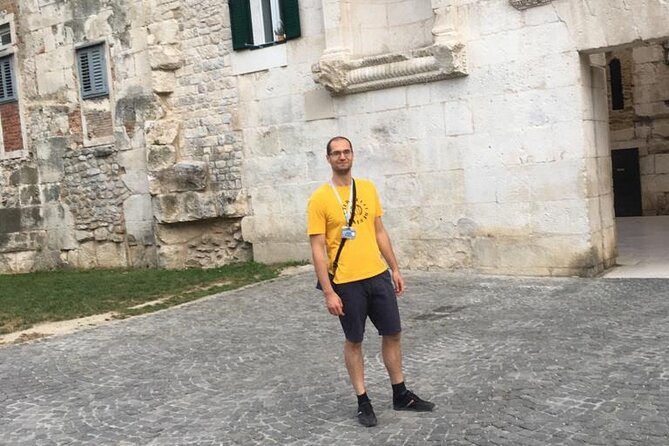
At Zeljezna Vrata, or the Iron Gate, the guide explains the gate’s changing role and the activities once held around it. The stop lasts about seven minutes and includes the oldest Roman church in Split.
The gates are useful reference points because they help you see how the Palace connected with the town around it. The Iron Gate is less grand than the Golden Gate, but its story is part of the city’s long transition from imperial residence to medieval and modern settlement.
You also pass the 17th-century Cindro family palace and a 15th-century palace linked with the wealthy Italian Augubio family. These details reinforce a theme running through the whole tour: Split is not only Roman. Later families built their own homes and influence into the ancient framework.
The City Museum of Split is located in Papalic Palace. The tour allows about three minutes here and notes the palace’s importance. There is also a connection for Game of Thrones fans, since a bloody scene takes place in front of the building.
Three minutes is enough to identify the museum and palace, but not enough for a museum visit. If you want to go inside, treat this as a useful pointer for a separate visit. The same advice applies to several monuments on the route: this tour is designed to show you where things are and explain why they matter, not to include every interior admission.
The Golden Gate and Grgur Ninski
The Golden Gate is the northern entrance to Diocletian’s Palace and the most decorated gate on the route. Your guide gives it about seven minutes, focusing on its design and the building skill behind it.
This is one of the tour’s strongest photo stops. The structure makes more sense when you understand that it was an important ceremonial entrance, not merely a passage through the wall. The details are easier to appreciate after seeing the simpler gates earlier in the walk.
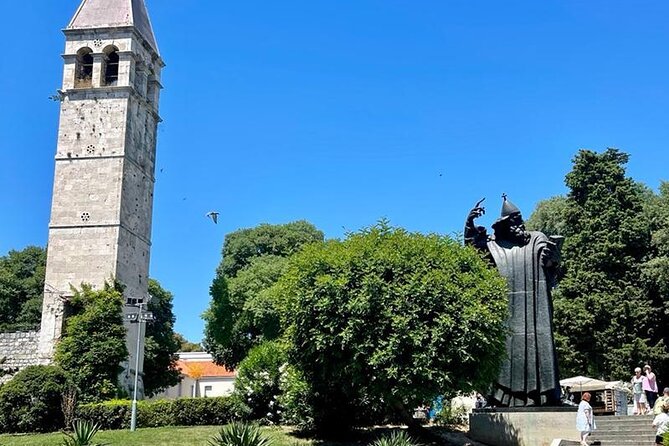
Across from the gate is the statue of Grgur Ninski, a medieval bishop of Nin created by Croatian sculptor Ivan Meštrović. The tour spends about five minutes here and explains why Grgur Ninski matters in Croatian history.
The statue provides a welcome break from ancient Rome. You move from imperial architecture to medieval church history and then to a work by one of Croatia’s best-known modern sculptors. It is also a good place to ask your guide about Croatian identity, language, and religious history.
Nearby, the Bell Tower of St. Arnir, the Chapel of St. Arnir, and remains of an early Christian church receive another five minutes. This cluster rewards close attention. You might otherwise see only a statue, a bell tower, and fragments of masonry. The guide connects them into a short story about the layers beneath modern Split.
Finishing on Marmontova Street
The final part of the route reaches Marmontova Ulica, with views toward the Croatian National Theater and the Monastery and Church of Our Lady of Health. The guide discusses the historical role of a short-lived period associated with French rule.
This ending shifts the focus away from the Palace and toward later urban Split. That is a good choice for a short tour because it prevents the experience from becoming a single-subject Roman history lesson.
The full walk takes approximately 1 hour and 45 minutes. The individual stops are short, usually between three and 10 minutes, so the pace is steady. You should expect to keep moving through the old town rather than linger at one site.
The supplied booking details say the activity ends back at the meeting point, while the route description finishes at Marmontova Street. I would confirm the exact end point when booking, especially if you need to meet a ship, catch transport, or reach a timed reservation.
Guide style, languages, and group size
The tour includes a licensed local guide who speaks English, French, German, Spanish, or Italian. Ivan is the guide most clearly identified in the available feedback, and the comments about him are consistent: friendly, humorous, patient with questions, and able to explain Split and Croatia in detail.
French-language comments identify him as Yvan, while an Italian-language account describes fluent Italian and special attention to hidden corners and unusual anecdotes. Families also found the tour suitable for children aged 5 and 7, and another family had success keeping 12-year-olds interested.
That does not mean every child will love every stop. The advantage is the private format. Your group can ask questions, and the guide can respond to your interests instead of following a fixed lecture for a large crowd.
The maximum is 15 people, but only your group participates. That wording is important: this is private, though not necessarily limited to two or four people. A larger family or friend group may find the arrangement good value, especially with group discounts.
Timing, access, and what the price covers
The listed operating window runs from June 29, 2022, through September 18, 2026, Monday to Friday, from 8:00 a.m. to 1:30 p.m. Check the available date and start time carefully, since the stated hours do not describe an evening tour.
You meet at Obala Hrvatskog narodnog preporoda 22, on the Riva. The location is near public transportation, service animals are allowed, and most people can take part. No admission tickets are included, and personal expenses are extra.
The tour has free cancellation up to 24 hours before the start time. Canceling inside that 24-hour window does not qualify for a refund, and late changes are not accepted. Confirmation arrives at booking, which makes it easier to plan a short Split visit.
At $53.95 per person, I would judge the price by your group size and priorities. It is a reasonable spend if you want a licensed local guide, a private pace, and a clear introduction to the old town. It is less attractive if you prefer to wander alone, plan to visit every interior independently, or want a longer archaeological tour.
The tour is often reserved about 91 days ahead. That suggests you should plan early for a specific weekday during the main season, especially if you need a particular language or guide.
Who should book this experience?
I would choose this tour for a first morning in Split, a short port stop, or a family group that needs a focused introduction. It is also a good fit if you like asking questions and want advice for expanding your sightseeing after the walk.
History fans will appreciate the links between Roman, Christian, medieval, noble, Croatian, and French periods. Game of Thrones followers get a quick Papalic Palace connection, while architecture fans receive a useful tour of gates, squares, temples, palaces, and churches.
I would look elsewhere if you want extended time inside the Cathedral, Palace substructures, or City Museum. The tour is a brisk orientation with many short stops, and all listed attractions are viewed as part of the walk rather than sold as included admissions.
Should you book the Split private history tour?
Book it if you want the old town to make sense quickly, value a local guide who can speak your language, and prefer a private conversation to a large group. Ivan’s reported style, with humor, detailed answers, and attention to children, is a particularly strong reason to consider it.
Skip it if you are satisfied with a self-guided walk and do not need help connecting the sites. For most first-time visitors with limited time, though, the route offers a useful balance: major landmarks, overlooked details, local context, and a clear path through Split’s complicated center.
FAQ
How long does the walking tour last?
The tour lasts approximately 1 hour and 45 minutes.
What is the price?
The listed price is $53.95 per person. Group discounts are available.
Is this a private tour?
Yes. Only your group participates, with a maximum group size of 15 people.
What languages can the guide speak?
The included licensed guide speaks English, French, German, Spanish, or Italian.
Who is the guide?
Ivan is the guide named in the available tour information and feedback. French-language comments also identify him as Yvan.
Where does the tour start?
The meeting point is Obala Hrvatskog narodnog preporoda 22, 21000 Split, Croatia.
What sights are included in the route?
The route includes the Riva Harbor, Palace substructures, Peristyle, Cathedral of Saint Domnius, Temple of Jupiter, Fruit’s Square, Narodni trg, Zeljezna Vrata, City Museum of Split, Golden Gate, Grgur Ninski Statue, Bell Tower of St. Arnir, and Marmontova Street.
Are admission tickets included?
No. The listed stops include free admission, but personal expenses and paid admissions are not included.
Can I cancel for a refund?
Yes, if you cancel at least 24 hours before the experience starts. Cancellations made less than 24 hours before the start time are not refunded.
Just added around Split
- Kayaking & Zipline Šibenik – Čikola Canyon★ 5.0 · 3 reviews
- Krka National Park & Zipline Šibenik – Čikola Canyon★ 5.0 · 3 reviews
- From Split: Krka National Park & Waterfalls Private Day Trip★ 5.0 · 3 reviews
- Split: Small-Group Half Day Sailing Trip★ 5.0 · 3 reviews
- Rafting River Cetina from Makarska Riviera including transfer★ 5.0 · 3 reviews
- Split Bike and Wine Experience★ 5.0 · 3 reviews
- Split and Salona Cultural Heritage Day Tour from Trogir★ 4.0 · 3 reviews
- Private transfer from Split to Dubrovnik with 2h sightseeing stop in Ston★ 5.0 · 3 reviews
Old Town & History Tours, compared.


Walking Tour of Split with a ‘Magister’ of History
Read our review →

Diocletian Palace & Old Town Guided Walking Tour
Read our review →

Diocletian’s Palace and Old Town SMALL GROUP Walking Tour
Read our review →

Split History and Gastro Small-Group Tour with Food and Drinks
Read our review →Browse the lists this tour appears in