
Reviewed · OLD TOWN & HISTORY TOURS
History Split Walking Tour in German – Small group
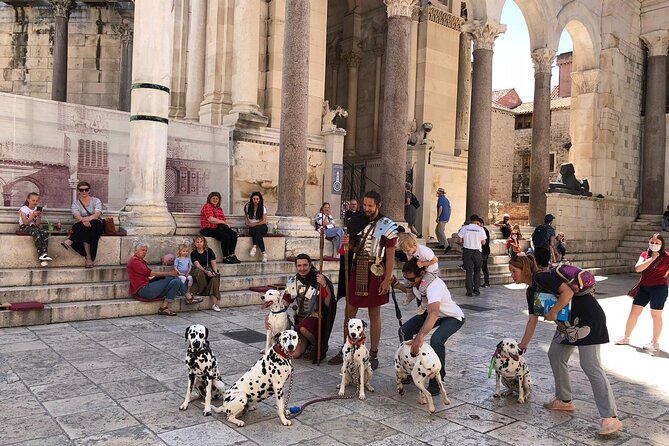
Diocletian’s Palace is not a quiet ruin set apart from modern life. It is the living center of Split, with Roman walls holding apartments, shops, cafés, and narrow streets. This German-language walking tour gives you the story behind that unusual mix, from Emperor Diocletian’s rise from obscurity to his rule over the Roman world.
I like the compact 90-minute format, which gives you a useful first look without taking half a day. I also like the chance to ask questions directly, a detail that fits the warm, engaging style associated with guides such as Antonella, Josip, and Marko. The main drawback is the price: at $165.08 per person, it is expensive for a short walking tour unless a group discount applies or you place a high value on a German-speaking guide and a small group.
In This Review
- Key points at a glance
- Why Diocletian’s Palace is the right place to start
- Peristyle and Vestibule: the palace’s grand entrance
- The substructures and what happened below the palace
- The Golden Gate and Gregory of Nin
- Riva Harbor and Split’s public face
- Fruit’s Square and the Venetian chapter
- The old synagogue and Split’s Jewish history
- German-speaking guides and the tone of the walk
- Group size, timing, and value at $165.08
- Starting point, ending point, and practical comfort
- Who will get the most from this tour?
- Should you book the German Split walking tour?
- FAQ
- How long does the History Split Walking Tour last?
- What language is the tour conducted in?
- Where does the tour start?
- Where does the tour end?
- What sights are included?
- Is admission to the sights included?
- How many people can join the tour?
- Is the tour suitable for people with mobility issues?
- What is the cancellation policy?
Key points at a glance
- The Peristyle anchors the tour: This central square helps you understand how the palace was laid out.
- Roman and later Split appear together: The route connects Diocletian’s buildings with Venetian, Jewish, Croatian, and modern city history.
- German-language guiding is the focus: Antonella, Josip, and Marko are among the guides associated with the experience.
- The substructures are included: You see the ancient lower level, but not the museum section.
- The group can reach 20 people: That is smaller and easier to manage than a large city tour, though not necessarily intimate.
- High steps matter: The activity is not recommended if you have trouble with steep or high steps.
Why Diocletian’s Palace is the right place to start
The best feature of this tour is its subject. Split’s old town is built inside and around a Roman emperor’s retirement palace, so the history is under your feet and in the walls beside you. You are not simply looking at a monument. You are walking through a city that has kept using the site for centuries.
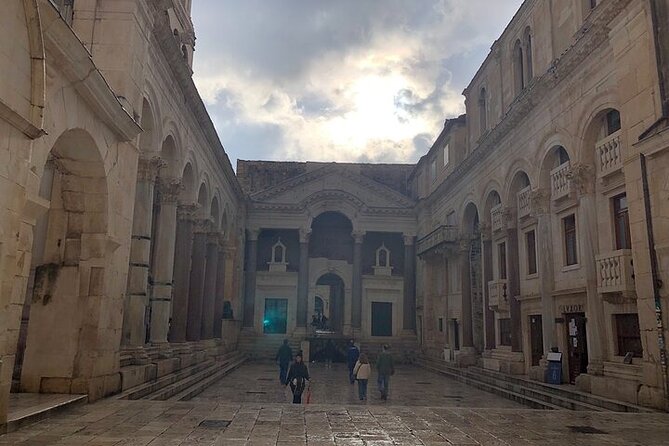
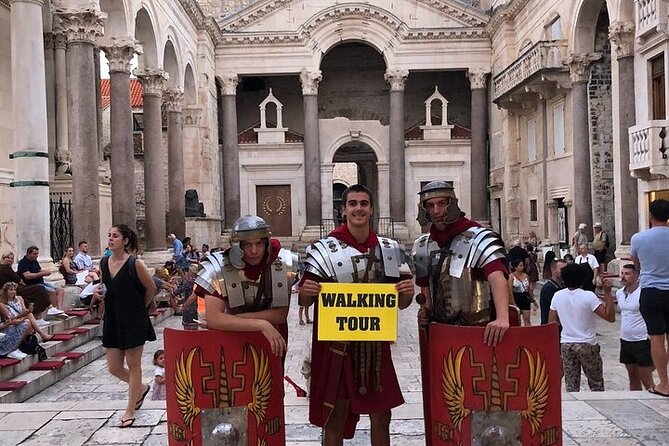
The tour begins on Peristil, usually written in English as the Peristyle, the palace’s central square. From here, your guide can explain the basic plan of Diocletian’s complex and show how the main routes led to other parts of the palace. This opening matters because Split can feel like a maze at first. Once you understand the Peristyle as the center, the rest of the walk makes much more sense.
The main story is Diocletian himself. The guide explains how he went from a little-known beginning to becoming the most powerful man in the Roman world. That is a strong way to frame the tour, because it turns a pile of old stones into a human story about ambition, power, retirement, and the long afterlife of an emperor’s building project.
I would take this tour early in your time in Split. It gives you a mental map before you return on your own for coffee, shopping, photographs, or a closer look at the palace museum.
More old town history walks in Split:
- Split: Old Town and Diocletian Palace Walking Tour
★ 4.9 · 4,727 reviews - Walking Tour of Split with a ‘Magister’ of History
★ 5.0 · 1,122 reviews - Split Walking Tour with Professor of History
★ 5.0 · 926 reviews
Peristyle and Vestibule: the palace’s grand entrance
The Peristyle receives about 15 minutes. Admission is free, and the square is the natural place to explain the palace’s public face. Expect your guide to focus on how the area connected the emperor’s private world with the ceremonial parts of the complex.
The value here is not just the view. Your guide’s explanation helps you read the space. Columns, arches, entrances, and surrounding walls begin to feel like parts of a plan rather than unrelated features. If you enjoy Roman history, this is likely the strongest opening section of the walk.
From the Peristyle, the route continues to the Vestibule, where you spend about five minutes. This was part of Emperor Diocletian’s palace entrance. The stop is short, but it adds a sense of movement through the building, taking you from the public square toward the emperor’s interior spaces.
You might also hear traditional Dalmatian singing here. The wording of the experience makes this a possibility, not a guaranteed performance, so treat it as a pleasant extra rather than the reason to book. The setting gives the moment a local flavor that a standard monument explanation would miss.
The substructures and what happened below the palace
The Diocletian Palace substructures receive around ten minutes. These lower rooms are important because they show how the palace was built and how the spaces were used over time. Your guide explains their original function and later changes, giving you another way to understand the structure above.
A useful point to know before booking is that this tour does not include the museum section of the substructures. You can visit that part after the walk, but it is not part of the guided route. If you want a longer archaeological visit, plan extra time and check the separate admission arrangements on site.
The lower level can also make the physical nature of the tour clearer. Split’s old center has uneven surfaces, steps, and passages. Most people can take part, but the activity specifically warns against it for anyone who has trouble with high steps. Wear shoes that feel secure, and do not expect a completely flat route.
The Golden Gate and Gregory of Nin
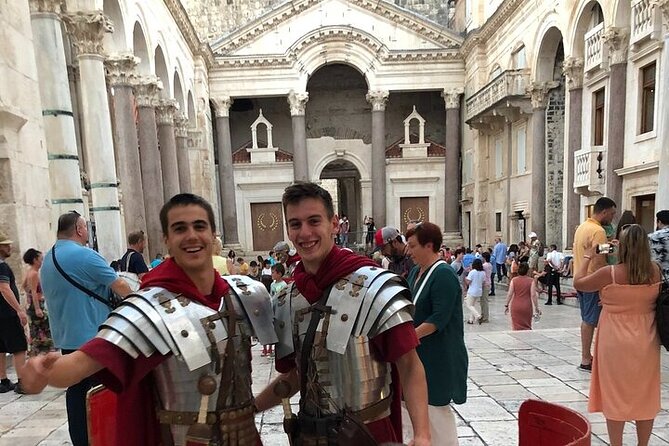
The Golden Gate is the palace’s main entrance, and the tour spends about ten minutes here. This is a useful stop for connecting the emperor’s original complex with the city that grew around it. The gate also gives the guide a chance to explain how people entered and moved through the palace.
Nearby is the statue of Gregory of Nin. The guide explains his importance to Croatian history and language, so this section moves beyond Roman archaeology. That shift is one of the tour’s strengths. You learn not only about the emperor who built the palace, but also about the people and cultural forces that shaped Croatia later.
The route is short enough that you can keep the story in your head. You are not being sent across Split to collect disconnected sights. Each stop adds another layer to the same place.
More walking tours in Split:
- Walking Tour of Split and Diocletian’s Palace
★ 5.0 · 2,588 reviews - Krka Waterfalls tour with Trogir Walking tour and Krka panoramic boat cruise
★ 5.0 · 1,659 reviews - Split & Diocletian’s Palace Walking Tour
★ 5.0 · 1,125 reviews - Split: Diocletian Palace & Old Town Guided Walking Tour
★ 4.7 · 882 reviews
Riva Harbor and Split’s public face
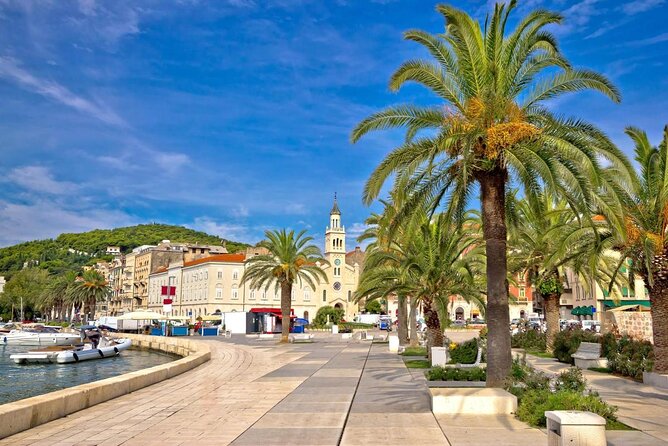
At Riva Harbor, you spend about 15 minutes. This is the longest stop after the Peristyle, and it changes the view from enclosed palace streets to Split’s waterfront promenade.
A bronze model of Diocletian’s Palace helps you see the whole complex. I find this kind of model especially useful after walking through tight lanes, because it shows the scale and layout that are hard to grasp from ground level. The guide also covers the history of Riva, helping you connect the ancient palace with the public waterfront used by modern Split.
This part is useful for practical orientation, too. The tour is not only about old stones. You are learning how the palace relates to the open spaces around it and where you might want to return later. The harbor is also a natural point to pause, look back toward the old center, and understand that Split’s story did not stop in Roman times.
Fruit’s Square and the Venetian chapter
Fruit’s Square, or Trg Brace Radic, receives about ten minutes. Here, the tour turns to a 15th-century Venetian citadel and to Marko Marulić, often described as the father of Croatian literature.
This is a good reminder that Split is not simply a Roman-history destination. The city’s identity was shaped by several periods and cultures. The Venetian connection adds another political and architectural layer, while Marulić gives the guide a way to explain Croatian cultural history.
You may appreciate this stop most if you want a broad introduction to Split rather than a tour focused only on Diocletian. It also helps explain why the old town feels like a working city, not a preserved archaeological park. Different eras remain close together, often in the same few streets.
The old synagogue and Split’s Jewish history
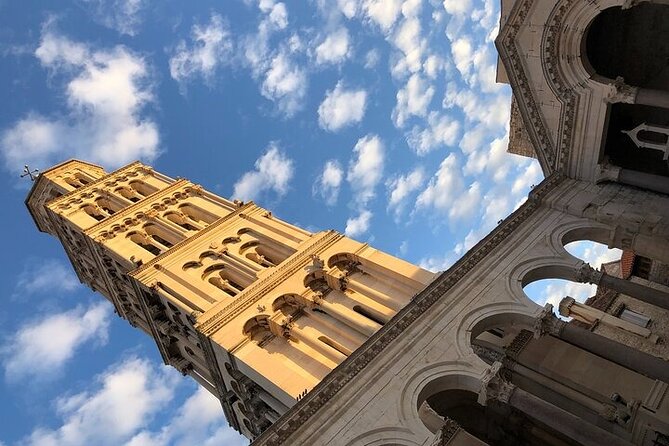
The final listed stop is the Split Synagogue, where the tour passes by a 16th-century synagogue and covers the history of the city’s Jewish population. The stop lasts about ten minutes.
This section adds a human story that can easily be missed if you explore only the palace’s major monuments. It shows that Split’s past includes religious and cultural communities beyond the Roman and Venetian authorities usually highlighted in guidebooks.
The synagogue is passed from the outside. Admission is not included, and the experience does not promise an interior visit. Still, the stop is worthwhile for the context it provides, particularly if you want to understand the old town as a place where different communities lived and worked over time.
German-speaking guides and the tone of the walk
The experience is designed for German speakers, and the guide is central to its value. The listed guides include Antonella, Josip, and Marko. Antonella is described as having a good sense of humor and an ability to handle questions, while Josip is noted for being friendly and able to answer a wide range of questions. Marko is described as a history teacher who tells stories about the palace.
Those details suggest a tour that is more conversational than scripted. That matters in a 90-minute walk. A guide who can explain a point clearly, keep the group moving, and answer questions can make a short tour feel much more useful than a longer walk delivered as a list of dates.
The strongest praise centers on three qualities: clear historical explanations, an entertaining manner, and openness to questions. Several comments also point to how much information fits into a short period. You should still keep your expectations realistic. A 90-minute tour can introduce the palace and nearby old town, but it cannot cover every room, period, or museum collection.
If you have a question about Split’s more recent history, ask it. The route includes some modern historical context, and the guide may be able to connect your question to the places around you. The experience is at its best when you treat it as an informed conversation, not just a photo walk.
Group size, timing, and value at $165.08
The maximum group size is 20 people. That is small enough for a guide to keep the group together in narrow streets and for you to hear more easily than in a large group. It is not a private tour, however, and a full group of 20 will not feel personal in the same way as a tour for six or eight.
The tour lasts approximately one hour and 30 minutes. The listed stops total about 75 minutes, leaving time for walking between them, gathering the group, and handling questions. That timing sounds sensible for the route. You get a brisk introduction without being rushed from one sight to the next.
The price is $165.08 per person, which is the clearest concern. For a standard shared walking tour of 90 minutes, that is a high rate. The value improves if you are booking for a group and receive a discount, or if a German-language tour is important to you and alternatives are limited.
I would compare the price against your priorities. If you want a short, structured introduction in German, with a trained guide and a route covering both the palace and nearby Split, it may be worthwhile. If you mainly want to see the Peristyle, Golden Gate, and Riva on your own, you may find the cost hard to justify.
The tour is booked, on average, 44 days ahead. That suggests you should plan early, especially if your dates in Split are fixed. Confirmation is sent within 48 hours, subject to availability, so leave room for that booking process.
Starting point, ending point, and practical comfort
Meet at Peristil ulica, at Peristil in Split. The tour ends in Diocletian’s Palace, not far from the starting point. If you want to return to the Peristyle, ask the guide. This is handy if you have a hotel, meeting point, or restaurant reservation near the palace.
The location is close to public transportation, and service animals are allowed. Most people can participate, but the high steps warning deserves attention. The route passes through historic buildings and old streets, so comfortable footwear is a sensible choice even though the walk is not long.
Bring your phone because the ticket is mobile. Gratuities are not included, so decide at the end if the guide’s work deserves a tip. The tour has free cancellation up to 24 hours before the start time. Inside that 24-hour window, you receive no refund, and changes are not accepted. If the minimum number of participants is not reached, the provider will offer another date or experience, or a full refund.
Who will get the most from this tour?
I would recommend it most to German-speaking visitors who want historical context quickly and prefer asking questions rather than reading signs. It also suits anyone who wants an introduction to Split before exploring the palace independently.
History fans will appreciate the range. The tour moves from Diocletian and Roman construction to Gregory of Nin, Venetian rule, Marko Marulić, the Jewish community, and the later life of the city. That broad scope is more useful than a tour that treats the palace as a single-period monument.
It is also a good fit for friends or family groups, particularly if a group discount reduces the per-person price. The small-group limit should make it easier to stay together, though a maximum of 20 is still large enough that you may need to position yourself near the guide.
I would skip it if you dislike steps, want a private guide, or are looking for a full museum visit. The substructure museum is not included, and the short duration means the tour offers an overview rather than a detailed archaeological study.
Should you book the German Split walking tour?
Book it if you want a German-language introduction to Split that combines Diocletian’s Palace with the city’s later Roman, Venetian, Croatian, and Jewish stories. The route is well chosen, the timing is manageable, and the guide’s ability to explain details and answer questions is a major part of the experience.
Think twice about the price before paying $165.08 per person. This makes the most sense for a group that can use the discount, or for someone who places real value on German-language guiding. If that is you, book well ahead and use the tour as your orientation walk. If not, explore the palace at your own pace and put the savings toward the separate substructure museum or another Split experience.
FAQ
How long does the History Split Walking Tour last?
The tour lasts approximately one hour and 30 minutes.
What language is the tour conducted in?
This experience is a German-language walking tour.
Where does the tour start?
The meeting point is Peristil ulica, at Peristil in Split, Croatia.
Where does the tour end?
It ends in Diocletian’s Palace, not far from the starting point. The guide can take you back to the Peristyle if you ask.
What sights are included?
The route includes the Peristyle, Vestibule, Diocletian Palace substructures, Golden Gate, Riva Harbor, Fruit’s Square, and the Split Synagogue area.
Is admission to the sights included?
The listed stops are free, except that admission to the Split Synagogue is not included. The museum section of the palace substructures is also not part of the tour.
How many people can join the tour?
The group can include a maximum of 20 participants.
Is the tour suitable for people with mobility issues?
Most people can participate, but the experience is not recommended for anyone who has trouble with high steps.
What is the cancellation policy?
You can cancel up to 24 hours before the start time for a full refund. Cancellations or changes made less than 24 hours before the start time are not accepted for a refund.
Just added around Split
- Kayaking & Zipline Šibenik – Čikola Canyon★ 5.0 · 3 reviews
- Krka National Park & Zipline Šibenik – Čikola Canyon★ 5.0 · 3 reviews
- From Split: Krka National Park & Waterfalls Private Day Trip★ 5.0 · 3 reviews
- Split: Small-Group Half Day Sailing Trip★ 5.0 · 3 reviews
- Rafting River Cetina from Makarska Riviera including transfer★ 5.0 · 3 reviews
- Split Bike and Wine Experience★ 5.0 · 3 reviews
- Split and Salona Cultural Heritage Day Tour from Trogir★ 4.0 · 3 reviews
- Private transfer from Split to Dubrovnik with 2h sightseeing stop in Ston★ 5.0 · 3 reviews
Old Town & History Tours, compared.


Walking Tour of Split with a ‘Magister’ of History
Read our review →

Diocletian Palace & Old Town Guided Walking Tour
Read our review →

Diocletian’s Palace and Old Town SMALL GROUP Walking Tour
Read our review →

Split History and Gastro Small-Group Tour with Food and Drinks
Read our review →Browse the lists this tour appears in