
Reviewed · OLD TOWN & HISTORY TOURS
History Split Walking Tour in French -Small group
Diocletian’s Palace is not a quiet ruin set apart from modern life. It is the working heart of Split, with homes, cafés, shops, and lanes built into the old Roman complex. This French-language walk helps you see how an emperor’s retirement palace became a living city, while tracing Diocletian’s remarkable rise from an obscure background to the most powerful man in the Roman world.
I like the route’s strong mix of Roman and later Split history, especially the shift from the palace’s imperial center to Riva and Fruit Square. I also like the chance to hear a guide such as Antonela or Irene explain the site in fluent French, with room for questions. The main consideration is the group limit of 30, which is small enough for a shared walk but not truly private, and some high steps may be difficult for you.
In This Review
- Key points at a glance
- Why Diocletian’s Palace makes a good walking tour
- The Peristyle, where the palace begins
- The Vestibule and the sound of Dalmatia
- Palace substructures and the practical side of Roman design
- The Golden Gate and Gregory of Nin
- Riva Harbor, with Split laid out in miniature
- Fruit Square and Split’s Venetian layer
- The Split Synagogue and a quieter piece of city history
- French guides who make the history easier to follow
- How long the walk really takes
- Is $69.14 a fair price?
- Who should book this French-language walk?
- Cancellation and booking details
- Should you book the History Split Walking Tour in French?
- FAQ
- What language is the tour conducted in?
- How long does the tour last?
- Where does the tour start and finish?
- What places are included on the route?
- Is the substructures museum included?
- Is the tour suitable if I have difficulty with high steps?
- What is the cancellation policy?
Key points at a glance

- Diocletian’s story gives the tour a clear thread: You learn how he rose from obscurity to rule the Roman Empire and why he built this vast palace.
- The route covers seven useful landmarks: The Peristyle, Vestibule, substructures, Golden Gate, Riva, Fruit Square, and the Split Synagogue area.
- French is the working language: Guides including Antonela and Irene have been praised for fluent, engaging explanations and for answering unusual questions.
- You see both Roman and Croatian identity: The walk connects the palace to Gregory of Nin, Marko Marulić, Dalmatian singing, Jewish heritage, and Venetian influence.
- The walk may last longer than 90 minutes: Allow up to two hours, since the route can continue when questions and explanations take time.
- The price includes the guide, not gratuities: At $69.14 per person, the value depends on how much historical context you want from a French-speaking guide.
Why Diocletian’s Palace makes a good walking tour
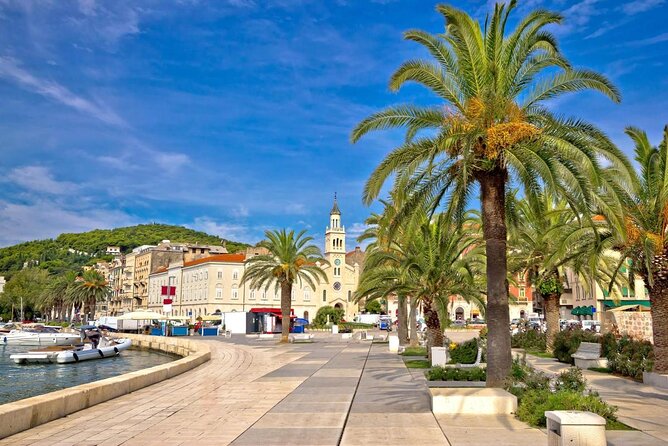
The biggest challenge in Split is that Diocletian’s Palace does not look like one single monument. Its walls and rooms are woven into the old city, so it is easy to walk through without understanding what you are seeing.
A guided walk gives you a map in your head. The Peristyle acts as the central anchor, and from there the route shows how the palace was organized and how its spaces changed over time. You are not just checking off famous corners. You are following the structure of an imperial residence and then watching it become part of a medieval and modern city.
The historical theme is also unusually personal. Diocletian was not born into the highest level of Roman power. The guide explains his rise from a little-known beginning to emperor, then connects that career to the palace he built for retirement. That makes the stonework easier to understand. You see not only architecture, but ambition made permanent.
This is a good choice if you want the basic story before exploring Split on your own. It is also useful if French is your strongest language for historical detail. Several guides, including Antonela and Irene, are specifically noted for speaking French fluently and explaining the palace with energy rather than simply reciting dates.
More old town history walks in Split:
- Split: Old Town and Diocletian Palace Walking Tour
★ 4.9 · 4,727 reviews - Walking Tour of Split with a ‘Magister’ of History
★ 5.0 · 1,122 reviews - Split Walking Tour with Professor of History
★ 5.0 · 926 reviews
The Peristyle, where the palace begins
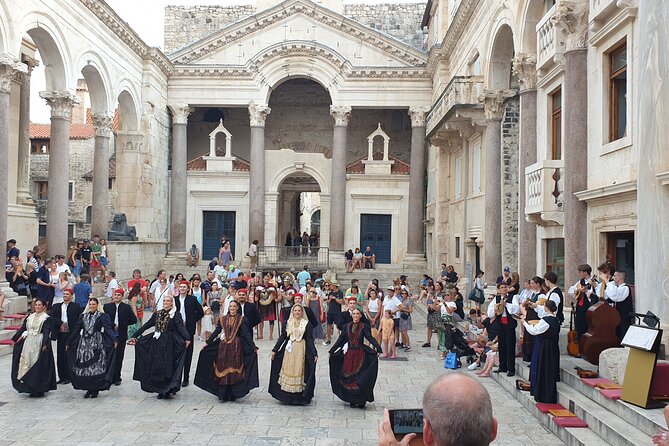
The tour starts at the Peristyle, the central square of Diocletian’s Palace. This is the natural place to begin because many routes inside the palace lead from here, and the space gives you an immediate sense of the complex’s scale.
You spend about 15 minutes here. That is enough time for the guide to explain its role and establish the layout before moving into tighter lanes and enclosed rooms. Listen closely at this first stop, since the information here will help you understand the later sections of the walk.
The Peristyle is also a practical meeting point. The official starting address is Peristil ulica in Split, and the activity ends back at the same meeting point. Since the old city has many lanes with similar stone walls, confirm that you are at Peristil ulica rather than simply waiting somewhere near the palace.
The Vestibule and the sound of Dalmatia
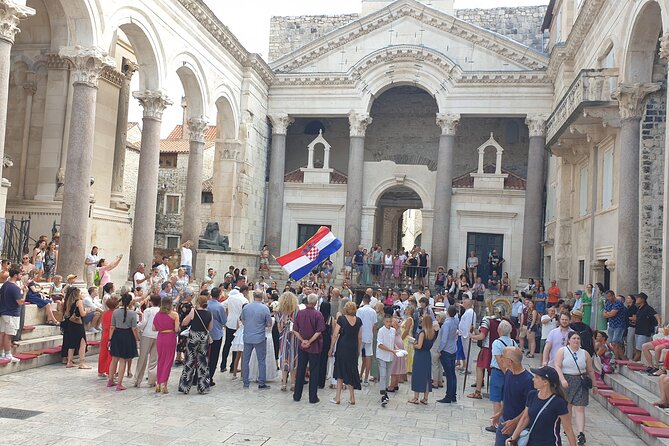
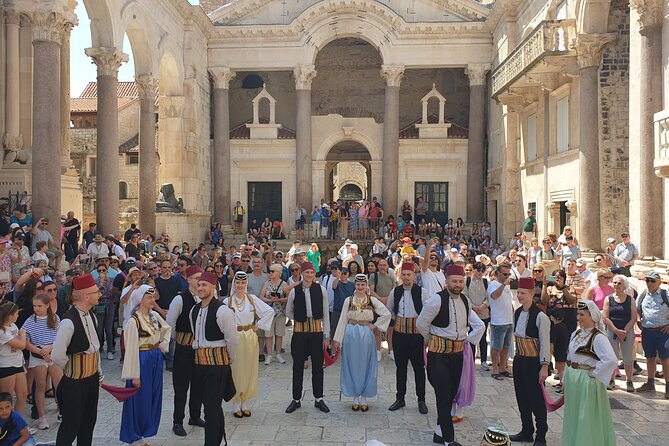
The next stop is the Vestibule, the entrance space associated with Emperor Diocletian. The stop lasts about five minutes, but it offers one of the more memorable human details on the route: you may hear traditional Dalmatian singing.
That possibility adds something a map or guidebook cannot provide. The palace is made of heavy stone and formal imperial design, while the singing connects the space to local culture. It is not guaranteed, so treat it as a welcome possibility rather than the central reason to book.
The short stop also shows how quickly the tour moves between different kinds of history. One moment you are hearing about imperial architecture, and the next you are considering the living traditions that continue inside the old city.
Palace substructures and the practical side of Roman design
The palace substructures receive about 10 minutes. These lower rooms help explain how the upper palace was built and how the spaces functioned across different periods.
The guide discusses their construction and changing use. This matters because the substructures are not just a dramatic set of underground chambers. They help you picture the palace as a planned complex, with support spaces beneath the areas used by the emperor and his household.
One important limit is easy to miss: this tour does not include the museum section of the substructures. You can visit that museum after the walk, but it is not part of the guided experience. If you want a longer look at the underground remains, plan extra time and budget for any separate admission.
This stop may involve uneven surfaces and steps. The activity is not recommended if you have trouble with high steps, so consider your comfort before booking. Most people can take part, and service animals are allowed, but the old palace is not a flat, purpose-built museum route.
More walking tours in Split:
- Walking Tour of Split and Diocletian’s Palace
★ 5.0 · 2,588 reviews - Krka Waterfalls tour with Trogir Walking tour and Krka panoramic boat cruise
★ 5.0 · 1,659 reviews - Split & Diocletian’s Palace Walking Tour
★ 5.0 · 1,125 reviews - Split: Diocletian Palace & Old Town Guided Walking Tour
★ 4.7 · 882 reviews
The Golden Gate and Gregory of Nin
The Golden Gate is the main entrance to Diocletian’s Palace and receives about 10 minutes. It is a useful stop for understanding how people entered the palace and how the complex presented itself to the outside world.
The guide also points out the statue of Gregory of Nin and explains his importance to Croatian history and language. This widens the tour beyond Roman history. You learn how later Croatian identity is connected to a place first shaped by a Roman emperor.
For you, the value of this section is the bridge between ancient stone and national culture. The Golden Gate is not treated as an isolated photo stop. It becomes part of a larger story about power, language, and the way historical figures remain present in a city.
Riva Harbor, with Split laid out in miniature
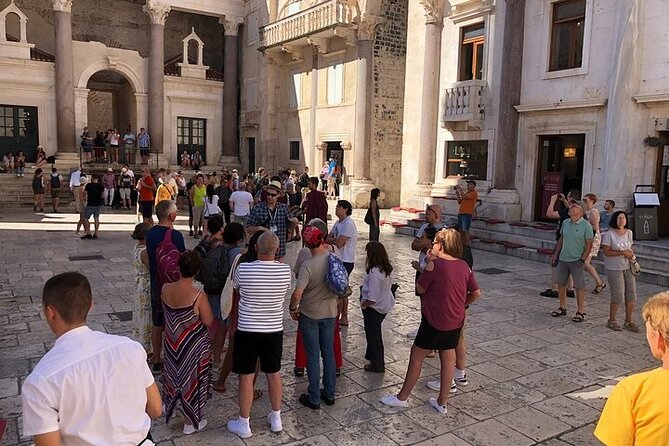
The route continues to Riva Harbor for about 15 minutes. Here you see a bronze model of Diocletian’s Palace and learn about the history of Split’s waterfront promenade.
The model is especially helpful after walking through the palace’s dense lanes. It lets you step back mentally and see the complex as a whole. If you have been struggling to understand where the gates, central square, and lower rooms fit together, this is your chance to put the pieces in order.
Riva also changes the feel of the walk. You leave the enclosed palace streets and reach a broad waterfront setting. The tour still focuses on history, but this stop gives you a clearer sense of Split as a city rather than only as an archaeological site.
I like this part for practical reasons. It can help you decide where to return later for a slower walk, a drink, or a view across the harbor. Since the tour finishes back at the Peristyle, you can also use the waterfront stop to orient yourself before continuing your own exploration.
Fruit Square and Split’s Venetian layer
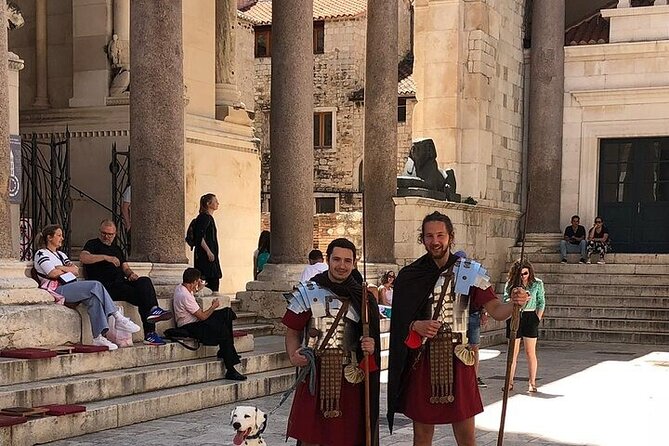
Fruit Square, officially Trg Braće Radić, receives about 10 minutes. The guide explains the 15th-century Venetian citadel and the importance of Marko Marulić, often described as the father of Croatian literature.
This is another strong change of period. The palace began as an imperial Roman project, but Split’s story did not stop there. Fruit Square brings in Venetian influence and Croatian literary culture, helping you understand that the old city is the result of many historical layers rather than one frozen moment.
The stop is also useful if you want more than an emperor-centered tour. Diocletian provides the main thread, but Marko Marulić and the Venetian citadel show how local life, politics, and culture continued to shape the city long after Rome’s power had faded.
The Split Synagogue and a quieter piece of city history
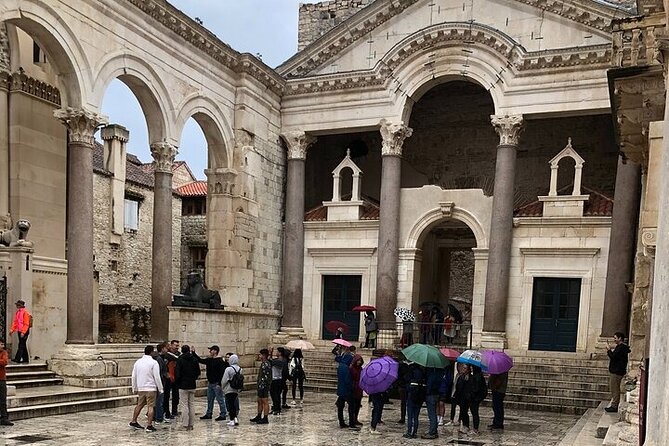
The final listed stop is the Split Synagogue area, where you pass by a 16th-century synagogue and learn about the history of the Jewish people in Split. The scheduled explanation lasts about 10 minutes.
This is a valuable inclusion because it adds a community story that can easily be missed while you focus on palace walls and famous gates. The stop is a reminder that Split’s old center has been home to different religious and cultural groups over the centuries.
The synagogue itself is passed by rather than presented as a separate included admission. The tour gives you historical context from the outside, but you should not expect an extended indoor visit as part of the package.
French guides who make the history easier to follow
The guide is the main reason to choose this experience over walking the same streets with a printed map. Ancient Tours assigns an educated guide with strong knowledge of the palace and surrounding sites. Names noted for this French-language route include Antonela and Irene.
The strongest guide feedback centers on three traits: fluent French, enthusiasm, and the ability to answer questions. One guide was described as a former diplomat, scholar, and passionate speaker. Another was singled out for making the visit enjoyable for children. Those details suggest a presentation that can work for families as well as adults who want more historical depth.
You should still remember that guides can vary by departure. The specific guide is not guaranteed in the information provided, so book this tour for the French-language format and subject matter rather than for one named person alone.
The group maximum is 30 people. That is smaller than a large coach excursion, but it is not a private tour. You should be able to follow the explanation more easily than in a very large crowd, though the experience may feel less personal if the group reaches its limit.
How long the walk really takes
The advertised duration is approximately one hour and 30 minutes. In practice, you should keep up to two hours free. Explanations and questions can extend the visit, and that is generally useful on a history walk, but it matters if you have a ferry, meal reservation, or another timed activity afterward.
The listed stop times add up to about 75 minutes, leaving room for walking between locations, introductions, and questions. Do not schedule something immediately after the tour. A little flexibility will make the experience more comfortable.
The route starts and ends at the Peristyle. It is near public transportation, but the actual walk takes place in the old center, where you should expect stone lanes and steps rather than a smooth modern promenade.
Is $69.14 a fair price?
At $69.14 per person, this is not the cheapest way to see Split’s old center. You can walk around the palace independently at no cost, and the listed stops do not include paid admission.
The price makes more sense if you value a French-speaking guide who can explain the connections between the sites. You are paying for structure, language access, historical interpretation, and the chance to ask questions. That is particularly useful at Diocletian’s Palace, where the remains are spread through an active city and are not always obvious.
The value is also better if you use the tour as an introduction rather than your entire visit. Afterward, you can return to the substructures museum, revisit Riva, or spend more time at the squares that caught your interest. The guided route gives you a framework, and independent wandering fills in the rest.
Group discounts may be available, which could improve the price for families or larger parties. Gratuities are not included, so allow for that extra cost if you feel the guide provided a helpful experience.
Who should book this French-language walk?
I would choose this tour if you want a clear introduction to Split and prefer to receive historical explanations in French. It suits couples, families, and small parties who want to see the main palace landmarks without committing to a full-day excursion.
Families may appreciate the guide-led format, especially if children need a story to make the old stones meaningful. The references to Diocletian’s rise, Gregory of Nin, Marulić, and the synagogue give the guide several different subjects to hold attention.
It is less suitable if you want a private tour, a museum-heavy visit, or a completely step-free route. It is also not the best fit if your schedule is tight enough that a possible two-hour duration would cause stress.
You should wear practical shoes and arrive ready for uneven old-city surfaces. The activity is near public transportation, and most people can participate, but the warning about high steps deserves attention.
Cancellation and booking details
Confirmation is sent within 48 hours of booking, subject to availability. You can cancel for a full refund up to 24 hours before the local start time. Cancellations or changes made less than 24 hours before the start are not accepted for a refund.
The experience requires a minimum number of participants. If that minimum is not met and the tour is canceled, you are offered another date or experience, or a full refund.
Should you book the History Split Walking Tour in French?
Book it if you want the palace explained in fluent French and prefer a well-organized route through Split’s main historical layers. The best parts are the clear Diocletian story, the move from Roman architecture to Croatian culture, and the inclusion of places such as Fruit Square and the synagogue area.
Skip it if you mainly want to wander independently, need guaranteed private attention, or cannot manage high steps. At $69.14, the cost is justified by the guide and language service rather than by included admissions.
For most French-speaking visitors spending a first day in Split, I would treat this as a useful orientation walk. Leave extra time, ask questions, and return afterward to whichever part of the palace caught your interest.
FAQ
What language is the tour conducted in?
The tour is conducted in French. Guides such as Antonela and Irene have been described as fluent French speakers, but a specific guide is not guaranteed.
How long does the tour last?
The scheduled duration is approximately one hour and 30 minutes. You should allow up to two hours because explanations and questions can extend the walk.
Where does the tour start and finish?
The meeting point is Peristil ulica, Peristil ul., 21000 Split. The activity ends back at the meeting point.
What places are included on the route?
The route includes the Peristyle, Vestibule, Diocletian’s Palace substructures, Golden Gate, Riva Harbor, Fruit Square, and the Split Synagogue area.
Is the substructures museum included?
No. The tour visits the palace substructures but does not include the museum section. You can visit the museum separately after the tour.
Is the tour suitable if I have difficulty with high steps?
The tour is not recommended for people who have issues with high steps. Most people can participate, and service animals are allowed.
What is the cancellation policy?
You can cancel up to 24 hours before the experience for a full refund. Changes or cancellations made less than 24 hours before the start time are not accepted for a refund.
Just added around Split
- Kayaking & Zipline Šibenik – Čikola Canyon★ 5.0 · 3 reviews
- Krka National Park & Zipline Šibenik – Čikola Canyon★ 5.0 · 3 reviews
- From Split: Krka National Park & Waterfalls Private Day Trip★ 5.0 · 3 reviews
- Split: Small-Group Half Day Sailing Trip★ 5.0 · 3 reviews
- Rafting River Cetina from Makarska Riviera including transfer★ 5.0 · 3 reviews
- Split Bike and Wine Experience★ 5.0 · 3 reviews
- Split and Salona Cultural Heritage Day Tour from Trogir★ 4.0 · 3 reviews
- Private transfer from Split to Dubrovnik with 2h sightseeing stop in Ston★ 5.0 · 3 reviews
Old Town & History Tours, compared.


Walking Tour of Split with a ‘Magister’ of History
Read our review →

Diocletian Palace & Old Town Guided Walking Tour
Read our review →

Diocletian’s Palace and Old Town SMALL GROUP Walking Tour
Read our review →

Split History and Gastro Small-Group Tour with Food and Drinks
Read our review →Browse the lists this tour appears in