
Reviewed · DIOCLETIAN PALACE TOURS
Split Diocletian Palace Highlights – Private walking tour
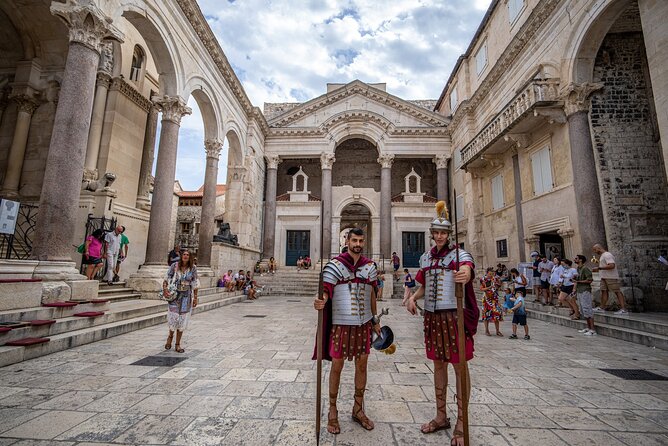
Diocletian’s Palace is not a quiet ruin sealed behind glass. It is the working heart of Split, where homes, shops, cafés, courtyards, and ancient Roman walls share the same narrow streets. This 90-minute private walk gives you a useful first look at that unusual mix, with the guide connecting each stone to the emperor who built it more than 1,700 years ago.
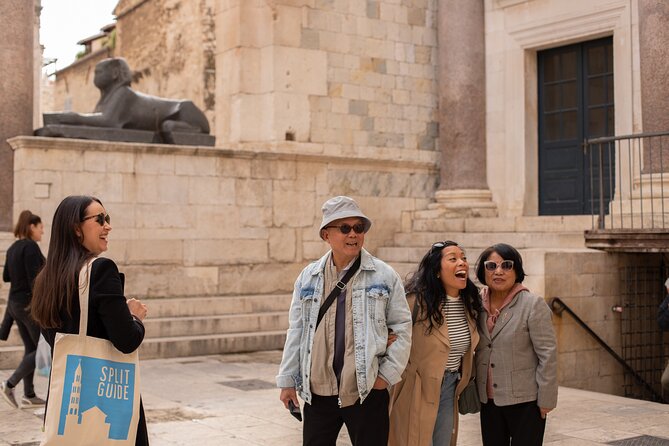
I especially like the chance to have a guide such as Dana, whose storytelling has been praised for bringing Split’s past to life. I also like the small-group setup and the practical advice about restaurants, bars, and leisure activities. The main consideration is that the tour focuses on exterior views, so you should not book it expecting a full visit inside the cathedral or Jupiter’s Temple.
In This Review
- Key points to know before you book
- Why Split’s palace works best on foot
- The Riva gives you the right opening view
- Inside Diocletian’s Palace, where ruins meet real life
- The cellars reveal the palace’s enormous scale
- The Peristyle shows Diocletian’s public face
- Saint Domnius connects imperial Rome with Christian Split
- Gates, defenses, and the route through modern Split
- Dining rooms and private chambers add human detail
- Jupiter’s Temple shows how buildings change purpose
- The Green Market brings you back to daily life
- What $137.80 per person buys you
- Who will get the most from this walk
- Should you book Split’s palace highlights tour?
- FAQ
- How long does the Split Diocletian Palace tour last?
- What language is the tour offered in?
- Where does the tour start?
- Where does the tour finish?
- Are entrance fees included?
- How many people can join?
- Can I cancel the tour for a full refund?
Key points to know before you book
- Roman palace still functions as a city: You walk through streets where people live and shop, not a detached archaeological park.
- A private format keeps the pace flexible: The experience is designed for a maximum of six participants, although the general information also states a maximum of 10, so confirm the final group size when booking.
- Dana may be your guide: Her storytelling and historical explanations receive especially strong praise.
- The route covers the main old-town landmarks: You see the Riva, palace walls, cellars, Peristyle, cathedral, gates, vestibule, temple, Pjaca, and Green Market.
- Paid interiors are not part of the plan: The sights are generally viewed from outside, and entrance fees are not included.
- You finish near Republic Square: The route returns toward the waterfront and ends at Prokurative, a handy spot for continuing your afternoon.
Why Split’s palace works best on foot
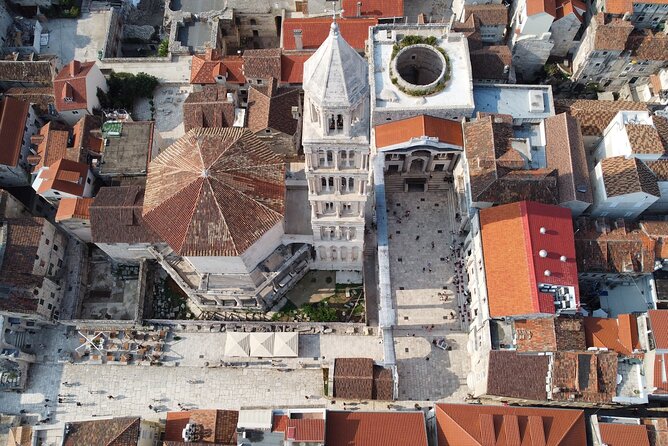
Diocletian’s Palace can confuse you at first. It is large, but it does not feel like one grand building. The original Roman complex has been absorbed into modern Split, so a palace wall may form the side of a shop, a medieval street may pass through an ancient gate, and a café table may sit where an emperor once received visitors.
That is why a guided walk helps. A map can show you the shape of the palace, but it cannot easily explain how an imperial residence became the center of daily life. I like this tour because it treats Split as both an archaeological site and a living town.
The route lasts about an hour and a half. That is enough time to get the main story and see the important points without turning the visit into a long lecture. You will walk over old stone surfaces and through crowded city areas, so comfortable shoes are sensible.
The starting point is by the model of Split’s historic core on Obala Hrvatskog narodnog preporoda, near the Riva. The advertised route begins and ends along the waterfront, while the stated end point is Republic Square, also called Prokurative. These places are close enough to fit naturally into an old-town walk, but check the exact meeting instructions before setting out.
More ways into Diocletian’s Palace:
- Split: Old Town and Diocletian Palace Walking Tour
★ 4.9 · 4,727 reviews - Walking Tour of Split and Diocletian’s Palace
★ 5.0 · 2,588 reviews - Split & Diocletian’s Palace Walking Tour
★ 5.0 · 1,125 reviews
The Riva gives you the right opening view
The tour begins on the Riva, Split’s broad waterfront promenade. This is where locals and visitors sit in cafés, watch the harbor, and enjoy the sun. It is also the best place to see how modern Split presents itself before you step into the older streets.
I like starting here because it gives you a sense of the city’s social life. The palace is not an isolated attraction hidden behind gates. It sits directly behind a promenade full of restaurants and outdoor tables. Your guide can help you understand the relationship between the waterfront and the palace’s southern side.
The Riva stop is brief, about 10 minutes at the start and another five minutes near the end. Do not expect a long café break during the tour. The point is to get your bearings and then move into the old town.
Inside Diocletian’s Palace, where ruins meet real life
The palace was built for Emperor Diocletian more than 1,700 years ago. He used it as a residence after stepping away from imperial rule, and the complex combined private rooms, ceremonial spaces, religious buildings, military defenses, and service areas.
Today, the palace does not feel like a traditional museum. You walk through active streets lined with shops and homes. This is one of the tour’s most valuable features because the guide can point out how Roman planning survives beneath later layers of the city.
A 15-minute palace stop may sound short, but it is really the setting for much of the walk. You will keep moving through the palace complex as the guide explains its different parts. If you want a long archaeological lecture or time to study every wall, you may find the schedule brisk. If you want a clear introduction before exploring on your own, the pace makes sense.
The cellars reveal the palace’s enormous scale
Through the south gate, the route goes toward Diocletian’s cellars. These underground rooms are unusually well preserved and help you picture the size of the palace above.
The cellars mattered for practical reasons. They supported the private and ceremonial rooms overhead and provided storage and structural support. In a complex that can feel like a maze at street level, the lower rooms give you a stronger sense of the original plan.
The scheduled visit here is only about five minutes, so expect an introduction rather than a long examination of every chamber. There is also an important detail to clarify: the tour information says the cellars are entered through the south gate, but it also says sights are visited only from outside and that no entrance fees are included. Ask the provider exactly what cellar access is covered on your date.
More walking tours in Split:
- Krka Waterfalls tour with Trogir Walking tour and Krka panoramic boat cruise
★ 5.0 · 1,659 reviews - Walking Tour of Split with a ‘Magister’ of History
★ 5.0 · 1,122 reviews - Split Walking Tour with Professor of History
★ 5.0 · 926 reviews - Split: Diocletian Palace & Old Town Guided Walking Tour
★ 4.7 · 882 reviews
The Peristyle shows Diocletian’s public face
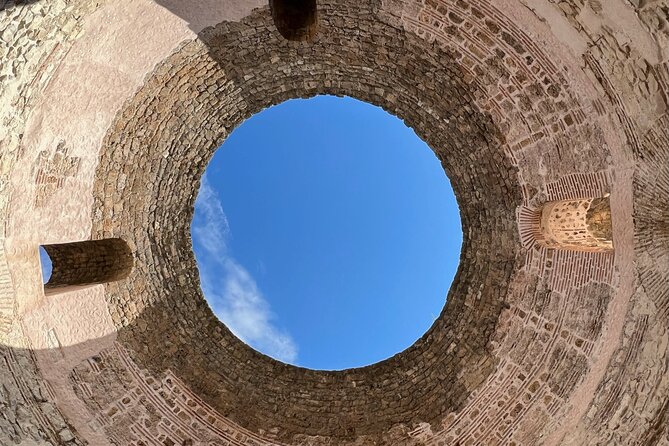
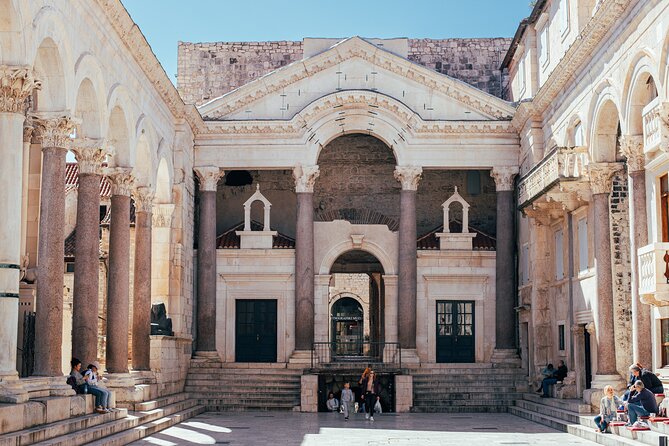
The Peristyle is the palace’s grand central ceremonial square. In Diocletian’s time, it was a sacred meeting place where the emperor appeared before his subjects and presented himself as the son of Jupiter.
This is where the political message of the palace becomes easy to understand. Diocletian was not simply building a comfortable retirement home. He was creating a setting that reinforced his power and divine status.
The guide spends about 10 minutes here, a worthwhile portion of the route. Look up as well as around. The surrounding architecture helps explain how the square framed the emperor’s appearances. The Peristyle is also one of the places where the old palace feels most theatrical, even with modern city life passing through it.
Saint Domnius connects imperial Rome with Christian Split
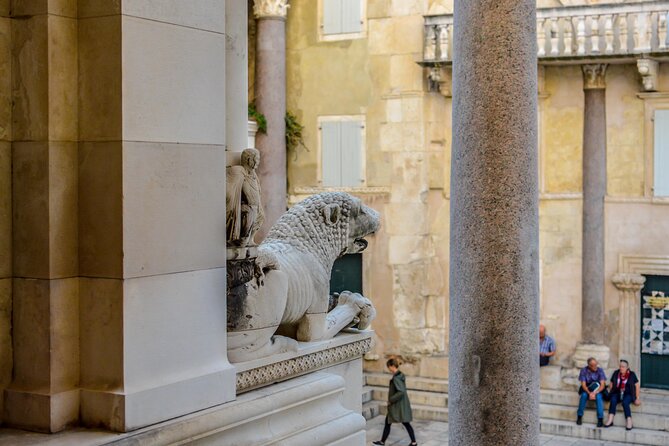
The Cathedral of Saint Domnius began as Diocletian’s mausoleum. Later, as the Roman world became Christian, the building was changed into a cathedral. The emperor’s coffin and remains eventually disappeared, and the former pagan mausoleum took on a new religious role.
The tour views the cathedral from outside and does not include an entrance fee. That keeps the experience simple and avoids adding admission costs, but it also means you will not see the interior on this walk.
I find this stop especially useful because it explains how Split’s religious identity changed without erasing the Roman structure. You get a compact lesson in the city’s transformation, from imperial cult to Christian worship, while standing beside one of its most important buildings.
Gates, defenses, and the route through modern Split
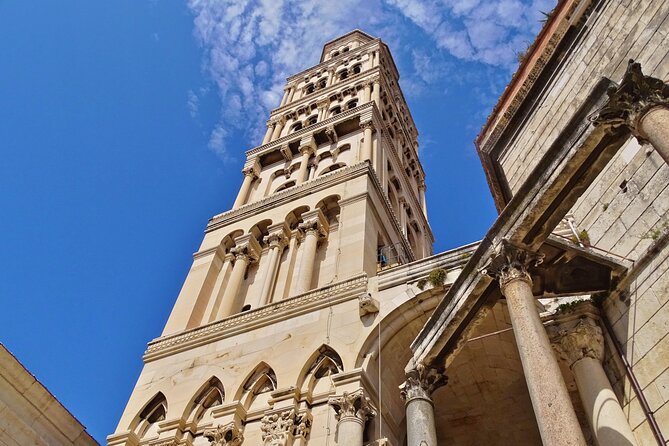
Several stops focus on the palace gates. These were not decorative entrances. They controlled movement through a fortified imperial complex and linked the palace with the surrounding roads and settlements.
The Golden Gate on the north side was the most important gate in Roman times. The road from here led toward Salona, capital of the Roman province. The gate gives you a strong sense of the palace as a place connected to a wider Roman network, not just a private seaside retreat.
The western Iron Gate was built as a double gate, known as a propugnaculum. The space between the gates could trap attackers, who might then be struck with stones, arrows, or hot oil. After passing through, you reach Pjaca, a handsome square that shows how later Split grew around the Roman plan.
There is a naming point worth watching. The stop identified as Iron Gate on the eastern side is described as the Silver Gate in the route details. The western entrance is clearly the Iron Gate. If the distinction matters to you, ask the guide to point out both names and locations as you go.
The eastern gate leads toward the market area. It was walled up and reopened several times over the centuries, including a reopening in the 1940s. That small detail makes the city’s changing relationship with its old defenses easier to see.
Dining rooms and private chambers add human detail
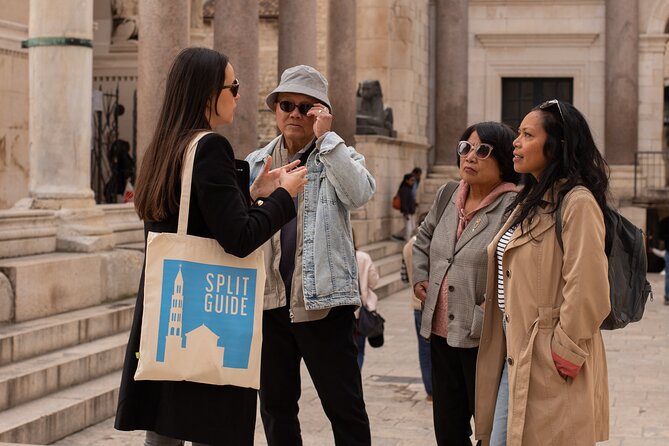
The Triclinium was a dining room where Diocletian entertained guests. The description of the banquets is a memorable bit of human detail: Mediterranean food, local wine, fish, honey, and as many as 20 courses in one evening.
You should treat the menu story as a way to picture court life rather than as a full account of Roman dining customs. Still, it gives the palace a more personal scale. Emperors made political decisions, but they also ate, entertained, and staged elaborate meals.
The vestibule was the entrance area to Diocletian’s private chambers. It is a short five-minute stop, but it helps you separate the emperor’s public spaces from his personal quarters. After seeing the Peristyle, the vestibule gives the route a more domestic turn.
Jupiter’s Temple shows how buildings change purpose
The Temple of Jupiter is now a baptistery. The tour views it from outside, with no admission included.
This is another compact but useful example of Split’s layered past. A Roman temple was not simply left behind. It was given a new Christian purpose, just as Diocletian’s mausoleum became the cathedral.
Because the stop lasts only about five minutes, you will get the basic connection rather than an extended visit. If you want to enter the baptistery, plan to ask about admission separately. The same applies to the cathedral.
The Green Market brings you back to daily life
The final section of the route follows the palace walls toward the Green Market. Fresh fruit, vegetables, and traditional foods are sold here each day.
I like ending with the market because it keeps the tour from becoming only a parade of emperors and monuments. Split’s old center is still useful to people who live there. The market gives you a look at ordinary commerce beside extraordinary Roman remains.
The route then returns toward the Riva and finishes at Republic Square, or Prokurative. From there, you can continue along the waterfront or use the guide’s suggestions for a restaurant, bar, or another leisure activity. Those recommendations are included, and they may be particularly useful if Split is your first stop in Croatia.
What $137.80 per person buys you
At $137.80 per person, this is not a budget orientation walk. The value comes from the private format, the small planned group, and the chance to shape the conversation around your interests.
A large group tour can cover the same landmarks, but it may give you less room to ask questions or adjust the pace. Here, the experience is described as individually customizable. That matters if you want more Roman history, more local life, extra explanation of the gates, or practical advice for the rest of your stay.
The price is easier to justify for a couple, family, or small group that values personal attention. It is harder to justify if you mainly want a quick route map or plan to enter the cathedral and temple on your own. Since those interiors are not included, you should add any separate admission costs to your budget.
The group-size information is slightly inconsistent. The included details describe a maximum of six participants, while the general activity information allows up to 10. Ask for confirmation if the size of the group is important to your decision.
Who will get the most from this walk
I would recommend this tour if you want a clear first explanation of Split before exploring independently. It suits people who enjoy Roman sites but do not want a full museum-style program, and it works well for anyone who prefers a private guide to a large crowd.
It is also a good choice if you want practical help after the history portion. Restaurant, bar, and leisure recommendations are included, and the end point near Prokurative makes it easy to continue into the city.
You may want something else if you need extensive interior visits, a longer archaeological tour, or a guaranteed group of only two people. You should also tell the provider about special needs in advance. The activity can be adapted to participants’ needs, most people can take part, service animals are allowed, and the route is near public transportation.
The tour requires good weather. You can cancel for a full refund up to 24 hours before the start time. If poor weather forces cancellation, you are offered another date or a full refund. Last-minute changes and cancellations inside 24 hours are not accepted.
Should you book Split’s palace highlights tour?
Book it if you want a focused, private introduction to Split’s Roman core, especially with a guide such as Dana who can add stories to the stones. The route covers the essential landmarks in a manageable 90 minutes, and the small format gives you a better chance to ask questions and adjust the emphasis.
Skip it if you want paid interior access included or prefer to explore entirely at your own pace. For most first-time visitors who want to understand why Split’s palace is also a neighborhood, market, and public square, this is a strong starting point. Plan a little extra time afterward for the places you only see from outside.
FAQ
How long does the Split Diocletian Palace tour last?
The walking tour lasts approximately 1 hour and 30 minutes.
What language is the tour offered in?
The tour is offered in English.
Where does the tour start?
The stated starting point is the model of Split’s historic core at Obala Hrvatskog narodnog preporoda 23, 21000 Split, Croatia.
Where does the tour finish?
The stated end point is Republic Square, also called Prokurative, at 21000 Split, Croatia.
Are entrance fees included?
No entrance fees are included. The sights are generally visited from the outside. The route description mentions entering the cellars, so you should confirm the exact access arrangements before the tour.
How many people can join?
The tour is designed for a maximum of six participants, while the additional activity information states a maximum of 10 travelers. Confirm the final group limit when booking.
Can I cancel the tour for a full refund?
Yes. You can cancel at least 24 hours before the experience start time for a full refund. If poor weather causes the provider to cancel, you will be offered another date or a full refund.
Just added around Split
- Kayaking & Zipline Šibenik – Čikola Canyon★ 5.0 · 3 reviews
- Krka National Park & Zipline Šibenik – Čikola Canyon★ 5.0 · 3 reviews
- Split: Small-Group Half Day Sailing Trip★ 5.0 · 3 reviews
- Rafting River Cetina from Makarska Riviera including transfer★ 5.0 · 3 reviews
- From Split: Krka National Park & Waterfalls Private Day Trip★ 5.0 · 3 reviews
- Split Bike and Wine Experience★ 5.0 · 3 reviews
- Split and Salona Cultural Heritage Day Tour from Trogir★ 4.0 · 3 reviews
- Krka Waterfalls, Lake Cruise & Skradin★ 5.0 · 3 reviews
Diocletian Palace Tours, compared.


Walking Tour of Split and Diocletian’s Palace
Read our review →

Diocletian Palace & Old Town Guided Walking Tour
Read our review →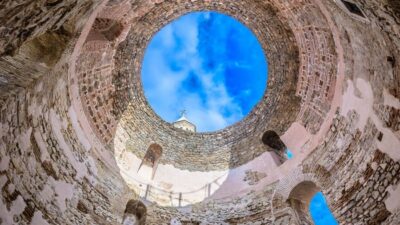
Game of Thrones Tour with Diocletian’s Palace Cellar
Read our review →
Diocletian’s Palace and Old Town SMALL GROUP Walking Tour
Read our review →

Browse the lists this tour appears in