
Reviewed · DIOCLETIAN PALACE TOURS
Split: 1.5-Hour Walking Tour and Diocletian’s Palace
Split’s old town is not a museum sealed behind glass. It is a living city built inside and around Diocletian’s Palace, where Roman walls frame cafés, shops, apartments, markets, and narrow lanes. This walking tour gives you the basic map and story before you wander off on your own.
I like the way the route joins grand Roman sights with everyday Split, especially the fruit market, Riva waterfront, and local advice on food and viewpoints. I also like the short running time, which makes it a smart first activity or a good fit for a port stop. The main drawback is that entrance fees are not included, and a 90-minute walk can feel brief if you want extended time inside the cathedral, temple, or cellars.
In This Review
- Key points at a glance
- Why Diocletian’s Palace makes this tour different
- From the South Gate to the Roman cellars
- Golden Gate and the northern entrance
- The Game of Thrones Museum stop
- People’s Square and Fruit Square
- Riva waterfront and the view toward Marjan Hill
- Peristyle, the palace’s grand central square
- Saint Domnius Cathedral and Vestibul
- How the guides shape the experience
- Duration, timing, and physical demands
- Is $41 a fair price?
- Who should book this Split walking tour?
- Should you book it?
- FAQ
- How long does the Split walking tour last?
- What language is the tour offered in?
- Where does the tour begin?
- What sights are included on the walking route?
- Does the tour include the palace cellars?
- Is Saint Domnius Cathedral included?
- Are food and drinks included?
- Is the tour suitable for people with limited mobility?
- What does the tour cost?
- Can I cancel the booking?
Key points at a glance
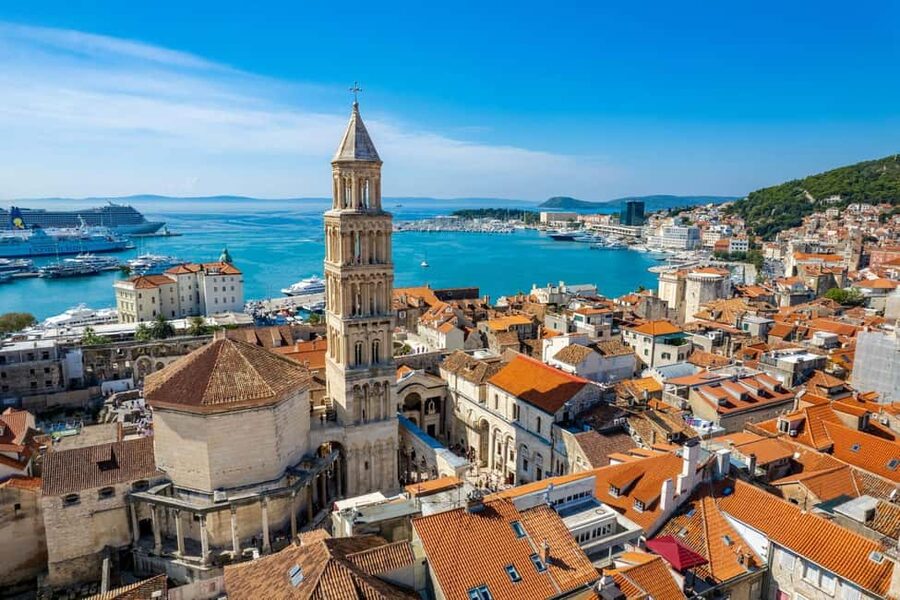
- Roman palace beneath a living city: Walk through Diocletian’s Palace, its cellars, gates, central square, and adjoining medieval streets.
- A useful first look at Split: The route covers the Golden Gate, People’s Square, Fruit Square, Riva, Peristyle, Vestibul, and Saint Domnius Cathedral.
- Local guides add personality: Guides including Sandra, Ana, Ivan, Jelena, and Iva have been praised for clear stories, local perspective, and practical suggestions.
- The best time can be early or late: An 8 a.m. start helps avoid heat and crowds, while an 18:00 departure can be cooler and calmer.
- A compact tour with extra costs: The guide is included for 1.5 to 2 hours, but food, drinks, and admission fees are separate.
- Not ideal for limited mobility: Expect uneven old-town streets, stairs, and plenty of standing and walking. Comfortable shoes matter.
Why Diocletian’s Palace makes this tour different
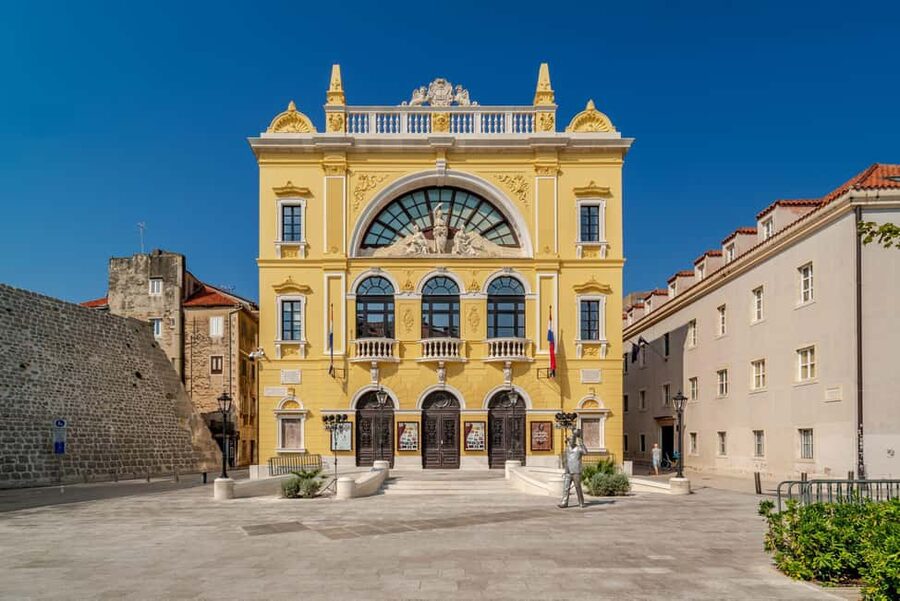
The palace is the main reason to book this walk. Built for Roman Emperor Diocletian around the turn of the 4th century AD, it is far more than a single building. Its walls, gates, courtyards, basements, and former ceremonial spaces form the core of Split.
I find the setting easier to understand with a guide because the old town can first look like a maze of stone lanes. A good explanation shows how Roman foundations, medieval homes, later civic buildings, and 20th-century additions share the same space.
That mixture is one of the tour’s best features. You are not simply moving from one ancient monument to the next. You are seeing how a Roman imperial residence became the framework for a modern Croatian city.
The tour also gives you a sense of local life. People pass through the palace on ordinary errands, and the route reaches markets, squares, cafés, and the waterfront. The result is a useful balance: Roman history provides the structure, while present-day Split keeps the walk grounded.
The experience receives a 4.7 rating from 256 reviews, with especially strong praise for the guides’ storytelling, warmth, and command of Split’s past and present. That matters here. The stones are impressive, but the quality of the explanation determines how much you take away.
More ways into Diocletian’s Palace:
- Split: Old Town and Diocletian Palace Walking Tour
★ 4.9 · 4,727 reviews - Walking Tour of Split and Diocletian’s Palace
★ 5.0 · 2,588 reviews - Split & Diocletian’s Palace Walking Tour
★ 5.0 · 1,125 reviews
From the South Gate to the Roman cellars
The walk begins through the old center, with the exact meeting point depending on the option you book. The listed starting location is South Tours Travel Agency, and the route returns there at the end.
The southern approach brings you toward the part of the palace that faces the sea. From here, the guide sets up the basic story of Diocletian, the palace, and the later growth of Split.
The palace cellars are one of the most worthwhile parts of the route. They preserve the shape of the upper palace and help you picture how the imperial complex was organized. Since entrance fees are not included, check at booking or with the guide to confirm the current admission arrangements for any interior areas.
The cellars also offer relief from the heat, which can be welcome during a summer walk. Still, do not expect a long underground visit within the listed schedule. The whole tour lasts 90 minutes to 2 hours, so the cellar stop is part of a broad introduction rather than a detailed archaeological visit.
Golden Gate and the northern entrance
The Golden Gate is one of the tour’s short stops, with about 10 minutes of guided sightseeing. It gives you a sense of the palace’s scale and defensive design.
The gate is also a good place to notice how the old Roman structure has been absorbed into the city around it. Your guide can point out the way later buildings and daily traffic relate to the ancient entrance.
The brief timing works well for orientation. You get enough information to recognize the gate later, but you do not spend too long at one spot while other parts of Split remain unseen.
The route also includes the North Gate and West Gate, even though the listed stop times focus on the Golden Gate. Taken together, the gates help you understand the palace as a walled complex with several distinct approaches.
The Game of Thrones Museum stop

The Game of Thrones Museum receives a short guided sightseeing stop of about five minutes. This is not presented as a full museum visit, and no museum admission is included.
Think of it as a quick reference point for the modern screen connection to Split. A few guides have added filming locations and related stories to the walk, particularly when the group showed interest.
This stop will matter more to fans of the series than to visitors focused only on Roman archaeology. The short pause keeps it from taking over the tour, which I consider a sensible choice. Split has much more to explain than its role as a filming location.
More walking tours in Split:
- Krka Waterfalls tour with Trogir Walking tour and Krka panoramic boat cruise
★ 5.0 · 1,659 reviews - Walking Tour of Split with a ‘Magister’ of History
★ 5.0 · 1,122 reviews - Split Walking Tour with Professor of History
★ 5.0 · 926 reviews - Split: Diocletian Palace & Old Town Guided Walking Tour
★ 4.7 · 882 reviews
People’s Square and Fruit Square
From the palace area, the route continues into People’s Square, known locally as Pjaca, for roughly 10 minutes of guided sightseeing. This helps show how Split expanded beyond the original Roman palace walls.
You will see a change in architectural character here, with later civic and residential buildings replacing the strict Roman feel of the palace core. The guide’s job is to connect those changes instead of treating each building as an isolated photo stop.
Fruit Square, or Voćni Trg, gets another 10-minute visit. The name points to its former role as a fruit market, and the square offers a more relaxed look at the city’s social life.
I like these two stops because they keep the tour from becoming a parade of emperors and dates. They show how people used the city over time, how commerce shaped public spaces, and how Split still functions as a place for everyday life.
The practical value is clear too. Several people who took the walk appreciated receiving suggestions for local taverns, authentic food, and other places to visit. You can ask your guide for current advice while you are still in the center, rather than trying to sort out the city later.
Riva waterfront and the view toward Marjan Hill
The walk reaches the Riva, Split’s waterfront promenade, for about 10 minutes. This is a useful change of pace after the tight lanes and enclosed palace spaces.
From the promenade, you get views toward Marjan Hill and a wider sense of Split’s position beside the water. The stop also helps connect the palace to the modern port and the city’s current rhythm.
The Riva is more open than the old town, but the promenade can still feel crowded at popular times. That makes timing important. The 8 a.m. departure is a strong choice if you want cooler air and fewer people, while the 18:00 option can bring softer temperatures and a less hurried feel.
The guide may also explain the port’s present role and offer ideas for seeing more of Split. One useful feature of the tour is that it does not treat the waterfront as an unrelated scenic pause. It forms part of the story of how the city lives today.
Peristyle, the palace’s grand central square
Peristyle is the heart of the Roman section and receives about 10 minutes of guided sightseeing. This is where the palace’s ceremonial purpose becomes easiest to imagine.
The square is framed by monumental Roman architecture, but it is not frozen in the past. People cross it, stop for photographs, and move between the surrounding streets. That mixture gives the place its real character.
One of the most unusual details here is the surviving Egyptian sphinx carved from black granite. It is a small but memorable reminder of the wider world connected to the Roman Empire.
A guide can make the square easier to read by explaining what was ceremonial, what was religious, and what belonged to the emperor’s private residence. Without that context, Peristyle can look like a handsome stone courtyard. With it, you begin to see the political theater built into the design.
Saint Domnius Cathedral and Vestibul
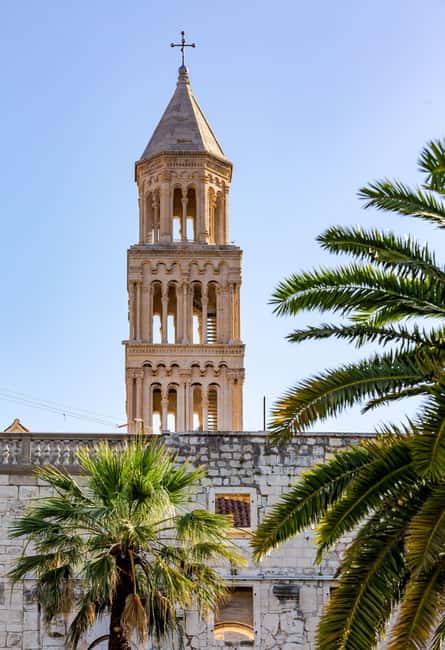
The Cathedral of Saint Domnius is formed from what was originally an imperial Roman mausoleum. It is described here as the oldest Catholic cathedral in the world, a remarkable example of one building being reused and transformed across centuries.
The tour allows about 10 minutes of guided sightseeing at the cathedral. That is enough for an explanation of its unusual origin and a look at the setting, but it may not satisfy you if you want a long interior visit or time for every detail.
Admission fees are not included, so plan for possible extra costs. The supplied details do not specify which individual interiors require payment, so ask before entering if you want to keep your spending clear.
Vestibul follows as a photo stop and guided visit of around 10 minutes. Its circular form and echoes make it one of the more atmospheric spaces on the route.
This section is especially useful for understanding the palace as a working complex rather than a collection of ruins. The mausoleum became a cathedral, Roman spaces gained new religious uses, and the city kept building around them.
How the guides shape the experience
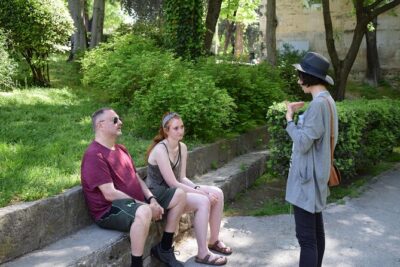
The guide is the main variable in any walking tour, and this one has a strong record on that point. Sandra, Ana, Ivan, Jelena, Iva, Elena, and other guides have been praised for lively explanations, local stories, and a friendly manner.
The best comments focus on more than dates. Sandra has been described as passionate about Split’s past and good at adding anecdotes. Ana has been appreciated for explaining the city through a Croatian point of view and for giving direct advice about restaurants and what is worth paying to see.
Ivan’s style has been described as warm and relaxed, with strong information about Croatia and Split. Jelena has been praised for making history easy to follow and for bringing energy to the walk.
These details suggest a tour that depends heavily on the individual guide, but that is not a reason to avoid it. It is a reason to treat the walk as a conversation. Ask about local food, Marjan Hill, the port, current life in Split, or places you plan to visit next.
English and Spanish tours are available. One past experience involved both language groups together, which made the walk less smooth. If you are choosing between language options, confirm that your preferred language is the main language of your departure.
Duration, timing, and physical demands
The advertised duration is 90 minutes to 2 hours. That is long enough to cover the main old-town landmarks without using up your whole morning or evening.
I would choose this tour early in the day during hot weather. The 8 a.m. time has the practical advantage of cooler conditions and fewer people, and it leaves the rest of the day open for the palace cellars, cathedral, Marjan Hill, or a longer meal.
The 18:00 departure is another sensible choice. One past booking found that time cooler and less crowded, with enough daylight for the streets and waterfront.
The route involves walking through an old city center, with uneven surfaces and likely periods of standing. The operator does not recommend it for people with limited mobility, and comfortable walking shoes are specifically advised.
A past guide made an effort to help a wheelchair user follow a route through town, but that should not be taken as a guarantee of accessibility. If mobility is a concern, contact the provider before booking and explain your needs clearly.
Is $41 a fair price?
At $41 per person, this is not the cheapest way to spend an hour and a half in Split. You can walk through much of the old town without paying for a guide.
The value comes from the explanation and the time saved. A good guide helps you connect the palace, gates, squares, cathedral, waterfront, and local customs in one clean route. That is useful on a first visit, especially if you have only a morning, an evening, or a port stop.
The price does not include entrance fees, food, or drinks. You should budget separately if you want to enter paid sections of the palace or cathedral. The tour itself is best seen as an orientation walk, not an all-inclusive sightseeing package.
Small groups and even private departures have occurred, but group size is not guaranteed. A smaller group lets you ask more questions and hear the guide more easily. A larger group may feel less personal, especially in narrow streets.
Free cancellation is available up to 24 hours before the tour for a full refund, and you can reserve now and pay later. Those terms are useful if your Split schedule may change.
Who should book this Split walking tour?
I would recommend it to a first-time visitor who wants a clear introduction before exploring alone. It also suits anyone who enjoys history but prefers short stories and visible places to a long lecture.
Cruise passengers and people with limited time should find the route practical. It covers the palace, old-town squares, Riva, cathedral, and Vestibul without demanding a full day.
It is also a good match for visitors who want local guidance, not only Roman facts. The guides have offered suggestions about taverns, authentic food, Marjan Hill, and other things to do in Croatia.
I would choose a different format if you want extensive interior visits, a slow archaeological study, or a tour built specifically around accessibility. Since admission fees are extra and the schedule is compact, you may need to return later for the cathedral, cellars, or other paid sights.
Should you book it?
Book this tour if you want to get your bearings fast and understand why Split feels like a city built inside a Roman palace. The route covers the main landmarks, adds the waterfront and local-life angle, and leaves you with useful ideas for the rest of your stay.
Choose an early start to beat the heat, or the 18:00 option for a cooler walk. Bring good shoes, allow extra money for entrance fees, and treat the guide as your first source of local advice. At $41, the tour is worthwhile when clear storytelling and efficient sightseeing matter more to you than exploring every interior at length.
FAQ
How long does the Split walking tour last?
The tour lasts between 90 minutes and 2 hours.
What language is the tour offered in?
The tour is available with a live guide in English or Spanish.
Where does the tour begin?
The meeting point can vary depending on the option booked. South Tours Travel Agency is listed as a starting location.
What sights are included on the walking route?
The route includes the Golden Gate, Game of Thrones Museum area, People’s Square, Fruit Square, Riva, Diocletian’s Palace, Peristyle, Saint Domnius Cathedral, and Vestibul.
Does the tour include the palace cellars?
The route includes a visit to the Roman-era cellars, but entrance fees are not included in the tour price.
Is Saint Domnius Cathedral included?
The cathedral is part of the guided route. Entrance fees are not included.
Are food and drinks included?
No. Food and beverages are not included.
Is the tour suitable for people with limited mobility?
The tour is not recommended for people with mobility impairments. Comfortable walking shoes are recommended.
What does the tour cost?
The listed price is $41 per person.
Can I cancel the booking?
You can cancel up to 24 hours in advance for a full refund. Reserve now and pay later is also available.
Just added around Split
- Kayaking & Zipline Šibenik – Čikola Canyon★ 5.0 · 3 reviews
- Krka National Park & Zipline Šibenik – Čikola Canyon★ 5.0 · 3 reviews
- Split: Small-Group Half Day Sailing Trip★ 5.0 · 3 reviews
- Rafting River Cetina from Makarska Riviera including transfer★ 5.0 · 3 reviews
- From Split: Krka National Park & Waterfalls Private Day Trip★ 5.0 · 3 reviews
- Split Bike and Wine Experience★ 5.0 · 3 reviews
- Split and Salona Cultural Heritage Day Tour from Trogir★ 4.0 · 3 reviews
- Krka Waterfalls, Lake Cruise & Skradin★ 5.0 · 3 reviews
Diocletian Palace Tours, compared.


Walking Tour of Split and Diocletian’s Palace
Read our review →

Diocletian Palace & Old Town Guided Walking Tour
Read our review →
Game of Thrones Tour with Diocletian’s Palace Cellar
Read our review →
Diocletian’s Palace and Old Town SMALL GROUP Walking Tour
Read our review →
Browse the lists this tour appears in