
Reviewed · OLD TOWN & HISTORY TOURS
Sightseeing Split’s Roman Ruins: A Self-Guided Audio Tour
Diocletian’s Palace is not a single monument waiting behind a ticket booth. It is the living center of Split, with Roman walls, shops, homes, cafés, churches, and narrow lanes all mixed together. This self-guided audio walk helps you make sense of that jumble as you move from the Riva into the palace core and onward to Fruit Square.
I like the freedom to start whenever you want and the lifetime access, which lets you pause, repeat sections, or use the tour again. I also like the price: at $14.99, it costs far less than many private walks and still gives you a clear route, GPS guidance, and historical narration.
The main thing to consider is that you are responsible for your own phone, headphones, timing, and navigation. The GPS start point has placed at least one listener slightly off course, though the mistake was easy to fix. This is a good choice if you prefer independence, but less so if you want a live guide answering questions.
In This Review
- Key points at a glance
- A smart way to understand Split’s Roman core
- From the Riva into Diocletian’s Palace
- The Peristyle and Vestibulum
- Jupiter’s Temple and the palace’s changing purpose
- Gates, museums, and the old city center
- Standarac, chapel, market, and Fruit Square
- What the app does well
- Is $14.99 good value?
- Who should choose this audio walk?
- Practical details before you start
- Should you book it?
- FAQ
- How long does the audio tour take?
- Where does the tour begin?
- Where does the tour end?
- What sights does the tour cover?
- Is the tour guided by a person?
- What language is available?
- Does the tour work offline?
- Are entrance tickets included?
- What do I need to bring?
Key points at a glance
- About 60 to 75 minutes: Follow a compact route from the Riva through Diocletian’s Palace and finish in Fruit Square.
- English audio with offline access: Download the VoiceMap app, maps, audio, and geodata before you begin.
- A Roman palace that is still a city: The route connects ancient ruins with Split’s cathedral, museum, synagogue, market, and public squares.
- No fixed departure time: Start at any hour listed for the experience, rather than gathering with a group.
- Important sights included: Hear about the Peristyle, Vestibulum, Jupiter’s Temple, palace cellars, Silver Gate, Golden Gate, and more.
- Bring your own equipment: A smartphone and headphones are not included, and admission fees are separate.
A smart way to understand Split’s Roman core
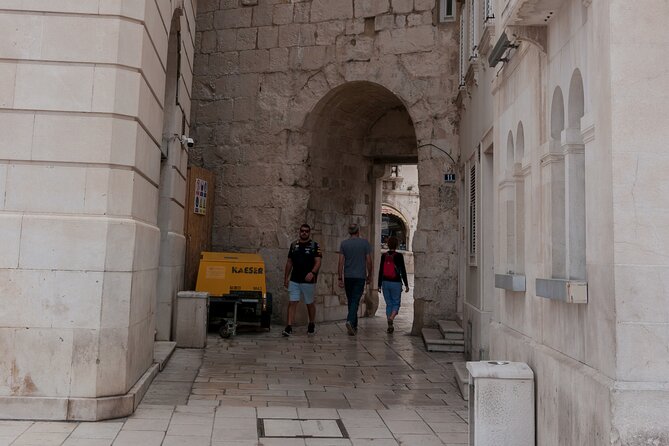
Diocletian’s Palace can be confusing at first. Its old walls form much of Split’s historic center, but the palace is not preserved as an empty archaeological site. People live and work inside it. You may pass a Roman column on the way to a café, then turn into a lane where medieval and later buildings cover parts of the original structure.
That makes an audio walk useful. Instead of stopping at only the most famous monument, this route links the palace to the surrounding old town. You get a guided thread through the ruins, streets, gates, religious buildings, museums, and squares.
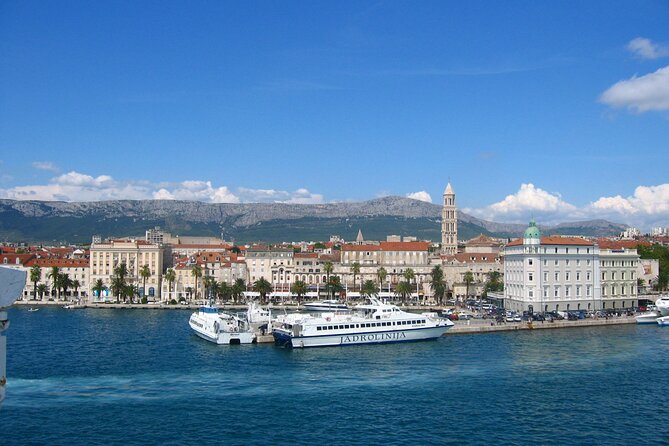
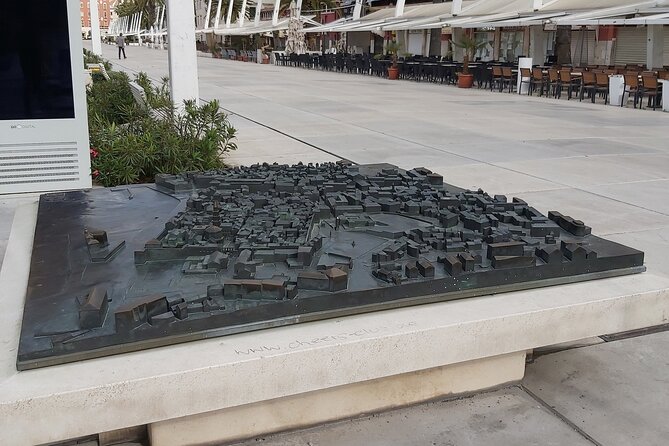
The tour starts beside a model of Split’s historic core on the Riva, at Obala Hrvatskog narodnog preporoda 23. That is a sensible starting point because the waterfront gives you a broad idea of the old city before you head into its tighter streets. From there, the route enters Diocletian’s Palace and gradually moves through its central sights.
You should allow around an hour for the basic walk. The stated duration is about one hour to one hour and 15 minutes, but your pace may change that. If you stop for photographs, look closely at the ruins, or enter an attraction, give yourself extra time. The tour itself does not include entrance tickets.
More old town history walks in Split:
- Split: Old Town and Diocletian Palace Walking Tour
★ 4.9 · 4,727 reviews - Walking Tour of Split with a ‘Magister’ of History
★ 5.0 · 1,122 reviews - Split Walking Tour with Professor of History
★ 5.0 · 926 reviews
From the Riva into Diocletian’s Palace
The first section takes you from the modern waterfront toward the palace. This change in setting is part of the appeal. You begin with open space and city movement, then enter a dense historic quarter where Roman planning still shapes the streets.
The route briefly visits the palace cellars. These underground spaces are among the clearest places to picture the original building. Their preserved structure gives you a sense of how the palace was built and how its lower levels supported the grander spaces above.
The walk also passes the Mozaik Podrum, or mosaic cellar, and the Triclinium. These stops point toward the private and ceremonial side of the palace, not just its defensive walls. The audio format is especially handy here because you can keep moving while the explanation fills in the setting around you.
The itinerary says the tour passes by some places rather than stopping for a long visit. That distinction matters. You should expect a narrated route through the historic center, not a series of extended indoor museum visits.
The Peristyle and Vestibulum
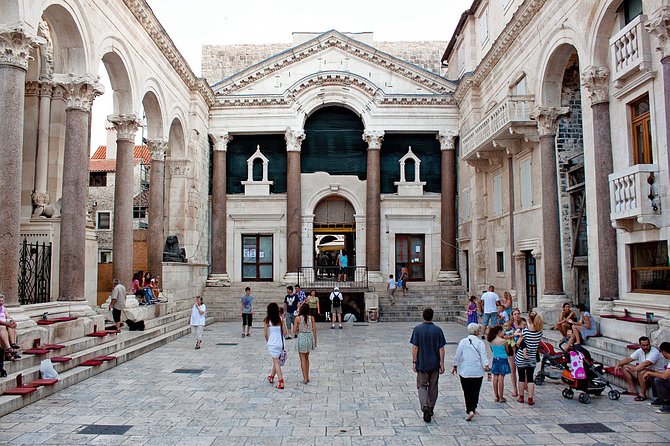
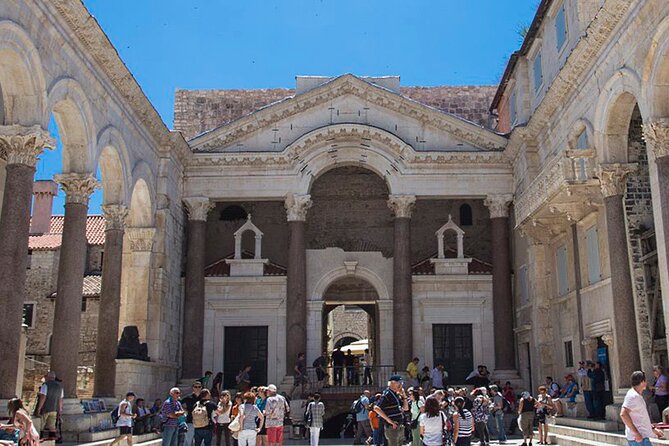
The Peristyle is the heart of the palace route. This formal square is where the scale and purpose of Diocletian’s complex become easiest to grasp. The audio pauses here, giving you time to look around and connect the surviving architecture with the palace’s ceremonial role.
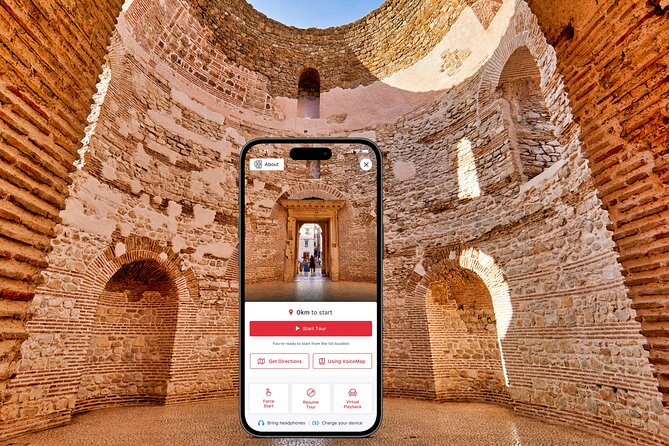
The route then makes a brief stop at the Vestibulum. This circular entrance space once led toward the emperor’s apartments. Its shape and position make it an important link between the public areas of the palace and the more private sections.
These are the points where I would slow down. The tour is designed to take about an hour, but you do not need to rush through the main sights simply to match the estimated time. The app gives you the route, while you decide how long to look.
Jupiter’s Temple and the palace’s changing purpose
Jupiter’s Temple is another brief stop. It adds religious context to the palace and helps explain that this was more than an imperial residence. The temple is one of the places where Roman beliefs, imperial power, and later Christian use meet within the same small area.
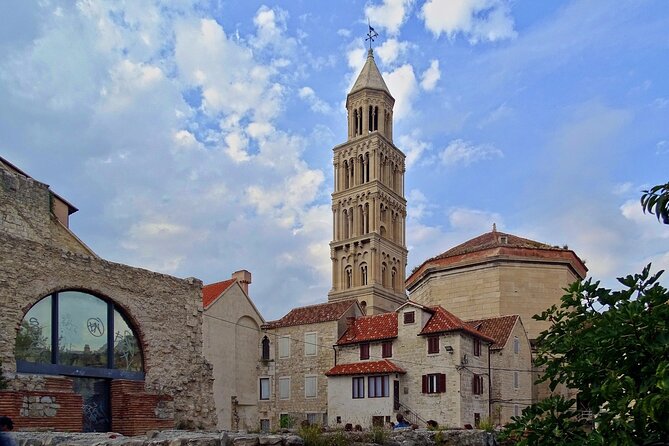
The route also passes Palaca Cindro and the cathedral. These sights help you see how Split changed after the Roman period. The palace did not remain frozen in antiquity. Later buildings and institutions took over its spaces, giving the old center its layered character.
You may find this part more rewarding if you listen carefully to the transitions between stops. The point is not only to identify Roman ruins. It is to understand how the palace continued to serve the city long after Diocletian’s time.
More self-guided routes around Split:
- Split: Self-Guided Plitvice Lakes Day Tour with Boat Ride
★ 4.9 · 1,519 reviews - From Split: Self-Guided Plitvice Lakes Day Tour with Boat Ride
★ 5.0 · 242 reviews - Self-guided mountain bike tour (non-electric)
★ 4.8 · 8 reviews
Gates, museums, and the old city center
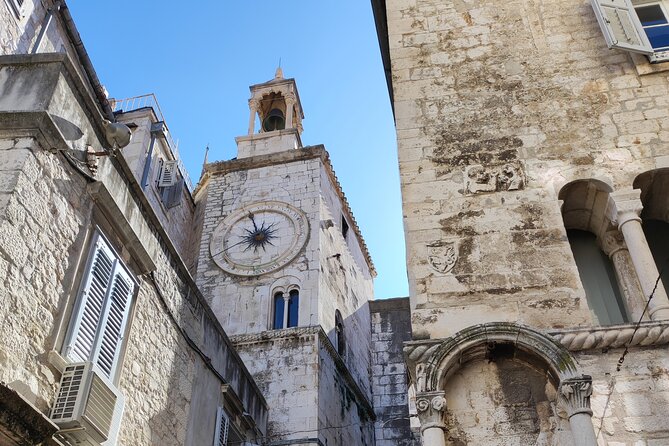
The audio walk passes the Silver Gate, one of the key entrances through the palace walls. It also continues by the Split City Museum and the Golden Gate. Together, these stops show how movement through the old city was organized and how the palace connected with the wider settlement.
The Golden Gate is one of the route’s major visual moments. It gives you a strong sense of the palace’s defensive edge and ceremonial entry. The Silver Gate offers another view of the wall system, while the city museum provides a reminder that Split’s story extends well beyond the Roman era.
The route does not include admission to the museum or any other attraction. You can still follow the audio walk without entering, but if you want a longer visit inside, plan for a separate ticket and more time.
The tour also passes a statue, the synagogue, and the old city hall. These stops move you away from a narrow Roman-only story and into the broader life of Split’s old town. The synagogue and city hall, in particular, point to the different communities and civic functions that developed inside and around the palace.
Standarac, chapel, market, and Fruit Square
Near the later part of the route, you pass Standarac and a chapel before continuing toward the fish market. The sequence gives you a feel for the old center as a place of everyday business and local routine, not just an archaeological display.
The fish market is a practical contrast to the grand Roman remains. It brings the route back to present-day Split and shows how the historic center still serves ordinary city life. The tour then moves through a square before ending at Radić Brothers Square, better known as Fruit Square.
Fruit Square is a useful finish because it leaves you in a central, lively part of the old town rather than sending you back to the starting point. From here, you can continue exploring on your own, stop for food or a drink, or use the route again later if you want to revisit a section.
The ending also makes the walk feel like a short cross-section of Split. You start on the waterfront, pass through an imperial palace, and finish in a later urban square. That range is one of the tour’s strongest features.
What the app does well
The tour uses the VoiceMap app for Android and iOS. After booking, you download the English tour and use the phone as your guide. The app includes audio, maps, and geodata for offline use, which is important if you do not want to depend on a constant mobile connection.
The GPS function is meant to keep you on the correct route and trigger the right audio as you move. One listener found that the starting point appeared slightly wrong, but it was easy to recover. I would still arrive at the Riva a few minutes early, compare the listed address with the map, and make sure the audio is downloaded before setting off.
A self-guided format also lets you stop without holding up anyone else. You can pause the narration at a café, replay a section near the Peristyle, or take a longer look at the gates. The tour has lifetime access, so you can return to it later rather than treating it as a one-time purchase.
The tradeoff is the lack of a human guide. If you have a question about a building, want help with a photograph, or enjoy conversation during a walk, this will feel limited. The audio gives you structure and context, but it cannot respond to your interests.
Is $14.99 good value?
At $14.99 per person, this is a low-cost way to get a planned introduction to Split’s historic center. The price includes lifetime access to the English tour and offline route material, but not your smartphone, headphones, food, transport, or entrance fees.
That makes the value strongest if you already have a phone and headphones and want a short orientation walk. You are paying for the route and narration, not for access to the palace as a ticketed attraction. Much of the palace is part of the public old town, but museums and other attractions along the way may charge separately.
Compared with a private tour, this option gives you more control for much less money. Compared with wandering alone, it adds a route and stories that help explain what you are seeing. The compromise is personal attention. You must handle the app and decide how deeply to explore each stop.
The current rating is 4.8 from four ratings, with especially strong praise for the clear route, enjoyable narration, and ability to move at your own pace. Those are exactly the areas where this experience makes the most sense.
Who should choose this audio walk?
I would recommend it to independent visitors who want a planned introduction without joining a crowd. It suits solo visitors, couples, and small private groups who prefer to begin when convenient and pause whenever they like.
It is also a good fit for a first visit to Split. The route covers the best-known palace sights while adding less obvious stops such as the Mozaik Podrum, Triclinium, synagogue, Standarac, and fish market. You get a useful first map of the old center.
Families with older children may like the freedom to take breaks, though the adults will need to manage the phone and audio. History-minded visitors should appreciate the mix of Roman, religious, civic, and everyday city sights.
I would choose a live guide instead if your main goal is detailed discussion or personal recommendations. I would also think twice if you dislike navigating with a phone or do not want to bring headphones. The tour is easy to use when the technology works, but the technology is still part of the experience.
Practical details before you start
The meeting point is at the model of Split’s historic core on the Riva, Obala Hrvatskog narodnog preporoda 23. The endpoint is Radić Brothers Square, Trg Braće Radić 5, also called Fruit Square.
The experience is listed as available Monday through Sunday, all day, from July 23, 2020 through September 1, 2026. Confirmation is sent at booking, and the activity is private, meaning only your group participates.
Public transportation is nearby, and most people can take part. Still, bring a charged smartphone and headphones, download the offline material, and check the starting location before you begin. Since the tour is non-refundable and cannot be changed after booking, confirm that the English format and self-guided style suit you first.
Should you book it?
Book this tour if you want a short, inexpensive introduction to Split’s Roman center and value control over your schedule. The route covers the Peristyle, Vestibulum, Jupiter’s Temple, cellars, gates, cathedral, museum area, market, and Fruit Square without making you follow a group.
Skip it if you want a live expert, included museum admission, or a fully hands-off experience. For most independent visitors with a smartphone and headphones, $14.99 is a sensible price for a one-hour orientation that you can reuse throughout your stay.
FAQ
How long does the audio tour take?
The tour takes approximately one hour to one hour and 15 minutes.
Where does the tour begin?
It begins at the model of the historical core of Split on the Riva, at Obala Hrvatskog narodnog preporoda 23, 21000 Split.
Where does the tour end?
It ends at Radić Brothers Square, also called Fruit Square, at Trg Braće Radić 5, 21000 Split.
What sights does the tour cover?
The route includes Diocletian’s Palace, the cellars, Mozaik Podrum, Triclinium, the Peristyle, Vestibulum, Jupiter’s Temple, Palaca Cindro, the Silver Gate, cathedral, Split City Museum, Golden Gate, synagogue, old city hall, Standarac, a chapel, the fish market, and Fruit Square.
Is the tour guided by a person?
No. It is a self-guided smartphone audio tour using the VoiceMap app.
What language is available?
The tour includes lifetime access in English.
Does the tour work offline?
Yes. Offline access includes the audio, maps, and geodata.
Are entrance tickets included?
No. Tickets and entrance fees for museums or other attractions along the route are not included.
What do I need to bring?
You need your own smartphone and headphones. Transportation and food or drinks are also not included.
Just added around Split
- Kayaking & Zipline Šibenik – Čikola Canyon★ 5.0 · 3 reviews
- Krka National Park & Zipline Šibenik – Čikola Canyon★ 5.0 · 3 reviews
- From Split: Krka National Park & Waterfalls Private Day Trip★ 5.0 · 3 reviews
- Split: Small-Group Half Day Sailing Trip★ 5.0 · 3 reviews
- Rafting River Cetina from Makarska Riviera including transfer★ 5.0 · 3 reviews
- Split Bike and Wine Experience★ 5.0 · 3 reviews
- Split and Salona Cultural Heritage Day Tour from Trogir★ 4.0 · 3 reviews
- Private transfer from Split to Dubrovnik with 2h sightseeing stop in Ston★ 5.0 · 3 reviews
Old Town & History Tours, compared.


Walking Tour of Split with a ‘Magister’ of History
Read our review →

Diocletian Palace & Old Town Guided Walking Tour
Read our review →

Diocletian’s Palace and Old Town SMALL GROUP Walking Tour
Read our review →

Split History and Gastro Small-Group Tour with Food and Drinks
Read our review →Browse the lists this tour appears in