
Reviewed · OLD TOWN & HISTORY TOURS
Private History tour – small group
Diocletian’s Palace is not a museum behind a rope. It is Split’s old town, full of homes, shops, cafés, churches, and Roman stonework still woven into daily life. This private walk with historian Ivan Fistanić helps you read that jumble, from the Golden Gate and palace cellars to the Peristyle and the medieval squares beyond.
I like the small-group format, which means your party of up to 10 can ask questions without being swallowed by a crowd. I also like Ivan’s academic background, since his Master’s Degree in History suits a city where Roman, Christian, Venetian, and modern stories sit on top of one another.
The main consideration is time. At 90 minutes to two hours, this is a brisk introduction rather than a full study of every palace interior. The cathedral and Temple of Jupiter are discussed from outside, and admission costs for those sights are not included.
In This Review
- Key points to know before you book
- Why this short walk makes sense in Split
- Starting at the Golden Gate
- The cellars and the Peristyle
- The Cathedral of Saint Domnius
- The Temple of Jupiter and the Vestibule
- Riva Harbor and the southern palace wall
- Fruit Square and the Venetian layer
- Pjaca, Split’s medieval civic square
- Gregory of Nin and the good-luck toe
- What the $238.28 group price buys you
- Timing, comfort, and who should choose it
- Should you book Ivan Fistanić’s Split history walk?
- FAQ
- How long does the private history tour last?
- How many people can join the private tour?
- Where does the tour start?
- Where does the tour end?
- Does the tour enter the Cathedral of Saint Domnius?
- Can I cancel for a full refund?
Key points to know before you book
- Diocletian’s Palace is still a living city: You walk through streets and squares that serve local life, not only ancient monuments.
- Ivan Fistanić leads the tour: His Master’s Degree in History gives the walk a strong historical focus.
- The itinerary covers nine central sights: Expect the Golden Gate, palace cellars, Peristyle, cathedral, Temple of Jupiter, Vestibule, Riva, Fruit Square, Pjaca, and Gregory of Nin.
- The private price covers your whole group: At $238.28 for up to 10 people, the value improves sharply when shared by several members of your party.
- The walk lasts about 90 to 120 minutes: That makes it easy to fit before lunch, after arrival, or before an evening plan.
- Some interiors are not included: You will not enter the Cathedral of Saint Domnius, and the Temple of Jupiter is also treated as an exterior stop.
Why this short walk makes sense in Split
Split can be confusing at first. The palace is large, but it does not look like a single Roman ruin. Parts of the walls are obvious, while other sections have been absorbed into later buildings. A doorway may lead to a modern business, a narrow lane may follow an ancient route, and a Roman column may sit beside a medieval home.
That is where a guide earns the fee. Ivan can give you the basic map of Diocletian’s Palace, explain how its rooms were used, and show how later Christian and Venetian changes altered the imperial complex. You are not simply ticking off monuments. You are learning how the old town grew around them.
The route also reaches beyond the palace itself. Riva Harbor, Fruit Square, and Pjaca show how Split developed after the Roman period. That broader view matters because the city’s character comes from the layers, not from Roman stone alone.
The tour is private, so it suits a family, couple, or group of friends with a shared interest in history. You can ask for clarification, pause over a detail, or use the guide to sort out the difference between an emperor’s residence, a temple, a church, and a medieval civic square.
More old town history walks in Split:
- Split: Old Town and Diocletian Palace Walking Tour
★ 4.9 · 4,727 reviews - Walking Tour of Split with a ‘Magister’ of History
★ 5.0 · 1,122 reviews - Split Walking Tour with Professor of History
★ 5.0 · 926 reviews
Starting at the Golden Gate
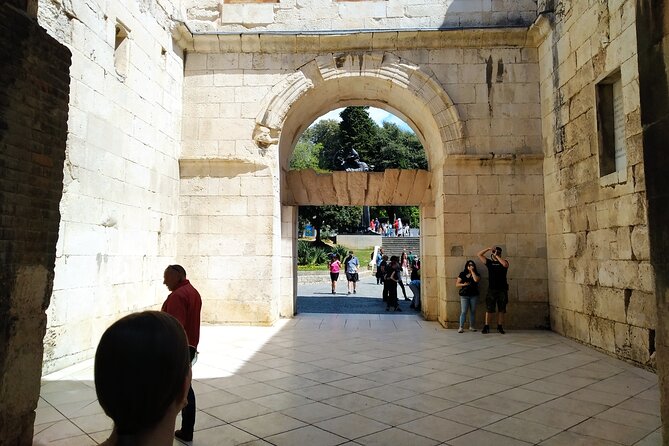
The Golden Gate is the northern entrance to Diocletian’s Palace and one of the four main Roman gates. Its ancient road led toward Salona, the capital of the Roman province of Dalmatia and the birthplace of Emperor Diocletian.
This is a useful first stop because it gives you a sense of the palace as a fortified residence, not just a collection of grand rooms. The gate’s position also helps you understand the palace’s connection to the wider Roman world.
Across from the Golden Gate, you see the statue of Gregory of Nin. The tour returns to this figure later, so the first glimpse gives you a helpful preview of one of Split’s best-known local landmarks.
You will spend about 15 minutes here, with no admission fee. The stop is mostly explanatory, so expect to study the architecture from outside rather than pass through a ticketed attraction.
The cellars and the Peristyle
From Riva, the route enters the central section of Diocletian’s Palace cellars. These underground spaces are important because they preserve the layout of the rooms above. In practical terms, the cellars help you understand the palace plan when the upper level has been altered by centuries of construction.
Ivan explains how the cellars were used over time. That historical change is one of the most useful parts of a guided visit, since it keeps the space from becoming a silent corridor of old stone.
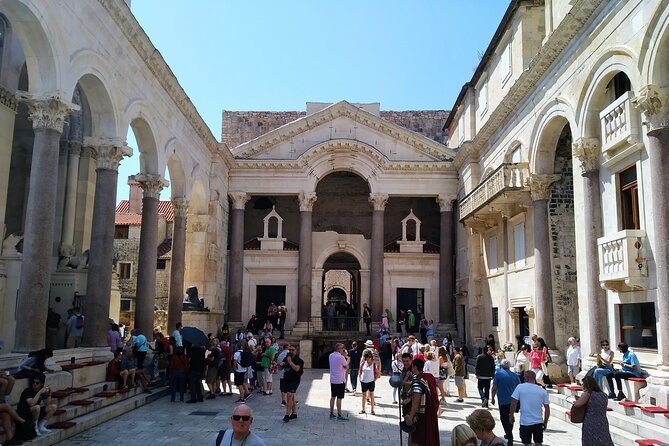
You then come out at the Peristyle, the palace’s central open square. Monumental arcades frame the space, and the imperial loggia faces the square. This is the architectural heart of the tour and one of the places where Roman power is easiest to picture.
The Peristyle also introduces the shift from imperial Rome to Christian Split. Ivan explains how the buildings changed as Christianity expanded and how that affected the life of the palace. You can expect about 15 minutes here, including the cellars.
The itinerary describes admission to this stop as free. Even so, the exact movement through the old town may depend on local conditions, since Split’s central streets remain active public spaces.
The Cathedral of Saint Domnius
From the Peristyle, the Cathedral of Saint Domnius is impossible to miss. The building is one of the city’s best-preserved Roman structures, yet it remains in use as a church.
That combination gives the cathedral unusual importance. You are looking at an ancient Roman building that later became part of Christian life, rather than at a monument frozen in one period. The guide points out significant parts of the structure and explains the story behind them.
This is an exterior explanation only. You do not enter the cathedral during this tour, and any admission is not included. If seeing the interior is important to you, you will need to arrange that separately.
The stop lasts about 10 minutes. That is enough for orientation and historical context, but not enough for a slow architectural examination or a visit to every part of the cathedral.
A few more Split half-days to weigh up
- Split: Krka Waterfalls Trip with Boat Cruise and Swimming
★ 4.8 · 10,519 reviews - From Split: Krka Waterfalls, Food & Wine Tasting Tour
★ 5.0 · 9,326 reviews - Blue cave, Mamma Mia and Hvar, 5 islands speedboat tour
★ 5.0 · 7,150 reviews - From Split: Krka Waterfalls, Food & Wine Tasting Tour
★ 4.9 · 6,598 reviews
The Temple of Jupiter and the Vestibule
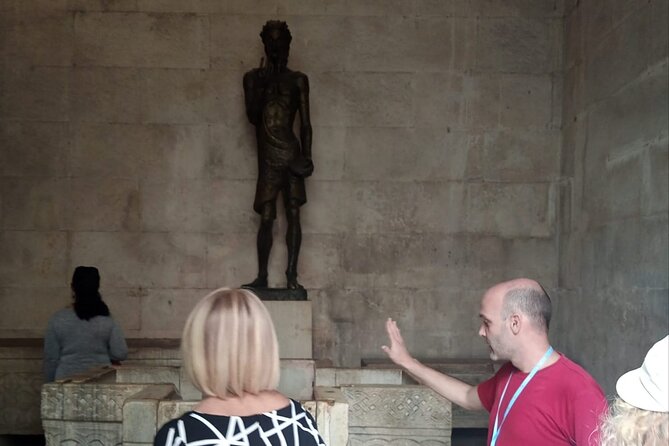
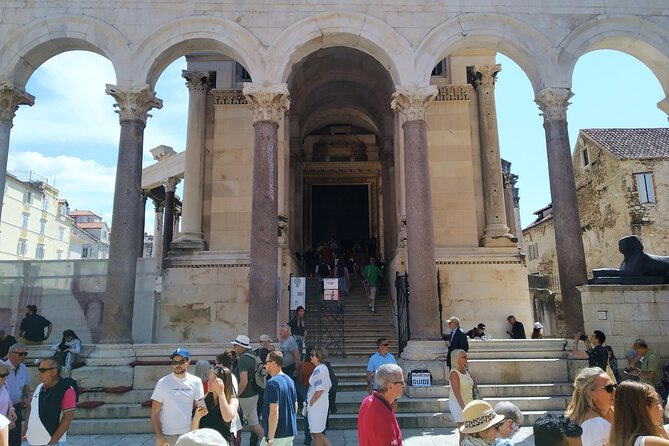
The Temple of Jupiter is described as one of the best-preserved late Roman temples in the world. Its original position was deliberate: the temple connected Emperor Diocletian with Jupiter, the Roman god of the sky and thunder and king of the gods.
The later history is just as interesting. During the Middle Ages, the temple became a baptistery dedicated to Saint John the Baptist. That change gives you another clear example of how Christian Split reused the imperial palace instead of simply abandoning it.
The visit here is an exterior stop, with no admission included. You receive about 10 minutes of explanation, so this section works best as part of the larger story about changing beliefs and changing use.
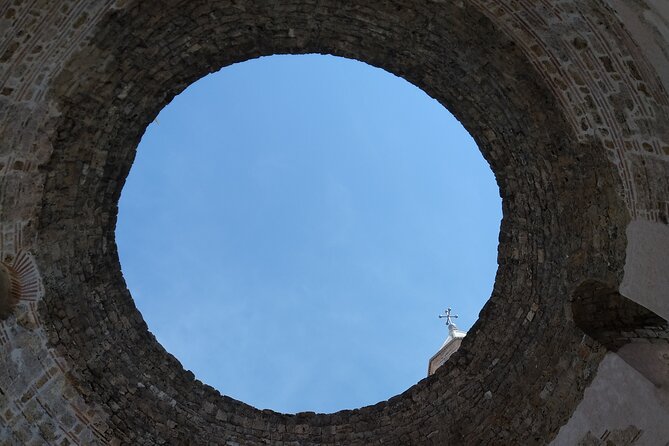
Next comes the Vestibule, the entrance to Diocletian’s private chambers. Its decoration reflected its importance, and Ivan explains what it looked like and how it functioned. From here, you also check the Triclinium, a dining room connected with the emperor’s private area.
The Vestibule is a good counterpoint to the Peristyle. The Peristyle presented imperial authority in public, while the Vestibule led toward the private side of the palace. You get about 10 minutes here, with no admission fee listed.
Riva Harbor and the southern palace wall
Riva Harbor is the tour’s most useful place for connecting the palace with modern Split. It is the city’s main promenade and a meeting point for local people and visitors. From this side, you can see the southern wall of Diocletian’s Palace clearly.
Ivan explains how Riva was built over the centuries and why it became central to local life. That context helps you see the harbor as more than a pleasant waterfront. It is part of the city’s long pattern of movement, trade, gathering, and public life.
The tour begins at the stated meeting point on Ul. kralja Tomislava 15, but the route also uses Riva as an early part of the walk. The supplied route information gives Riva about 10 minutes. Since the activity ends back at the meeting point, you do not need to arrange a separate return transfer.
Riva is also a practical orientation point. If Split is new to you, this view of the palace wall gives you a clearer sense of the city’s shape before the route moves into the tighter lanes and squares.
Fruit Square and the Venetian layer
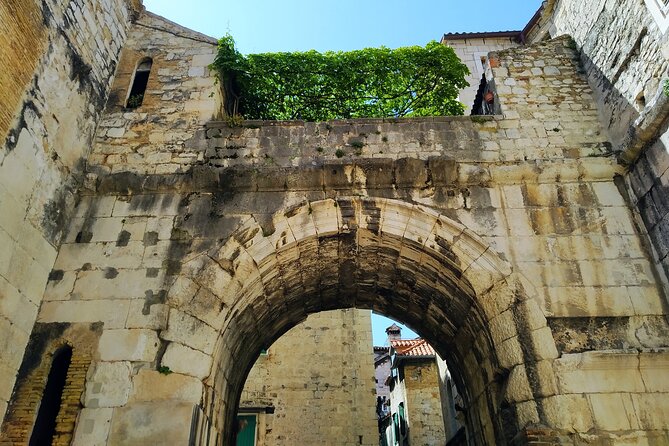
Fruit Square, or Trg Braće Radić, is one of the most picturesque squares just outside the Roman palace. It shows the city moving into its later Venetian period, with the remains of a 15th-century Venetian fort dominating the space.
The square is not only about the fort. Ivan discusses the significant monument in the middle and the important buildings around it, helping you read the square as a civic setting rather than a photo stop.
The 20-minute visit is the longest single stop on the route. That extra time matters because this is where the tour broadens beyond Diocletian. You see how medieval and Venetian Split developed around the earlier Roman core.
If you want a tour focused only on Roman archaeology, this section may feel like a change of subject. I see it as a strength, since Split is more than the palace and its later history is part of what makes the old town worth walking.
Pjaca, Split’s medieval civic square
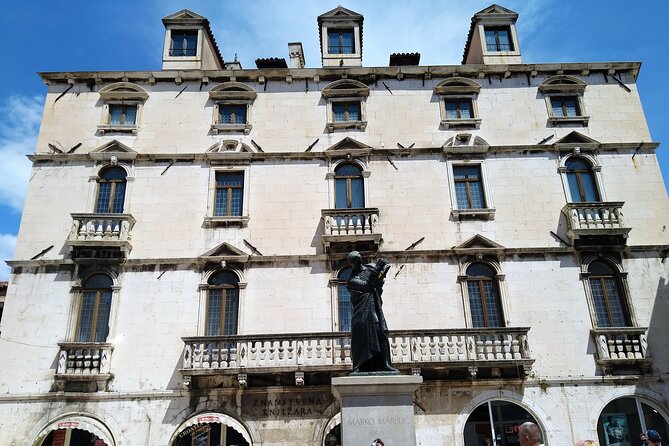
Pjaca sits outside the western wall of the palace, in front of the old Town Hall. It has served as the city’s main square since medieval times and remains one of the key public spaces in the center.
The 14th-century Town Hall and other surrounding structures give Ivan another chance to explain how civic life took shape beyond the emperor’s residence. This stop helps you understand the boundary between the Roman palace and the later city, even though the two now blend together.
You spend about 10 minutes here. That should be enough to identify the main buildings and understand the square’s role, though you will not have time for a long pause or an extended architectural lecture.
For first-time visitors, Pjaca is especially helpful because it shows how Split’s historic center works as a town. You are not moving from isolated ruin to isolated ruin. You are walking through a functioning urban area with several historical periods sharing the same space.
Gregory of Nin and the good-luck toe
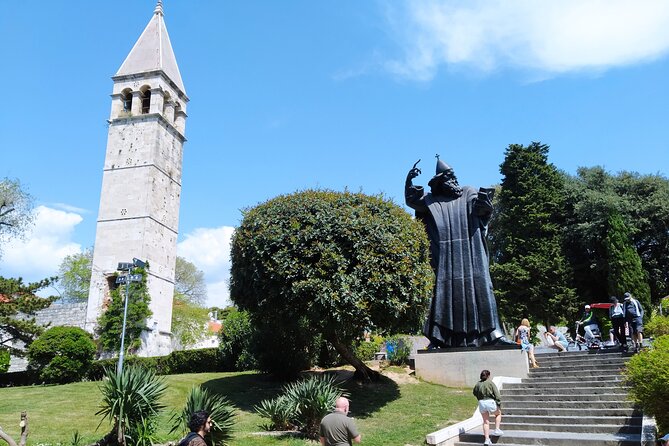
The final featured sight is the statue of Grgur Ninski, or Gregory of Nin, near the Golden Gate. It is one of Split’s most recognizable landmarks and the work of Ivan Meštrović, one of Croatia’s most famous sculptors.
Ivan explains the historical figure, the reason the monument is important, and details about the sculptor. The statue is also linked to a local good-luck tradition: rub its toe.
This is a lighter ending after the imperial and religious material. It gives you a memorable landmark and a simple custom to remember. The stop lasts about 10 minutes and is free to view.
Since the statue is near the Golden Gate, its position also brings the walk back toward the starting area. The activity ends at the meeting point, making the route easy to follow even if you are still getting used to Split’s old town.
What the $238.28 group price buys you
The listed cost is $238.28 per group of up to 10 people, not per person. That distinction is central to the value.
For a full group of 10, the effective cost is about $23.83 per person. For five people, it is about $47.66 each. For two people, it becomes a much more expensive private experience, so the price makes the most sense for families or groups of friends sharing the booking.
You are paying for a private guide with a strong history background, a route through nine important areas, and the ability to ask questions meant for your own group. You are not paying for entrance to the cathedral or Temple of Jupiter, and those sights are covered from outside.
I would compare this price with your group’s priorities. If you want a quick, well-organized introduction and plan to explore the old town on your own afterward, it can be good value. If you prefer to spend several hours inside paid monuments, you may want a longer tour or separate admissions.
Timing, comfort, and who should choose it
The official duration is approximately one hour and 30 minutes to two hours. The listed stop times add up to about 110 minutes, so the upper end of the range makes sense once you include walking between locations and questions.
You should expect a walking tour through the old town, with historical stops rather than a long sit-down presentation. Wear comfortable shoes and leave room in your schedule for the pace of a central city walk.
Most people can participate, and the meeting point is near public transportation. The tour requires good weather, so poor conditions can lead to a different date or a full refund. Free cancellation is available if you cancel at least 24 hours before the start time. Changes or cancellations made later are not accepted for a refund.
This experience suits you best if:
- You want a private guide rather than a large group.
- You care about Roman and medieval history.
- You have roughly two hours for a first look at Split.
- You want to ask detailed questions.
- You are traveling with enough people to share the group price.
It may not suit you if you need extensive interior visits, a slow photography walk, or a full-day archaeological tour. The cathedral and Temple of Jupiter are not entered, and the schedule moves through many sights in a short time.
Should you book Ivan Fistanić’s Split history walk?
Book it if you want the city to make sense quickly. The best feature is not any one monument. It is the way the route links the Roman palace to Christian worship, Venetian defenses, medieval government, the harbor, and modern public life.
Ivan’s history training is a useful match for that subject, and the private format gives you space to ask the questions that often get lost in a larger group. The experience also received a perfect five-star rating from six reviews, including direct praise for the amount of history explained and for detailed answers to many questions. One French-language account describes the visit as enriching and off the usual path, which fits the tour’s aim beyond the most obvious palace views.
I would choose this walk for a first visit, especially if you are traveling with family or friends and can divide the cost. If you already know Diocletian’s Palace well, or if you want to enter every major monument, use this as an introduction only and plan additional visits afterward.
FAQ
How long does the private history tour last?
The tour lasts approximately one hour and 30 minutes to two hours.
How many people can join the private tour?
The price covers one private group of up to 10 people.
Where does the tour start?
The stated meeting point is Ul. kralja Tomislava 15, 21000 Split, Croatia.
Where does the tour end?
The activity ends back at the meeting point.
Does the tour enter the Cathedral of Saint Domnius?
No. The cathedral is explained from the outside, and admission is not included.
Can I cancel for a full refund?
Yes. You must cancel at least 24 hours before the experience start time for a full refund. If poor weather causes the tour to be canceled, you will be offered another date or a full refund.
Just added around Split
- Kayaking & Zipline Šibenik – Čikola Canyon★ 5.0 · 3 reviews
- Krka National Park & Zipline Šibenik – Čikola Canyon★ 5.0 · 3 reviews
- From Split: Krka National Park & Waterfalls Private Day Trip★ 5.0 · 3 reviews
- Split: Small-Group Half Day Sailing Trip★ 5.0 · 3 reviews
- Rafting River Cetina from Makarska Riviera including transfer★ 5.0 · 3 reviews
- Split Bike and Wine Experience★ 5.0 · 3 reviews
- Split and Salona Cultural Heritage Day Tour from Trogir★ 4.0 · 3 reviews
- Private transfer from Split to Dubrovnik with 2h sightseeing stop in Ston★ 5.0 · 3 reviews
Old Town & History Tours, compared.


Walking Tour of Split with a ‘Magister’ of History
Read our review →

Diocletian Palace & Old Town Guided Walking Tour
Read our review →

Diocletian’s Palace and Old Town SMALL GROUP Walking Tour
Read our review →

Split History and Gastro Small-Group Tour with Food and Drinks
Read our review →Browse the lists this tour appears in