
Reviewed · DIOCLETIAN PALACE TOURS
Chill Private Walking Tour of Diocletian’s Palace
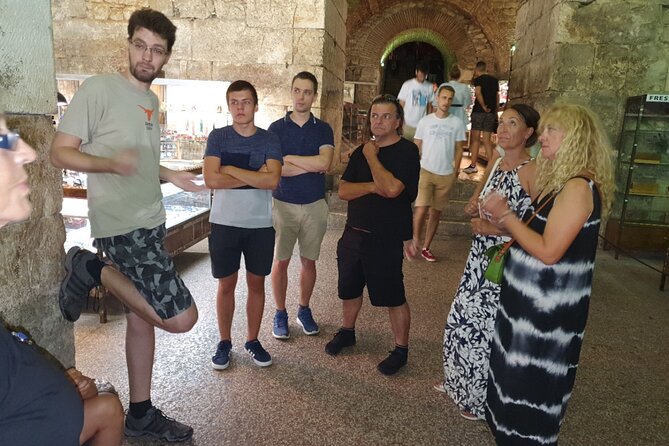
Diocletian’s Palace is not a single monument you walk around and leave behind. It is Split’s old town, with homes, cafés, shops, lanes, churches, and Roman walls folded into modern life. This private walk with guide Mili helps you read those layers, from the emperor’s mausoleum to the cathedral it became.
I like the tour’s small private format, which lets you ask questions and set a comfortable pace. I also like the 3D reconstructions, a useful way to picture the palace as it looked 17 centuries ago rather than staring at ruins and guessing. The main consideration is that some interiors cost extra, so the advertised price does not cover every sight.
In This Review
- Key points at a glance
- Why this palace is easier with a guide
- Starting at the Peristyle, the palace’s grand center
- Going below ground in the substructures
- Seeing a Roman mausoleum become Saint Domnius Cathedral
- The Temple of Jupiter and a second Roman building
- Triklinij and the question of how Diocletian lived
- Papalićeva ulica and the palace as a city
- Fruit’s Square and Croatia’s changing story
- The Golden Gate and the palace defenses
- Grgur Ninski and the final Croatian chapter
- What the $107.84 group price really buys
- Timing, weather, and practical planning
- Who will get the most from Mili’s tour
- Should you book this private Palace walk?
- FAQ
- Where does the tour start?
- Where does the tour end?
- How long does the tour last?
- How much does the private tour cost?
- Is the tour offered in English?
- Are entrance fees included?
- Can I visit the cathedral interior?
- Can I visit more of the palace substructures?
- What happens if bad weather cancels the tour?
Key points at a glance
- Private for your group: The $107.84 rate covers up to 15 people, making it better value for a family or group than for one or two people.
- A clear Roman-to-Croatian story: The route links Diocletian, later church use, medieval Split, and modern city life.
- Nine compact stops: You cover the Peristyle, substructures, cathedral, Temple of Jupiter, Triklinij, Papalićeva ulica, Fruit’s Square, Golden Gate, and Grgur Ninski.
- Optional paid interiors: The free portions are included, while the museum section of the substructures, cathedral interior, and Temple of Jupiter interior require separate tickets.
- Useful visual aids: 3D reconstructions show how key parts of the palace may have looked in Roman times.
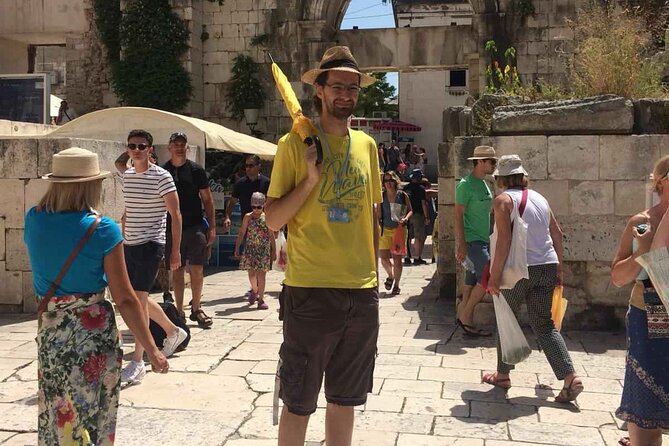
- English-speaking guide Mili: His style combines history, humor, local context, and optional Game of Thrones connections.
Why this palace is easier with a guide
The first surprise in Split is how little the palace feels like an isolated archaeological site. You do not simply enter through a gate, admire four walls, and move on. The Roman structure forms the core of the city, and the route takes you through public squares, narrow lanes, surviving stonework, and later buildings that grew into the old palace.
That layering can be confusing on your own. A Roman column may sit beside a medieval wall, while a modern doorway uses an ancient opening. Mili’s job is to show you how the pieces fit, not just name them. He uses 3D reconstructions to compare what you see now with the palace’s original form.
The tone is relaxed rather than academic. Mili is described as clear in English, responsive before the walk begins, and willing to adjust the amount of information to the group. His humor includes a few groan-worthy puns, which may sound minor, but it helps keep a 90-minute history walk from becoming a stone-by-stone lecture.
The private setup matters most for families and mixed-age groups. You can ask about Roman life, Croatian history, church architecture, or filming locations without waiting for a large group to catch up. A group of four can expect a comfortable pace, while a larger party can divide the cost among up to 15 people.
More ways into Diocletian’s Palace:
- Split: Old Town and Diocletian Palace Walking Tour
★ 4.9 · 4,727 reviews - Walking Tour of Split and Diocletian’s Palace
★ 5.0 · 2,588 reviews - Split & Diocletian’s Palace Walking Tour
★ 5.0 · 1,125 reviews
Starting at the Peristyle, the palace’s grand center
The meeting point is at the Eastern, or Silver, Gate, at Poljana kraljice Jelene 5. From there, the first major stop is the Peristyle, the ceremonial heart of Diocletian’s Palace.
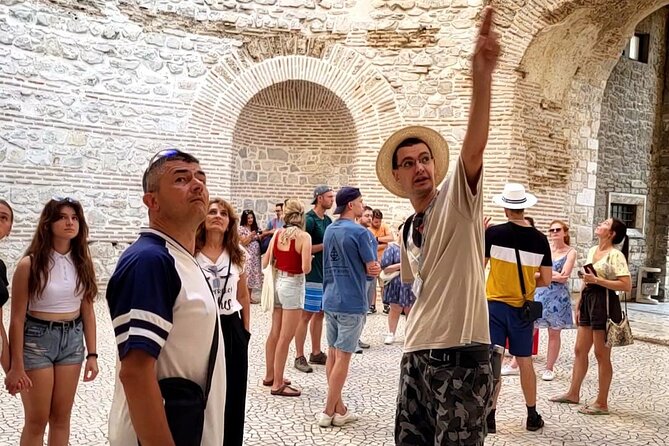
This is the right place to begin because it gives you the palace’s basic idea: part residence, part military compound, part sacred complex. You learn who Diocletian was and why he built this enormous retirement residence in Split. The Peristyle also gives Mili room to explain the original plan before the walk moves into the more tangled remains.
You should expect about 20 minutes here. Admission is listed as free for this stop, so you do not need to budget an entrance fee just to understand the square and its Roman setting.
The 3D images are especially useful here. Ancient buildings are hard to picture from fragments, and a reconstruction can show the scale, surfaces, and arrangement that are no longer visible. I would pay close attention at this point because later stops make more sense once you understand the palace’s original layout.
Going below ground in the substructures
The free part of the Diocletian Palace substructures takes about 10 minutes. These lower rooms are valuable not only as ruins, but also because they help explain the shape of the palace above.
The substructures supported the emperor’s residence and reflect the plan of the upper level. As you walk through, Mili can connect the masonry below to the rooms and spaces that once occupied the floor above. This is one of the strongest parts of the tour for anyone who wants architecture explained in plain terms.
You can also buy a separate ticket for the museum section of the substructures. If you choose to do that, allow roughly 20 extra minutes. That option makes the experience longer and more detailed, but it also means the final length depends partly on your choices and interest.
I like that the paid section is optional. You can keep the walk moving if you have limited time, or add more underground rooms if Roman construction is your main reason for coming. Ask about the ticket before the tour starts if you need to keep to a firm schedule.
Seeing a Roman mausoleum become Saint Domnius Cathedral
The Cathedral of Saint Domnius takes about 10 minutes from the outside. The important point is its original function: the building began as part of Diocletian’s Palace and was constructed as the emperor’s mausoleum.
Later, it became a Christian cathedral. That change gives you a compact lesson in how Split’s old buildings survived. Instead of being erased, the Roman structure was reused and given a new religious role.
If you already have a cathedral ticket, Mili will go inside with you, adding about 10 minutes. The interior visit lets you see more directly how a Roman tomb was adapted for Christian worship. If you do not have a ticket, the exterior explanation still covers the key story.
This stop is a good example of the tour’s main strength: it treats the palace as a living historical record. You are not only looking at Roman remains. You are seeing how later generations changed them, preserved them, and built daily life around them.
More walking tours in Split:
- Krka Waterfalls tour with Trogir Walking tour and Krka panoramic boat cruise
★ 5.0 · 1,659 reviews - Walking Tour of Split with a ‘Magister’ of History
★ 5.0 · 1,122 reviews - Split Walking Tour with Professor of History
★ 5.0 · 926 reviews - Split: Diocletian Palace & Old Town Guided Walking Tour
★ 4.7 · 882 reviews
The Temple of Jupiter and a second Roman building
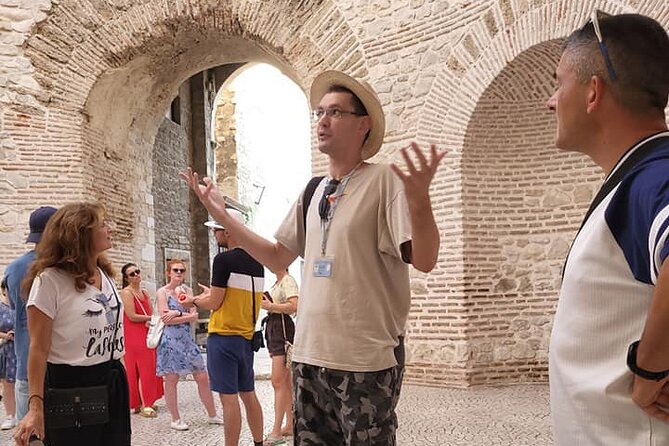
The Temple of Jupiter takes about 10 minutes. It was dedicated to Jupiter, the chief god of the Roman pantheon, and later became another church site.
The temple remains in unusually good condition because of that later reuse. Mili explains the Roman purpose from outside, and if you have a ticket for the small interior, the group can go in. Again, the interior fee is separate.
This stop works well beside the cathedral. At Saint Domnius, you see a mausoleum turned cathedral. At the Temple of Jupiter, you see a Roman religious building that also survived through church use. The comparison helps you understand why parts of the palace remain visible today.
The drawback is practical: you need to decide in advance if you want to enter. The tour price includes the guide and the listed free portions, not the optional admission charges.
Triklinij and the question of how Diocletian lived
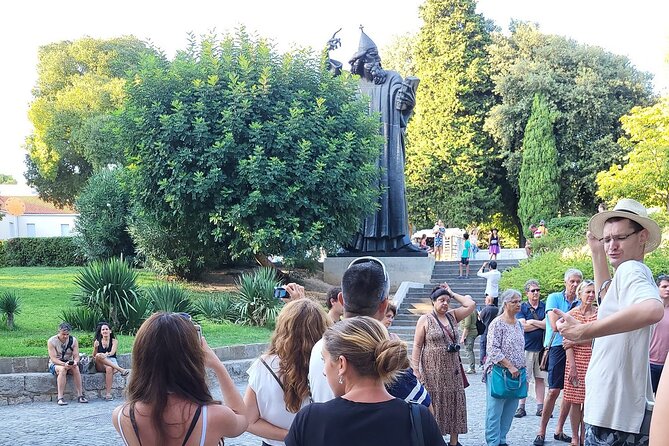
The Triklinij stop lasts about 15 minutes in the southeastern corner of the palace. This area suffered major destruction, but its original construction allowed part of it to be accurately reconstructed.
That reconstruction gives you a more grounded idea of the emperor’s private world. Ruins often tell you where walls were, but a partial rebuilding can suggest how rooms worked and how a palace residence might have felt.
I would not treat this as a complete reconstruction of Diocletian’s home. It is a partial impression, and that is the honest value of the stop. You get enough structure to imagine the setting without pretending that every missing detail is known.
This is also where the visual comparisons can do more work than a long speech. Seeing the current remains beside a Roman-era image helps you understand the gap between the palace as built and the fragments visible today.
Papalićeva ulica and the palace as a city
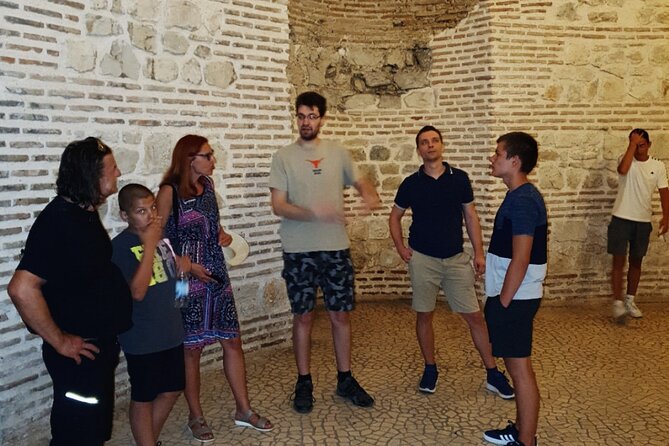
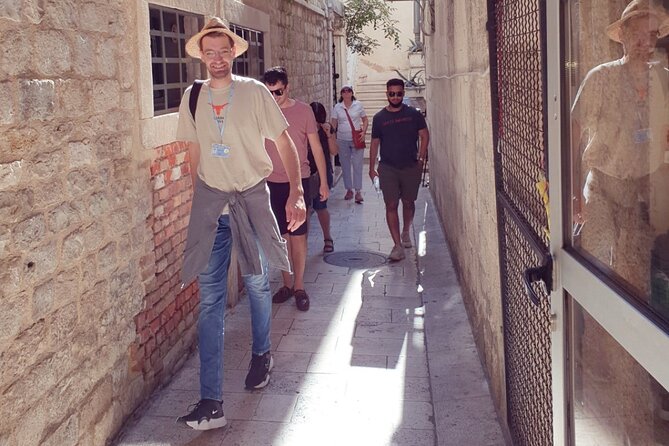
Papalićeva ulica is a 15-minute walk through the north half of the palace. The alley is a chance to shift from major monuments to smaller details and lesser-known facts.
This part of the route matters because Split is not just a collection of grand Roman sites. The palace’s lanes and later buildings show how the old structure became a town. You are walking through a place where historic fabric was absorbed into ordinary city life.
The narrow route may not have the visual drama of the Peristyle or Golden Gate, but it helps connect the stops. Mili can point out how the northern section developed and how the palace’s original boundaries still shape movement through the center.
For you, this is also a useful pacing break. The tour alternates between major monuments and shorter walks, so you are not standing in one square for the entire 90 minutes.
Fruit’s Square and Croatia’s changing story
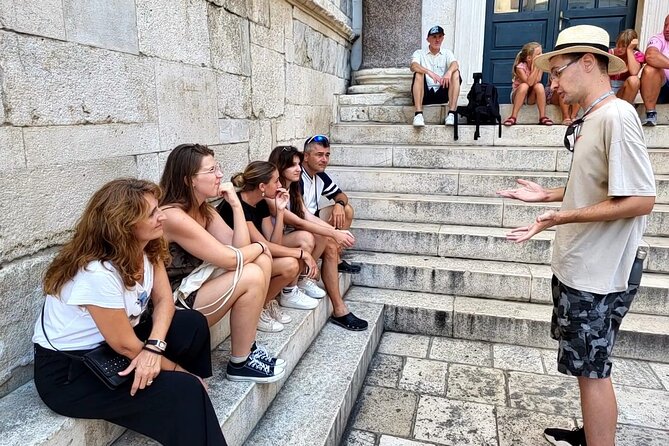
Fruit’s Square, or Trg Braće Radić, sits outside the palace and takes about 15 minutes. Here the tour moves beyond Diocletian and into an important period of Croatian history.
The square also shows how the palace was absorbed into newer construction. The Roman complex did not remain frozen in its original form. Buildings came up against it, used its walls, and helped create the city you see today.
This is one of the stops that gives the walk wider purpose. If you only want Roman archaeology, the earlier sites may be enough. If you want to understand Split as a Croatian city shaped by many periods, Fruit’s Square supplies the bridge.
Mili’s approach appears to cover both the famous facts and the less obvious changes. He explains not only what a structure was built for, but also how it was repurposed and how the surrounding city developed.
The Golden Gate and the palace defenses
The Golden Gate is the northern gate of Diocletian’s Palace and takes about 10 minutes. It is a good late-tour stop because it brings the focus back to the palace’s military side.
Here you learn about the fortifications and how the gate changed between Roman construction and the present day. The name can make it sound decorative, but its original purpose was defensive and controlled access into the palace.
The route ends outside this gate, at Dioklecijanova 7, by the bronze statue of Grgur Ninski. That finish is convenient if you want to continue exploring Split on foot, but it is not the same place where you began. Pay attention to the end point if you have a pickup, restaurant booking, or another timed activity.
Grgur Ninski and the final Croatian chapter
The last 15 minutes focus on the Grgur Ninski statue, a large bronze figure of an important bishop in Croatian history. The stop gives Mili a place to wrap up the story beyond the Roman emperor.
You have moved from Diocletian’s palace plan to church reuse, medieval development, Croatian identity, and the modern city. The statue helps close that loop. It also keeps the tour from treating Split as a Roman-only destination.
This final stop is especially useful if you are new to Croatian history. You leave with more than a list of Roman buildings. You have a basic timeline for how the city changed after the palace was built.
What the $107.84 group price really buys
The listed price is $107.84 for a private group of up to 15 people. For one person or a couple, that is a serious expense compared with a large shared walk. For a family or group of friends, the calculation changes quickly. Split among 10 people, it comes to about $10.78 per person, before optional entrance fees.
The real value is control. You are paying for an experienced English-speaking guide who can adjust the pace, answer questions, use visual aids, and keep the route focused on your group. That is useful in a palace where the physical remains are impressive but not always easy to interpret.
The tour lasts about 1 hour 30 minutes to 2 hours. The extra time depends on questions, pace, weather adjustments, and optional interiors. Add roughly 20 minutes for the museum section of the substructures and 10 minutes for the cathedral interior if you have tickets. The Temple of Jupiter interior is also optional, though no added time is specified.
Because the price excludes interiors, budget separately if you want the fullest version. You can still get a meaningful tour without entering every paid site, but make your choice clear at the start.
Timing, weather, and practical planning
The walk is outdoors and requires good weather. If poor weather cancels it, you are offered another date or a full refund. A sudden thunderstorm can affect Split quickly, so I would avoid placing a tightly timed activity immediately afterward.
For warm days, an evening start may be more comfortable. The route includes open squares and exposed stone, and one practical suggestion is to choose a cooler part of the day when possible. The listed operating information covers May 1 through October 31, 2026, with Monday hours shown as 8 a.m. to 6 p.m. Check your confirmed booking for the exact time available to your group.
The meeting point is near public transportation at the Eastern, or Silver, Gate. Service animals are allowed, and most people can take part. Since this is a walking route through historic streets, wear shoes suited to uneven stone and expect regular standing, though the supplied details do not promise a specific accessibility route.
Confirmation is provided when you book. Free cancellation is available up to 24 hours before the local start time. A cancellation or change inside that window is not refunded or accepted.
Who will get the most from Mili’s tour
I would choose this walk if you have only one day in Split and want the palace explained quickly but properly. It gives you the main Roman sights, a few less obvious corners, and a useful account of later Croatian history.
It also suits families. The private format avoids the stop-and-start feel of a large group, and Mili’s relaxed humor can keep younger members engaged. Teens who like Game of Thrones can ask about connections to the show, while people who do not care about filming locations still get a full history tour.
History and architecture fans should consider adding the paid substructures section and the cathedral interior. Casual sightseers can stay with the included portions and still see the main structure of the palace.
I would not book it if you only want a quick photo walk or prefer to explore silently at your own pace. The point is explanation, context, and conversation. Also, solo visitors and couples should weigh the fixed group price carefully, since the cost is much easier to justify with several people.
Should you book this private Palace walk?
Book it if you want Diocletian’s Palace to make sense, not just look old. Mili’s strongest qualities are his clear English, flexible communication, lively delivery, and use of 3D images to restore the missing palace in your imagination.
The best value comes with a family or group of friends, especially if you want to ask plenty of questions. Choose a cooler time on warm days, decide in advance which paid interiors interest you, and leave room for the tour to run closer to two hours.
Skip it if your main goal is a low-cost stroll or if you plan to spend a full day independently inside every museum. For most first-time visitors who want a focused introduction to Split, this is a practical and personable way to begin.
FAQ
Where does the tour start?
It starts at the Eastern, or Silver, Gate, at Poljana kraljice Jelene 5 in Split, Croatia.
Where does the tour end?
The tour ends outside the Golden Gate at Dioklecijanova 7, beside the bronze statue of Grgur Ninski.
How long does the tour last?
It lasts approximately 1 hour 30 minutes to 2 hours. Optional interior visits and the pace of your group can add time.
How much does the private tour cost?
The listed price is $107.84 per group, for up to 15 people.
Is the tour offered in English?
Yes. The experience is offered in English.
Are entrance fees included?
The free portions of the listed stops are included. Separate fees apply to the museum section of the substructures, the cathedral interior, and the Temple of Jupiter interior.
Can I visit the cathedral interior?
Yes, if you have a cathedral ticket. The interior visit adds about 10 minutes to the tour.
Can I visit more of the palace substructures?
Yes. You can buy a ticket for the museum section of the substructures, which adds about 20 minutes.
What happens if bad weather cancels the tour?
You will be offered a different date or a full refund. You can also cancel up to 24 hours before the start time for a full refund.
Just added around Split
- Kayaking & Zipline Šibenik – Čikola Canyon★ 5.0 · 3 reviews
- Krka National Park & Zipline Šibenik – Čikola Canyon★ 5.0 · 3 reviews
- From Split: Krka National Park & Waterfalls Private Day Trip★ 5.0 · 3 reviews
- Split: Small-Group Half Day Sailing Trip★ 5.0 · 3 reviews
- Rafting River Cetina from Makarska Riviera including transfer★ 5.0 · 3 reviews
- Split Bike and Wine Experience★ 5.0 · 3 reviews
- Split and Salona Cultural Heritage Day Tour from Trogir★ 4.0 · 3 reviews
- Private transfer from Split to Dubrovnik with 2h sightseeing stop in Ston★ 5.0 · 3 reviews
Diocletian Palace Tours, compared.


Walking Tour of Split and Diocletian’s Palace
Read our review →

Diocletian Palace & Old Town Guided Walking Tour
Read our review →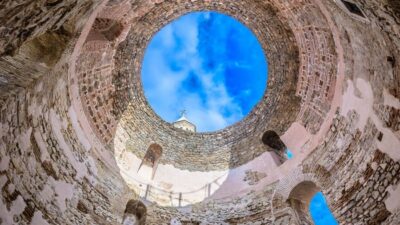
Game of Thrones Tour with Diocletian’s Palace Cellar
Read our review →
Diocletian’s Palace and Old Town SMALL GROUP Walking Tour
Read our review →
Browse the lists this tour appears in