
Reviewed · WALKING TOURS
Walking tour of Split with an Art Historian
Split’s Old Town is not a museum behind ropes. It is a living Roman palace, with homes, shops, cafés, laundry, churches, and daily life tucked into stones laid more than 1,700 years ago. This walking tour with art historian Josipa helps you read that unusual city, from the water system that kept Diocletian’s palace alive to the way a mausoleum became a cathedral.
I like the small maximum of 10 people, which makes it easier to hear, ask questions, and adjust the pace. I also like the way the walk connects architecture with local customs, including Gregory of Nin’s lucky toe, Split’s narrowest lane, and the klapa singing often heard in the Vestibule. The main limitation is that you do not enter paid sites, including the cathedral or the full palace substructures, so you will need separate tickets if you want to see their interiors.
In This Review
- Key points to know before booking
- Why Diocletian’s Palace needs a guide
- Strossmayer Park: begin with water and bearings
- Tower 2 and Gregory of Nin
- The Golden Gate and the ancient Cardo
- Peristyle: Split’s grand Roman stage
- Saint Domnius and the palace’s changing purpose
- Let Me Pass Street and the Vestibule
- The substructures and the route to the Riva
- Riva and the model of Split
- Group size, timing, and walking conditions
- Is $30.23 a fair price?
- Who should book this Split walk?
- Should you book it?
- FAQ
- How long does the Walking Tour of Split with an Art Historian last?
- What is the tour price?
- What language is the tour offered in?
- Where does the tour begin?
- Where does the tour end?
- Does the tour enter Diocletian’s Palace paid sites?
- Is the tour suitable for people with limited mobility?
- What happens if it rains?
Key points to know before booking
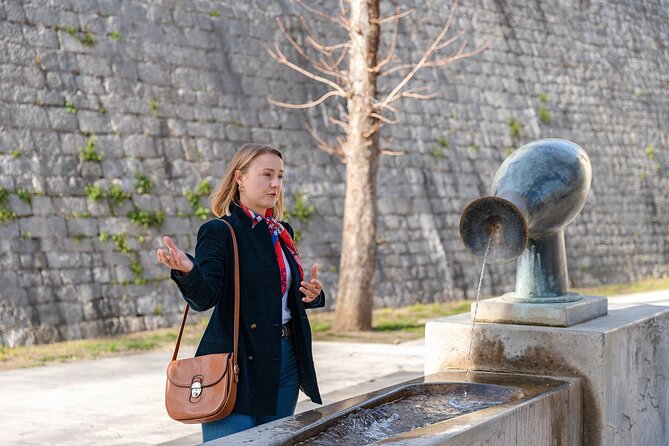
- Start with Split’s water story: The tour opens in Strossmayer Park with the practical system that allowed Diocletian’s palace to function for centuries.
- Walk through a real Roman street plan: You follow the ancient Cardo and Decumanus, not a recreated route in a modern museum.
- Get an art historian’s eye: Josipa explains architecture, sculpture, geography, and local life in a clear, conversational way.
- Small groups make a difference: With no more than 10 people, you can hear well and ask follow-up questions.
- No paid interiors are included: The guide explains the Cathedral of Saint Domnius and substructures from outside, but admission costs extra.
- Morning is a smart choice: An early start can mean cooler weather and fewer large cruise groups around the palace.
Why Diocletian’s Palace needs a guide
At first glance, Split can feel like a maze of pale stone lanes. You see a Roman column beside a medieval wall, then turn a corner and find a modern café operating inside an ancient chamber. Without context, the pieces are attractive but disconnected.
Josipa’s strength is showing how the pieces fit. She explains the palace as both an imperial residence and a fortified complex, then follows its later life as the center of Split. The walk also links history to geography: why Diocletian chose this peninsula, how the palace met the sea, and why the Roman plan still shapes the city you see today.
That approach suits you if you want more than dates and names. The focus is on how buildings changed purpose and how people adapted an imperial structure over many centuries. You are not simply looking at ruins. You are learning how a city grew inside them.
The art historian angle is especially useful at the major monuments. Josipa can point out design choices, sculpture, reused stone, and the relationship between spaces. Several comments about her guiding style emphasize clear explanations, lively conversation, and the ability to answer questions that go beyond the standard facts.
More walking tours in Split:
- Split: Old Town and Diocletian Palace Walking Tour
★ 4.9 · 4,727 reviews - Walking Tour of Split and Diocletian’s Palace
★ 5.0 · 2,588 reviews - Krka Waterfalls tour with Trogir Walking tour and Krka panoramic boat cruise
★ 5.0 · 1,659 reviews
Strossmayer Park: begin with water and bearings
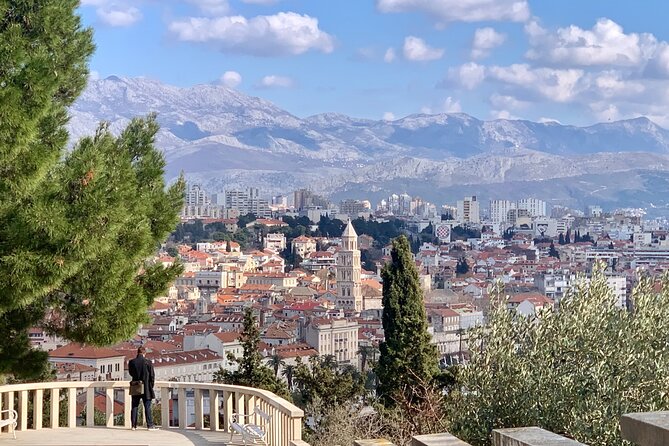
The meeting point is beside the central fountain in Strossmayer Park, locally called Đardin. It is a sensible place to begin because you are outside the palace walls but close to the northern entrance.
The opening story concerns water. That may sound less exciting than an emperor or a cathedral, but it gives you a useful foundation. A palace of this size needed a dependable supply, and water helps explain how an imperial residence could operate for more than 17 centuries of changing use.
You will spend about 10 minutes here, with no admission fee. This is also a good moment to arrive early, confirm the guide, and fill your bottle before the walk gets underway.
Tower 2 and Gregory of Nin
The first sight is Tower 2 of Diocletian’s Palace. It is not the prettiest stop, and that is part of the point. The tower helps you see the palace as a fortified compound rather than a collection of elegant ruins.
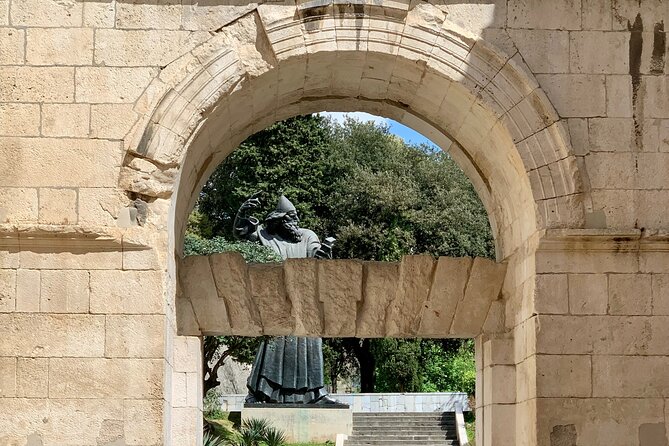
From here, the tour moves to the seven-meter bronze statue of Gregory of Nin, made by Croatian sculptor Ivan Meštrović. The famous custom is to rub the statue’s toe for good luck. The toe is noticeably polished by generations of hands, making this a quick photo stop with a strong local connection.
Josipa also explains how the statue became part of Split’s popular culture. You get a bit of folklore alongside the sculpture’s artistic and civic importance, which keeps the stop from becoming a simple photo opportunity.
Each stop lasts roughly five minutes. The route is mostly easy walking, but the stone surfaces can be uneven and the tour includes several unavoidable steps.
The Golden Gate and the ancient Cardo
The Golden Gate was the northern entrance to the palace and one of four major entry points. Its scale and decoration give you a clear sense that this was an emperor’s compound, not an ordinary town gate.
After discussing the gate, you walk along the Cardo Maximus, the principal north to south Roman street. The value here is spatial. Instead of hearing about the Roman plan in the abstract, you follow the line that once directed movement through the palace.
The route then turns toward a small garden inside the palace. This change of pace is welcome. Split’s central lanes can become crowded, and a quieter corner gives you time to notice how much of the old structure is now woven into ordinary urban life.
You will also visit the Iron Gate in the northwest corner. Its story explains why this entrance was regarded as the city’s platinum gate through parts of its history. The nickname is memorable, but the larger lesson is that each gate had a different role and reputation as the palace changed.
A few more Split half-days to weigh up
- Split: Krka Waterfalls Trip with Boat Cruise and Swimming
★ 4.8 · 10,519 reviews - From Split: Krka Waterfalls, Food & Wine Tasting Tour
★ 5.0 · 9,326 reviews - Blue cave, Mamma Mia and Hvar, 5 islands speedboat tour
★ 5.0 · 7,150 reviews - From Split: Krka Waterfalls, Food & Wine Tasting Tour
★ 4.9 · 6,598 reviews
Peristyle: Split’s grand Roman stage
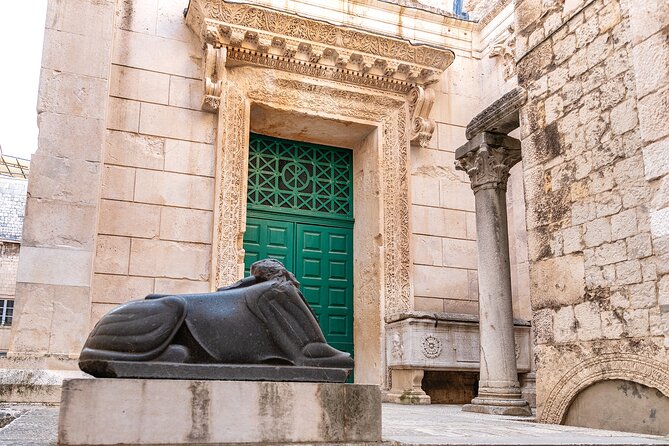
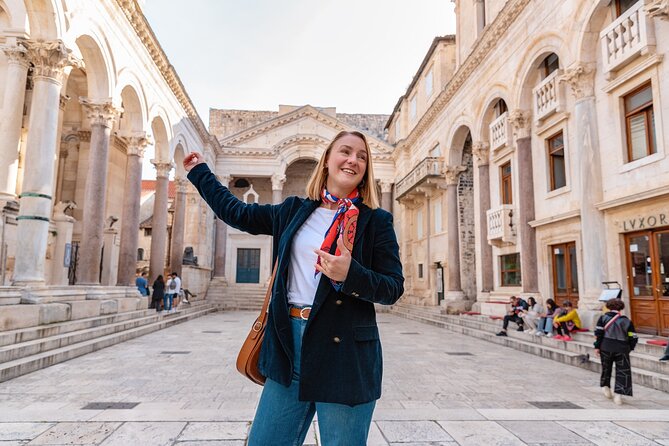
The Peristyle is the visual high point of the walk. Following the Decumanus toward this monumental court, you begin to see the palace’s ceremonial scale.
This was not just an open square. It formed a formal approach to the emperor’s quarters and carried the weight of Roman power. Josipa explains its origin and later changes, helping you read the columns, surrounding buildings, and layers of use instead of treating the space as a single frozen monument.
The tour allows about 10 minutes here, though the actual time can shift with the group and crowd levels. That flexibility is useful. The guide has been praised for avoiding packed areas when possible, which can make a noticeable difference at the Peristyle.
You will then make a short trip toward the Eastern, or Silver, Gate. The detour is brief, but it adds another piece to the palace’s defensive and ceremonial plan. Because the four gates are not identical, seeing more than one makes the layout easier to remember.
Saint Domnius and the palace’s changing purpose
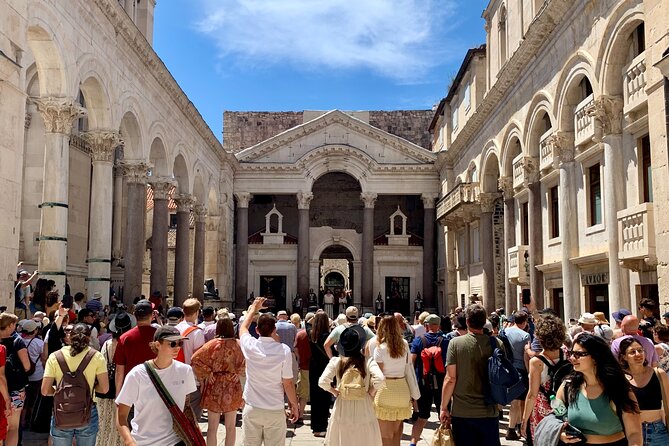
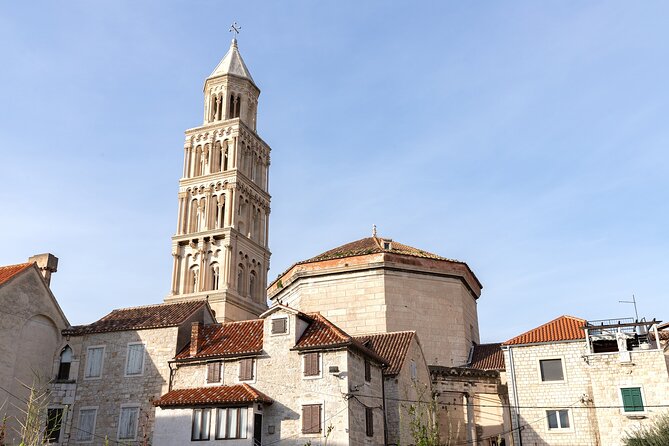
The Cathedral of Saint Domnius occupies what was originally built as Diocletian’s mausoleum. That change from imperial tomb to Christian cathedral is one of the clearest examples of Split’s layered past.
Josipa explains the cathedral from the Peristyle, including the essential historical background and details that help you imagine the building’s earlier role. You do not enter the cathedral on this tour, and the admission fee is not included.
This matters when you set expectations. The walk gives you a strong orientation and historical explanation, but it is not a ticketed cathedral visit. If you want to see the interior, you will need to return independently and pay the separate admission.
A nearby point of interest is described as one of Europe’s most beautiful monuments by Scottish architect Robert Adam in the 18th century. Its appeal still comes through today, and the guide uses this part of the route to show why the palace has attracted architectural attention far beyond Croatia.
Let Me Pass Street and the Vestibule
One of Split’s best small surprises is Let Me Pass Street, or Pusti me da prođem. It is less than 10 meters long and only 57 centimeters wide, making it one of the narrowest streets in the world.
The lane is fun to see, but the local meaning is more interesting than the measurement. It holds a place in Split’s civic memory and is honored with a public monument elsewhere in the city. This is the sort of detail you are unlikely to notice while wandering alone.
The Vestibule follows. It once served as an entrance to the emperor’s private quarters and is now one of the city’s favored open-air photo spots. The circular space also has strong acoustics, and you might hear traditional klapa singing there.
Plan for about 10 minutes. This is a pause for photos, but it also helps you understand the transition from public ceremonial spaces to the emperor’s more private area. The best part is the combination of architecture and living culture. You are looking at an ancient room that still has a role in the city.
The substructures and the route to the Riva
The palace substructures provide a shortcut toward the waterfront. The atmosphere changes as you move from the brighter Peristyle into darker, quieter passages before emerging near the sea.
You do not explore the entire substructure complex because the full area requires additional admission and more time. The guide can arrange a separate visit if you want to focus on this part of the palace.
Even without entering all of it, this portion of the route is useful. The substructures preserve the shape of the rooms above and show how Roman engineering supported the palace. They also make the city’s vertical layers easier to grasp: modern Split occupies and crosses through structures built for an emperor.
Allow about 15 minutes for this section. Watch your footing, especially where the stone is worn or steps interrupt the route.
Riva and the model of Split
The Riva is Split’s waterfront promenade, street, and public meeting place all at once. You walk along part of it toward Fruit Square, getting a welcome change from enclosed palace lanes.
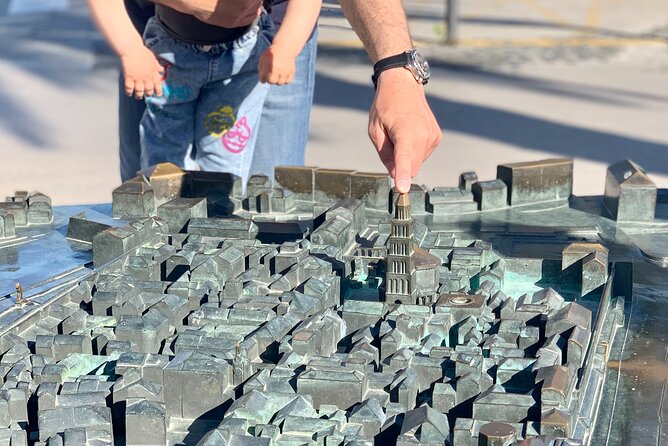
The final stop is a bronze model of Split’s Old Town near the seaside exit of the substructures. This model helps you review what you have seen: the palace’s rectangular plan, its gates, its position by the water, and the way the modern city surrounds it.
The tour is scheduled for about 1 hour and 40 minutes to two hours. The model is likely to be the final stop because the palace contains so much to explain. If time allows, Josipa may continue, but she will also give you suggestions for further exploring Split, including personal tips for places to visit and eat.
That ending is practical. You leave with a mental map rather than simply being dropped at a monument. Several past guests have also valued local food recommendations, so ask directly if you want ideas for the rest of your day.
Group size, timing, and walking conditions
The maximum group size is 10 people. That is small enough for a personal feel, and it allows the guide to respond to questions without turning every stop into a lecture.
The pace can also be adjusted. A family group with ages ranging from 29 to 77 was able to follow comfortably, and the walk includes a useful balance of standing and moving. Still, you should be comfortable walking on old stone streets and handling several steps.
Hot weather is the main practical concern. Wear sun protection, carry water, and consider booking a morning departure. An early tour may also help you avoid the largest cruise-related crowds at the palace’s busiest points.
The tour operates rain or shine. Service animals are allowed, and dogs may be possible if you contact Josipa before booking. She asks for a quick discussion first so the arrangement works for everyone in the group.
The meeting point is Strossmayerova Fountain at Ul. kralja Tomislava 12. The walk ends on the Riva beside the bronze model of Split’s historic core at Obala Hrvatskog narodnog preporoda 23. The guide waits no more than 10 minutes after the scheduled start, so arrive with time to spare.
Is $30.23 a fair price?
At $30.23 per person, this is a good value if you want a guided introduction to Split rather than a series of paid admissions. The price covers a small-group walk lasting close to two hours, led by an art historian who explains architecture, sculpture, Roman planning, medieval changes, and modern local customs.
The value comes from interpretation. You can walk through the palace for free, but it is easy to miss why the gates differ, how the Cardo and Decumanus organize the site, or why the cathedral occupies a former mausoleum. Josipa’s explanations give meaning to details that otherwise pass by as old stone.
The price is less attractive if you want a full museum-style visit. Cathedral entry and the complete substructures are not included, and neither are other paid sites. Think of this as an orientation walk with serious historical content, then budget separately for any interiors you want to visit.
Group discounts are available, and the small cap makes the cost easier to justify for families or couples who value direct access to the guide.
Who should book this Split walk?
I would choose this tour for a first visit to Split, especially if you want to understand the city before exploring it on your own. It also suits history and architecture fans who enjoy seeing how one site changed from Roman imperial complex to medieval town and modern city center.
Families can benefit from the short stops, memorable stories, and narrow lane. The pace can work for a wide age range, provided everyone is comfortable with steps and uneven pavement.
This may not be the best fit if your main goal is entering the cathedral, walking through every substructure chamber, or spending a long time at each monument. In that case, use this tour as an introduction and return later for paid interiors.
I would also book it early in the day when possible. The tour is often reserved well ahead, with bookings averaging about 25 days in advance, and a morning walk can be cooler and calmer.
Should you book it?
Book this walking tour if you want Split explained by someone who can connect Roman design, Croatian sculpture, local folklore, and present-day life. Josipa’s art historian background, small-group format, and willingness to answer detailed questions give the walk a personal edge.
Skip it only if you prefer to explore entirely alone or want all admission tickets bundled into one package. For most first-time visitors, the tour offers a smart way to get oriented, spot details you might otherwise miss, and leave with useful ideas for the rest of your time in Split.
FAQ
How long does the Walking Tour of Split with an Art Historian last?
The tour lasts approximately 1 hour and 40 minutes to 2 hours.
What is the tour price?
The listed price is $30.23 per person. Group discounts are available.
What language is the tour offered in?
The tour is offered in English.
Where does the tour begin?
It begins at Strossmayerova Fountain in Strossmayer Park, also known locally as Đardin. The address is Ul. kralja Tomislava 12, Split.
Where does the tour end?
The tour ends on the Riva waterfront beside the bronze model of Split’s Old Town, at Obala Hrvatskog narodnog preporoda 23.
Does the tour enter Diocletian’s Palace paid sites?
No. The tour does not enter museums or paid sites. The Cathedral of Saint Domnius and the full palace substructures are explained from outside, but admission is not included.
Is the tour suitable for people with limited mobility?
The route includes several unavoidable steps and some uneven areas. You should consider your walking comfort and safety before booking and contact the provider if you need assistance.
What happens if it rains?
The tour runs rain or shine. You should dress for the weather and carry water and sun protection during hot conditions.
Just added around Split
- Kayaking & Zipline Šibenik – Čikola Canyon★ 5.0 · 3 reviews
- Krka National Park & Zipline Šibenik – Čikola Canyon★ 5.0 · 3 reviews
- Split: Small-Group Half Day Sailing Trip★ 5.0 · 3 reviews
- Rafting River Cetina from Makarska Riviera including transfer★ 5.0 · 3 reviews
- From Split: Krka National Park & Waterfalls Private Day Trip★ 5.0 · 3 reviews
- Split Bike and Wine Experience★ 5.0 · 3 reviews
- Split and Salona Cultural Heritage Day Tour from Trogir★ 4.0 · 3 reviews
- Krka Waterfalls, Lake Cruise & Skradin★ 5.0 · 3 reviews
Walking Tours, compared.


Walking Tour of Split and Diocletian’s Palace
Read our review →
Krka Waterfalls tour with Trogir Walking tour and Krka panoramic boat cruise
Read our review →

Walking Tour of Split with a ‘Magister’ of History
Read our review →

Diocletian Palace & Old Town Guided Walking Tour
Read our review →
Browse the lists this tour appears in