
Reviewed · WALKING TOURS
Split highlights – Evening walking tour
Split’s best evening walk begins inside Diocletian’s Palace, where Roman walls still form the center of daily life. You move from the Golden Gate and the ancient Peristyle to the Riva, then climb gently toward Marjan for a broad view of the city.
I like the small maximum group of eight, which gives you a better chance to ask questions and hear your guide in narrow stone lanes. I also like the local angle: guides such as Bosko Papic, Pavle, and Luka bring personal stories, restaurant tips, and insight into life in Split.
The main thing to consider is timing. The palace can still be busy in the evening, and the tour includes a walk to the Marjan viewpoint. If you want to enter the Cathedral of Saint Domnius, you will need to pay its admission separately.
In This Review
- Key details before you book
- Why an evening walk works so well in Split
- Entering through the Golden Gate
- The Peristyle, Split’s Roman heart
- The Cathedral of Saint Domnius and the separate ticket
- Klapa echoes in the Vestibule
- Pjaca, where Split meets and watches
- Prokurative and the open view toward the harbor
- The Riva, Split’s outdoor living room
- The first Marjan lookout and the final view
- What the $39.74 price gets you
- Group size, meeting point, and practical planning
- Who will get the most from this Split tour?
- Should you book the Split highlights evening walk?
- FAQ
- Where does the Split evening walking tour start?
- Where does the tour end?
- How long does the experience last?
- Is admission to the Cathedral of Saint Domnius included?
- What language is the tour offered in?
- How many people can join the tour?
- Can I cancel for a full refund?
Key details before you book
- Start at 7:00 p.m. by the Golden Gate: Meet at Dioklecijanova 7, beside the palace entrance.
- Finish with a city view: The route ends at the first Marjan lookout, about 15 minutes on foot from the old town.
- Expect 1½ to 2 hours: The listed stops add up to roughly 100 minutes, with some flexibility for walking and questions.
- Small-group format: The tour has a maximum of eight people, a useful size in Split’s tight old-town streets.
- The Cathedral ticket costs extra: All other listed stops are free to enter.
- Free cancellation has a deadline: Cancel at least 24 hours before the start time for a full refund. Bad weather may lead to another date or a full refund.
Why an evening walk works so well in Split
Split is easiest to understand once you realize that Diocletian’s Palace is not simply an archaeological site. It is the old town itself. Homes, cafés, shops, squares, and churches occupy the spaces once designed for a Roman emperor.
That makes this tour more useful than a quick look at a few ruins. You are shown how the palace was arranged, where the imperial rooms were located, and how later generations adapted the Roman structure for ordinary city life.
The 7:00 p.m. start is well chosen for many visitors. You can spend the afternoon at the waterfront or nearby sights, eat later, and use the walk to get your bearings early in your stay. One particularly practical benefit is orientation. After following the route from the Golden Gate to the Riva, you should have a clearer sense of how the palace connects with Split’s main public spaces.
The evening also changes the mood of the stone lanes. Warm light, open cafés, and local activity make the palace feel like part of a living town rather than a museum. Still, do not expect an empty old city. The palace may remain crowded during the evening, especially around the Peristyle and main lanes.
More walking tours in Split:
- Split: Old Town and Diocletian Palace Walking Tour
★ 4.9 · 4,727 reviews - Walking Tour of Split and Diocletian’s Palace
★ 5.0 · 2,588 reviews - Krka Waterfalls tour with Trogir Walking tour and Krka panoramic boat cruise
★ 5.0 · 1,659 reviews
Entering through the Golden Gate
The tour starts at the Golden Gate, at Dioklecijanova 7. This was the grand northern entrance to Diocletian’s Palace, and it gives you a strong first look at the scale of the imperial complex.
The story here is tied to Emperor Diocletian’s retirement. After leaving imperial power, he came to the palace and made it his home. The guide uses the gate to set up the larger question behind the tour: why did this place appeal to an emperor enough for him to retire here?
Above the gate, the statue of Grgur Ninski, a Croatian bishop, is linked with good luck. You will likely see people touching the statue’s toe, a small local custom that adds a human touch to the formal Roman entrance.
The Golden Gate is also a practical meeting point. It is easy to identify, and starting here avoids wasting the first part of the tour on a long transfer from the waterfront.
The Peristyle, Split’s Roman heart
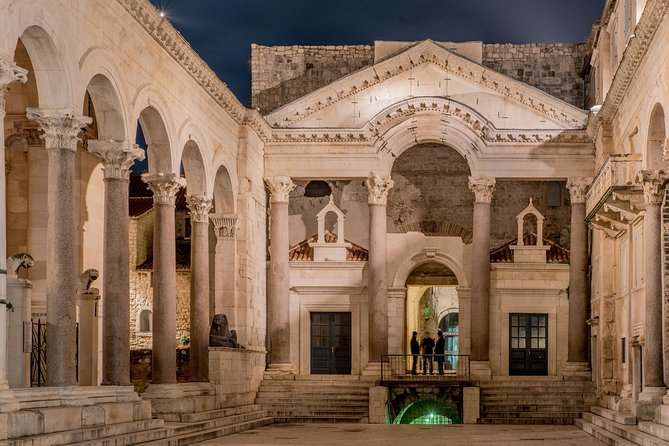
From the Golden Gate, you reach the Peristyle, the central square of Diocletian’s Palace. This is the most important stop for understanding the palace plan. It was both a formal Roman court and the spiritual center of the complex.
The setting has real drama. Tall stone columns and ancient walls surround the square, while the remains of Roman architecture mix with later buildings and modern city life. You are not looking at a preserved site separated from the present. People still pass through this space as part of their daily routines.
A 3,500-year-old sphinx watches over the square. Its presence points to Diocletian’s interest in Egyptian imagery and gives the Peristyle an extra layer beyond its Roman design.
Your guide can help you read the space rather than simply photograph it. Look at the proportions, the raised areas, the columns, and the way the surrounding buildings frame the square. This is where the palace becomes more than a collection of old stones.
The drawback is crowding. The Peristyle is one of Split’s main attractions, so the evening does not guarantee peace and quiet. A small group helps, but you may still need to pause at the edge of the square to hear every detail.
The Cathedral of Saint Domnius and the separate ticket
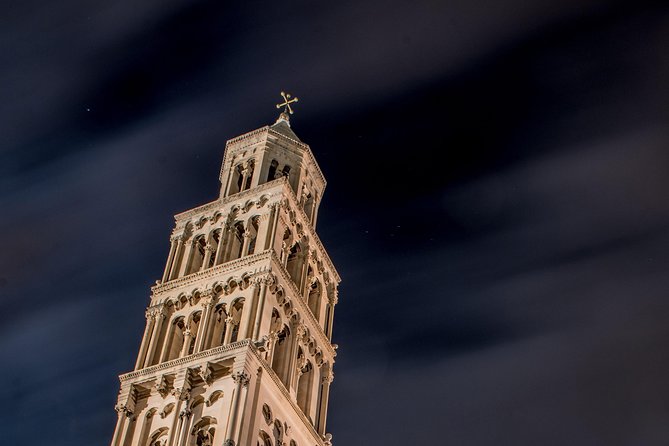
The next stop is the Cathedral of Saint Domnius, built inside what was once Diocletian’s mausoleum. This unusual change of purpose is one of Split’s most interesting historical turns. A structure created for a Roman emperor later became a Christian cathedral.
It is described as the oldest building in the world in which a cathedral is situated. The Romanesque bell tower in front of it gives the site a strong visual marker and helps explain how the palace changed over time.
The tour includes the outside visit, but admission is not included. That distinction matters when you compare the price with tours that include interior entries. If you want to go inside, budget for the extra ticket and allow time for the visit if the group schedule permits.
At only about 10 minutes, this is a short stop. You will get the main historical context, but this is not a long cathedral tour. The value here is the connection between the imperial mausoleum and the later religious building.
A few more Split half-days to weigh up
- Split: Illuminated Evening Guided Kayaking Tour
★ 4.8 · 1,622 reviews - Split: Stand Up Paddleboard Night Glow Tour
★ 4.9 · 916 reviews - Split: Sunset Boat Party with Live DJs and Blue Lagoon Swim
★ 4.5 · 638 reviews - Split: Klis Sunset Sightseeing Bus Tour
★ 4.4 · 494 reviews
Klapa echoes in the Vestibule
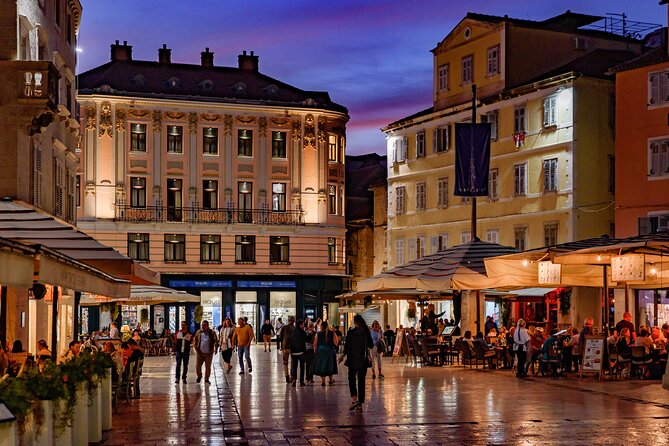
The Vestibule is a round hallway that once led toward the emperor’s private chambers. Its shape and stone surfaces create strong acoustics, and local klapa singing may be heard here.
Klapa is a traditional style of Croatian vocal music, usually performed without instruments. Hearing it in the Vestibule links the physical space with a living part of local culture. It is one of the tour’s most distinctive moments because it uses sound, not just architecture, to bring the site to life.
The stop lasts about 10 minutes. That is enough to appreciate the shape of the room and listen if singing is taking place, but the experience may depend on what is happening during your visit. The tour promises the chance to hear local klapa singing, not a private concert at a fixed time.
This is also a good place to notice how the palace was built for ceremony and control. The passage toward the emperor’s rooms was not an ordinary hallway. Its form helped announce the importance of the person at its center.
Pjaca, where Split meets and watches
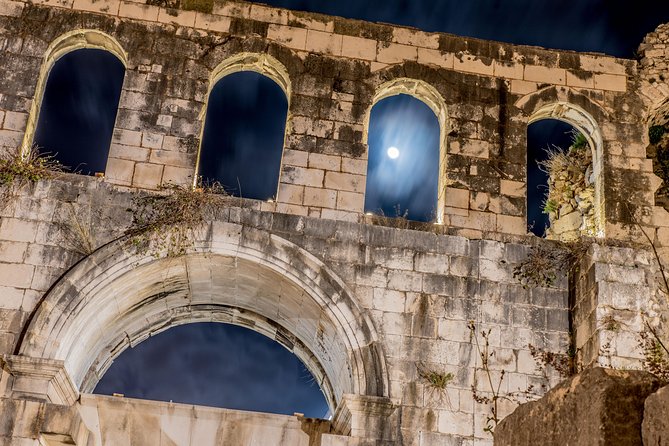
From the palace, the walk continues to Pjaca, the city’s central square. This is a shift from imperial space to public life. The square functions as a meeting place where people rest, catch up, and watch the city move around them.
The guide connects Pjaca with a familiar local pastime: football. That detail helps keep the tour grounded. Split is not only about Roman emperors and old churches. It is also a modern city with strong loyalties, daily arguments, and social rituals.
Pjaca is a useful place to pause and watch how Split uses its public spaces. You will see why a walking tour can offer more than a list of dates. The guide can point out how the square fits into local life and answer questions about customs, food, or the city today.
This stop lasts about 10 minutes, so expect a concise explanation rather than a long break. If you want time to sit or take photos, you may need to return later on your own.
Prokurative and the open view toward the harbor
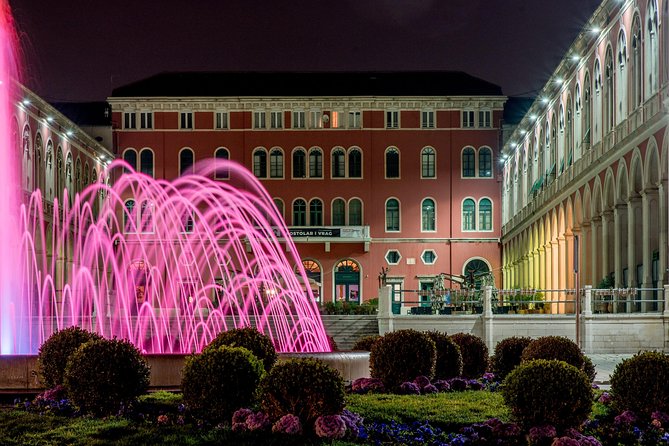
The route then reaches Prokurative, officially called Republic Square. Its architecture recalls Saint Mark’s Square in Venice, a reminder of Split’s links with the wider Adriatic world.
The square is open on its southern side, giving you a view toward the harbor and the Riva. That opening changes the feel of the walk. Inside the palace, stone walls can make the city feel enclosed. Here, the space opens toward the sea and the waterfront.
This is a good stop for photographs, but the guide’s explanation adds useful context. You can see how Split’s public spaces developed beyond the Roman palace and how the city faces the harbor.
The stop is brief, at around 10 minutes. You will have time to take in the view, but not necessarily to linger over every architectural detail. If you want a slower visit, note the location and return in daylight.
The Riva, Split’s outdoor living room
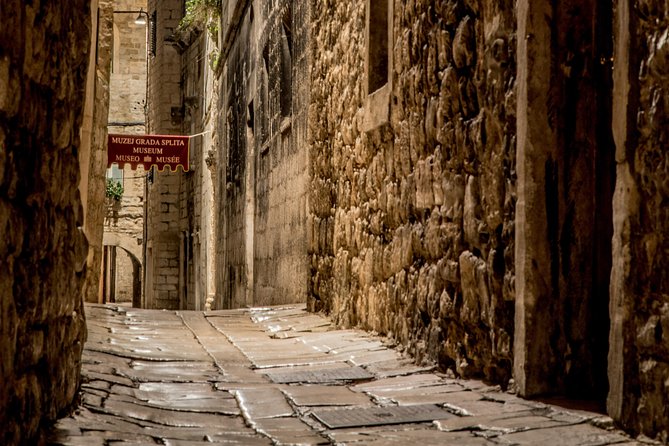
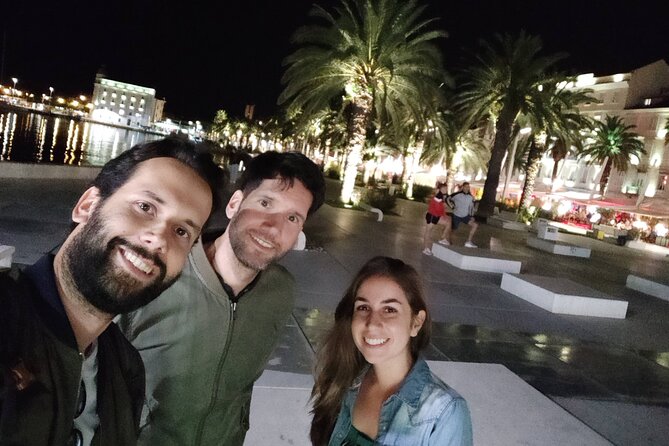
The Riva promenade is the tour’s most public and contemporary setting. Lined with cafés and facing the harbor, it is where Split walks, meets, watches events, and spends time outdoors.
Calling the Riva the city’s living room is fair. You can read the city here through movement and habit. The palace behind you provides the ancient setting, while the promenade shows how Split functions now.
The guide may also point out the Riva’s place in important public events and everyday life. This is where local stories about the city can be especially helpful. Guides Bosko Papic, Pavle, and Luka have been praised for answering questions about Split, Croatia, and local routines, though the guide assigned to your date may be different.
The Riva is also the finishing point for many visitors exploring Split on their own, but this tour continues. Keep some energy for the final walk to Marjan. The route is not just a flat old-town circuit.
The first Marjan lookout and the final view
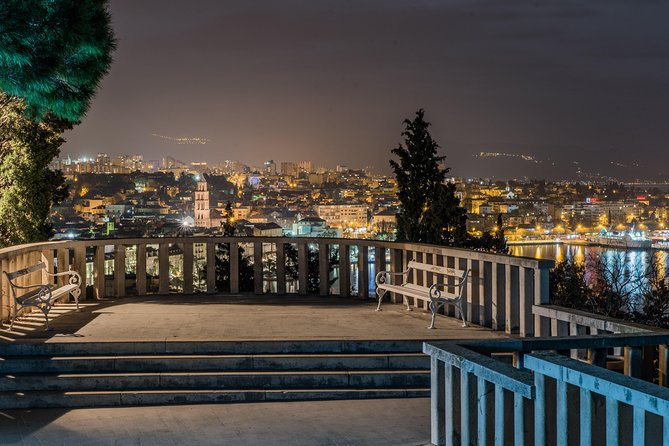
The last stop is Prva Vidilica na Marjanu, the first lookout on Marjan. It takes about 15 minutes to walk there from the old town, making this the only part of the route that feels like a short uphill extension beyond the central streets.
The reward is the wide view over Split. From the terrace, the city, harbor, and surrounding setting spread out below you. It is a fitting end because you can finally see how the old palace sits within the wider city.
This viewpoint also gives you a useful mental map. After walking through the palace, Pjaca, Prokurative, and the Riva, you can look back and connect those places from above.
The exact light will depend on the season and the day’s weather. The tour requires good weather, and poor conditions can lead to a new date or a full refund. Wear comfortable shoes and be ready for the extra walk. The tour is not presented as strenuous, and most people can participate, but the Marjan section is worth considering if you prefer a completely level route.
The official end is at Vodoskok, in front of the fountain at the beginning of the Riva promenade. This may seem different from the Marjan lookout, so check with your guide at the end if you need clear directions back to your accommodation or the waterfront.
What the $39.74 price gets you
At $39.74 per person, the main purchase is the guide rather than admission tickets. The tour includes an English-speaking licensed local guide, while personal purchases and the Cathedral admission are extra.
The price makes the most sense if you want a strong introduction to Split in a short period. You get roughly 1½ to 2 hours, eight major locations, Roman history, local customs, city orientation, and a viewpoint beyond the old town.
A large part of the value comes from the small group. With a maximum of eight people, the guide can usually manage questions more easily than on a large coach-style walk. That matters in the Peristyle and narrow palace lanes, where staying close to the guide can be difficult in a crowd.
You may find the price less attractive if you only want a quick look at Diocletian’s Palace or plan to visit every site independently. Split’s old town is walkable, and many exterior sights are free. The tour earns its keep through explanation, local context, and the efficient route.
Restaurant advice is another useful extra. Bosko Papic has been praised for sharing food tips along with history and insight into life in Split. Those suggestions are not a formal inclusion, but they can help you make better use of the rest of your evening.
Group size, meeting point, and practical planning
The tour is offered in English and starts at 7:00 p.m. at the Golden Gate. Confirmation is sent when you book, and the experience is near public transportation.
The maximum group size is eight. That is small enough to feel personal without requiring the price of a private tour. The licensed local guide is the central feature, so listen for the guide near the gate and arrive with enough time to find Dioklecijanova 7.
Most people can participate, and service animals are allowed. The main practical issue is the evening walk to Marjan, not access to the first seven stops. Comfortable shoes are a sensible choice.
You can cancel for a full refund up to 24 hours before the start time. Changes or cancellations inside that window are not accepted for a refund. Since the experience depends on good weather, poor conditions may result in another date or a full refund.
Who will get the most from this Split tour?
I would choose this walk if you have just arrived in Split and want to understand the old town quickly. The route gives you a working map of the palace and leads you toward the Riva, two areas you are likely to use repeatedly during your stay.
It also suits anyone who prefers history in small pieces. You move from emperor to cathedral, from Roman ceremony to local music, then from public squares to modern waterfront life. The guide’s stories connect the pieces without asking you to spend half a day in a museum.
The tour is a good match for couples, solo visitors, and small groups who enjoy asking questions. It can also work well for people adjusting to a new time zone, since the evening start lets you stay active without committing to a long full-day excursion.
I would think twice if you want extensive interior visits. The Cathedral ticket is not included, and the stops are short. This is primarily an outdoor orientation walk with a few focused historical explanations.
I would also avoid booking it if you dislike group pacing or do not want to walk beyond the center. The route ends with the climb toward Marjan, and the palace can remain busy at night.
Should you book the Split highlights evening walk?
Book it if you want a compact first look at Split, a small group, and a local guide who can explain both Roman remains and present-day life. The final Marjan view gives the route a satisfying finish, while the Peristyle, Vestibule, and Riva provide the strongest moments along the way.
The experience is especially worthwhile early in your stay. It helps you find your way, understand why the palace matters, and gather useful ideas for food and further exploring.
Skip it if your main goal is included admission to historic interiors or a quiet, uncrowded visit. For most visitors who want history, orientation, and a little local character in one evening, the $39.74 cost is reasonable, provided you are happy to pay separately for the cathedral and walk to the viewpoint.
FAQ
Where does the Split evening walking tour start?
It starts at 7:00 p.m. at the Golden Gate, located at Dioklecijanova 7 in Split, Croatia.
Where does the tour end?
The listed end point is Vodoskok, at Trg Franje Tuđmana, in front of the fountain at the beginning of the Riva promenade. The route also includes the first Marjan lookout near the end of the walk.
How long does the experience last?
The tour lasts approximately 1 hour 30 minutes to 2 hours.
Is admission to the Cathedral of Saint Domnius included?
No. Admission to the Cathedral of Saint Domnius is not included. The other listed stops have no admission charge.
What language is the tour offered in?
The tour is offered in English and includes an English-speaking licensed local guide.
How many people can join the tour?
The activity has a maximum of eight people.
Can I cancel for a full refund?
Yes. You must cancel at least 24 hours before the experience start time for a full refund. If poor weather causes the tour to be canceled, you will be offered another date or a full refund.
Just added around Split
- Kayaking & Zipline Šibenik – Čikola Canyon★ 5.0 · 3 reviews
- Krka National Park & Zipline Šibenik – Čikola Canyon★ 5.0 · 3 reviews
- From Split: Krka National Park & Waterfalls Private Day Trip★ 5.0 · 3 reviews
- Split: Small-Group Half Day Sailing Trip★ 5.0 · 3 reviews
- Rafting River Cetina from Makarska Riviera including transfer★ 5.0 · 3 reviews
- Split Bike and Wine Experience★ 5.0 · 3 reviews
- Split and Salona Cultural Heritage Day Tour from Trogir★ 4.0 · 3 reviews
- Private transfer from Split to Dubrovnik with 2h sightseeing stop in Ston★ 5.0 · 3 reviews
Walking Tours, compared.


Walking Tour of Split and Diocletian’s Palace
Read our review →
Krka Waterfalls tour with Trogir Walking tour and Krka panoramic boat cruise
Read our review →

Walking Tour of Split with a ‘Magister’ of History
Read our review →

Diocletian Palace & Old Town Guided Walking Tour
Read our review →
Browse the lists this tour appears in