
Reviewed · WALKING TOURS
Split: Cultural Walking Tour with Anthropologist Guide
Split is easy to admire at street level. This tour asks you to look again, then explains how religion, identity, politics, and war have shaped what you see. Cultural anthropologist Marin leads the walk, connecting Split’s monuments with the arguments and social questions still affecting Croatia.
I like the unusual subject matter, and I like that you still visit the city’s main sights rather than spending two hours in an abstract lecture. The possible drawback is clear: this is not a light, purely entertaining introduction. Some subjects are contested and serious, so you should come ready to think and ask questions.
In This Review
- Key points
- A different way to meet Split
- Starting at Park Josipa Jurja Strossmayera
- Golden Gate: the first lesson in public memory
- Peristil: from imperial square to Croatian identity
- Diocletian’s Cellars: history beneath the streets
- People’s Square: where public life gets political
- Židovski prolaz: a smaller place with larger questions
- Fruit Square: daily life beside grand narratives
- Riva: a brief waterfront connection
- Republic Square: bringing the past into the present
- Why the controversial approach matters
- Marin’s guiding style and the audio-visual material
- Who will get the most from two hours
- Is $33 a fair price?
- Practical advice before you book
- Should you book the Split Controversies tour?
- FAQ
- How long does the Split cultural walking tour last?
- What language is the tour conducted in?
- Who guides the tour?
- Where does the tour start?
- Which major sights are included?
- Does the tour discuss modern Croatian society?
- Is the tour wheelchair accessible?
- Is any extra payment required during the tour?
- Can I cancel for a full refund?
Key points
- Anthropologist-led storytelling: Marin links buildings and public spaces to Croatian society, identity, and politics.
- Main Split sights included: The walk covers the Golden Gate, Peristil, Diocletian’s Cellars, People’s Square, Fruit Square, Riva, and Republic Square.
- Controversial subjects are central: Expect discussion of religion, ethnicity, demographics, sexuality, economics, geopolitics, and modern history.
- Useful on your first day: The tour gives you a framework for understanding Split before you explore on your own.
- Audio-visual support: Additional material is used to help explain each topic.
- Good value for curious minds: At $33 for two hours, the price pays for interpretation rather than entry tickets or add-on activities.
A different way to meet Split
Many walking tours of Split follow the familiar route: Roman emperor, palace walls, medieval lanes, sunny waterfront. This one takes that route but refuses to stop at the postcard view. At each major site, Marin uses the setting to discuss how Croatians understand the past and how that past affects public life today.
That difference matters. Diocletian’s Palace is not simply an old Roman monument. A square is not only a pleasant place for coffee. A passage connected with Jewish history can raise questions about memory, belonging, and what a city chooses to preserve. The tour treats Split as a living place where old stones and current arguments meet.
I would choose this experience if you want more than dates and architectural labels. It suits you especially well if you enjoy anthropology, politics, social history, religion, or questions about national identity. The tone is intended to be direct, with no effort to avoid difficult subjects.
The walk is in English and lasts two hours. That is enough time to cover the center without turning the outing into an all-day commitment, though the pace may feel full because the tour combines many subjects with several stops.
More walking tours in Split:
- Split: Old Town and Diocletian Palace Walking Tour
★ 4.9 · 4,727 reviews - Walking Tour of Split and Diocletian’s Palace
★ 5.0 · 2,588 reviews - Krka Waterfalls tour with Trogir Walking tour and Krka panoramic boat cruise
★ 5.0 · 1,659 reviews
Starting at Park Josipa Jurja Strossmayera
The meeting point is next to the fountain in the middle of the large park at Ul. kralja Tomislava 12. This is a practical starting place because you meet outside rather than trying to locate a guide inside a crowded building.
I would arrive a few minutes early and look for the fountain. The stated meeting point is specific, but the park itself may have several paths and entrances, so allowing a little time is sensible. From there, the group heads into central Split.
One useful feature of beginning here is that the guide can establish the larger themes before the monuments begin to compete for your attention. You are not simply collecting sites. You are preparing to ask what each place means, who gets represented, and how public memory is formed.
Golden Gate: the first lesson in public memory
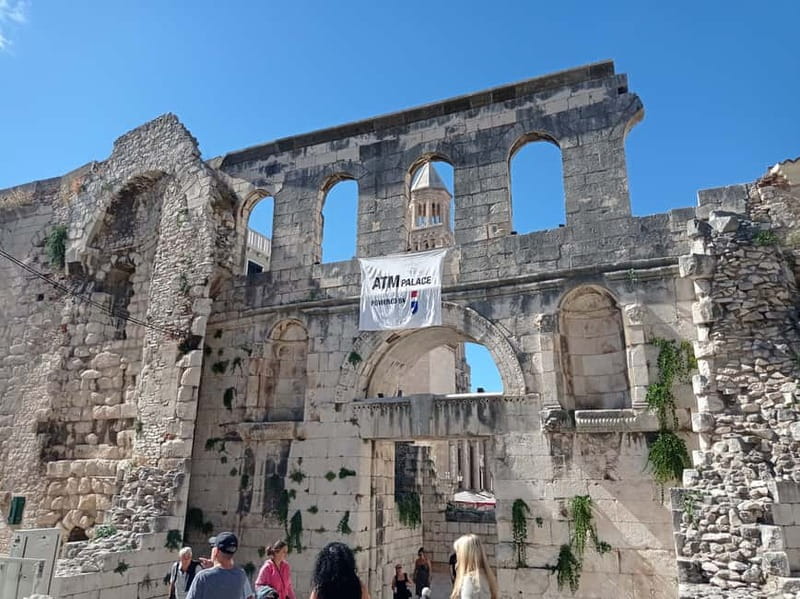
The Golden Gate receives about 15 minutes of guided attention. It is one of the key entrances into Diocletian’s Palace, so it makes a natural first major stop.
Here, you can expect more than a quick explanation of Roman construction. The tour’s method is to use the architecture as a doorway into later periods and current questions. The gate helps frame Split as a city repeatedly claimed, reused, and interpreted by different societies.
The 15-minute slot is long enough for explanation and questions without keeping you fixed in one place for too long. If you already know Roman sites well, the value will come from the social and political connections rather than basic architectural facts.
Peristil: from imperial square to Croatian identity
The next stop is Peristil, with around 15 minutes of guided discussion. This is one of Split’s most important public spaces and one of the places where the layers of the city are easiest to see.
I like this part of the route because Peristil can support several readings at once. It is Roman, religious, civic, and highly symbolic. Marin uses such spaces to explore how people interpret the past and how national identity is built around selected moments in history.
You should expect a conversation that moves between ancient and modern Croatia. The point is not to pretend that one version of the past explains everything. Instead, you get a sense of why historical stories can become political, and why different groups may attach different meanings to the same place.
A few more Split half-days to weigh up
- Split: Krka Waterfalls Trip with Boat Cruise and Swimming
★ 4.8 · 10,519 reviews - From Split: Krka Waterfalls, Food & Wine Tasting Tour
★ 5.0 · 9,326 reviews - Blue cave, Mamma Mia and Hvar, 5 islands speedboat tour
★ 5.0 · 7,150 reviews - From Split: Krka Waterfalls, Food & Wine Tasting Tour
★ 4.9 · 6,598 reviews
Diocletian’s Cellars: history beneath the streets
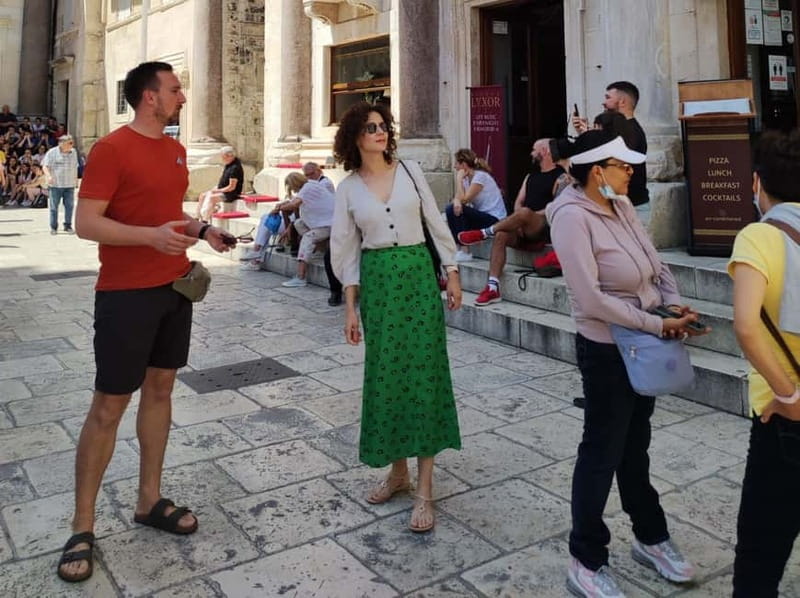
The tour spends about 10 minutes at Diocletian’s Cellars. The cellars are a familiar Split sight, but this visit gives them a wider role in the story of the city.
The stop helps connect the palace as an imperial project with the later life of the settlement. The focus is not only on what the Romans built, but also on how old structures continue to shape everyday space and public understanding.
Ten minutes is a relatively short stop, so do not expect an exhaustive architectural explanation. That is probably a good fit for this tour. The cellars become one part of a larger discussion rather than the entire subject.
People’s Square: where public life gets political
At People’s Square, Marin gives about 15 minutes to the relationship between public space and society. This is the kind of stop that shows why the tour is different from a standard monument walk.
A square can serve as a meeting place, a commercial center, a stage for public events, and a setting for political expression. You will look at the space not just as a place to photograph, but as somewhere that reflects who has power, who belongs, and how a community presents itself.
This section may be especially useful if you want to understand modern Croatia rather than only ancient Split. The tour combines politics, economics, identity, and demographics, using the city center to make those broad subjects easier to grasp.
Židovski prolaz: a smaller place with larger questions
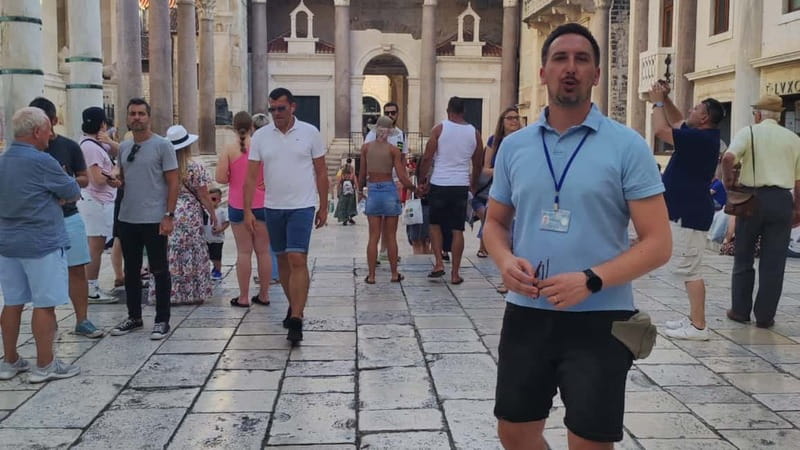
The walk then reaches Židovski prolaz, or Jewish Passage, for about 10 minutes. This is a shorter stop, but it adds an important strand to the tour’s treatment of Split’s past.
The passage creates room to discuss Jewish heritage and the place of minority communities in the city’s story. It also fits the tour’s interest in subjects that can receive less attention in a conventional introduction.
I value this stop because it reminds you that a city’s identity is never made by one group alone. The tour does not treat Split as a simple, single-story destination. Instead, it points toward the communities, beliefs, and memories that complicate the usual account.
Fruit Square: daily life beside grand narratives

Fruit Square gets approximately 15 minutes. Its name and setting bring the discussion closer to ordinary city life, commerce, and the way public spaces change over time.
This stop can help balance the heavier political material. You are still examining social and economic forces, but in a place connected with the practical life of the city. The tour’s strength is this movement between large subjects and familiar urban details.
You might find the discussion here especially useful after the more formal palace sites. It shows how Split’s story is not confined to emperors, churches, and official monuments. Markets, streets, and shared squares also tell you how a society works.
Riva: a brief waterfront connection
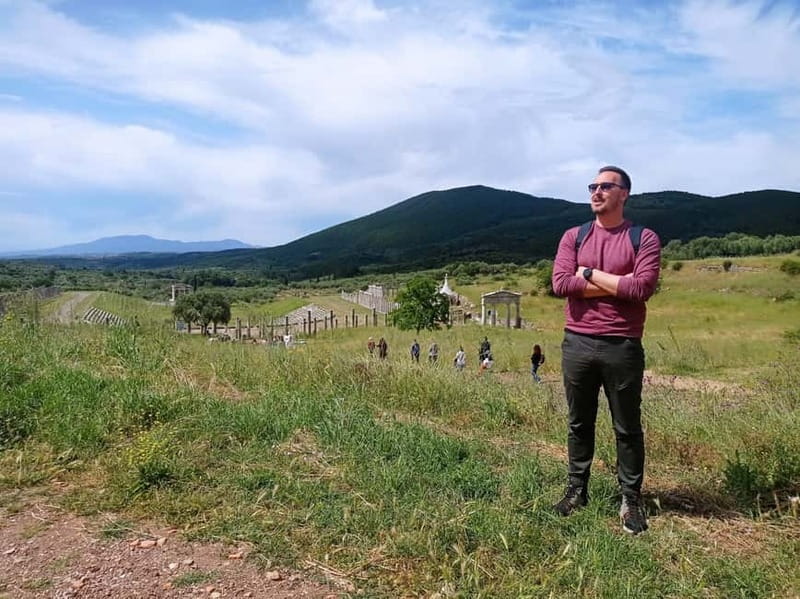
The group passes along the Riva for about five minutes rather than stopping for a full guided talk. This keeps the route moving and gives you a view of Split’s famous waterfront.
Do not expect a long promenade break or a separate lecture here. The Riva works as a transition between the central squares and the final stop. It also gives you a chance to place the old center within the modern city.
If you want waterfront photographs or time to sit with a coffee, plan to return later. This is a walking tour with a full program, not a relaxed sightseeing stroll.
Republic Square: bringing the past into the present
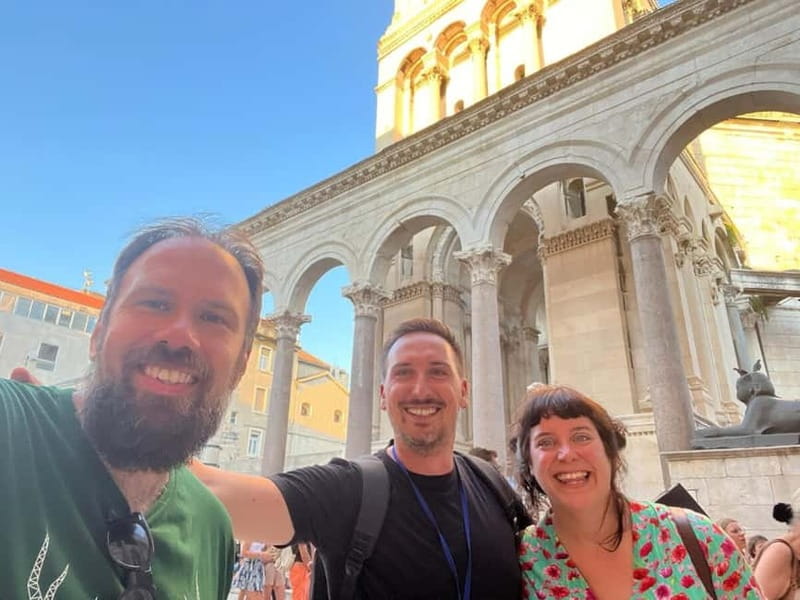
The final guided stop is Republic Square, with about 15 minutes of discussion. By this point, the tour has moved through Roman, religious, minority, civic, and commercial settings. Republic Square gives Marin a place to bring those strands together.
The conversation may include the social forces shaping Croatia now, including political ideas, identity, sexuality, religion, economics, and geopolitics. These topics are not treated as separate academic subjects. They are linked to the places you have just walked through.
That connection is the main reason to book this experience. You leave with more than a list of sites. You have a way to interpret the city, and you can use that framework during the rest of your time in Split.
The listed route finishes at Trumbićeva obala. The meeting information also says the activity ends back at the meeting point, so I would confirm the exact finishing point when you book or meet the guide. That is a small practical detail, but it matters if you have a ferry, meal reservation, or another timed activity afterward.
Why the controversial approach matters
The tour is built around contested history and contested modern issues. That means Marin does not smooth every disagreement into a harmless tourist story. You may hear about the ways Croatians understand their history, the tensions around identity, and the political or religious questions that continue to influence society.
This approach can make the city easier to understand, but it can also make the walk emotionally heavier than a standard introduction. I would not choose it if you want only Roman architecture, cheerful anecdotes, and a quick orientation to restaurants.
I would choose it if you appreciate a guide who explains uncertainty and disagreement rather than hiding them. One particularly useful feature is the link between past and present. Instead of treating modern politics as a separate topic, the tour shows how old events and inherited ideas continue to affect public life.
The material is designed for a general audience, not only for academics. You do not need specialist knowledge to follow it. Still, the range is broad, and you may want to keep a note of subjects you would like to explore later.
Marin’s guiding style and the audio-visual material
Marin’s background as a cultural anthropologist and school teacher shapes the experience. He does not simply recite information. He explains the context, relates ideas to architecture, and engages with the people in the group.
That teaching style is valuable when the subject matter becomes complicated. If you have ever left a tour with a pile of dates but no sense of why they matter, this walk takes the opposite approach. The aim is understanding rather than memorization.
Additional audio-visual material is provided for each topic covered. That can help make abstract subjects clearer and give you a second way to take in the information. The supplied experience details do not specify the exact format or device, so you should not assume it is a full multimedia presentation. Think of it as support for the guide’s live explanation.
The tour also has a record of adapting to practical needs. The route was adjusted for rain, and time was allowed so a deaf participant could follow the interpretation. That suggests a thoughtful teaching approach, though you should still confirm your own access needs before booking.
Who will get the most from two hours
I would recommend this tour for:
- First-time visitors to Split who want a useful framework before exploring alone.
- History and politics readers who prefer difficult questions to a polished, simple story.
- Students and teachers interested in identity, religion, nationalism, or social change.
- Repeat visitors who already know the main monuments and want a new way to read them.
- Curious couples and small groups who enjoy discussing what they see as they walk.
It may be less suitable if your priority is a slow architectural tour, a family activity aimed at young children, or a route built around food and shopping. The material is described as suitable for people over 15, so families with older teenagers may find it a good fit.
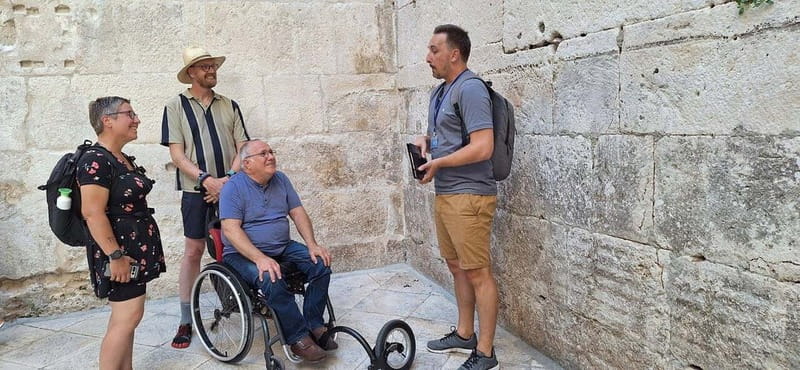
Because the tour is wheelchair accessible, it can work for people who need an accessible walking option. The supplied details do not explain the exact surfaces, slopes, or restroom arrangements, so ask the provider for those specifics if they affect your plans.
Is $33 a fair price?
At $33 per person, this is priced above a basic orientation walk, but the comparison is not quite fair. You are paying for a specialist guide, a carefully shaped argument about Split and Croatia, and supporting audio-visual material.
There are no extra costs listed. You do not need to budget for an admission ticket or optional add-on during the activity. The value depends on how much you want interpretation. If you only want to identify the Golden Gate and Peristil, a cheaper general walk may be enough. If you want to understand the forces behind the city’s public spaces, $33 is reasonable for two focused hours.
The tour also offers free cancellation up to 24 hours before the start and a reserve-now, pay-later option. Those terms make it easier to fit into a changing Croatia itinerary, especially when ferry schedules or weather are uncertain.
Practical advice before you book
Start early in your Split stay if you can. The tour’s biggest benefit is not just the two hours themselves. It gives you ideas that can shape how you see the palace, squares, waterfront, and conversations around you afterward.
Wear comfortable shoes and bring water, since this is a walking route through the center. Check the start time when booking, because several departure times may be available and the exact schedule is not fixed in the supplied details.
Plan to listen closely. The guide covers many subjects in a short period, from ancient history to contemporary social issues. If you want a leisurely photo stop at every location, you may feel hurried. If you prefer a clear route with substantial discussion, the pace should suit you.
Also confirm the end point. The route description gives Trumbićeva obala, while the meeting information says the activity ends back at the meeting point. Sorting that out in advance will help you plan your next move.
Should you book the Split Controversies tour?
Book it if you want Split explained as a society, not just displayed as an old city. Marin’s anthropological approach, willingness to address uncomfortable topics, and use of major landmarks make this a strong choice for an intellectually curious first day.
Skip it if you want a breezy sightseeing loop with little discussion of politics or identity. The subjects are the point, and they require attention.
For me, the best reason to choose it is the balance: you still see the Golden Gate, Peristil, Diocletian’s Cellars, People’s Square, Fruit Square, the Riva, and Republic Square, but each place carries a wider question. At $33, that is a fair exchange for a more thoughtful understanding of Split.
FAQ
How long does the Split cultural walking tour last?
The tour lasts two hours.
What language is the tour conducted in?
The live tour is conducted in English.
Who guides the tour?
The tour is led by Marin, a cultural anthropologist and school teacher.
Where does the tour start?
It starts at the fountain in the middle of Park Josipa Jurja Strossmayera, at Ul. kralja Tomislava 12, 21000 Split, Croatia.
Which major sights are included?
The route includes the Golden Gate, Peristil, Diocletian’s Cellars, People’s Square, Židovski prolaz, Fruit Square, the Riva, and Republic Square.
Does the tour discuss modern Croatian society?
Yes. It connects Split’s past with current questions involving politics, geopolitics, religion, identity, demographics, sexuality, history, and economics.
Is the tour wheelchair accessible?
Yes, the activity is listed as wheelchair accessible.
Is any extra payment required during the tour?
No extra costs are listed for the activity.
Can I cancel for a full refund?
Yes. You can cancel up to 24 hours in advance for a full refund.
Just added around Split
- Kayaking & Zipline Šibenik – Čikola Canyon★ 5.0 · 3 reviews
- Krka National Park & Zipline Šibenik – Čikola Canyon★ 5.0 · 3 reviews
- Split: Small-Group Half Day Sailing Trip★ 5.0 · 3 reviews
- Rafting River Cetina from Makarska Riviera including transfer★ 5.0 · 3 reviews
- From Split: Krka National Park & Waterfalls Private Day Trip★ 5.0 · 3 reviews
- Split Bike and Wine Experience★ 5.0 · 3 reviews
- Split and Salona Cultural Heritage Day Tour from Trogir★ 4.0 · 3 reviews
- Krka Waterfalls, Lake Cruise & Skradin★ 5.0 · 3 reviews
Walking Tours, compared.


Walking Tour of Split and Diocletian’s Palace
Read our review →
Krka Waterfalls tour with Trogir Walking tour and Krka panoramic boat cruise
Read our review →

Walking Tour of Split with a ‘Magister’ of History
Read our review →

Diocletian Palace & Old Town Guided Walking Tour
Read our review →
Browse the lists this tour appears in