
Reviewed · WALKING TOURS
Sibenik: Guided Walking Tour
Šibenik saves its best surprise for the end: St. James’s Cathedral, built entirely from stone without mortar and decorated with more than 70 carved human faces. The walk leading there passes through the city’s waterfront, gardens, main square, and tightly packed old streets, so you get a clear sense of how modern Šibenik fits inside its medieval shell.
I like the route’s natural shape, from the sea to the historic center, and I like that the guide adds the sort of small, funny details you will not find in a basic printed guide. The main consideration is the terrain. Cobblestones, narrow lanes, and some walking difficulty make this a poor match for anyone with mobility limitations.
In This Review
- Key points to know
- Why Šibenik is best understood on foot
- Starting at Gat Krka on the waterfront
- A quiet pause at Mediterranean Park
- Poljana Square and the modern city
- Into Šibenik’s narrow old-town streets
- St. James’s Cathedral and its carved faces
- What the private format changes
- Is $57 a fair price?
- Languages, timing, and practical preparation
- Who will get the most from this walk?
- Should you book the Šibenik guided walking tour?
- FAQ
- Where does the Šibenik walking tour start?
- Where does the tour finish?
- How long does the tour last?
- Is the cathedral entrance included?
- Which languages are available?
- Is the tour suitable for people with mobility impairments?
Key points to know
- The 90-minute route ends at St. James’s Cathedral, Šibenik’s most important sight.
- The cathedral entrance costs an additional €5 per person, so budget for it if you want to go inside.
- The walk starts at Gat Krka, a waterfront parking area beside the gas station.
- A private group format gives you a more personal way to ask questions and set the pace.
- English, Croatian, and Russian are available with the live guide.
- Comfortable shoes and water matter, especially on the old town’s stone streets.
Why Šibenik is best understood on foot
Šibenik is not a city you should rush through from a bus window. Its character appears in the transitions: the open Adriatic waterfront gives way to a garden, the garden leads to a broad public square, and then the city folds into lanes barely wide enough for two people.
That gradual change is the strength of this tour. You begin with the present-day city, where people meet for coffee and look out over the water. By the finish, you are standing before one of Croatia’s great Renaissance buildings, surrounded by centuries of stonework and local stories.
The walk also aims to explain both sides of Šibenik: the city’s past and the realities of life there now. That balance matters. A history lesson alone can leave you admiring old buildings without understanding the place. A local guide can connect the monuments to the streets, shops, public spaces, and daily routines around them.
You should expect a compact tour rather than a full-day examination of Dalmatia. In 90 minutes, you will get a strong introduction to the city center and its key sights, but not an exhaustive look at every church, fortress, museum, or neighborhood.
More Walking Tours in Sibenik
- Sibenik: Guided Evening Walking Tour
★ 4.9 · 62 reviews - Šibenik: Medieval Night Walking Tour
★ 5.0 · 19 reviews - The Best of Sibenik Private Walking Tour
★ 5.0 · 13 reviews
Starting at Gat Krka on the waterfront
The meeting point is Gat Krka, a parking area on the waterfront next to a gas station. This is useful to know because it is not described as a major monument or a grand square. Give yourself enough time to find the exact spot, especially if you are arriving by car or coming from a ship or bus.
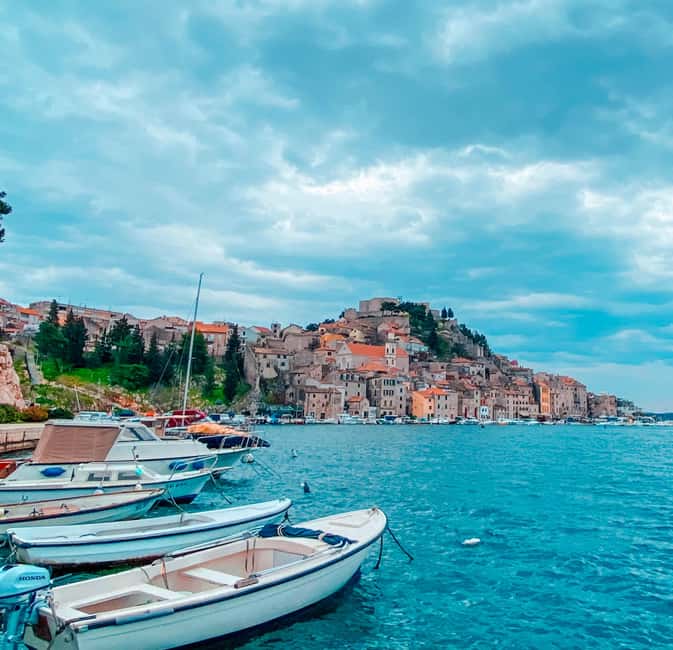
From here, the walk begins along the Riva, Šibenik’s waterfront promenade. The setting gives you an immediate sense of the city’s position on the Adriatic. You can look back toward the skyline, watch the water, and see how closely the historic center sits beside the coast.
The Riva is also a good place to notice the difference between Šibenik as a working city and Šibenik as a sightseeing destination. Cafes and restaurants line the promenade, and the waterfront has a relaxed social role for local people. The guide’s explanation here helps put the city in context before the route turns inland.
I like beginning at the water because it gives you a sense of direction. Once you enter the old town, the streets can feel like a puzzle. Starting with the broadest view first helps you understand where the center sits and how the later stops connect.
A quiet pause at Mediterranean Park
A short walk brings you to Mediterranean Park, also called Perivoj Roberta Visianija. This green space offers a change of pace after the openness of the waterfront.
The park is named for Roberto de Visiani, a Croatian botanist, and includes Mediterranean plants, shade trees, flowers, and formal landscaping. It is not simply a shortcut between two sights. It shows how Šibenik creates breathing room within its built-up center.
This stop adds welcome variety to the tour. You are not looking only at stone walls and old facades. You are also seeing the plants and public spaces that make the city comfortable to live in.
The park may be especially useful if you have just arrived in Šibenik and need a calmer introduction before entering the old town. Still, do not expect a long garden visit. The tour moves through several parts of the city in a short time, so the park functions as one part of a larger story.
Poljana Square and the modern city
From the park, the route continues to Poljana Square, the main square of Šibenik. This is where the old and current city meet most clearly.
Poljana is surrounded by landmarks, shops, cafes, historic buildings, and newer architecture. That mix helps you see Šibenik as a living place rather than a preserved set for sightseeing. The guide can explain how the square works today while pointing out the older structures around it.
I find public squares useful because they reveal the scale of a city. A cathedral may tell you about religion, craftsmanship, and power. A square tells you more about movement and everyday life. You can see where people gather, where businesses operate, and how the city has changed without losing its basic shape.
The square is also a practical orientation point. After the waterfront and park, it gives you another broad open space before you head into the narrow old-town lanes. If you are taking photographs, this is one of the places where you can step back and take in more than one building at a time.
Same coast, a completely different day out:
- From Split: Krka National Park Tour
★ 4.7 · 2,359 reviews - Vodice: Krka Waterfalls National Park Boat Tour
★ 4.6 · 250 reviews - Split: Krka Waterfalls Guided Day Trip with Swim & Boat Tour
★ 4.5 · 170 reviews - Split: Krka National Park Full-Day Tour with Wine Tasting
★ 4.9 · 142 reviews
Into Šibenik’s narrow old-town streets
The most atmospheric section comes next, as you enter the old town. The streets are narrow and paved with stone, with stone houses, small shops, hidden courtyards, and winding passages that turn the walk into a series of small discoveries.
This is where a guide earns the tour fee. A printed map can show you the route, but it cannot easily explain why a particular corner matters, what a building was used for, or how the city’s past connects to life today. The guide is also able to add amusing details, which can keep the history from becoming a string of dates.
The narrow streets have a clear drawback: they are not easy for everyone. Uneven stone surfaces can be tiring, and the route is specifically not suitable for people with mobility impairments. Wear firm, comfortable shoes, bring water, and avoid treating this as a stroll for sandals or formal footwear.
You should also keep your expectations practical. This is a walking tour, not a vehicle-based orientation. The route includes old lanes and historic surfaces by design. That is precisely what makes it atmospheric, but it also means the experience asks more from your feet than a flat waterfront walk.
I like this part because it gives you a feel for the city’s texture. The old town is not only a set of grand monuments. It is the space between them: the worn stones, compact houses, small openings, and sudden views down a side street.
St. James’s Cathedral and its carved faces
The tour ends at St. James’s Cathedral, also called the Cathedral of St. Jacob. This is the central reason many people will choose the walk.
The cathedral is a UNESCO World Heritage site and a major example of Renaissance architecture. Its most unusual feature is its construction: the building was made entirely of stone without mortar. That technical achievement becomes easier to appreciate when you are standing close to the walls and looking at how the stone pieces fit together.
The exterior is decorated with more than 70 carved human faces. They are believed to represent citizens of Šibenik in the 15th century. These are not vague decorative figures hidden high above the street. They give the building a remarkably human quality, as if ordinary people were given a place on the cathedral itself.
Your guide explains the construction, historical importance, and architectural details before the walk ends. This is an important distinction: the cathedral is the final stop, not simply a landmark you pass on the way to somewhere else.
Admission is not included. The extra cost is €5 per person, so add that amount if you want to enter. The supplied details do not promise an interior visit as part of the tour price, so you should treat the cathedral entrance as an optional additional expense and confirm the current arrangements when booking.
Ending here is smart. The cathedral gives the tour a clear finish and leaves you near one of Šibenik’s most important places. Afterward, you can continue exploring independently, return toward the waterfront, or spend more time around the cathedral area.
What the private format changes
This is a private group tour, which can make a difference in a compact old town. A small private party usually makes it easier to hear the guide in narrow streets and to ask questions about the places that interest you most.
You are not simply following a large crowd from one marker to the next. The guide can explain the city in a more conversational way, and the experience may feel less rushed even though the full route lasts only 90 minutes.
That said, the private format does not turn the tour into a flexible custom itinerary. The listed route still has a clear progression from Gat Krka through the waterfront, park, Poljana Square, old town, and cathedral. If you want to visit several interiors or spend a long time photographing one building, this may not be the right format.
The strongest value comes from the guide’s local interpretation. A perfect historical survey is not possible in an hour and a half. What you get instead is a focused introduction with room for useful details and humor. One recent participant specifically praised the guide for pointing out things that would not appear in a printed guide, along with interesting and funny explanations.
Is $57 a fair price?
At $57 per person, the tour is not the cheapest way to walk around Šibenik. You can see the waterfront, park, square, and old streets without paying for a guide. The question is what you want from the visit.
If you are comfortable researching the city yourself, the price may feel high for a 90-minute route. The cathedral entrance is also extra, and food, drinks, and gratuity are not included.
For you, the cost makes more sense if you value a private group, a live guide, and local context. The guide links the stops together and adds small details that are easy to miss on your own. You also avoid spending your limited time trying to work out the old town’s layout.
The tour is especially useful early in your stay. Take it near the beginning, then use the route as a framework for later exploring. You will know where the Riva, Poljana Square, old town, and cathedral fit together, and you can return to the places that caught your attention.
The price also includes taxes, the walking tour, and the guide. It does not include transportation, which is not needed once you reach the meeting point, or admission to the cathedral.
Languages, timing, and practical preparation
The live tour is offered in English, Croatian, or Russian. You should select the language that lets you follow historical explanations without effort, since the value of this experience depends heavily on the guide’s storytelling.
The duration is 90 minutes. That is long enough to cover the planned route without taking over your day. It also makes the tour a workable choice if you are fitting Šibenik into a larger Dalmatian itinerary.
Starting times vary, so check availability before booking. The tour is offered with free cancellation up to 24 hours in advance for a full refund, and you can reserve now and pay later. Those terms are useful if your schedule depends on changing transport or port plans.
Bring water and comfortable shoes. This is not just a suggestion for comfort. The old town’s stone streets and narrow passages are central to the route, and the walking surface is part of the experience.
The tour is not suitable for people with mobility impairments. If you need a fully accessible route, you should not assume that the old town section can be changed to meet your needs, because no adapted itinerary is specified.
Who will get the most from this walk?
I would recommend this tour to first-time visitors who want a clear introduction rather than a long specialist lecture. It also suits anyone who enjoys architecture, city history, local stories, and walking through old neighborhoods without rushing from one major sight to another.
It works well for couples, families with older children, and private groups who want to ask questions along the way. The private format is useful if your group prefers a more personal pace.
You should think twice if you dislike uneven streets, want a mostly flat route, or plan to spend the entire visit inside museums and churches. The tour focuses on the city as seen from its streets, with the cathedral as the major final sight.
It is also not the best choice if you want a food tour, a boat trip, or an extensive visit to Šibenik’s wider region. Meals, drinks, and other activities are not included. This is a focused city walk.
Should you book the Šibenik guided walking tour?
Book it if you want the city to make sense quickly, especially if you are new to Šibenik. The route is well shaped, the cathedral provides a memorable finish, and the guide adds the personal stories and humor that make an old town easier to remember.
The main reasons to pass are the price, the extra cathedral fee, and the walking conditions. If those are acceptable, $57 buys more than a route between landmarks: it gives you a local explanation of how Šibenik’s waterfront, public spaces, old streets, and major cathedral belong to one city.
FAQ
Where does the Šibenik walking tour start?
The tour starts at Gat Krka, a parking area on the waterfront next to a gas station.
Where does the tour finish?
The walk finishes at St. James’s Cathedral, also known as the Cathedral of St. Jacob.
How long does the tour last?
The guided walking tour lasts 90 minutes.
Is the cathedral entrance included?
No. Cathedral admission costs an additional €5 per person.
Which languages are available?
The live guide can conduct the tour in English, Croatian, or Russian.
Is the tour suitable for people with mobility impairments?
No. The tour is not suitable for people with mobility impairments, and comfortable shoes are recommended because the route includes narrow old-town streets and stone surfaces.
Just added around Sibenik
- Kayaking & Zipline Šibenik – Čikola Canyon★ 5.0 · 3 reviews
- Krka National Park & Zipline Šibenik – Čikola Canyon★ 5.0 · 3 reviews
- Zipline Šibenik★ 5.0 · 3 reviews
- Panorama Tour – Eco City Tour Šibenik★ 4.5 · 4 reviews
- Panorama & Wine tour – Eco City Tour Šibenik★ 5.0 · 4 reviews
- Kayaking Sunset Tour★ 5.0 · 4 reviews
- Private tour Sibenik full day★ 5.0 · 5 reviews
- From Sibenik: Private Skradinski buk waterfall in Krka NP★ 5.0 · 5 reviews
Walking Tours, compared.


Walking Tour of Split and Diocletian’s Palace
Read our review →
Krka Waterfalls tour with Trogir Walking tour and Krka panoramic boat cruise
Read our review →

Walking Tour of Split with a ‘Magister’ of History
Read our review →

Diocletian Palace & Old Town Guided Walking Tour
Read our review →
Browse the lists this tour appears in