
Reviewed · DIOCLETIAN PALACE TOURS
Essential Diocletian’s Palace Tour for First-Time Visitors
Diocletian’s Palace is not a museum sealed behind glass. It is the heart of Split, where Roman walls frame cafés, shops, homes, and narrow lanes. This 90-minute walking tour gives first-time visitors a clear route through that maze, with stops at the Golden Gate, Peristyle, Jupiter’s Temple, the cathedral, the Vestibule, the Cellars, and the Riva.
I like two things right away: the small group of no more than 10 people, which makes it easier to ask questions, and the guide’s effort to connect ancient history with daily life in modern Split. Jelena Tanjić is praised for mixing facts, humor, present-day context, and practical food and sightseeing advice.
The main limitation is time. Ninety minutes is enough for a strong orientation, but not for a slow examination of every monument. The tour also does not include entry to the Substructures or the Bell Tower, so you will need a separate ticket and more time if those are high on your list.
In This Review
- Key points at a glance
- Why this is a smart first look at Split
- Meeting the guide by Gregory of Nin
- Walking through the Golden Gate
- People’s Square and the medieval city
- Jupiter’s Temple and the shift from emperor to cathedral
- Peristyle, the Palace’s great stage
- Saint Domnius Cathedral and the Palace’s changing identity
- The Vestibule and a group selfie
- Diocletian’s Cellars and an important expectation
- Finishing near Split’s Riva
- What the food vouchers add
- Price, pace, and group size
- Who will get the most from this walk
- Should you book Essential Diocletian’s Palace Tour?
- FAQ
- How long does the tour last?
- What is the price?
- What language is the tour in?
- How large is the group?
- Where does the tour start?
- Where does the tour finish?
- Does the tour include the Substructures?
- Does the tour include the Bell Tower?
- Are restaurant discounts included?
- Can wheelchair users join?
Key points at a glance

- A first-timer’s route through the Palace: See the Golden Gate, People’s Square, Jupiter’s Temple, Peristyle, cathedral, Vestibule, Cellars, and Riva.
- Jelena’s local perspective: Learn about Split today as well as Emperor Diocletian and the Roman past.
- Small-group format: With a maximum of 10 participants, the walk should feel more personal than a large city tour.
- A useful stop for food planning: You receive restaurant and bar vouchers plus personal recommendations after the walk.
- A memorable Vestibule moment: The group takes a selfie beneath the dome.
- Important access limit: The tour does not include entry to the Substructures or Bell Tower.
Why this is a smart first look at Split
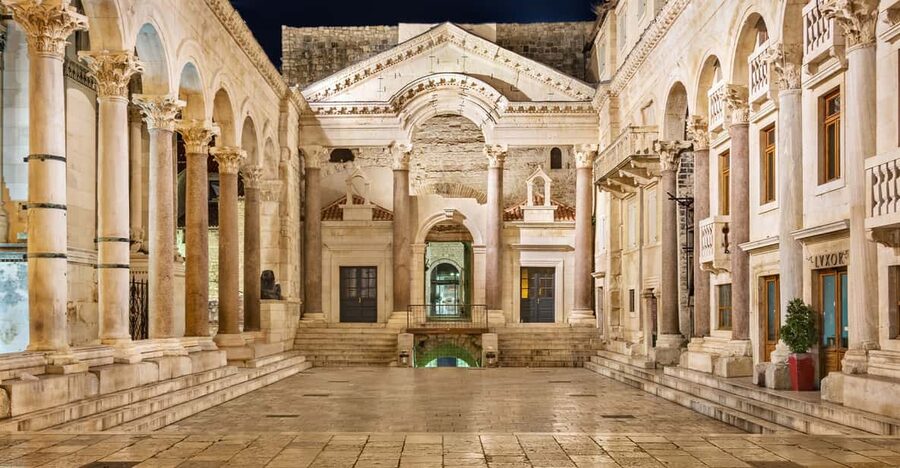
Split can be confusing at first because the Old Town is not simply located beside Diocletian’s Palace. Much of the old city is built inside and around the former imperial complex. Roman walls now form part of ordinary streets, apartments, businesses, and public squares.
That unusual mix is the main reason I like starting with a guide. You are not only looking at old stones. You are learning how the palace shaped the modern city and why people still move through it as part of daily life.
The route also gives you several different views of Split in a short time. You see the monumental Roman entrances, the ceremonial center of the Palace, Christian buildings, medieval public space, and the waterfront promenade. It is a useful orientation before you return on your own to explore at a slower pace.
Jelena Tanjić brings a regional viewpoint as a guide originally from Bosnia and Herzegovina who has lived in Split for many years. That background helps place the city in a wider Balkan setting rather than treating its past as an isolated Roman story.
The tone is meant to be relaxed and conversational. You can expect facts, questions, humor, and practical comments about life in Split today. That balance matters because a tour that only recites dates can make the Palace feel distant. Here, the goal is to show how the past and present occupy the same streets.
More ways into Diocletian’s Palace:
- Split: Old Town and Diocletian Palace Walking Tour
★ 4.9 · 4,727 reviews - Walking Tour of Split and Diocletian’s Palace
★ 5.0 · 2,588 reviews - Split & Diocletian’s Palace Walking Tour
★ 5.0 · 1,125 reviews
Meeting the guide by Gregory of Nin
The tour begins in front of the large statue of Bishop Gregory of Nin, beside the northern entrance to the Palace, known as the Golden Gate. Look for a black umbrella, which is the guide’s meeting marker.
Give yourself enough time to find the statue. The Palace area contains many lanes and landmarks close together, and a calm arrival is better than trying to locate the group at the last minute. The starting point is central and well suited to an immediate introduction to Split’s old core.
Gregory of Nin is a fitting place to begin because the statue is one of the recognizable public markers near the Palace entrance. From there, the route moves directly into the Roman complex.
Walking through the Golden Gate
The Golden Gate is the northern entrance to Diocletian’s Palace and one of the best places to understand the scale of the complex. Your guide explains how the gates and walls controlled movement into the imperial residence.
This first stop sets up the rest of the tour. Instead of meeting a monument with no context, you begin by seeing the Palace as a planned structure with entrances, ceremonial areas, and lower service spaces. The explanation also helps you read the city map in your head.
The Golden Gate is a busy photographic spot, so the group may need to pause to one side while the guide speaks. That is a normal tradeoff in Split’s compact Old Town. The tour keeps moving, which helps the group cover more ground.
People’s Square and the medieval city
From the Palace, the route continues to People’s Square, one of the main public spaces in Split. This stop helps show that the city did not end when Roman rule faded. Later generations built, traded, gathered, and governed within the old urban fabric.
I find this change of focus useful. A tour of Diocletian’s Palace can easily become only a Roman history lesson, but Split’s appeal comes from the layers. The walk gives you a sense of how the Old Town grew beyond the original imperial plan.
People’s Square also gives you a break from the enclosed passages of the Palace. You get a broader public setting and a chance to see how Split’s central spaces work today. Your guide adds context about modern life, not just ancient dates.
A few more Split half-days to weigh up
- Split: Krka Waterfalls Trip with Boat Cruise and Swimming
★ 4.8 · 10,519 reviews - From Split: Krka Waterfalls, Food & Wine Tasting Tour
★ 5.0 · 9,326 reviews - Blue cave, Mamma Mia and Hvar, 5 islands speedboat tour
★ 5.0 · 7,150 reviews - From Split: Krka Waterfalls, Food & Wine Tasting Tour
★ 4.9 · 6,598 reviews
Jupiter’s Temple and the shift from emperor to cathedral
Jupiter’s Temple is one of the essential ancient stops. It offers a close look at the religious side of Diocletian’s building program and the way Roman power used architecture to express authority.
The temple is especially useful when paired with the cathedral later in the route. You see how sacred spaces changed meaning over time, with the Palace eventually becoming a Christian center as well as a place of ordinary city life.
The stop is relatively focused, so listen for the main ideas rather than expecting a long private examination. The guide’s job here is to make the connection between Roman religion, imperial identity, and Split’s later history easy to follow.
Peristyle, the Palace’s great stage
The Peristyle is the visual center of the tour. This grand open space was designed for ceremony and imperial display, and it remains one of the strongest places to feel the scale of Diocletian’s project.
Your guide explains how the square functioned and points out the architectural details that can be easy to miss when you are busy taking photographs. Look around at the surrounding stonework and the way later buildings press against the Roman setting.
This is also where the tour’s storytelling matters most. The Peristyle is impressive on its own, but a clear explanation turns it from a pretty square into a place with a role, purpose, and audience. You can better understand how power was presented here and how the space later became part of the living city.
Because the Peristyle is a central meeting area, it can be crowded. You may not get a quiet, uninterrupted view. The advantage of a guide is that you can still understand what you are seeing even when the square is full.
Saint Domnius Cathedral and the Palace’s changing identity
The Cathedral of Saint Domnius is another major stop, and it adds an important layer to the route. The building is tied to the former imperial complex and shows how the site gained a new religious role.
This is where the tour’s wider time frame becomes valuable. You are not being shown isolated Roman remains. You are seeing a place that continued to change, with older structures used and adapted by later communities.
The standard walk does not include access to the Bell Tower. If climbing the tower is important to you, plan that separately. The same applies to the Substructures, which are not included as an entry experience even though the Cellars appear on the walking route.
That distinction is worth noting before you book. The tour gives you the story and the essential exterior and interior points included in its route, but it is not an all-access Palace ticket.
The Vestibule and a group selfie
The Vestibule is one of the tour’s more playful moments. This round domed space creates a striking acoustic and visual setting, and the group takes a shared selfie beneath the dome.
The photo is a small detail, but it helps break up the history. After several stops involving emperors, temples, and city planning, a quick group memory keeps the experience human and informal.
You will also hear why the Vestibule mattered as part of the Palace’s ceremonial approach. The shape and position of the space make more sense once your guide explains how it connected to the imperial apartments and the route into the complex.
Diocletian’s Cellars and an important expectation
The route includes Diocletian’s Cellars, which are essential for understanding how the Palace worked below the grand public spaces. These lower areas help explain the practical side of the complex, including its support and storage functions.
Do not confuse a guided stop here with admission to the Substructures. This activity does not include entry to the Substructures, so you should check the exact access included when booking or ask the guide at the start.
That limitation will not bother everyone. If you have only a short stay in Split, a guided overview may be a better use of time than trying to inspect every section. If underground architecture is your main interest, add a separate visit.
Finishing near Split’s Riva
The route takes you toward the Riva, Split’s famous waterfront promenade. This is a good finish because it moves you from the enclosed Roman lanes into one of the city’s most useful modern spaces.
The Riva is an easy place to continue your day. You can use the guide’s suggestions to choose a restaurant or bar, return to the Palace for more wandering, or simply sit and watch the city move along the waterfront.
The directions contain a small inconsistency. The route information says the tour finishes at Split Riva, while the meeting instructions say the activity ends back at the meeting point. Confirm the exact ending point with the guide when you arrive, especially if you have a reservation, ferry, or other timed plan afterward.
What the food vouchers add
The tour includes access to vouchers and discounts at selected Split restaurants and bars. You also receive personal recommendations about where to eat, what to see, and which local experiences to consider.
This is more useful than a generic list because you can ask for advice that fits your plans. Tell Jelena if you want a quick meal, a local dish, a drink, or a place near your next stop. The value depends on which participating businesses you use, so treat the vouchers as a bonus rather than the main reason to book.
The timing is good. Food advice at the end of a walking tour lets you act on it immediately, while the landmarks are still fresh in your mind. For a first visit, that can save you from choosing a restaurant at random in the busiest part of the Old Town.
Price, pace, and group size
At $17 per person, this is priced as an affordable orientation walk rather than a long specialist tour. I consider that good value if you want a guide to explain the Palace and help you get your bearings before exploring alone.
The strongest value comes from the combination of route and advice. In 90 minutes, you cover the key sights, hear an organized explanation, and can ask about modern Split, restaurants, and follow-up visits. You are paying for structure and local context, not for entry tickets to every monument.
A group limit of 10 is another advantage. It should be easier to hear the English-speaking guide and easier to ask a question than on a large coach-style walk. The group can still feel busy in narrow lanes, but the size is suited to conversation.
The short duration also keeps the tour manageable for families and for people arriving in Split by cruise ship or on a tight schedule. Just do not expect a slow architectural study. The pace is designed to introduce the essentials.
You can reserve now and pay later, which helps if your plans are still changing. Free cancellation is available up to 24 hours before the activity for a full refund. Wheelchair users should note that the tour is not suitable for wheelchair access.
Who will get the most from this walk
I would choose this for a first visit, especially if you want a simple route through the Old Town rather than a long academic lecture. Solo visitors, couples, friends, and families can all benefit from the compact format.
It is also a good match if you want to understand Split beyond its Roman monuments. Jelena’s background and years living in the city allow the conversation to include present-day life and the wider region.
You may want something else if you have already spent several days studying the Palace or if you mainly want interior admission to the Substructures and Bell Tower. This tour explains those places as part of the wider story, but it does not replace separate entry.
The walk is in English. Wear comfortable shoes and expect historic streets and enclosed passages, though no special equipment is listed. The tour is not suitable for wheelchair users.
Should you book Essential Diocletian’s Palace Tour?
Book it if you are visiting Split for the first time and want the main story in a friendly, compact format. The best reasons are the limited group size, Jelena’s mix of ancient history and current local life, and the useful restaurant and sightseeing advice after the walk.
At $17, it offers a practical introduction without taking half your day. The main caution is to keep your expectations clear: the tour does not include the Bell Tower or Substructures, and 90 minutes leaves little time for lingering.
If you want an easy way to understand why Split’s Palace is also a living Old Town, this is a sensible pick. Confirm the ending point and any access questions before setting out, then use the rest of your day to revisit the places that caught your attention.
FAQ
How long does the tour last?
The tour lasts 1.5 hours, or 90 minutes. Starting times vary, so check availability when booking.
What is the price?
The listed price is $17 per person.
What language is the tour in?
The live tour guide speaks English, and English is the listed tour language.
How large is the group?
The tour is limited to 10 participants.
Where does the tour start?
It starts in front of the large statue of Bishop Gregory of Nin, beside the Golden Gate, the northern entrance to Diocletian’s Palace. Look for a black umbrella.
Where does the tour finish?
The route information lists Split Riva as the finish. The meeting instructions also say the activity ends back at the meeting point, so confirm the exact ending location with the guide.
Does the tour include the Substructures?
No. The tour does not include access to the Substructures.
Does the tour include the Bell Tower?
No. Bell Tower access is not included.
Are restaurant discounts included?
Yes. The experience provides access to vouchers and discounts at some Split restaurants and bars, along with personal recommendations.
Can wheelchair users join?
No. The activity is listed as not suitable for wheelchair users.
Just added around Split
- Kayaking & Zipline Šibenik – Čikola Canyon★ 5.0 · 3 reviews
- Krka National Park & Zipline Šibenik – Čikola Canyon★ 5.0 · 3 reviews
- From Split: Krka National Park & Waterfalls Private Day Trip★ 5.0 · 3 reviews
- Split: Small-Group Half Day Sailing Trip★ 5.0 · 3 reviews
- Rafting River Cetina from Makarska Riviera including transfer★ 5.0 · 3 reviews
- Split Bike and Wine Experience★ 5.0 · 3 reviews
- Split and Salona Cultural Heritage Day Tour from Trogir★ 4.0 · 3 reviews
- Private transfer from Split to Dubrovnik with 2h sightseeing stop in Ston★ 5.0 · 3 reviews
Diocletian Palace Tours, compared.


Walking Tour of Split and Diocletian’s Palace
Read our review →

Diocletian Palace & Old Town Guided Walking Tour
Read our review →
Game of Thrones Tour with Diocletian’s Palace Cellar
Read our review →
Diocletian’s Palace and Old Town SMALL GROUP Walking Tour
Read our review →

Browse the lists this tour appears in