
Reviewed · DIOCLETIAN PALACE TOURS
Diocletian’s Palace Small Group Tour in Split
Diocletian’s Palace is not a single quiet building waiting behind a ticket booth. It is Split’s living city center, a maze of lanes, homes, shops, cafés, and ancient stone. This two-hour walk helps you read that jumble, from the Roman emperor’s ceremonial square to the Egyptian sphinxes and the old palace gates.
I like the choice of departures, which makes it easier to fit the tour around a ferry arrival or a hot summer day. I also like the local angle: guides such as Luka, Sandra, and Jelena have been praised for clear explanations, good humor, and useful tips about shops and daily life.
The main drawback is the scale of the advertised group, which can reach 99 people, even though one outing had about 20 and another became private. Ask about the expected group size if close contact with the guide matters to you.
In This Review
- Key points to know before booking
- Why a guided walk helps you understand Split
- Starting at South Tours Travel Agency
- Walking the 1,700-year-old palace streets
- The Peristyle, Split’s grand central stage
- Inside the circular Vestibule
- The Diocletian’s Cellars and the palace below
- The Golden Gate and the emperor’s entrance
- The guide style and local advice
- Is $60.21 a fair price?
- Who should book this Split walking tour?
- Final call: a useful first look at Split
- FAQ
- How long does the Diocletian’s Palace tour last?
- Where does the tour start and finish?
- What language is the tour offered in?
- Which places are included in the walking route?
- Are food, drinks, and cathedral tickets included?
- Can I cancel for a full refund?
Key points to know before booking
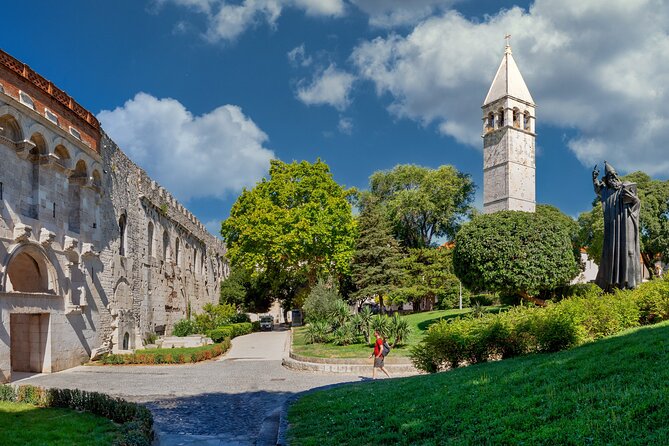
- The palace is the city: You walk through streets where Roman walls and modern homes occupy the same block.
- Five focused sights: The route covers the Palace, Peristyle, Vestibule, cellars, and Golden Gate.
- A strong guide makes the difference: Luka, Sandra, and Jelena are among the guides praised for history, humor, and local advice.
- Two hours gives you a useful overview: You get your bearings without spending half a day indoors.
- The price is $60.21 per person: That is fair for a guided introduction, especially if you value context and local tips.
- Timing matters in August: An early morning departure can be more comfortable than walking at midday.
Why a guided walk helps you understand Split
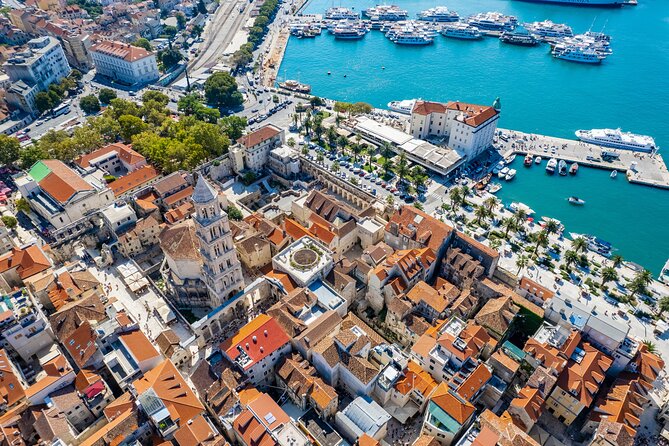
At first glance, Diocletian’s Palace can feel like a stone maze with no clear beginning or end. That is part of its charm, but it also makes the old center hard to decode on your own. A guide gives you the basic map and explains why the palace became the heart of modern Split.
Built for Emperor Diocletian at the turn of the fourth century, the palace was designed as a retirement residence and a military stronghold. Calling it a palace can make you picture a single grand house. In reality, roughly half served Diocletian and the other half housed the military garrison.
You will walk through the historic core rather than simply look at ruins from outside. That means the experience connects Roman planning with the everyday life of the modern city. Ancient columns can sit near a much newer building, and a narrow lane can follow the line of an old wall.
I find this kind of walk especially useful at the start of a Split visit. After two hours, you should have a clearer sense of where the main gates, central square, and underground levels fit together. You can then return to the places that caught your eye.
The guide is central to the experience. The strongest comments focus on friendly, clear teaching rather than on a long list of monuments. Luka was praised for enthusiasm and practical suggestions, while Sandra was singled out for her history knowledge and warm manner. Jelena has also been described as both informative and fun, with helpful advice about local shops.
That does not mean every departure will feel identical. Guides have different personalities, and group size can change the rhythm. One outing had about 20 people, while another became private. The stated maximum is 99, so the phrase small group should not be treated as a firm promise of a tiny party.
More ways into Diocletian’s Palace:
- Split: Old Town and Diocletian Palace Walking Tour
★ 4.9 · 4,727 reviews - Walking Tour of Split and Diocletian’s Palace
★ 5.0 · 2,588 reviews - Split & Diocletian’s Palace Walking Tour
★ 5.0 · 1,125 reviews
Starting at South Tours Travel Agency
The meeting point is South Tours Travel Agency at Mrčelina 1 in Split. The walk ends back at the same meeting point, which is convenient if you have plans afterward or need to return toward the port and old town.
You receive confirmation when you book, and the mobile ticket keeps the paperwork simple. Since several departures are offered throughout the day, you can choose a time that suits your schedule. An early start is worth considering during August. One particularly useful tip from the experience is that early morning offered a cooler, calmer way to see the city.
The tour lasts about two hours. That is long enough for a proper orientation but short enough for a busy day in Split. You are on foot throughout, so wear comfortable shoes and expect uneven streets, steps, and standing. A moderate level of fitness is requested.
Food and drinks are not included. Plan to eat before or after the walk, rather than expecting a refreshment stop. Cathedral tickets are also excluded, so the tour should be viewed as a guided city walk, not an all-inclusive package covering every interior in the palace.
Walking the 1,700-year-old palace streets
The main palace portion occupies most of the experience. You move through a place that has been adapted over many centuries rather than preserved as an empty Roman shell. The route may feel like a history lesson at first, then suddenly like a stroll through an ordinary neighborhood.
That mix is the point. The palace is not separated from Split. It forms about half of the old town and city center, so local life continues within the ancient plan. You might pass from Roman masonry to a 20th-century building within a few steps.
The streets can feel confusing without an explanation. A guide can show how the old palace was organized and point out the difference between ceremonial areas, defensive features, and working spaces. You also get a better sense of how Diocletian’s private quarters related to the military side of the complex.
The walk is not limited to grand viewpoints. Its value lies in details that are easy to miss, including old stonework, unusual corners, and the way later buildings were fitted into the Roman structure. The Spanish-language comment about a maze full of surprises captures the experience well, though the tour is offered in English.
You should not expect every minute to be spent inside a formal archaeological site. Much of the route is through the active city center. If you want a quiet museum-style visit, this may feel too open and informal. If you want to understand how a Roman complex became a modern city, it is a good match.
The Peristyle, Split’s grand central stage
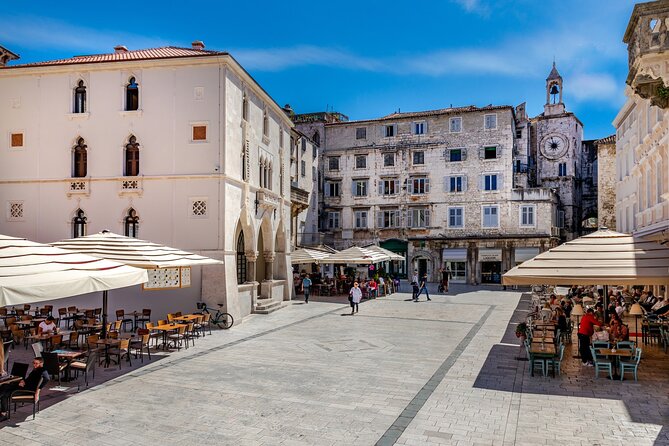
The Peristyle is the palace’s central square and one of the clearest places to understand Diocletian’s imperial image. It was designed for the emperor, who was presented as the living son of Jupiter. The space was meant to impress, and its columns and surrounding temples still give it a strong ceremonial feel.
Your guide can help you read the square as more than a photogenic stop. This was a place of power, procession, and public display. The unusual acoustics also gave the Peristyle a later life as a setting for opera, classical literature, and urban events.
The stop is listed at about 10 minutes, so expect a focused explanation rather than a long period to wander. That is enough for an overview, but you may want to return later if you hope to study the architecture or take photographs without feeling rushed.
The square also shows how old and new Split overlap. It is not presented as an isolated Roman stage. Modern city life continues around it, which can make the setting feel less pristine but more authentic.
A few more Split half-days to weigh up
- Split: Krka Waterfalls Trip with Boat Cruise and Swimming
★ 4.8 · 10,519 reviews - From Split: Krka Waterfalls, Food & Wine Tasting Tour
★ 5.0 · 9,326 reviews - Blue cave, Mamma Mia and Hvar, 5 islands speedboat tour
★ 5.0 · 7,150 reviews - From Split: Krka Waterfalls, Food & Wine Tasting Tour
★ 4.9 · 6,598 reviews
Inside the circular Vestibule

The Vestibule was part of the old imperial court. From outside, it has a rectangular form, while the interior is circular. That change in shape is the feature to watch for, and the guide’s explanation helps you notice why the space feels so monumental despite its short stop.
The Vestibule is scheduled for around 10 minutes. You will likely hear how it related to the emperor’s apartments and ceremonial approach, then move on with the group. Its value comes from seeing another part of the palace plan, not from spending a long time inside.
The acoustics and shape make it a memorable pause. Still, do not expect an extended architectural lecture or a performance. This is a compact stop within a broader walk.
The Diocletian’s Cellars and the palace below
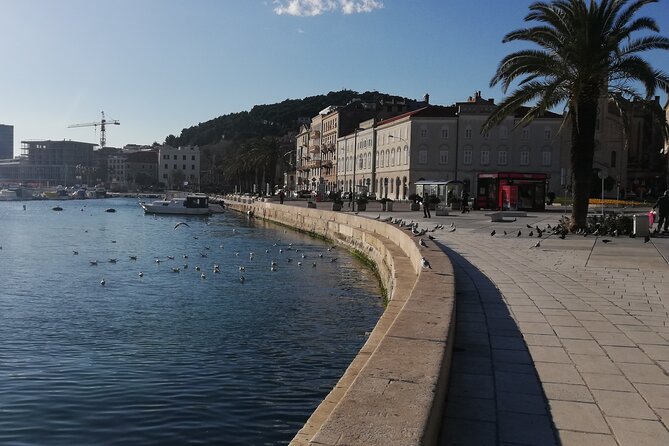
The substructures are among the most important parts of the route. They are unusually well preserved, and their survival helped support the historic core’s inclusion on the UNESCO World Heritage list in 1979.
These lower spaces show how the palace was built and organized. They also help explain the shape of the rooms above. Without them, the palace can seem like a collection of disconnected walls. Below ground, the plan becomes easier to imagine.
The scheduled visit lasts about 10 minutes. That is enough to introduce the cellars and explain their role, but it is not a full archaeological examination. If underground architecture is your main interest, check how much time your guide expects to spend there.
The available details identify the planned stops as free admission, while cathedral tickets are specifically not included. That means you should not assume the tour price covers every separate interior in the old town. The guide can give you a useful introduction, but you may choose to return later for a longer visit.
The Golden Gate and the emperor’s entrance
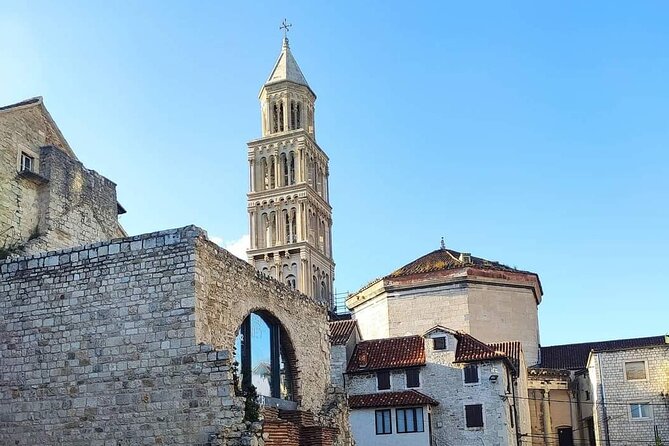
The Golden Gate, or Porta Septemtrionalis in Roman usage, gives the tour a strong closing image. It was built as part of the palace’s defensive system, with a rectangular form and double doors. The design reflects the military purpose of the complex, not just its role as an imperial home.
The date attached to the gate is striking: Diocletian is said to have passed through it when he entered the palace on June 1, 305. That detail turns the gate from a piece of stonework into a point of arrival, ceremony, and political theater.
The stop lasts around 10 minutes. You can expect an explanation of the gate’s structure and defensive purpose, along with a clearer picture of how the palace connected to the outside world.
The Golden Gate is also a useful place to think about the contrast running through the whole walk. The palace was designed to protect an emperor and his troops, yet its streets now carry ordinary city life. That long change is one of the most interesting parts of Split.
The guide style and local advice
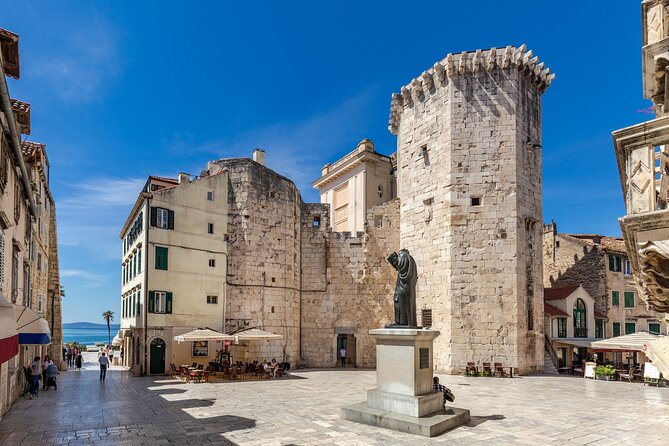
The strongest part of this experience is likely to be the person holding the guiding microphone. The guides are described as friendly, professional, and generous with their time. One guide answered questions throughout a private outing, while another added recommendations for shops.
You should expect history explained in a conversational way rather than a dry sequence of dates. A quirky sense of humor has also been part of the experience, which can make the Roman material easier to follow during a warm walk.
The local advice matters because the palace is still part of Split’s daily life. A guide can point out details about residents, streets, and businesses that you would probably pass without context. That makes the walk more useful than a quick circuit of famous photo stops.
There is one practical caution. The experience is offered in English, and the quality of the explanation depends on the assigned guide and the size of the group. A group of 20 can still be manageable, but a much larger group may make questions and quiet listening harder.
Is $60.21 a fair price?
At $60.21 per person, this is not the cheapest way to see the center of Split. The main sights on the route have no admission ticket included in the stated itinerary, so you are paying mainly for the guide, the structure of the walk, and the local interpretation.
That can be good value if you want to understand the palace quickly. The city center is easy to enter but not always easy to understand. A good guide can save you time, explain the Roman plan, and give you ideas for the rest of your stay.
The value is stronger if you are visiting Split for a short time, arriving by cruise ship, or beginning your trip with limited background. Two hours gives you a solid foundation without taking over the day.
The price is harder to justify if you are happy to wander alone and read at your own pace. You may also prefer another option if you want extended access to paid interiors, a very small party, or a long archaeological lecture. Remember that the maximum group size can be 99, so confirm your expectations before booking.
The 4.8 rating from 12 submitted ratings and the 92 percent recommendation figure point to a consistently positive experience, but the sample is small. I would place more weight on the specific guide, departure time, and group size than on the headline score alone.
Who should book this Split walking tour?
I would recommend it to first-time visitors who want a clear introduction to the old town. It also suits anyone who enjoys history but prefers it connected to streets, buildings, and local routines rather than presented only in a museum.
The tour works well for you if:
- You have about two hours and want an organized overview.
- You want an English-speaking local guide.
- You like learning how ancient sites became modern neighborhoods.
- You want tips about local shops and everyday life.
- You can manage moderate walking and standing.
- You prefer several departure choices rather than one fixed start.
I would think twice if you need a guaranteed tiny group. The advertised maximum is high, although actual outings can be smaller or even private. I would also look elsewhere if cathedral access or a longer cellar visit is your main goal, since cathedral tickets are not included and the listed stops are brief.
Book at least a day ahead if your plans are firm. The activity is often reserved about 45 days in advance, which suggests that popular dates can fill early. Free cancellation is available up to 24 hours before the local start time. Changes or cancellations inside that window are not accepted for a refund.
Final call: a useful first look at Split
I would book this tour if you want the palace to make sense before exploring it on your own. The Peristyle, Vestibule, cellars, and Golden Gate give you the essential framework, while a local guide adds the human details that make the old center feel like a city rather than a monument.
The best reason to choose it is the guide-led interpretation. Luka, Sandra, and Jelena have each brought warmth, clear history, and practical advice to the walk. The main thing to check is group size, since the official maximum is much larger than the phrase small group suggests.
For $60.21, you are buying orientation, context, and two efficient hours on foot. If that sounds useful, choose an early departure in hot weather and use the rest of the day to revisit the corners that caught your attention.
FAQ
How long does the Diocletian’s Palace tour last?
The tour lasts approximately two hours.
Where does the tour start and finish?
It starts at South Tours Travel Agency, Mrčelina 1, 21000 Split, Croatia. The activity ends back at the same meeting point.
What language is the tour offered in?
The tour is offered in English.
Which places are included in the walking route?
The route includes Diocletian’s Palace, the Peristyle, the Vestibule, Diocletian’s Cellars, and the Golden Gate.
Are food, drinks, and cathedral tickets included?
No. Food and drinks are not included, and tickets for the cathedral are excluded.
Can I cancel for a full refund?
Yes. You can cancel at least 24 hours before the experience start time for a full refund. Cancellations or changes made less than 24 hours before the start are not accepted for a refund.
Just added around Split
- Kayaking & Zipline Šibenik – Čikola Canyon★ 5.0 · 3 reviews
- Krka National Park & Zipline Šibenik – Čikola Canyon★ 5.0 · 3 reviews
- From Split: Krka National Park & Waterfalls Private Day Trip★ 5.0 · 3 reviews
- Split: Small-Group Half Day Sailing Trip★ 5.0 · 3 reviews
- Rafting River Cetina from Makarska Riviera including transfer★ 5.0 · 3 reviews
- Split Bike and Wine Experience★ 5.0 · 3 reviews
- Split and Salona Cultural Heritage Day Tour from Trogir★ 4.0 · 3 reviews
- Private transfer from Split to Dubrovnik with 2h sightseeing stop in Ston★ 5.0 · 3 reviews
Diocletian Palace Tours, compared.


Walking Tour of Split and Diocletian’s Palace
Read our review →

Diocletian Palace & Old Town Guided Walking Tour
Read our review →
Game of Thrones Tour with Diocletian’s Palace Cellar
Read our review →
Diocletian’s Palace and Old Town SMALL GROUP Walking Tour
Read our review →

Browse the lists this tour appears in