
Reviewed · GUIDED
Split and Trogir Half Day Guided tour
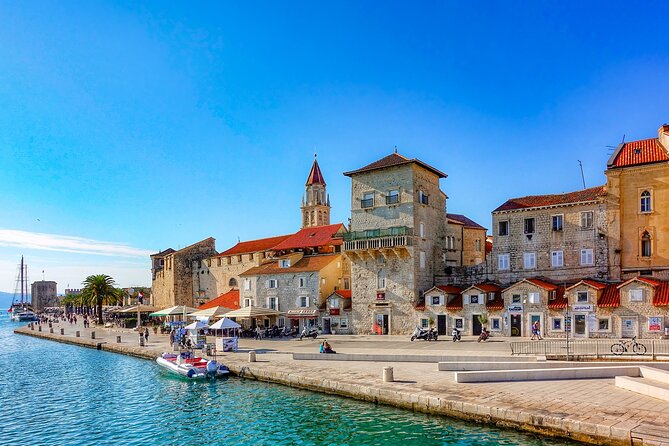
Split’s greatest surprise is that Diocletian’s Palace is not simply a ruin. It is a living part of the city, with homes, cafés, churches, shops, and busy lanes inside the walls. This tour helps you read that strange mix, then adds a visit to compact, beautiful Trogir.
I like two things here: you get two important Dalmatian towns in one outing, and round-trip transport takes the hassle out of reaching Trogir. The main caution is the pace. There is a lot of walking, summer heat can be hard, and a large combined group or a late start may leave less time in Trogir.
In This Review
- Key points at a glance
- Why Split and Trogir work well together
- Reading Diocletian’s Palace from the basements upward
- The Vestibule, Golden Gate, and palace entrances
- From Riva Harbor to Fruit’s Square
- The ride to Trogir and a change of scale
- Ayuntamiento and Trogir’s central square
- Saint Lawrence’s Cathedral and St. Sebastian
- Kula Karmelengo and free time in Trogir
- What $60.49 includes, and what it does not
- Who should book this Split and Trogir tour?
- The final call: a strong introduction with a brisk pace
- FAQ
- Where does the tour start?
- Where does the tour end?
- How long does the tour last?
- What language is the tour conducted in?
- Is transportation included?
- Are entrance tickets included?
- Is food included?
- How large can the group be?
- Can I cancel for a full refund?
Key points at a glance
- Two old towns in five to six hours: Split’s palace and old town come first, followed by Trogir.
- The palace feels like a neighborhood: You see ancient structures still woven into daily city life.
- Local guides add personality: Antonia, Ivana, Ante, Mia, and others have been praised for clear history, humor, and love of Croatia.
- Trogir includes free time: You get a guided introduction, then time to explore or stop for a drink.
- Expect serious walking: The route is mostly on foot, with uneven historic streets and no promise of a slow pace.
- Good value at $60.49: Transport and two guided town visits make the price fair, though entrance fees are extra.
Why Split and Trogir work well together
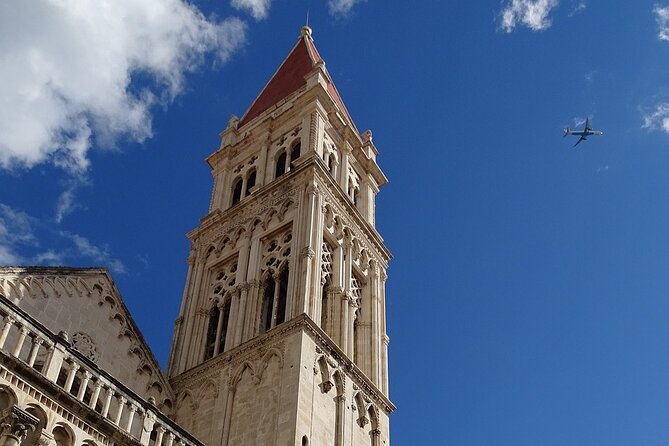
Split gives you scale and drama. Trogir gives you a smaller, quieter old-town experience. Putting the two together lets you compare how Dalmatian cities developed under Roman, medieval, and Venetian influence without spending a full day arranging buses, taxis, or ferries.
The experience lasts about five to six hours. That is enough time to see the major sights, but not enough for a long museum visit or a relaxed, unplanned afternoon in both places. I would treat this as an orientation tour: you see the essential places, understand what you are looking at, and decide where to return on your own.
The tour meets at Split’s Golden Gate, at Dioklecijanova 7, and finishes there. That central start is useful if you are staying in Split. If you arrive by cruise ship, allow time to reach the meeting point and pay close attention to the return schedule. One group had to shorten its Trogir visit because several people needed to return to their ship early.
A few more Split half-days to weigh up
- Split: Krka Waterfalls Trip with Boat Cruise and Swimming
★ 4.8 · 10,519 reviews - From Split: Krka Waterfalls, Food & Wine Tasting Tour
★ 5.0 · 9,326 reviews - Blue cave, Mamma Mia and Hvar, 5 islands speedboat tour
★ 5.0 · 7,150 reviews
Reading Diocletian’s Palace from the basements upward
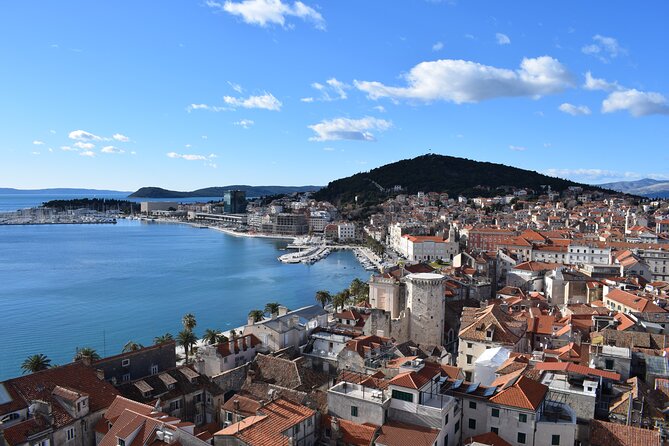
The first stop is the substructures, often called the basements. These underground rooms are also associated with Game of Thrones, which may attract fans, but the more important point is architectural: the lower level shows how the palace was built and helps you understand the layout above.
The palace was created as the retirement residence of Roman emperor Diocletian. The underground spaces supported the upper rooms, so the plan below mirrors much of what once stood above. A guide can point out how later city life filled the ancient shell.
The stop is scheduled for about 10 minutes. That is enough for an introduction, not a long examination of every chamber. Entrance to the listed stop is free, but other historical monuments on the route may charge admission.
From there, you reach the Peristyle, the palace’s ancient main square. This is the visual heart of the complex, framed by stone, columns, and the remains of imperial architecture. It is also one of the places where the palace’s past and present meet most clearly.
Your guide may explain how this space functioned as a ceremonial area and how its meaning changed over time. The best guides, including those praised for their local insight, do more than recite dates. They draw your attention to details showing how a Roman palace became a working city over roughly 1,700 years.
You have about 20 minutes here. Crowds can gather in the central palace area, especially when cruise ships are in port. If you want photographs without people in every frame, listen closely to your guide’s timing advice and be ready to take pictures quickly.
The Vestibule, Golden Gate, and palace entrances
The Vestibule was the ancient entrance to Diocletian’s private residence. Its round form and open roof make it an easy place to picture the palace as an imperial home rather than only a fortified block.
The visit here lasts about 10 minutes. It is a short stop, so expect explanation and a look around rather than extended free time. The value comes from seeing how the route through the palace was organized, from public ceremonial areas toward the emperor’s more private quarters.
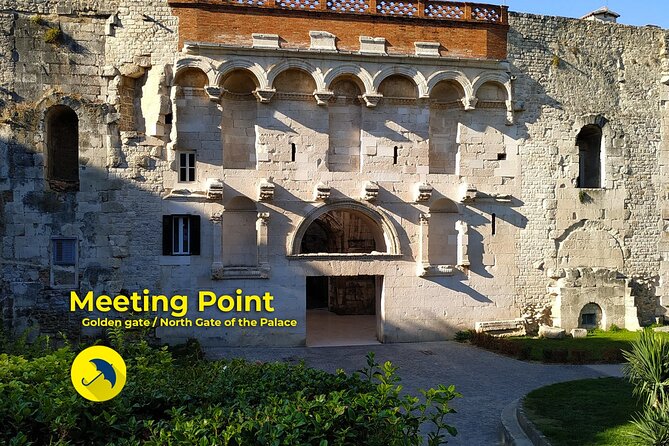
The Golden Gate is the palace’s north entrance and the meeting point for the tour. It is one of Split’s most recognizable spots, with a strong sense of arrival and a useful connection to the city beyond the palace walls.
The stop is scheduled for about 20 minutes. Your guide may use the gate to explain the palace’s defensive design and the way people entered and left the complex. Because the tour both starts and ends here, remember the location. It is an easy landmark to use if you separate from the group during free time.
The tour does not require admission for these listed outdoor stops. That keeps the basic price down, but monument tickets are not included if you choose to enter places that charge separately.
From Riva Harbor to Fruit’s Square
After the palace, the route moves toward Riva Harbor, Split’s famous waterfront promenade. You get about 10 minutes to walk along the harbor and take in the views. This is less a formal historical stop than a change of mood after the enclosed palace lanes.
Riva helps you see Split as a coastal city, not only an archaeological site. It is also a practical place to pause, take photographs, and get your bearings before moving through the older urban streets.
Fruit’s Square, officially Trg Braće Radić, receives about 20 minutes. It is one of Split’s most interesting squares, and the guide’s explanation gives the buildings and surrounding lanes more meaning than a quick photograph would.
This part of the tour is useful because it broadens the story beyond Diocletian. You see how later periods shaped the city around the Roman core. Pay attention to the transitions between grand monuments and ordinary streets. Split’s appeal lies in those contrasts.
The walking is not described as especially hilly, but you should still expect plenty of time on your feet. Historic centers can involve uneven paving, narrow lanes, and little shade. Wear shoes with a firm sole, carry water, and dress for the forecast. The tour operates in all weather conditions, so sun protection and a light rain layer are sensible choices.
Same coast, a completely different day out:
- From Split: Krka Waterfalls, Food & Wine Tasting Tour
★ 4.9 · 6,598 reviews - Split/Trogir: Blue Cave, Mamma Mia, Hvar and 5 Island Tour
★ 4.6 · 6,320 reviews - Blue Lagoon & 3 Islands Cruise with Lunch from Split
★ 4.5 · 5,756 reviews - Split: Old Town and Diocletian Palace Walking Tour
★ 4.9 · 4,727 reviews
The ride to Trogir and a change of scale
An air-conditioned vehicle takes you from Split to Trogir and back. That matters in the warmer months, when a road transfer is far easier than trying to organize local transport in the middle of a sightseeing day.
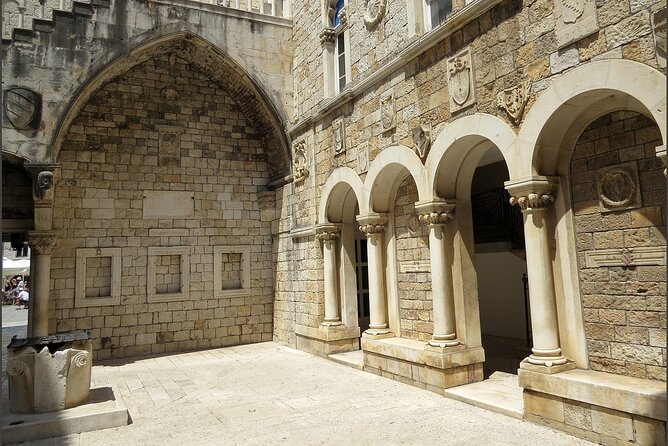
Trogir feels different from Split. Instead of a large urban center built around an imperial palace, you get a compact historic town where the main sights are close together. The visit is shorter than the Split portion, but the contrast makes it worthwhile.
The tour includes a guided walk through Trogir’s old town and free time afterward. The exact balance can depend on traffic, group timing, and the needs of people returning to cruise ships. If Trogir is your main reason for booking, confirm the expected return time before departure and do not assume you will have a long independent visit.
The group size is advertised at up to 50 people, though some departures have been divided into smaller groups, with about nine people in each guide’s section. Smaller groups make it easier to hear explanations and ask questions, but you should not book expecting a private tour. Group size can vary.
Ayuntamiento and Trogir’s central square
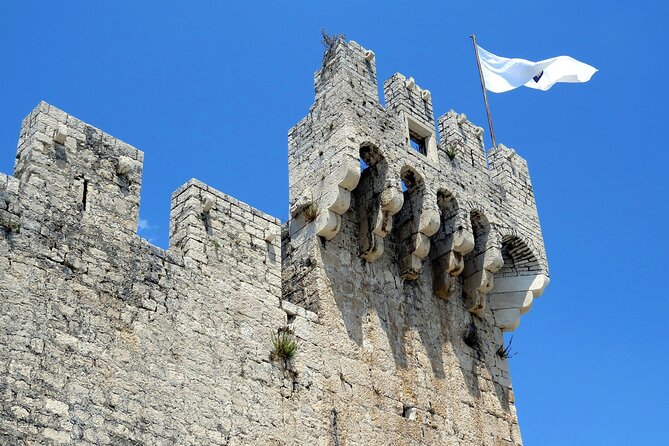
The first listed Trogir stop is Ayuntamiento, the city hall, with about 10 minutes for the visit. Its story helps explain how the town was governed and how public buildings reflected the city’s changing political powers.
The short time here is appropriate for a guided introduction. You will not be studying every architectural feature at length, but you should come away with a clearer idea of why the building matters.
Next comes Trogir’s central square, with about 20 minutes. This is the town’s main gathering space and the place where several important sights come together. A guide can turn what might look like a pleasant stone plaza into a readable historical scene.
Trogir rewards looking upward and around. Notice the relationship between the square, the religious buildings, civic architecture, and defensive structures. The town is photogenic, but its value is not only visual. It gives you a compact lesson in Dalmatian town planning and power.
The guide-led portion is especially useful here because Trogir can seem small enough to explore without help. You can certainly walk around alone, but a clear explanation of the main square saves time and gives context to details you might otherwise pass without noticing.
Saint Lawrence’s Cathedral and St. Sebastian
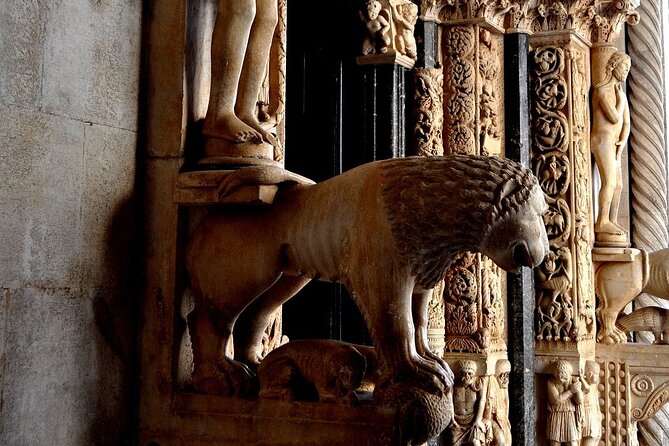
Saint Lawrence’s Cathedral is dedicated to Trogir’s patron saint and receives about 15 minutes. An entrance ticket is not included, so check with your guide about the current cost if you want to go inside.
The cathedral is one of the principal sights in Trogir, but the short schedule means this is not a long religious or architectural study. Think of it as a focused visit within a larger town walk. If you are especially interested in sacred art or medieval architecture, you may want to return during your free time, if opening hours and timing allow.
St. Sebastian, once a church and now a memorial place, gets about 10 minutes. This is a smaller stop, but it adds another layer to the town’s story. It also shows how buildings can change purpose as local needs and historical events change.
Guides such as Ivana, Antonia, Ante, Mia, and Frane have been praised for making these details understandable and engaging. Their strengths appear to vary by person. Some are especially strong storytellers, some add personal Croatian perspectives, and some bring humor and energy. Since the guide is a major part of the experience, the quality of your day can depend on who leads your departure.
Kula Karmelengo and free time in Trogir
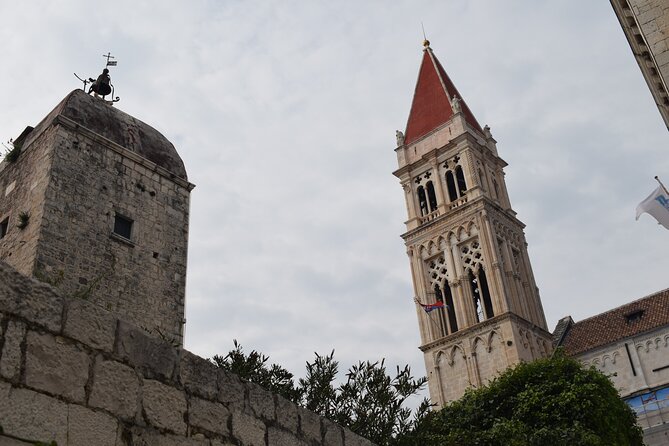
Kula Karmelengo is a Venetian fortress built for defense. The visit lasts about 10 minutes, and an entrance ticket is not included. Even from a brief stop, the fortress helps explain why Trogir’s position mattered and how the town protected itself.
The monument may be more appealing from the outside if your schedule is tight. If you want to enter, budget for the extra ticket and ask how much time remains. The tour’s stated inclusions cover guided visits and transport, not admission to historical monuments.
Free time follows the guided portion. This is one of the tour’s best features because it gives you a chance to set your own pace. You can take photographs, sit down for a drink, revisit a place that caught your eye, or simply enjoy the old-town setting without listening to a running commentary.
Do not expect hours of independent exploration. The entire Trogir segment is limited by the return to Split, and early departures or traffic can reduce the spare time. Still, even a short pause makes the visit feel less like a bus stop and more like a real town visit.
What $60.49 includes, and what it does not
At $60.49 per person, the price is fair for a five to six-hour outing that includes an English-speaking professional guide, an air-conditioned vehicle, guided visits in both towns, and free time in Trogir.
You are paying for planning as much as transport. Split and Trogir are easy to locate on a map, but fitting both into one day requires careful timing. The guide also helps you make sense of places that can otherwise seem like a jumble of old stones and attractive squares.
Food and drinks are not included. Entrance tickets to historical monuments are also extra, including the listed charges for Saint Lawrence’s Cathedral and Kula Karmelengo. Carry some spending money if you want to enter them or buy something during free time.
The value is strongest if you have only one day for sightseeing, are visiting Split from a cruise ship, or prefer a guide to handle the road transfer. If you already plan to spend several days in Split and can arrange Trogir independently, a self-guided visit may offer more freedom. This tour buys convenience and explanation, not maximum independence.
Who should book this Split and Trogir tour?
I would recommend it to first-time visitors who want a clear introduction to the area. It also suits couples, families with older children, and solo visitors who prefer company and a planned route.
You should be comfortable walking for much of the day. One participant specifically warned that the outing can be tiring for older people or anyone with mobility problems. Most people can take part, and service animals are allowed, but the tour is not designed around minimal walking.
English is the operating language. Children must be accompanied by an adult. The vehicle is air-conditioned, which is a real plus in summer, but you still need to manage heat during the walking portions.
The tour operates in all weather, and poor weather may affect the experience. Dress for the conditions. Free cancellation is available if you cancel at least 24 hours before the start time. Cancellations inside that window are not refunded, and weather cancellations offer a different date or a full refund.
The final call: a strong introduction with a brisk pace
Book this tour if you want the essential sights of Split and Trogir without spending time arranging transport. The combination is smart, the price is reasonable, and strong guides can turn the palace and old town into a clear, memorable story.
Go in knowing that this is not a leisurely day. Crowds, heat, group timing, and cruise-ship schedules can affect the pace. Ask about the return time at the start, bring water, and save some energy for Trogir.
For most first visits, I think the convenience is worth it. You get the Roman palace, Split’s waterfront and squares, Trogir’s cathedral and fortress, and a little time to wander on your own. If you value depth over coverage, choose a private or longer tour. If you want two major towns in one well-organized outing, this is a practical choice.
FAQ
Where does the tour start?
The tour starts at the Golden Gate, Dioklecijanova 7, 21000 Split, Croatia.
Where does the tour end?
The activity ends back at the Golden Gate meeting point in Split.
How long does the tour last?
It lasts approximately five to six hours.
What language is the tour conducted in?
The tour operates in English.
Is transportation included?
Yes. Round-trip transportation in an air-conditioned vehicle is included.
Are entrance tickets included?
No. Entrance tickets to historical monuments are not included. Saint Lawrence’s Cathedral and Kula Karmelengo are listed with admission fees.
Is food included?
No. Food and drinks are not included.
How large can the group be?
The tour may have a maximum of 50 travelers. Some departures may be divided into smaller groups.
Can I cancel for a full refund?
Yes, if you cancel at least 24 hours before the experience start time. Cancellations or changes made less than 24 hours before the start time are not accepted for a refund.
Just added around Split
- Kayaking & Zipline Šibenik – Čikola Canyon★ 5.0 · 3 reviews
- Krka National Park & Zipline Šibenik – Čikola Canyon★ 5.0 · 3 reviews
- Rafting River Cetina from Makarska Riviera including transfer★ 5.0 · 3 reviews
- From Split: Krka National Park & Waterfalls Private Day Trip★ 5.0 · 3 reviews
- Split: Small-Group Half Day Sailing Trip★ 5.0 · 3 reviews
- Split and Salona Cultural Heritage Day Tour from Trogir★ 4.0 · 3 reviews
- Split Bike and Wine Experience★ 5.0 · 3 reviews
- Split: Jewish Heritage & Diocletian’s Palace Walking Tour★ 5.0 · 3 reviews
Guided, compared.
Plitvice Lakes Guided Tour with Entry Tickets
Read our review →
Plitvice Lakes National Park Guided Day Tour from Split
Read our review →
Krka National Park Tour with tour Guide & Wine tasting from Split & Trogir
Read our review →
Self-Guided Plitvice Lakes Day Tour with Boat Ride
Read our review →