
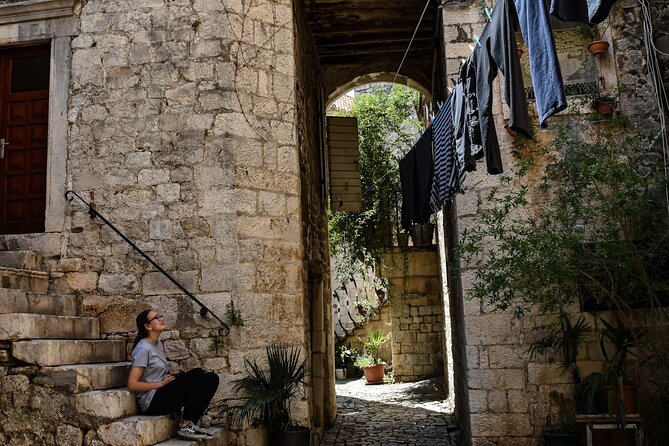
Reviewed · GUIDED
Experience Trogir with a Local Guide
Trogir’s best stories sit in its narrow lanes, old gates, and busy squares. This private walking tour brings those details together, from the North Gate and the town’s ancient beginnings to the cathedral’s famous Radovan portal. You also get a look at the unusual football field inside the UNESCO-protected historic area.
I like the private format, since your group can ask questions and move at a comfortable pace. I also like the local focus. Guide Sandra is closely connected with Trogir, knows its people, and shares practical stories about daily life, local customs, and the city’s patron saint.
The main consideration is time. At roughly 1 hour 20 minutes to 2 hours, the walk gives you a strong introduction rather than a long museum visit. The cathedral and Karmelengo Fortress are viewed from outside unless you choose to pay for entry.
In This Review
- Key Points to Know Before Booking
- Why a Local Walk Helps in Trogir
- Starting at the North Gate and Walking Through Old Trogir
- A Former Noble Palace and Trogir’s Social Life
- Karmelengo Fortress and the Summer Concert Setting
- Igralište Batarija: A Football Field Inside Protected Trogir
- The Promenade and the Everyday Rhythm of Trogir
- The South Gate, Small Lodge, and St. Nicholas
- Central Square: Courts, Palaces, and Venetian Lions
- St. Lawrence’s Cathedral and the Optional Bell Tower Climb
- What $82.80 Means for the Value
- Practical Details for a Smooth Walk
- Who Should Book This Trogir Tour?
- Should You Book Experience Trogir with a Local Guide?
- FAQ
- How long does the Trogir tour last?
- Is this a private tour?
- What language is the tour offered in?
- Where does the tour start?
- Where does the tour finish?
- Is cathedral admission included?
- Can I cancel for a full refund?
Key Points to Know Before Booking

- A private walk with Sandra: Your group has the guide to itself, with the chance to ask questions about Trogir past and present.
- Medieval gates and narrow streets: Begin at the North Gate and learn how the fortified town controlled entry and life inside the walls.
- A football field in a UNESCO-protected area: Igralište Batarija offers one of the tour’s most unexpected sights.
- Cathedral entry is optional: You can pay €6 per person to see the interior, St. John’s Chapel, the baptistery, and the bell tower.
- A useful local view of history: Sandra presents competing sides of the past, including the French removal of parts of the walls for better hygiene.
- Easy private logistics: Meet at Ul. Gradska vrata 6, stay in central Trogir, and return to the same point.
Why a Local Walk Helps in Trogir
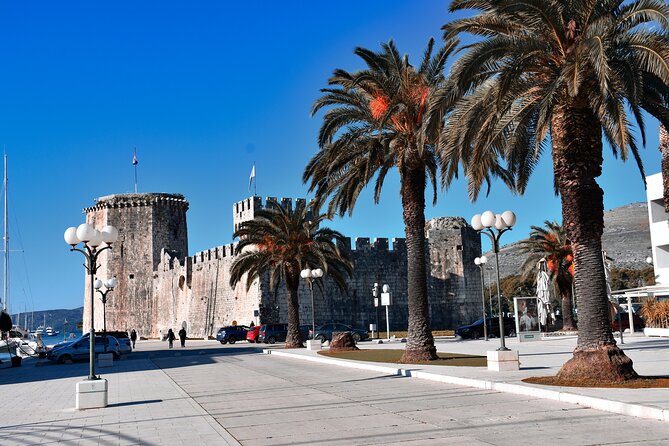
Trogir is compact, but its story is not simple. The town has roots reaching back to the 3rd century BC, later shaped by medieval rule, Venetian power, French control, religious life, and the needs of ordinary residents. A short walk can leave you with plenty of stonework and photos, but a guide helps connect those pieces.
This experience is especially useful when you want context without spending half a day indoors. Sandra’s route covers the main public spaces and landmarks, while her stories explain why gates closed at night, why bells mattered, and how the town’s buildings were used.
The personal side of the walk is a real advantage. Sandra is greeted by local children and people around town, which gives the tour a sense of place rather than making it feel like a memorized speech. Her approach also appears balanced. One example concerns the French destruction of sections of the city walls. The loss changed Trogir’s appearance, but the reason was practical: the narrow medieval streets had poor sanitation, and waste was thrown from windows.
That sort of explanation is more useful than a simple list of dates. You get a better sense of how people actually lived inside the old walls.
A few more Trogir half-days to weigh up
- Blue cave, Mama Mia and Hvar, 5 island speedboat tour from Trogir
★ 5.0 · 2,861 reviews - From Trogir: Three Islands Half-Day Speedboat Tour
★ 4.8 · 804 reviews - From Trogir or Split: Full-Day Blue Cave & Hvar Island Tour
★ 4.7 · 413 reviews
Starting at the North Gate and Walking Through Old Trogir
The meeting point is at Ul. Gradska vrata 6, by the North Gate. This was the main entrance during the medieval period, when the town was protected by walls and access was controlled. Beginning here gives the walk a clear theme: Trogir was not just a collection of attractive buildings, but a defended community with rules about movement and security.
Sandra introduces the name of the town and the first settlers before leading you into the narrow streets. The route reaches back to the 3rd century BC, so even a short lane can carry several layers of history.
I like this opening because it gets you oriented without rushing straight to the most famous building. You learn how to read the town first. Look for the way the lanes compress the space, how the stone buildings meet the streets, and how the old gates frame the center.
You also hear about Trogir today, including the importance of its patron saint. Bells receive special attention, and that is a useful detail. In an older town, bells were not simply church decoration. They helped mark time and carried meaning in daily life. The tour explains their role rather than leaving you to guess why they mattered.
The walk also pauses at the birth house of Petar Berislavić, a Croatian nobleman important to the history of both Trogir and Croatia. This stop adds a person to the story. Instead of seeing only anonymous stone facades, you connect one house with a figure who had a wider national role.
A Former Noble Palace and Trogir’s Social Life
Along the route, you learn about a museum that was once a noble palace. The building links private wealth with public life, showing how a residence connected to an elite family can later serve the wider town.
The important point is not only the architecture. The palace also has a role in Trogir’s social life today. That change in use helps you see how old buildings remain part of the town rather than becoming empty monuments.
The route does not appear to include a long museum visit, so plan your expectations accordingly. This is a guided look at the building and its place in Trogir, not a dedicated museum tour.
Karmelengo Fortress and the Summer Concert Setting
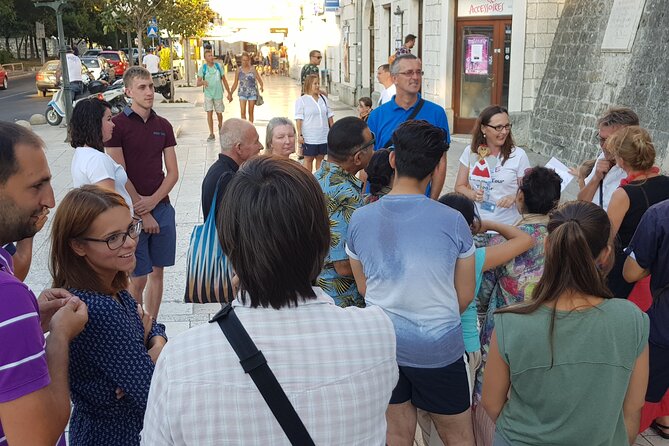
Karmelengo Fortress sits at the edge of the historic center and gives the tour a change of scale after the tight lanes. Sandra explains that it was intended as shelter for the town’s rector during Ottoman invasions. Its defensive purpose becomes easier to understand when you consider the uncertainty that shaped coastal towns in earlier centuries.
The fortress was once called the Fort of Chains, and the guide explains the reason behind that name. This is the kind of small detail that makes a brief stop worthwhile.
You visit Karmelengo from outside. Entry is not included, and the tour does not promise an interior visit. Today, the fortress also hosts summer concerts, so its role has shifted from defense to public entertainment. Music in a fortified setting is a fitting example of how Trogir’s old structures still serve the town.
The stop lasts about 10 minutes. That is enough for an explanation and exterior views, but not enough for an extended exploration. If entering the fortress matters to you, check the separate admission arrangements before booking.
Same coast, a completely different day out:
- Half Day Speedboat Tour to Three Islands from Trogir
★ 5.0 · 401 reviews - Blue Lagoon & Šolta Island from Trogir LUNCH & DRINKS INCLUDED
★ 4.5 · 374 reviews - Trogir, Žedno: Čiovo Island 100% Off-Road Quad ATV Tour
★ 4.9 · 331 reviews - Trogir: Blue Lagoon and 3 Islands Speedboat Tour
★ 4.8 · 263 reviews
Igralište Batarija: A Football Field Inside Protected Trogir
One of the most unusual stops is Igralište Batarija, a football field in the protected historic area. There are not many football fields in the world in a UNESCO-protected setting, which makes this a memorable contrast with the usual old-town sights.
The stop is brief, around 10 minutes, but it shows that Trogir is not preserved as a frozen display. People still use the historic area for ordinary activities. A football field brings modern local life right up against the old fortifications.
From here, you can also see a gloriette connected with French rule and the Tower of St. Mark. Those views add another layer to the story of Trogir’s defenses and political changes.
I like this stop because it breaks up the expected sequence of gates, churches, and palaces. If you want only traditional monuments, it may seem less important. If you want a sense of how the old town functions now, it is one of the most revealing parts of the walk.
The Promenade and the Everyday Rhythm of Trogir
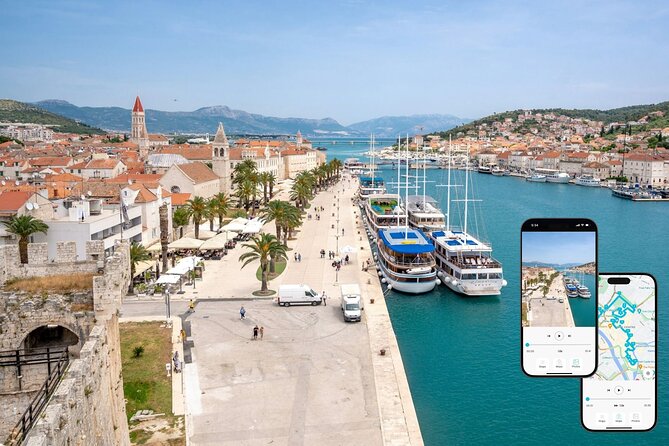
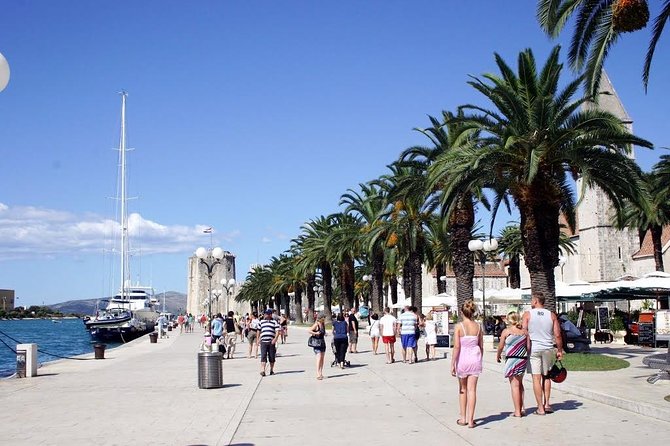
Trogir’s promenade is the place to watch the town at leisure. Locals and tourists come here for coffee, conversation, and time by the water. The tour allows about 10 minutes, enough to explain why this strip is central to daily life.
This is not presented as a long café break, so do not expect time for a full drink stop unless the pace allows it. Instead, you get a short look at the social heart of the town.
The promenade also gives your feet a break after the old lanes. The contrast matters. Inside the center, the streets feel enclosed and medieval. Along the waterfront, the town opens outward and feels more relaxed.
The South Gate, Small Lodge, and St. Nicholas
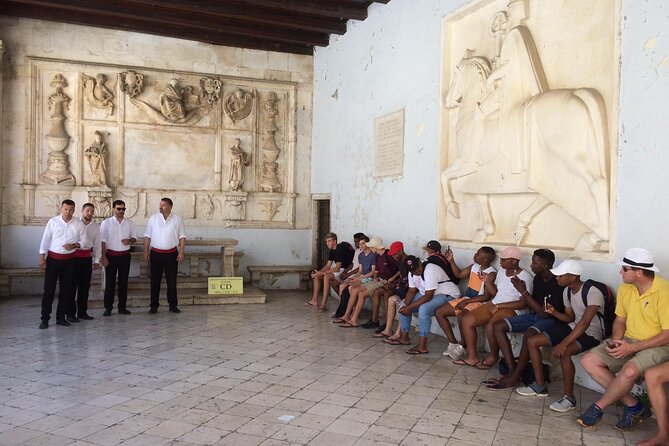
The South Gate still has its original doors, which would be closed in the evening. That detail gives the old town a practical edge. At night, the gate separated the protected center from the outside world.
Next to it is the Small Lodge, where people could find shelter during the night. This stop is about more than taking a picture, though the gate makes a fine frame. The colors and light change during the day, so the same view can look different depending on when you arrive.
Behind the gate, you learn about the church and Benedictine Monastery of St. Nicholas. The monastery also connects to the story of Trogir as the town of the happy moment. That phrase hints at a local tale, and Sandra uses the setting to explain it.
This is another short stop, around 10 minutes. You will not have time for a slow photographic session unless your guide’s schedule permits it, but you will know where to return later.
Central Square: Courts, Palaces, and Venetian Lions
The central square brings many of Trogir’s major buildings together. Here you see the court, the Rector’s Palace, noble palaces, and the cathedral. The square is the clearest place to understand how government, religion, wealth, and public life were concentrated in a small area.
Sandra discusses the Venetian lions, trials, and the theatre that once occupied the heart of Trogir. These subjects widen the story beyond architecture. The square was a place for legal decisions, political power, public performance, and displays of status.
The history of the wealthy families is also part of the stop. Their palaces show how important families marked their position, while the court and Rector’s Palace reveal how the town was governed.
Allow about 20 minutes here. That is a useful amount of time for explanation, though the number of buildings and stories means you may want to return on your own if you prefer close architectural study.
St. Lawrence’s Cathedral and the Optional Bell Tower Climb
St. Lawrence’s Cathedral is the tour’s main architectural stop. It was the most important building in Trogir’s past and remains the town’s leading sight today.
The exterior includes Radovan’s Portal, a celebrated work that deserves time to inspect. The guide also points out a drawing on the cathedral wall that continues to surprise people. Details like this reward a slower look at the facade, so do not treat the 20-minute stop as a quick photo opportunity.
The cathedral’s bell tower is another major feature. The walk ends with the guide outside, but you can choose to enter. Admission costs €6 per person and is paid separately.
With entry, you can see:
- St. John’s Chapel
- The baptistery
- The cathedral interior
- The bell tower and its view over Trogir
The optional entry is a sensible arrangement. You can keep the walk within its shorter time frame, or add more time if religious art, stone carving, and high views matter to you. Since the cathedral visit and bell tower climb are not included, bring that extra cost into your planning.
What $82.80 Means for the Value
The price is $82.80 per person. That is not a bargain for a short standard group walk, but this is a private activity, and that changes the calculation.
If you are traveling with several people, group discounts may improve the value. You are paying for a licensed guide, a route through the main historic areas, and the ability to ask questions without sharing the guide with a large crowd.
The duration also matters. At about 80 minutes to two hours, this works best as an orientation walk at the beginning of your time in Trogir. You learn what you are looking at, identify places you want to revisit, and get local suggestions during the walk.
The price makes less sense if you want a long indoor visit or a full architectural lecture. Cathedral admission is extra, and Karmelengo Fortress is seen from outside. You should book this for the local explanation and private attention, not for a large number of included admissions.
Practical Details for a Smooth Walk
The tour is offered in English and operates Monday through Saturday from 9:00 AM to 7:00 PM during the stated operating period of July 14, 2024 through November 26, 2026.
You meet at Ul. Gradska vrata 6 and return to the same point at the end. The route stays in central Trogir, is near public transportation, and is suitable for most participants. Pushchairs are allowed, and service animals are allowed.
The old center includes narrow streets and historic surfaces, so comfortable shoes are sensible. The schedule is flexible within the stated duration, but the cathedral and fortress choices can affect how much time you have for each stop.
Free cancellation is available if you cancel at least 24 hours before the start time. Cancellations made less than 24 hours ahead are not refundable, and late changes are not accepted.
Who Should Book This Trogir Tour?
I would choose this walk if you want a private introduction to Trogir with a strong local voice. It suits first-time visitors, families who want to ask questions, and anyone who prefers stories about people and daily life along with the major sights.
It is also a good choice if you are short on time. The route covers the North Gate, South Gate, central square, promenade, Karmelengo Fortress, Igralište Batarija, and St. Lawrence’s Cathedral without requiring a full day.
You may want something longer if your main goal is interior architecture, museum collections, or a detailed cathedral visit. In that case, use the tour as an orientation and plan separate time for the cathedral, bell tower, and any museum you want to see.
Should You Book Experience Trogir with a Local Guide?
Book it if you value local connection over a checklist of admissions. Sandra brings Trogir to life through personal links, practical history, and balanced explanations of difficult changes, such as the removal of parts of the city walls for sanitation.
The tour’s strongest points are its private format, compact route, and mix of famous sights with less expected details. The football field inside the protected area, the original South Gate doors, the Fort of Chains story, and the bells of Trogir give you more to remember than a basic walk past monuments.
Skip it if you need a low-cost group tour or want every attraction included in the price. For a private English introduction that helps you understand how Trogir works, $82.80 can be reasonable, especially when shared across a group and used as the starting point for further exploring.
FAQ
How long does the Trogir tour last?
The experience lasts approximately 1 hour 20 minutes to 2 hours.
Is this a private tour?
Yes. Only your group participates in the activity.
What language is the tour offered in?
The tour is offered in English.
Where does the tour start?
The meeting point is Ul. Gradska vrata 6, 21220 Trogir, Croatia.
Where does the tour finish?
The activity ends back at the meeting point.
Is cathedral admission included?
No. Entry to St. Lawrence’s Cathedral is optional and costs €6 per person. The fee is paid by the client.
Can I cancel for a full refund?
Yes, if you cancel at least 24 hours before the experience start time. Cancellations made less than 24 hours in advance are not refunded.
Just added around Trogir
- Split and Salona Cultural Heritage Day Tour from Trogir★ 4.0 · 3 reviews
- Split and Trogir private tour *ideal for cruise ship guests*★ 5.0 · 3 reviews
- Trogir; Private walking tour of higlights of Trogir★ 4.7 · 3 reviews
- Trogir to Krka Waterfalls – Full Day Private Tour Including Free Detour★ 5.0 · 3 reviews
- From Trogir Day sailing (private tour)★ 5.0 · 4 reviews
- Private Transfer from Split Croatia Airport to Hotel★ 5.0 · 4 reviews
- Split (airport) – Hvar (town) sea transfer★ 5.0 · 4 reviews
- Private speedboat tour to Blue Cave and visit Island Hvar★ 4.0 · 4 reviews
Guided, compared.
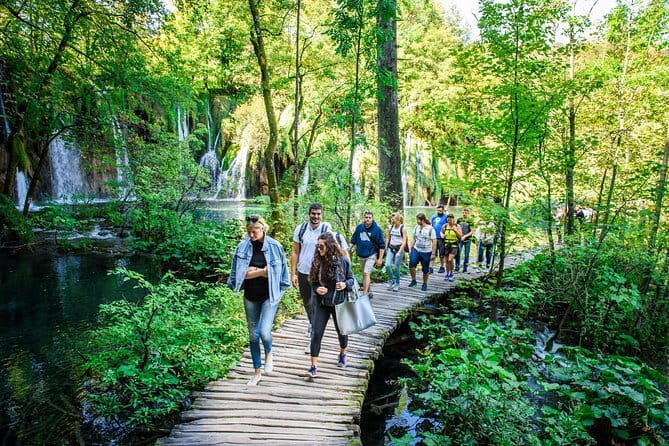
Plitvice Lakes Guided Tour with Entry Tickets
Read our review →
Plitvice Lakes National Park Guided Day Tour from Split
Read our review →
Krka National Park Tour with tour Guide & Wine tasting from Split & Trogir
Read our review →
Self-Guided Plitvice Lakes Day Tour with Boat Ride
Read our review →
Diocletian Palace & Old Town Guided Walking Tour
Read our review →Browse the lists this tour appears in