Reviewed · PRIVATE
Experience Split With Local Professional Historian – Private
Split’s old town is not simply built around Diocletian’s Palace. It is built inside it. This private walk with local historian Boris connects the Roman emperor’s palace, Christian monuments, medieval squares, and modern city life in one compact route.
I like the private format, which lets the guide adjust his pace and explanations to your group. I also like the use of 3D reconstruction images, a useful aid when you are trying to picture missing walls, imperial rooms, and the Palace as it once looked. The main consideration is time: two hours gives you a strong orientation, but not a full visit inside every monument.
In This Review
- Key points
- Starting at Split’s Golden Gate
- Gregory of Nin and a useful local custom
- Diocletian’s Palace as a living city
- The Peristyle, where the Palace made its power visible
- Jupiter’s Temple and Roman religious life
- Saint Domnius Cathedral, from mausoleum to church
- The Vestibule and the emperor’s private side
- From Roman residence to Riva Harbor
- Fruit Square and the marks of medieval Split
- Ending at Pjaca, Split’s people’s square
- What the $156.21 group price gets you
- Timing, walking, and practical details
- Who should choose this Split walk
- Should you book this private history tour?
- FAQ
- How long is the private Split history tour?
- Where does the tour begin?
- Where does the tour end?
- How many people can join the private tour?
- Is the tour offered in English?
- Are admission tickets included?
- Can the start time be changed?
Key points
- A private tour for up to 15 people, priced at $156.21 per group rather than per person.
- Historian Boris leads the walk, with a master’s degree in history and a flexible approach to different interests.
- The route links Roman, Christian, medieval, and modern Split without leaving the historic center.
- Most sights are viewed from outside, so admission fees are not included.
- 3D images and pictures help explain the Palace’s original appearance and later changes.
- The route ends at Pjaca, a central square where you can continue exploring on your own.
Starting at Split’s Golden Gate
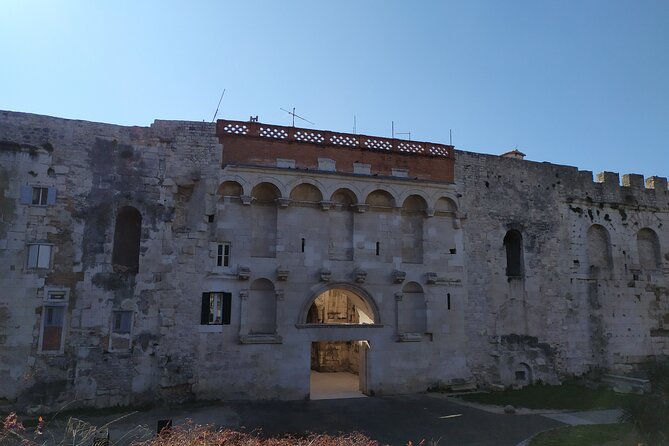
Meet at the Golden Gate, the northern entrance to Diocletian’s Palace on Dioklecijanova 7. The name is grander than the material. This gate is made of stone, not gold, but it is still one of the best places to begin understanding Split.
The gate once controlled access to the imperial complex. Today, it is a busy meeting point at the edge of the old town, opposite the famous statue of Gregory of Nin. Boris uses this first stop to explain the broad story of Split and why the northern entrance mattered.
I like beginning here because you get your bearings before entering the maze of lanes. The Palace can feel confusing when you first arrive. Its ancient walls, later homes, shops, churches, and cafés are mixed together, so a guide’s opening explanation gives the rest of the walk a clear frame.
Allow about 15 minutes at the gate. Admission is free, and the stop is outdoors. If you are meeting Boris here, look for the Golden Gate itself rather than a separate office or ticket booth.
A few more Split half-days to weigh up
- Split: Krka Waterfalls Trip with Boat Cruise and Swimming
★ 4.8 · 10,519 reviews - From Split: Krka Waterfalls, Food & Wine Tasting Tour
★ 5.0 · 9,326 reviews - Blue cave, Mamma Mia and Hvar, 5 islands speedboat tour
★ 5.0 · 7,150 reviews
Gregory of Nin and a useful local custom
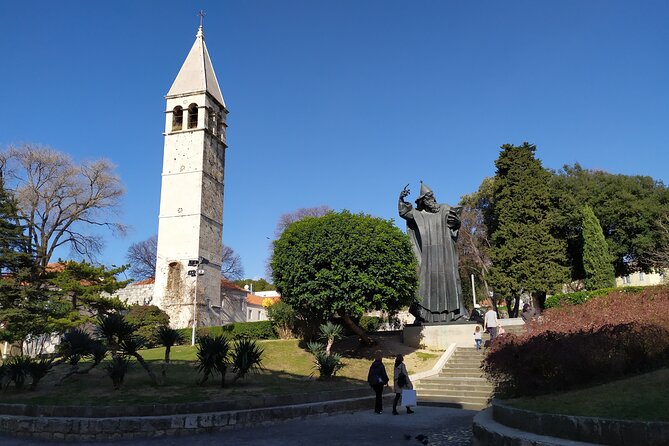
The statue of Grgur Ninski, or Gregory of Nin, is only a few steps from the Golden Gate. The figure is large, imposing, and easy to spot. Boris explains who Gregory was, why he matters in Croatian history, and how the monument came to be here.
The statue was created by sculptor Ivan Meštrović, one of Croatia’s best-known artists. The monument is also tied to a local habit: people rub the statue’s toe for good luck. The tour focuses on the story and meaning of the figure rather than treating it as a quick photo stop.
This 10-minute visit adds a later Croatian layer to the Roman setting. You are no longer looking only at emperors and ancient stone. You are also learning how Split remembers important figures from its own past.
Diocletian’s Palace as a living city
The Palace is the center of the tour and the reason this walk works so well as an introduction to Split. Built for Emperor Diocletian, it is among the best-preserved Roman imperial residences of its type. Yet it does not feel like a sealed archaeological site.
People still live, work, eat, shop, and walk through the old complex. The Roman plan survives, but the buildings have changed uses many times. Boris explains Diocletian’s role, the purpose of the imperial residence, and how the Palace became a medieval city after the Roman period.
That change is one of the most useful ideas to grasp. You are not just seeing ancient ruins. You are seeing a place that continued to function, with later generations adapting old rooms and structures instead of abandoning them.
The route covers the major central parts of the Palace, including the Peristyle, Jupiter’s Temple, the central cellars, the Triclinium, and the outside of the former mausoleum, now the Cathedral of Saint Domnius. The Palace portion takes about 20 minutes before the tour continues into more detailed stops.
Boris also uses a display book with pictures and 3D reconstructions. This matters because many Roman structures are easier to understand when you can compare the stones in front of you with an image of the original building.
The Peristyle, where the Palace made its power visible
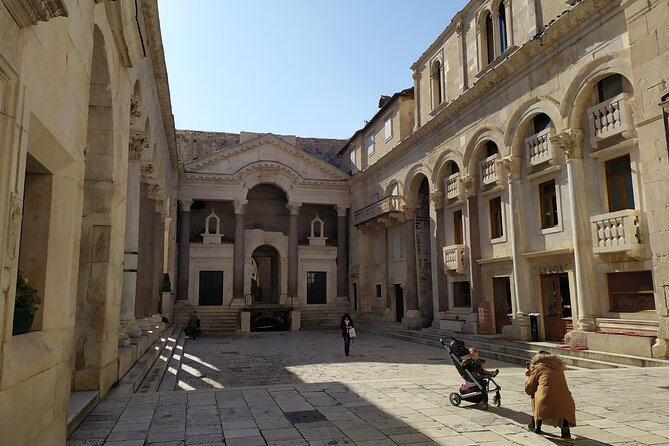
The Peristyle is the Palace’s great central court. It was not just an open square. It helped organize movement through the imperial residence and made the emperor’s position clear to anyone approaching his private rooms.
From the Peristyle, you can look around and see how different periods have altered the space. Roman columns and architectural forms share the setting with Christian buildings and later additions. Boris explains how the court connected parts of the Palace, while also separating the emperor from everyone else.
This is one of the best places to pause and listen. The space is visually strong, but its purpose is not obvious at first glance. A good explanation helps you read the court as a stage for ceremony, authority, and controlled access.
The tour then moves into the central section of the Palace cellars. These underground rooms are important for two reasons. They reveal the layout of the imperial apartments above, and they show how the lower structures have been used across the centuries.
The cellars also help you understand the scale of the Palace. Looking at walls from street level can make the complex feel scattered. Below ground, the plan becomes easier to follow. Boris explains their historical use and their importance to Split today.
At the Triclinium, you hear about Roman dining habits and the organization of the emperor’s dining room. This gives the tour a more personal angle. Instead of hearing only about politics and architecture, you get a sense of how elite Roman life was arranged around meals, ceremony, and status.
Same coast, a completely different day out:
- From Split: Krka Waterfalls, Food & Wine Tasting Tour
★ 4.9 · 6,598 reviews - Split/Trogir: Blue Cave, Mamma Mia, Hvar and 5 Island Tour
★ 4.6 · 6,320 reviews - Blue Lagoon & 3 Islands Cruise with Lunch from Split
★ 4.5 · 5,756 reviews - Split: Old Town and Diocletian Palace Walking Tour
★ 4.9 · 4,727 reviews
Jupiter’s Temple and Roman religious life
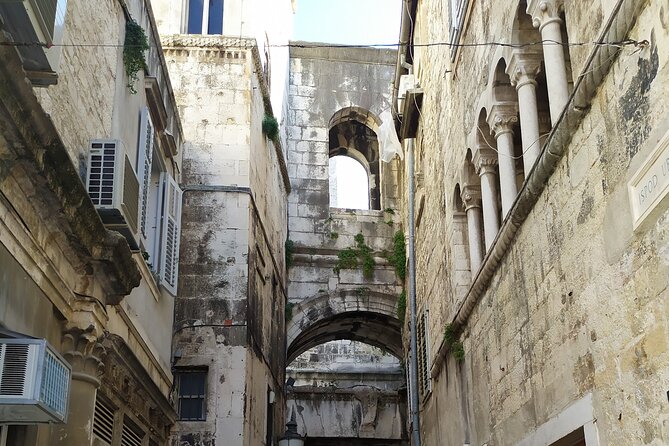
The Temple of Jupiter is visited from outside and takes about 10 minutes. That limitation is worth knowing before you book. You will hear about Roman religion and the role temples played in imperial residences, but no admission to an interior visit is included.
Even from the outside, the temple helps explain the religious order of Diocletian’s Palace. Roman emperors used architecture, statues, and temples to express their connection to the gods and their own authority. Boris places this particular building within that larger system.
This is a short stop, but it links neatly with the Peristyle and the imperial apartments. The Palace was not simply a private home. It was a carefully arranged residence where politics, religion, ceremony, and daily life worked together.
Saint Domnius Cathedral, from mausoleum to church
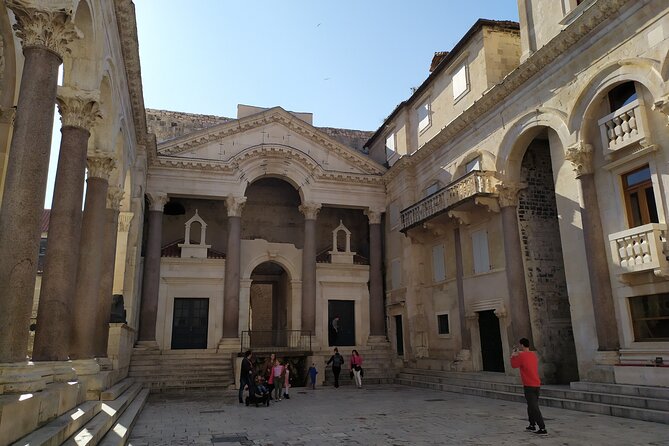
The Cathedral of Saint Domnius occupies Diocletian’s former mausoleum. The tour visits it from outside, where Boris points out important features and explains the building’s story.
This is one of Split’s clearest examples of religious change. A structure built for a Roman emperor later became a Christian cathedral. That shift reflects the larger change from the world of Diocletian to the medieval city that grew inside and around the Palace.
Boris also points out features to notice if you choose to enter the cathedral after the walk. That advice is useful because the tour does not include an admission ticket or an interior visit. You can decide afterward if you want more time with the building.
The Vestibule and the emperor’s private side
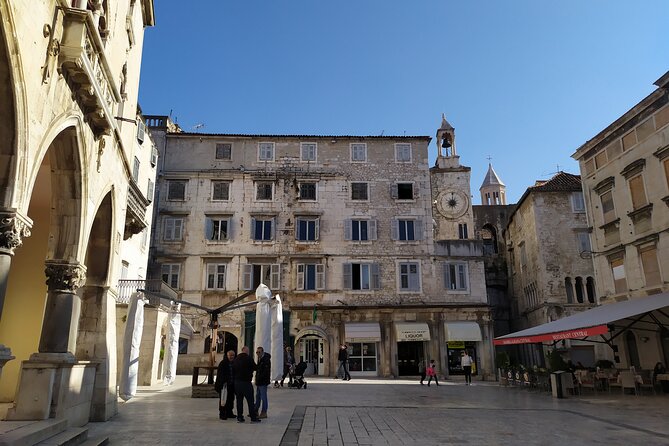
The Vestibule was the entrance to Diocletian’s private chambers. It was a formal pre-entrance, designed to prepare visitors for the importance of the rooms beyond it.
Boris explains what the Vestibule looked like and how it functioned. This short, 10-minute stop adds a sense of sequence to the Palace. The public route through the Peristyle and the more restricted approach to the emperor’s rooms were not accidental. Architecture helped control who went where.
For me, this is the kind of detail that makes a walking tour more useful than a quick circuit of famous photo spots. You begin to notice how the Palace directed people through space.
From Roman residence to Riva Harbor
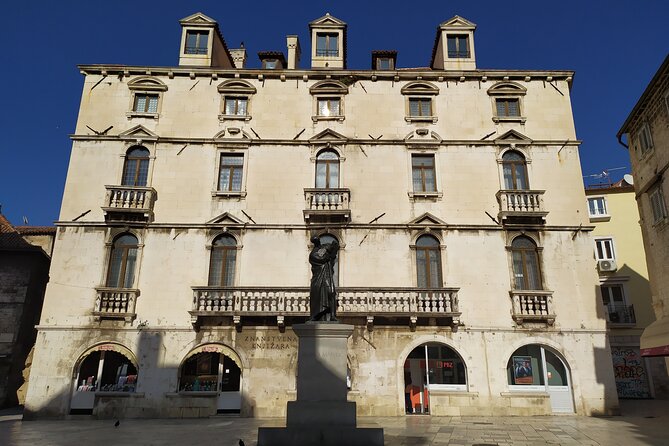
The walk leaves the Palace’s central monuments and reaches Riva, Split’s main waterfront promenade. This section lasts about five minutes, so it is brief, but it helps connect the old town with the city you see today.
Boris explains how Riva developed over the centuries and why it became important to local life. The promenade is not just a waterfront for visitors. It is a central part of Split’s public space and a place where the city meets the harbor.
This stop gives the tour a change of pace after the dense stone lanes around the Palace. It also reminds you that Split’s story is not confined to the Roman walls. The waterfront helped shape the city’s later growth and daily routines.
Fruit Square and the marks of medieval Split
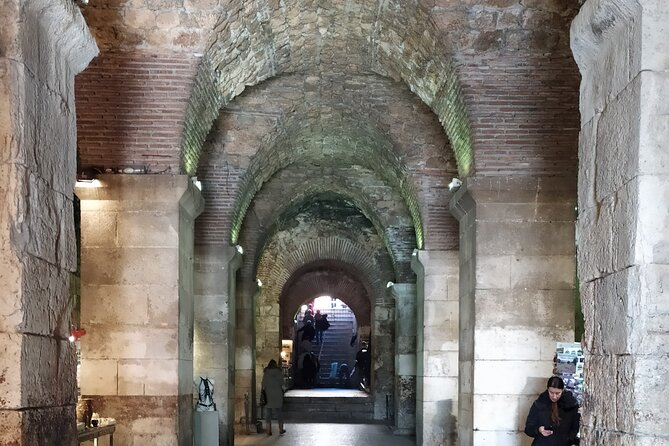
Fruit Square, officially Trg Braće Radić, is a small, attractive square with a name tied to its former market use. Boris explains why it became known as Fruit Square and points out the important monument in its center, along with the surrounding buildings.
The square is a good example of how Split’s public spaces evolved. Roman structures form the foundation of the old town, but medieval and later urban life created new centers around them. A short stop here helps you see how the city expanded beyond the original imperial plan.
You spend about 10 minutes in the square. It is not a major archaeological site, so its value comes from the story Boris adds and the way it fits into the city’s broader development.
Ending at Pjaca, Split’s people’s square
The final stop is Pjaca, officially Narodni trg, or People’s Square. This has been a center of city activity since medieval times and remains one of Split’s key gathering places.
Boris explains the square’s history and points out surrounding buildings, including the old City Hall. The tour ends at Narodni trg 16, a useful location for continuing your afternoon or evening in the old town.
I like ending here because it leaves you in an active part of Split rather than back at the starting point. From Pjaca, you can follow Boris’s suggestions for further sightseeing. The route also gives you a practical orientation for returning to the Palace, finding the Riva, or choosing a place to eat.
What the $156.21 group price gets you
The price is $156.21 for a group of up to 15 people. That is a strong value for a full group, especially if you are traveling with family or friends. Split’s historic core is compact, but a private historian can save you time by explaining what you are looking at instead of leaving you to sort out the Roman, medieval, and modern layers on your own.
For one or two people, the cost is less of a bargain than a shared group tour. Still, the private arrangement brings useful benefits. You do not have to follow an unfamiliar group’s pace, and the guide can respond to your questions and interests.
Boris has adjusted the walk for real travel problems, including a delayed flight and a fixed dinner reservation. He has also slowed the route and made room for sitting when someone had difficulty walking after a fall. That does not make the tour fully accessible in every possible sense, but it suggests a considerate and adaptable guide.
Admission tickets are not included. Since the main route views several important places from outside, the listed price covers the guiding experience rather than entry to every monument. Ask Boris about current access and ticket choices if you want to enter the cathedral or other paid areas afterward.
Timing, walking, and practical details
The advertised duration is about two hours. The listed operating period gives weekday times from 5:00 PM to 7:00 PM, but the start time is flexible if you contact the provider before the tour. Do this before booking if your arrival, meal reservation, or cruise schedule is tight.
The meeting point is the Golden Gate, and the finish is Pjaca. You should plan for an urban walking route through old stone streets and open squares. Most travelers can participate, and service animals are allowed. Public transportation is nearby, though the actual tour itself takes place on foot.
Bring water and wear comfortable shoes. The route is not long by sightseeing standards, but hard surfaces and uneven historic streets can make two hours feel more demanding than the distance suggests. If someone in your group needs regular rests, tell Boris ahead of time. His flexible approach is one of the stronger reasons to choose this private format.
The tour requires good weather. You can cancel for a full refund up to 24 hours before the start time. If poor weather forces cancellation, you are offered another date or a full refund. Changes made within 24 hours are not accepted, so keep the local cutoff time in mind.
Who should choose this Split walk
I would choose this tour if you want a clear introduction to Split before exploring independently. It suits people who enjoy history but do not want a lecture disconnected from the streets around them. The route also works for mixed groups, since Boris can explain archaeological subjects in an approachable way and adjust the focus to the people in front of him.
It is a good fit for:
- Families or friends who want a private guide at a group price.
- First-time visitors who need help reading the Palace.
- History fans who want Roman and medieval context.
- People with a tight schedule and a need for flexible timing.
- Anyone who wants suggestions for what to see after the walk.
You may prefer another option if your main goal is extended interior access to the cathedral, cellars, or other paid sites. This experience is primarily an outdoor orientation and interpretation walk. It shows you the key places and tells you what they mean, but you will need extra time and admission fees for a fuller visit inside selected monuments.
Should you book this private history tour?
Book it if you want Split to make sense quickly, especially if you are traveling with a group of several people. The strongest features are the private setting, Boris’s ability to adapt the pace, and the visual material that helps explain how the Palace looked in Roman times.
For a couple, the price requires more thought. For a larger group, it becomes much better value. Contact the provider about your preferred start time, mention any mobility needs, and decide in advance if you want to visit the cathedral or other interiors after the walk.
If you want a focused introduction to the Roman Palace and the later city built around it, this is a sensible choice. If you want a long archaeological tour with every admission included, choose something with a longer duration and interior access.
FAQ
How long is the private Split history tour?
The tour lasts approximately two hours.
Where does the tour begin?
It begins at the Golden Gate of Diocletian’s Palace, at Dioklecijanova 7 in Split.
Where does the tour end?
The tour generally ends at People’s Square, also called Pjaca Square, at Narodni trg 16.
How many people can join the private tour?
The price covers one private group of up to 15 people.
Is the tour offered in English?
Yes. The experience is offered in English.
Are admission tickets included?
No. Admission tickets are not included. The listed route includes outside visits to several monuments, and you can choose to visit some interiors independently afterward.
Can the start time be changed?
The tour has a flexible starting time, but you should contact the provider before the tour to arrange it. The listed operating hours are Monday through Friday from 5:00 PM to 7:00 PM for the stated booking period.
Just added around Split
- Kayaking & Zipline Šibenik – Čikola Canyon★ 5.0 · 3 reviews
- Krka National Park & Zipline Šibenik – Čikola Canyon★ 5.0 · 3 reviews
- Split: Small-Group Half Day Sailing Trip★ 5.0 · 3 reviews
- Rafting River Cetina from Makarska Riviera including transfer★ 5.0 · 3 reviews
- From Split: Krka National Park & Waterfalls Private Day Trip★ 5.0 · 3 reviews
- Split and Salona Cultural Heritage Day Tour from Trogir★ 4.0 · 3 reviews
- Split Bike and Wine Experience★ 5.0 · 3 reviews
- Krka Waterfalls, Lake Cruise & Skradin★ 5.0 · 3 reviews
Private, compared.

Private Krka Waterfalls tour with 30min Boat Cruse
Read our review →
Split by Private Electric Rickshaw – Palace & Hidden Gems
Read our review →
Private Blue cave, Mamma Mia and Hvar, 5 islands tour from Split
Read our review →


Private Boat Tour by local expert – Create Your Itinerary
Read our review →