

Reviewed · GUIDED
Controversies behind Split and Croatia-Anthropologist guide
Split’s old center is not just a pretty collection of Roman stones. It is a place where ancient power, Venetian rule, Ottoman wars, socialism, nationalism, and modern tourism still rub against one another. This anthropological walking tour uses those tensions to explain how Split became the city you see today.
I like the focus on people and public memory, not just dates carved into walls. I also like the small group limit of 12, along with Marin’s use of maps and visuals on an iPad. The main drawback is that you spend much of the two hours standing outdoors, so hot weather, hard pavement, and limited shade can test your legs.
In This Review
- Key points to know before booking
- Why this Split tour takes a different road
- Starting at King Tomislav Street
- Riva: where Split’s public life comes into view
- Venetian Split and the memory of Ottoman conflict
- Narodni trg and the layers under your feet
- Šperun and the story behind a popular neighborhood
- Franjo Tuđman Square and Croatia’s hardest lesson
- Ending at Matejuška with a view of modern Split
- What makes Marin’s guiding style work
- Is $35 a fair price for two hours?
- Who should book this walk?
- Should you book the Controversies behind Split and Croatia tour?
- FAQ
- Where does the tour begin?
- Where does the tour end?
- How long does the experience last?
- What language is the tour offered in?
- How many people can join the tour?
- What locations are included?
- Can I cancel for a full refund?
Key points to know before booking
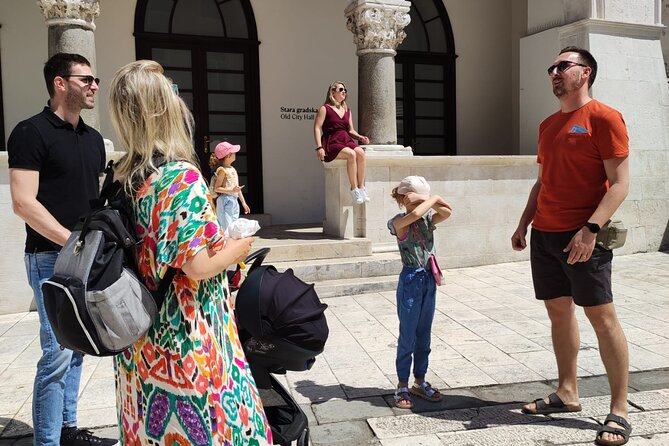
- Diocletian’s Palace is treated as a disputed living place, not simply an ancient monument.
- Marin leads in English and uses maps, visuals, humor, and discussion to explain complex subjects.
- The route connects seven central Split locations, from the palace to the fishing quarter of Matejuška.
- Modern Croatia receives serious attention, including difficult issues from the late 20th century.
- The group is limited to 12 people, which gives you a better chance to ask questions.
- The $35 price buys about two hours of focused interpretation, with no large attraction entry fee added along the route.
Why this Split tour takes a different road
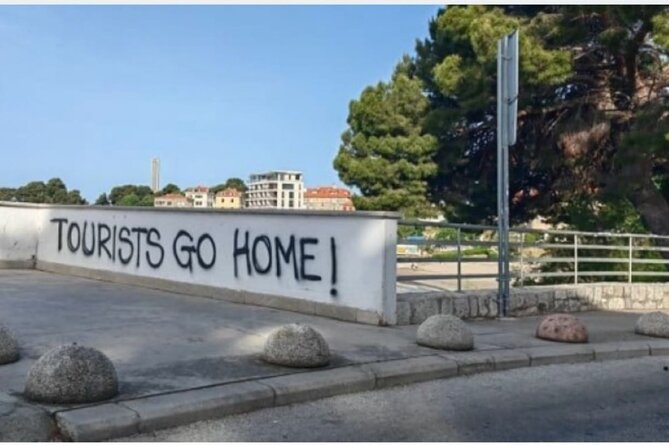
Most walks through Split concentrate on Roman architecture. You hear about Emperor Diocletian, look at the palace walls, admire the Peristyle, and move on. This tour takes another route. It asks who controlled these spaces, how local people viewed them in different eras, and why old arguments still matter in Croatia.
That makes the tour a good match for you if you want more than a checklist of buildings. You will still see important central places, but the guide’s main subject is the society around them. The palace becomes a way to talk about power, memory, identity, and change.
Marin’s approach appears to be part classroom lesson, part conversation. He has been praised for clear explanations, warmth, humor, and careful preparation. An iPad with maps and visual material helps when a story involves changing borders or a city that no longer looks the way it once did.
The tone is serious without being grim. Expect difficult subjects, including contested national memory and political divisions, but also small jokes and local details. If you prefer a light stroll with only basic facts, this may feel more demanding than you want. If you like asking why a place matters, it offers far more than a standard sightseeing loop.
A few more Split half-days to weigh up
- Split: Krka Waterfalls Trip with Boat Cruise and Swimming
★ 4.8 · 10,519 reviews - From Split: Krka Waterfalls, Food & Wine Tasting Tour
★ 5.0 · 9,326 reviews - Blue cave, Mamma Mia and Hvar, 5 islands speedboat tour
★ 5.0 · 7,150 reviews
Starting at King Tomislav Street
The tour begins at Ul. kralja Tomislava 12, close to Split’s central old town. You should arrive ready for a walking experience rather than an indoor museum visit. The entire route uses public streets and squares, and the pace includes repeated stops while Marin explains the setting around you.
The opening section centers on Diocletian’s Palace and lasts about 35 minutes. This is the longest stop, which makes sense: the palace is not just the first sight on the route, but the main case study for the whole tour.
You will look at the palace as a site repeatedly argued over by local people in different historical periods. The supplied details do not promise a fixed lecture on every room or monument, so do not book this expecting a conventional architectural tour. Instead, expect the palace to frame questions about ownership, use, preservation, and local life.
That distinction matters. Split’s old center is still woven into the city, rather than being only a fenced archaeological park. A guide who discusses the palace as a place with social and political meaning can help you notice why ordinary streets and ancient structures share the same space.
The palace portion includes admission, according to the tour details. You should still expect to walk outside for most of the stop, and you may spend time standing while listening. Shade is not guaranteed, though Marin has made an effort to seek it when possible.
Riva: where Split’s public life comes into view
From the palace, the route reaches Obala Hrvatskog narodnog preporoda, better known as the Riva. This traditional Mediterranean promenade is more than a waterfront photo stop. It is a public stage where daily life, political events, and major moments in the city’s story have played out.
The stop lasts about 15 minutes. That is enough time to connect the broad promenade with the way Split presents itself to residents and visitors today. You can expect the conversation to move from stones and emperors toward public space and civic life.
I find this kind of stop useful because it gives you a different way to read a familiar waterfront. Instead of only asking where to sit for coffee, you begin to ask who gathers here, what gets remembered, and how a public square can carry several meanings at once.
There is no admission fee for this part of the walk. The practical concern is sun. On a hot day, the open promenade may be less comfortable than the narrow streets nearby, so bring water and wear a hat.
Venetian Split and the memory of Ottoman conflict
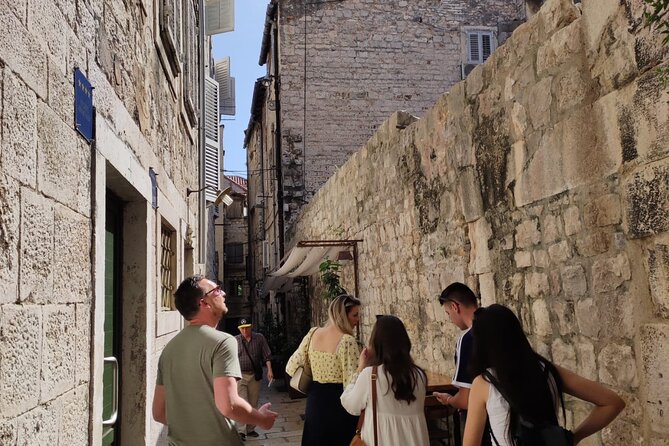
Trg Braće Radić, the old Venetian square, provides the setting for a discussion of the turbulent period when Split was a frontier facing the Ottoman Empire. The stop lasts roughly 15 minutes.
The value here is not only the historical account of warfare. The tour also looks at how that era is understood now, and why it still shapes local identity and politics. That gives you a useful warning about historical stories in Croatia: the past is not always safely sealed away from current arguments.
You will likely get more from this stop if you listen for the difference between an event and its later interpretation. A battle, border, or period of foreign rule can become part of how a community explains itself. Marin’s anthropological approach is designed for exactly that kind of question.
Again, there is no entry charge. The square is part of the public route, and the lesson comes from the location and the discussion rather than from an indoor display.
Same coast, a completely different day out:
- From Split: Krka Waterfalls, Food & Wine Tasting Tour
★ 4.9 · 6,598 reviews - Split/Trogir: Blue Cave, Mamma Mia, Hvar and 5 Island Tour
★ 4.6 · 6,320 reviews - Blue Lagoon & 3 Islands Cruise with Lunch from Split
★ 4.5 · 5,756 reviews - Split: Old Town and Diocletian Palace Walking Tour
★ 4.9 · 4,727 reviews
Narodni trg and the layers under your feet
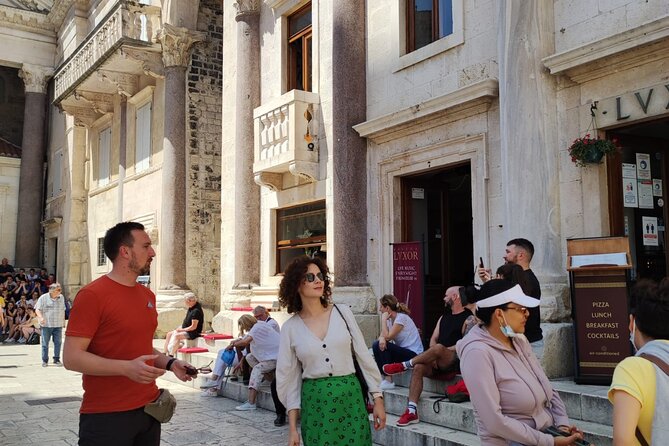
At Narodni trg, the tour turns to a detail that is easy to miss: human remains lie beneath the square because the site was once an ancient graveyard. That single fact changes how you see an ordinary-looking urban space.
The stop lasts about 15 minutes and also covers later events, including some of the more infamous episodes connected with the location. The information provided does not spell out every event, so you should expect a selective interpretation rather than a full chronological account.
This is one of the route’s strongest ideas. Split’s history is not confined to grand monuments. It can sit below a square, hide behind a modern facade, or survive in a story that a simple information board leaves out. A guide can connect those fragments in a way that makes the city easier to read on your own afterward.
The walking is generally manageable for most people, but standing remains the issue. One group of 10 found the listening portions tiring, even though the pace itself was well balanced. If you need frequent sitting breaks, you should take that into account before booking.
Šperun and the story behind a popular neighborhood
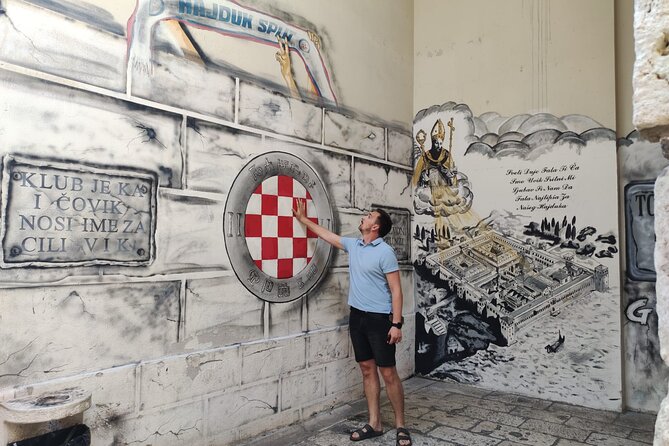
The 15-minute stop on Šperun ulica focuses on one of Split’s best-known neighborhoods. It is a popular area for accommodation, yet many people staying there may know little about its background.
That makes this part especially useful if you are sleeping in or near Šperun. You get more than a name and a row of attractive streets. You hear how the neighborhood fits into Split’s wider social story and why its current popularity does not tell you everything about its past.
The tour does not treat tourist-friendly areas as empty scenery. It asks what existed before the present wave of visitors and how local identity survives when neighborhoods become part of a city’s visitor economy. That is a practical lesson for anyone who wants to understand the place rather than simply pass through it.
The route remains in central Split, so this stop is not a separate excursion or a long transfer. You continue on foot through the city streets.
Franjo Tuđman Square and Croatia’s hardest lesson
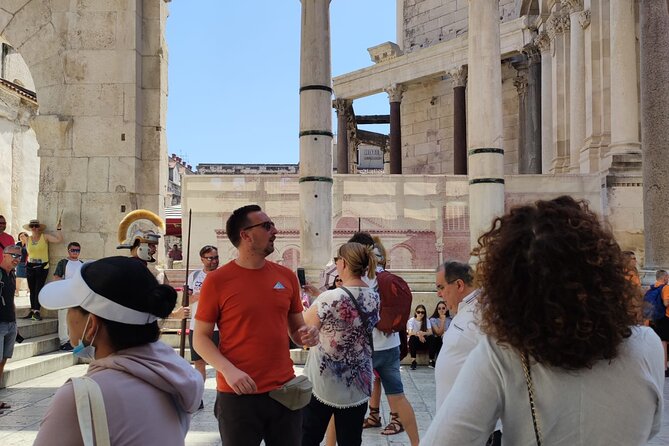
At Trg Franje Tuđmana, the guide introduces Franjo Tuđman, Croatia’s first president, and uses his legacy to discuss the country’s turbulent late 20th century. This is another 15-minute stop, but the subject is large.
The material here concerns one of the most difficult chapters in Croatian education and public life. The tour addresses issues that still divide Croatian society, rather than presenting a tidy ending to the story. That is important context for you: Croatia’s recent past can be personal, political, and sensitive.
Marin’s value as a guide is particularly clear in a section like this. A good explanation needs balance, room for questions, and care with competing viewpoints. His teaching background comes through in the way the tour is described: structured, prepared, and open to discussion.
You should not expect every modern political question to be settled in 15 minutes. The benefit is a starting framework. Afterward, you will have better context for place names, monuments, public debates, and conversations you may encounter elsewhere in Croatia.
Ending at Matejuška with a view of modern Split
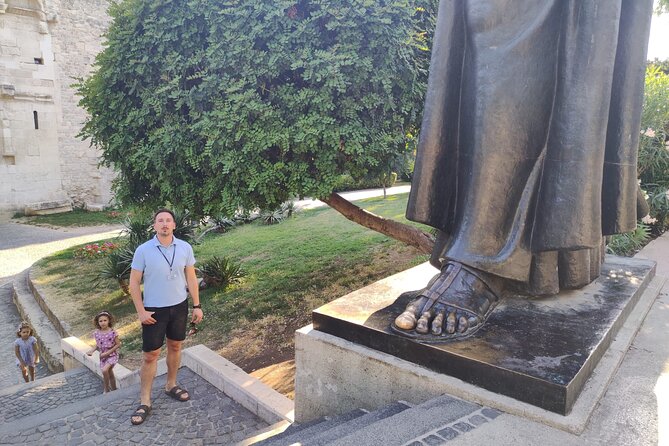
The walk ends at Matejuška, the old fishing quarter, after about 10 minutes of final discussion. The endpoint is Trumbićeva obala 2, and the view from here is one of Split’s best known.
Matejuška is a fitting finish because it brings the discussion back to the present city. The route has moved through emperors, Venetian rule, Ottoman conflict, buried remains, neighborhoods, and modern politics. Here, Marin draws those threads together and offers his view of contemporary Split.
The final stop includes admission, though the supplied tour information does not identify a separate attraction requiring a ticket. Think of it mainly as the closing setting and viewpoint.
This is also a useful place to continue exploring on your own. You finish near the waterfront rather than returning to the starting point, so plan your next stop from the end location. The one-way route saves you from retracing the walk and leaves you in a lively central part of town.
What makes Marin’s guiding style work
Marin is the named guide associated with the experience, and the strongest praise centers on his teaching style. He is described as warm, open, prepared, and able to answer questions. His humor helps keep serious material from becoming a dry lecture.
The use of maps and iPad visuals is a real practical benefit. Geography can be hard to follow when borders and political control have changed repeatedly. Seeing those changes can make the explanation clearer than listening to a long list of names.
The tour also appears to keep a steady pace. You should not expect to hurry from one sight to the next, but you should not be left with long unexplained stretches either. The structure gives each location a purpose.
That said, the style depends on your interest. You will get the most from it if you enjoy history, current affairs, sociology, or thoughtful questions about national identity. If you want a tour built around entering grand interiors and taking photos, this is not the best fit.
Is $35 a fair price for two hours?
At $35 per person, this is priced above a basic free walking tour tip, but the comparison is not quite fair. You are paying for a small group capped at 12, an English-speaking specialist guide, a planned route, visual aids, and a focused interpretation of subjects that are often skipped.
The price makes more sense if you value context. The walk covers seven locations, but its real product is the connection between them. You are not simply paying to be led from one square to another. You are paying for help understanding why those squares matter.
There are limits. The tour is only about two hours, and it cannot explain every era or settle every controversy. You also spend most of the time outside, with standing rather than museum seating. Still, for a first or second day in Split, the cost is reasonable if you want a stronger foundation for the rest of your stay.
Multiple departure times make it easier to fit around other plans. The experience is booked, on average, about 12 days ahead, so you should reserve early if your dates are fixed, especially in a busy season.
Who should book this walk?
I would choose this tour for you if you:
- Want Split explained through local people, memory, and politics
- Prefer a small group to a large guide-led crowd
- Enjoy asking questions about sensitive historical subjects
- Want context for Croatia’s recent past, not only Roman history
- Are happy walking and standing outdoors for two hours
- Like tours that use humor and discussion along with facts
I would be more cautious if you want a gentle stroll with frequent seats, a detailed tour of palace interiors, or a simple list of architectural highlights. The subject matter is more thoughtful than light, and the route may feel demanding in strong heat.
The tour is offered in English. Mobile tickets are used, service animals are allowed, and the meeting point is near public transportation. Most people can participate, but you should still consider the outdoor format and standing time when deciding.
Free cancellation is available if you cancel at least 24 hours before the start time. Changes or cancellations inside that window are not refunded, and poor weather can lead to a new date or a full refund.
Should you book the Controversies behind Split and Croatia tour?
Book it if you want to understand why Split is more than a Roman palace beside the sea. Marin’s route links ancient remains with Venetian rule, Ottoman conflict, buried graves, neighborhood history, and the divisions surrounding modern Croatia.
The best reason to go is the perspective. You will leave with fewer postcard facts and more questions about who shaped the city, who remembers what, and how the past remains present in public life. Just bring water, prepare to stand, and choose another tour if your priority is architecture alone.
FAQ
Where does the tour begin?
The tour begins at Ul. kralja Tomislava 12, 21000 Split, Croatia.
Where does the tour end?
The tour ends at Trumbićeva obala 2 in the Matejuška area of Split.
How long does the experience last?
The walking tour lasts approximately two hours.
What language is the tour offered in?
The tour is offered in English.
How many people can join the tour?
The maximum group size is 12 travelers.
What locations are included?
The route includes Diocletian’s Palace, Riva, Trg Braće Radić, Narodni trg, Šperun ulica, Trg Franje Tuđmana, and Matejuška.
Can I cancel for a full refund?
Yes. You can cancel at least 24 hours before the experience start time for a full refund. Cancellations made less than 24 hours before the start time are not refunded.
Just added around Split
- Kayaking & Zipline Šibenik – Čikola Canyon★ 5.0 · 3 reviews
- Krka National Park & Zipline Šibenik – Čikola Canyon★ 5.0 · 3 reviews
- From Split: Krka National Park & Waterfalls Private Day Trip★ 5.0 · 3 reviews
- Split: Small-Group Half Day Sailing Trip★ 5.0 · 3 reviews
- Rafting River Cetina from Makarska Riviera including transfer★ 5.0 · 3 reviews
- Split and Salona Cultural Heritage Day Tour from Trogir★ 4.0 · 3 reviews
- Split Bike and Wine Experience★ 5.0 · 3 reviews
- Private transfer from Split to Dubrovnik with 2h sightseeing stop in Ston★ 5.0 · 3 reviews
Guided, compared.

Plitvice Lakes Guided Tour with Entry Tickets
Read our review →
Plitvice Lakes National Park Guided Day Tour from Split
Read our review →
Krka National Park Tour with tour Guide & Wine tasting from Split & Trogir
Read our review →
Self-Guided Plitvice Lakes Day Tour with Boat Ride
Read our review →