
Reviewed · EVENING EXPERIENCES
Split: Magical Evening Sightseeing Private Tour
Split’s old town is a living Roman ruin, and this evening walk takes you right into its center. Diocletian’s Palace is not an isolated monument behind a fence. It forms the bones of modern Split, with cafés, shops, homes, and busy squares tucked among the ancient stones. I like the private format, which lets you set the pace and ask questions without keeping up with a large group. I also like the route’s mix of Roman, medieval, Venetian, and modern Split, ending along the Riva waterfront.
The main thing to consider is timing. The cathedral and other historic interiors are likely to be closed during this late tour, and entrance fees are not included. You’ll still see the exteriors and the palace cellars, but this is mainly an atmospheric evening walk rather than a full indoor museum visit.
In This Review
- Key points at a glance
- Why an evening walk suits Split
- Meeting the guide beside the palace cellars
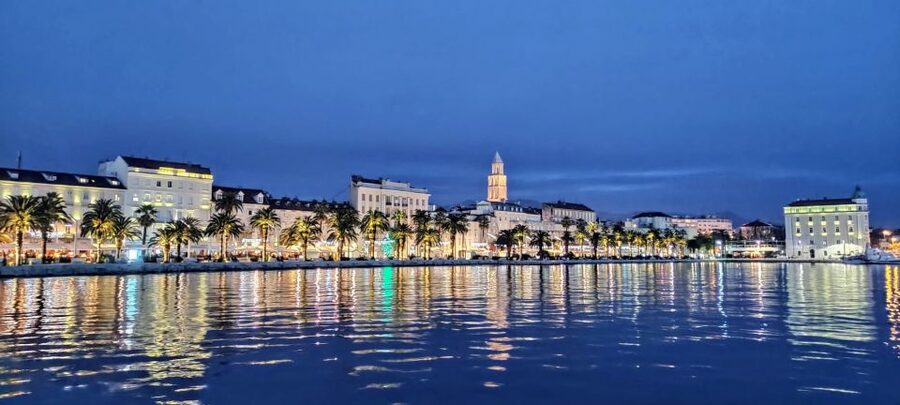
- Riva, Split: start with the city’s social heart
- Diocletian’s Palace and its Roman foundations
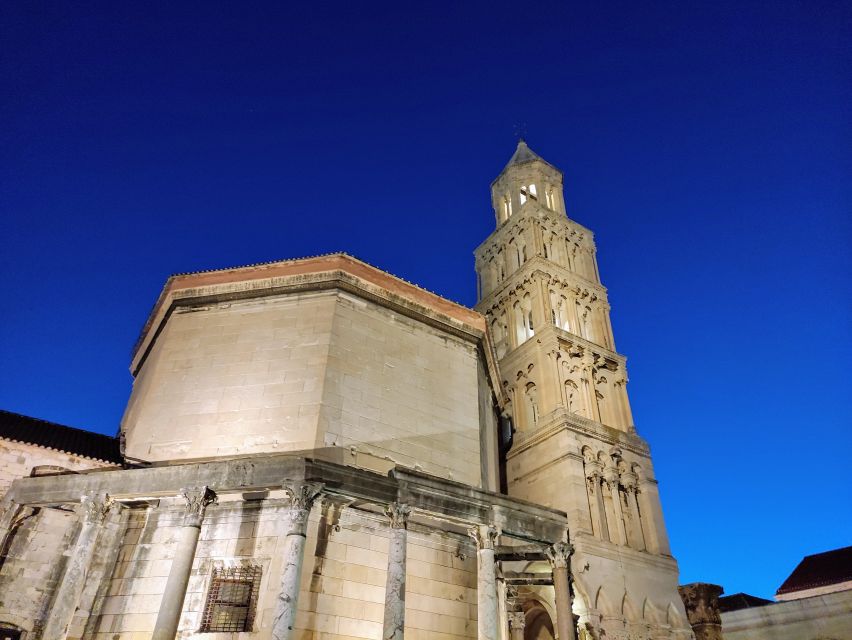
- St. Domnius Cathedral and the former imperial mausoleum
- Golden Gate: entering the old city
- People’s Square and Venetian Split
- Fruit Square and the modern evening city
- The Riva finish and the value of $129
- Who will get the most from this tour
- Should you book this Split evening tour?
- FAQ
- How long does the Split evening sightseeing tour last?
- What is the price of the private tour?
- Where do I meet the guide?
- What languages are available?
- Is the tour private?
- Is the tour wheelchair accessible?
- Are entrance fees included?
- Will the cathedral be open during the tour?
- What should I bring?
Key points at a glance
- A private group of up to 20: You get a guide for your own party, with room to adjust the pace and focus.
- Diocletian’s Palace at evening time: Walk through Roman cellars, the Peristyle, and the Temple of Jupiter as Split’s streets come alive.
- A 1,700-year-old city still in daily use: Ancient walls lead directly into shops, markets, cafés, and homes.
- A route across several eras: The walk includes Roman, medieval, and Venetian landmarks.
- A waterfront finish: The tour ends on the Riva, a handy place to continue your evening over dinner or a drink.
- Good practical flexibility: The tour is wheelchair accessible, and steps can be avoided if needed.
Why an evening walk suits Split
Split changes character as the heat of the day fades. The old town fills with people heading to dinner, browsing the shopping streets, or gathering in the squares. That gives this tour a useful sense of place. You are not simply looking at ruins. You are watching a modern Dalmatian city use them.
The two-hour length is enough to cover the main sights without turning the outing into an endurance march. A private guide can pause for questions, slow down for photographs, or move along when you have had enough of a particular monument. That matters in a city where the most interesting details are often tucked into a narrow passage or a corner of a square.
The tour is conducted in English, French, or Croatian. Guide Zrinka has been praised for a personable manner, a comfortable pace, and useful restaurant suggestions. Guide assignments can change, so you should not assume she will lead every departure, but the private setup gives you a better chance to explain what interests you before the walk begins.
A few more Split half-days to weigh up
- Split: Illuminated Evening Guided Kayaking Tour
★ 4.8 · 1,622 reviews - Split: Stand Up Paddleboard Night Glow Tour
★ 4.9 · 916 reviews - Split: Sunset Boat Party with Live DJs and Blue Lagoon Swim
★ 4.5 · 638 reviews
Meeting the guide beside the palace cellars
The meeting point is in front of the entrance to the cellars of Diocletian’s Palace at Obala Hrvatskog narodnog preporoda 23, 21000 Split. It is on the Riva side of the old town, so allow a little time to find the exact entrance if you are arriving from elsewhere in the city.
The route returns to the same general area at the end. Wear comfortable shoes. Split’s old town has stone paving, uneven surfaces, and steps in parts of the palace complex. If steps are difficult for you, tell the guide at the start. The tour is wheelchair accessible, and steps can be avoided when necessary, though the historic center’s old paving may still require some care.
Because this is a private experience, your group can include up to 20 people. That is a generous maximum. A party of that size will not feel as intimate as a couple or small family, but it remains more adaptable than a standard public group tour.
Riva, Split: start with the city’s social heart
The walk begins around the Riva, Split’s palm-lined waterfront promenade. This is a place for seeing and being seen, with cafés, restaurants, and boats along the harbor. It is also a useful opening scene because the Riva shows you Split as it is now before the guide leads you back toward the Roman foundations.
You get about 15 minutes here for a guided introduction and photographs. The stop is brief, so do not expect a detailed waterfront history lesson. Its value is orientation. You can see how close the harbor is to the old town and understand why Split has remained an active port city through many centuries.
The Riva is also your practical end point. If you want to continue the evening, you will already be near places to eat and sit outside. The guide may offer restaurant suggestions, as Zrinka did for one party, but meals and drinks are not part of the tour.
Diocletian’s Palace and its Roman foundations
The palace receives the longest part of the walk, about one hour. Diocletian was a Roman emperor who built this enormous residence and fortress in the early fourth century. The key point for you is that the palace did not disappear. Its walls and layout became the framework for the old city.
The cellars are among the most useful places to begin. These lower rooms are well preserved and help you picture the structure above them. They also show how practical the palace was, with solid construction and service areas beneath the imperial apartments. The guide can explain how the lower level reflects the plan of the rooms that once stood above it.
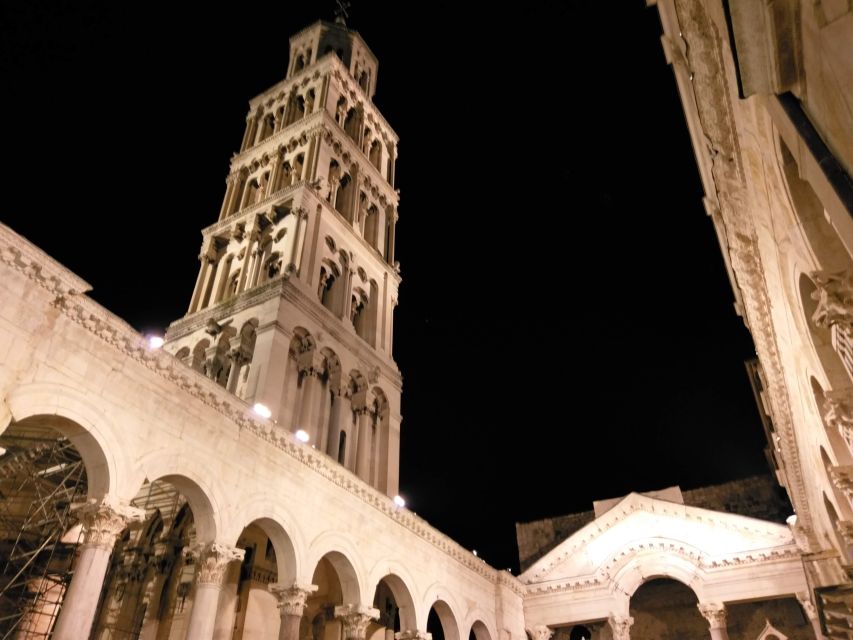
From the cellars, you walk up toward the Peristyle, the palace’s grand central court. This change in level gives the route a natural sense of discovery. Below, you see the working foundations. Above, you reach the ceremonial heart of the complex, framed by stone columns and ancient walls.
The evening setting can be especially effective here. The Peristyle is not presented as a silent archaeological zone. It is part of Split’s public life, which means you may see people crossing through on their way elsewhere. That combination of ancient architecture and ordinary city movement is one of the strongest reasons to choose this tour over a simple daytime walk with a guidebook.
The route also includes the Temple of Jupiter. The temple is a compact reminder that the palace was built around Roman power and religion, not only domestic comfort. Your guide can connect the structure to Diocletian’s role as emperor and to the way later generations adapted the site.
One limitation is worth keeping clear: the entrance fee to Diocletian’s Palace is not included. The supplied information does not specify the exact ticket price or which palace areas require payment, so check the current arrangements when booking. The tour does include the guided visit to the palace area and cellars, but you should budget for any required admission separately.
Same coast, a completely different day out:
- Split: Krka Waterfalls Trip with Boat Cruise and Swimming
★ 4.8 · 10,519 reviews - From Split: Krka Waterfalls, Food & Wine Tasting Tour
★ 5.0 · 9,326 reviews - Blue cave, Mamma Mia and Hvar, 5 islands speedboat tour
★ 5.0 · 7,150 reviews - From Split: Krka Waterfalls, Food & Wine Tasting Tour
★ 4.9 · 6,598 reviews
St. Domnius Cathedral and the former imperial mausoleum
The Cathedral of Saint Domnius, also called St. Duje, is dedicated to Split’s patron saint. Its story is one of the city’s most striking examples of reuse. The building began as Diocletian’s mausoleum and was later converted into a Christian cathedral.
That change gives the stop more weight than a simple church visit. You are looking at a Roman imperial structure that acquired a new religious purpose over time. The bell tower adds another recognizable part of Split’s skyline and is one of the features you will admire from outside.
The planned stop is about 15 minutes, with time for photographs. The cathedral will likely be closed during the evening tour because of its operating hours. That means you should not book this walk expecting to see the interior, climb the bell tower, or inspect the cathedral’s furnishings.
Entrance to the cathedral is also not included. If seeing inside matters to you, plan a separate visit during opening hours. The guide can still explain the building’s transformation and point out the key exterior details, but the late timing is a real tradeoff.
Golden Gate: entering the old city
The Golden Gate is one of the palace’s best-known entrances. It gives you a strong sense of the original defensive design, with thick stonework and a formal gateway marking the approach to the imperial complex.
This is a 15-minute photo stop. You will not spend a long time here, but the gate works well as part of the larger story. The palace was not merely a grand home. It was also a fortified compound with controlled entrances and a clear division between inner spaces and the outside world.
The stop also helps you notice how Split has grown around the Roman plan. Medieval streets and later buildings gather around the ancient gate, and the route moves naturally from imperial architecture into the later city.
People’s Square and Venetian Split
After leaving the palace area, the walk enters the medieval part of Split and reaches People’s Square, known as Piazza during the period of Venetian rule. This shift is important because it prevents the tour from becoming only a Roman history lesson.
People’s Square is a public urban space shaped by later centuries of trade, government, and daily life. Here, you can see how Split developed beyond the palace walls. The guide spends about 15 minutes on a guided visit and photo stop, giving you context without asking you to stand in one place for too long.
I like this part of the route because it connects the famous palace to the city you are actually visiting. Once you understand the Roman core, the medieval and Venetian additions make more sense. You also get a better feel for Split as a town with several layers rather than a single archaeological attraction.
Fruit Square and the modern evening city
Fruit Square provides another short stop, with about 15 minutes for a visit and photographs. The square belongs to the part of Split where historic buildings, cafés, and evening foot traffic meet.
The supplied details do not promise a market visit or a specific performance here, so keep your expectations practical. The point is to see another public square and observe how the old town functions after dark. In summer, shopping streets, markets, and squares become part of the evening entertainment, giving the final stretch a more local, lived-in feel.
This is also where a private guide can add value through small observations. You can ask about nearby restaurants, the best place to return for a drink, or which parts of the center deserve another look the next day. Zrinka’s restaurant recommendations were a particular strength for one party, so it is worth asking your own guide for dinner ideas before the tour ends.
The Riva finish and the value of $129
The price is $129 per group of up to 20 people, rather than $129 per person. That changes the calculation. For a couple, it is a fairly expensive two-hour walk. For a family or group of friends, the cost can become quite reasonable when divided among several people.
The private format is the main reason to pay more than you would for a basic group walk. You can ask questions freely, avoid steps if needed, adjust the pace, and focus on Roman architecture, religious history, food, or city life depending on your interests. If your group has a tight schedule, the guide can also keep the route moving.
There are limits to the value. Only a licensed guide is included. Cathedral and palace entrance fees are extra, and the cathedral is likely to be closed at this hour. If you want extensive interior access, a bell tower visit, or a long archaeological explanation, you may need a separate daytime tour.
For a group of four or more, the private rate is easier to justify. It also suits families who do not want to match the pace of strangers. A couple who mainly wants a quick orientation may find a shared walking tour less costly.
Who will get the most from this tour
I would choose this tour if you want a first look at Split that combines major landmarks with a sense of how the city works today. It is especially useful for first-time visitors, families, and groups with different walking speeds or interests.
It also suits anyone arriving in Split for a short stay. In two hours, you see the palace cellars, Peristyle, Temple of Jupiter, cathedral exterior, Golden Gate, People’s Square, Fruit Square, and Riva. That is a lot of ground, but the route remains manageable because the sights are concentrated in and around the old town.
You should look elsewhere if your priority is entering every major monument. The late hour makes the walk atmospheric, but it also means interiors are limited. Treat it as a guided introduction and evening orientation, then return on your own to any site you want to explore more fully.
Free cancellation up to 24 hours before departure and reserve-now, pay-later booking add useful flexibility. Starting times depend on availability, so check the schedule carefully when choosing your date.
Should you book this Split evening tour?
Book it if you value a private, flexible introduction to Split and want Roman ruins, medieval squares, and the waterfront in one compact walk. The $129 group price is strongest for families and larger parties, while guide Zrinka’s friendly pace and restaurant advice are encouraging signs for the personal side of the experience.
Skip it if cathedral interiors and included admission are essential. Since the cathedral will likely be closed and entrance fees are separate, a daytime visit may suit you better. For everyone else, this is a sensible way to get your bearings, learn how Diocletian’s Palace became a living city, and finish close to Split’s best evening dining area.
FAQ
How long does the Split evening sightseeing tour last?
The tour lasts two hours.
What is the price of the private tour?
The price is $129 per private group of up to 20 people.
Where do I meet the guide?
Meet in front of the entrance to the cellars of Diocletian’s Palace at Obala Hrvatskog narodnog preporoda 23, 21000 Split.
What languages are available?
The live guide can conduct the tour in English, French, or Croatian.
Is the tour private?
Yes. It is offered as a private group experience.
Is the tour wheelchair accessible?
Yes, the activity is wheelchair accessible. Steps can be avoided if necessary.
Are entrance fees included?
No. Entrance fees to the Cathedral of Saint Domnius and Diocletian’s Palace are not included.
Will the cathedral be open during the tour?
The cathedral will likely be closed because of its operating hours during the evening tour.
What should I bring?
Bring comfortable shoes for walking through the historic center.
Just added around Split
- Kayaking & Zipline Šibenik – Čikola Canyon★ 5.0 · 3 reviews
- Krka National Park & Zipline Šibenik – Čikola Canyon★ 5.0 · 3 reviews
- From Split: Krka National Park & Waterfalls Private Day Trip★ 5.0 · 3 reviews
- Split: Small-Group Half Day Sailing Trip★ 5.0 · 3 reviews
- Rafting River Cetina from Makarska Riviera including transfer★ 5.0 · 3 reviews
- Split Bike and Wine Experience★ 5.0 · 3 reviews
- Split and Salona Cultural Heritage Day Tour from Trogir★ 4.0 · 3 reviews
- Private transfer from Split to Dubrovnik with 2h sightseeing stop in Ston★ 5.0 · 3 reviews
Evening Experiences, compared.



Split Riviera Panoramic Sunset Cruise with Summer Vibes on Boat
Read our review →
Browse the lists this tour appears in