Reviewed · TOURS
Small-Group Communist Tour of Split – Boutique group tour
Split’s communist story is told through stadiums, shopping centers, apartment blocks, and an armored train, not just through dates in a history book. This small-group tour connects those places to World War II, Tito’s Yugoslavia, everyday consumer life, and the violent breakup of the country in the 1990s.
I like the access to Split 3, a carefully planned socialist neighborhood, and the fact that local historian and history teacher Boris leads the tour. The private, air-conditioned vehicle also makes it easy to reach scattered sites. The main consideration is its serious subject matter and outdoor format, plus the fact that it runs only in English.
In This Review
- Key points to know before booking
- Why this tour adds another side to Split
- Starting at Trg Franje Tuđmana
- Poljud Stadium and the ambition of Yugoslav design
- Koteks, Yugoslavia’s experiment with modern shopping
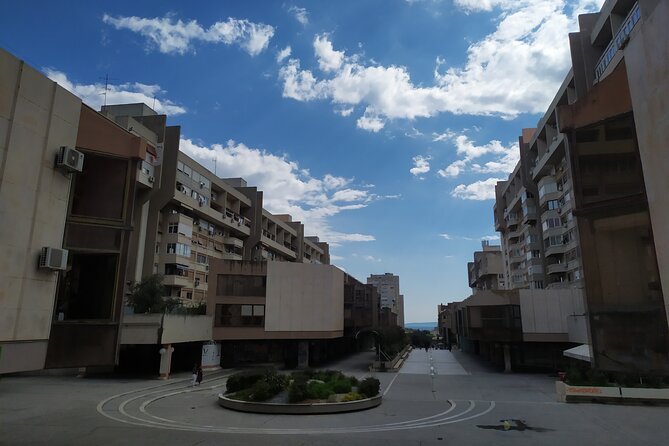
- Split 3 and the socialist idea of a complete neighborhood
- Kopilica and the violent end of Yugoslavia
- What the private vehicle changes
- Is $108.14 a fair price?
- Who should book it?
- Final call: a strong choice for curious history fans
- FAQ
- Where does the Communist Tour of Split start?
- Where does the tour finish?
- How long does the tour last?
- What language is the tour offered in?
- How many people can join the tour?
- Is transportation included?
- What happens if the weather is poor?
Key points to know before booking
- Poljud Stadium is presented as a major work of Yugoslav architecture, including its place in a Museum of Modern Art exhibition in New York.
- Split 3 gives you a close look at socialist housing, planning, schools, health care, work, and daily life under Tito.
- Koteks shopping center explains how Yugoslav consumers lived between the open West and the closed East.
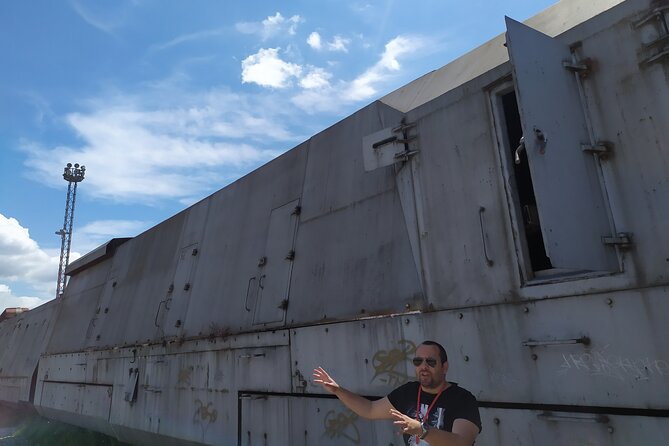
- Kopilica railway station brings the story to Yugoslavia’s violent collapse, with an armored train as a powerful visual marker.
- Boris, a local historian and history teacher, gives the tour a personal, academic focus.
- The tour lasts about three and a half hours, has a maximum of eight people, and includes private transportation plus a local soft drink.
Why this tour adds another side to Split
Most first visits to Split begin and end around Diocletian’s Palace. That makes sense, but it can leave you with only a partial view of the city. Split is also a place shaped by the 20th century, when Yugoslavia tried to build a modern socialist society with its own political system, architecture, economy, and culture.
This tour takes you away from the ancient center and into the parts of the city where modern Split was planned and lived. You see places built for sport, shopping, housing, transportation, and public life. That makes the subject easier to understand. Instead of hearing only about ideology, you see how the system affected ordinary routines.
I especially like that the tour does not treat communism as a simple good-versus-bad story. The schedule covers social services, housing, education, and economic life, while also giving attention to Tito’s dictatorship and the failures that helped bring Yugoslavia down. You get a look at both the promise and the limits of the system.
The group is capped at eight people, which matters for a topic that benefits from questions. Boris can spend more time explaining a building or responding to a point from the group than he could with a large busload. One person even received what became a one-on-one tour, creating a more tailored experience.
A few more Split half-days to weigh up
- Split: Krka Waterfalls Trip with Boat Cruise and Swimming
★ 4.8 · 10,519 reviews - From Split: Krka Waterfalls, Food & Wine Tasting Tour
★ 5.0 · 9,326 reviews - Blue cave, Mamma Mia and Hvar, 5 islands speedboat tour
★ 5.0 · 7,150 reviews
Starting at Trg Franje Tuđmana
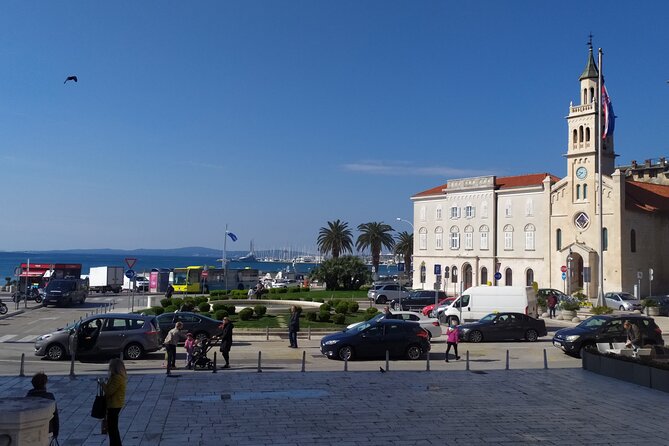
The meeting point is the bus stop at Trg Franje Tuđmana, or Franjo Tuđman Square, with a start time of 9:00 a.m. The tour begins with orientation and a short explanation of what happened in Split and Yugoslavia during World War II.
This opening section sets up the creation of the new communist state. You also see photographs showing wartime damage in Split. That visual material gives the later architecture and city planning a useful frame: postwar Yugoslavia was not designing from a blank page. It was rebuilding after conflict while trying to create a new political and social order.
The first stop lasts about 25 minutes. There is no admission charge, and the tour data indicates that the meeting point is near public transportation. Since the group moves beyond the central sights, listen closely at the beginning. The basic timeline introduced here will help you follow the later discussion of Tito, socialist life, and the breakup of Yugoslavia.
Poljud Stadium and the ambition of Yugoslav design
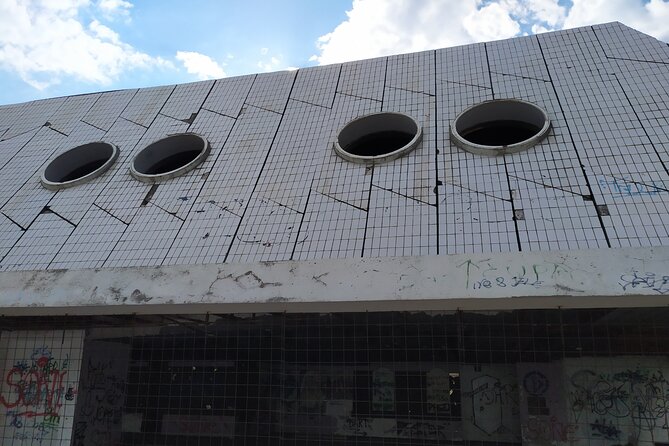
A short panoramic stop introduces Poljud Stadium, one of Split’s best-known modern landmarks. The stadium was built for the Mediterranean Games, described here as the biggest sporting event Yugoslavia had hosted up to that time.
The building is important not only as a sports venue but also as a piece of architecture. Poljud was included among the leading examples in an exhibition of Yugoslav architecture at the Museum of Modern Art in New York. That detail helps explain why the stadium matters beyond Split. Yugoslavia wanted to show that its architecture could be modern, inventive, and distinct from both Soviet-style building and Western commercial design.
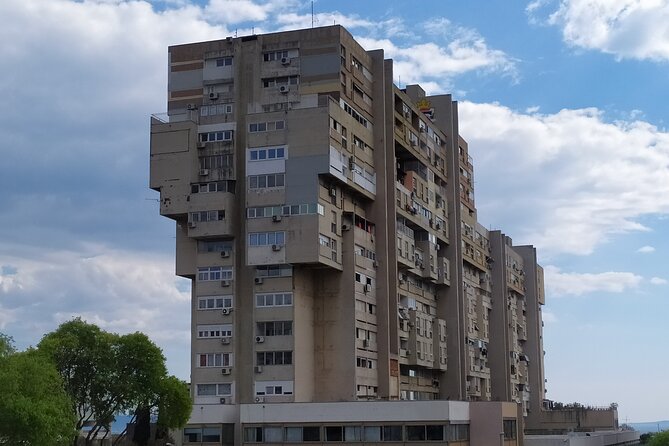
The same stop includes the China Wall, described as the widest building in Split and another product of Yugoslav socialist architecture. You do not spend a long time here, only about ten minutes, so expect a panoramic introduction rather than an extended architectural study.
That short timing is both useful and limiting. You get a quick sense of the scale and ambition of the buildings, but anyone especially interested in design may wish for more time on foot. Still, the private vehicle makes it practical to see this area without arranging separate transportation.
Koteks, Yugoslavia’s experiment with modern shopping
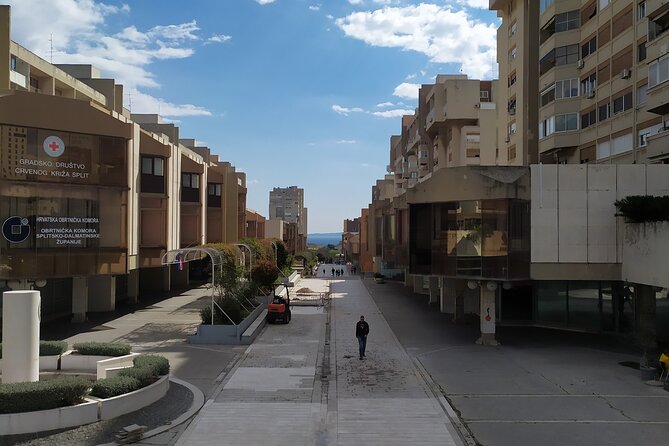
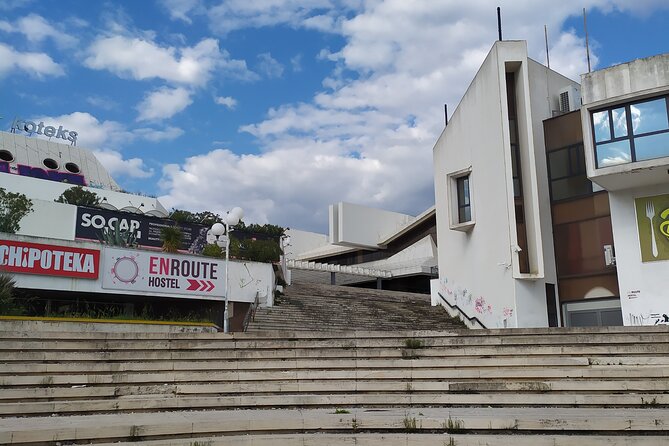
The next stop looks at Prodajni centar Koteks, presented as the first shopping mall in Yugoslavia. The focus is not simply on the building. It is on what shopping revealed about the country’s unusual position between East and West.
Yugoslavia was socialist, but it was not governed in the same way as the Soviet Union and its closest allies. Its citizens often had more contact with Western goods and ideas than people in many other communist countries. At the same time, supplies could be uneven, and access to imported products was not always simple.
Koteks becomes a useful place to discuss that tension. The mall represented a modern idea of consumer life, yet its popularity faded and the complex declined over time. You learn how people had to be inventive when finding certain goods, and how Yugoslav life could combine socialist politics with a desire for Western-style shopping.
The stop lasts around 30 minutes and is conducted on foot around the shopping center. That is a good length for connecting the building to daily life without turning the visit into a technical architecture lecture. It also gives the tour a welcome change of pace after the panoramic stadium stop.
Do not expect a polished shopping attraction. The appeal is precisely in seeing how an older socialist commercial project fits into present-day Split. The value comes from the explanation, not from shopping there.
Same coast, a completely different day out:
- From Split: Krka Waterfalls, Food & Wine Tasting Tour
★ 4.9 · 6,598 reviews - Split/Trogir: Blue Cave, Mamma Mia, Hvar and 5 Island Tour
★ 4.6 · 6,320 reviews - Blue Lagoon & 3 Islands Cruise with Lunch from Split
★ 4.5 · 5,756 reviews - Split: Old Town and Diocletian Palace Walking Tour
★ 4.9 · 4,727 reviews
Split 3 and the socialist idea of a complete neighborhood
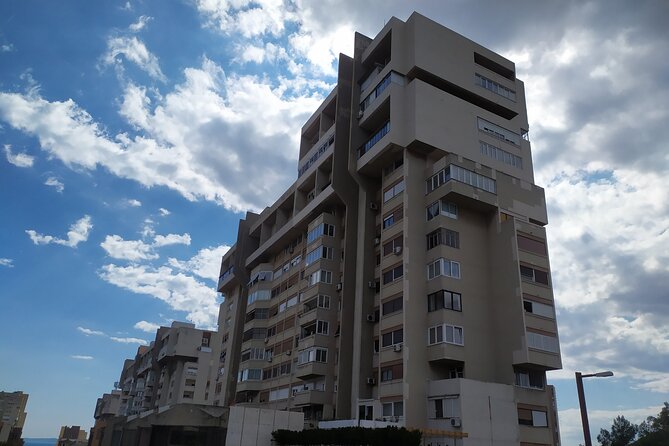
Split 3 is the longest and most important stop, lasting about 1 hour and 10 minutes. This modern neighborhood was deliberately planned around the socialist goal of living, working, and resting in one area.
As you walk, Boris points out different building styles and the work of local architects. One building called Cruiser is singled out as an example. The point is not merely to admire unusual apartment blocks. You are shown how the design reflected ideas about housing, public services, work, leisure, and community life.
Split 3 was also included in the Museum of Modern Art exhibition of Yugoslav architecture in New York. Its inclusion signals that the neighborhood was considered an important residential project, not just a collection of concrete apartment buildings.
This is where the tour becomes most useful for understanding daily life. The discussion covers housing policy, education, health care, the economy, social life, and politics. Tito’s rule receives particular attention, including the dictatorial side of his leadership. You can then compare the ideal of a planned, well-served neighborhood with the political limits of a one-party state.
The walking portion means comfortable shoes are sensible. You have some free time at this stop, which gives you a little room to look around without listening every second. That break can also help if the amount of information becomes heavy.
Split 3 is likely to appeal most to people interested in architecture, urban planning, or the practical side of history. If you only want ancient monuments and scenic views, this will feel less familiar and perhaps less immediately exciting. If you want to understand how a society tried to organize modern city life, it is the heart of the tour.
Kopilica and the violent end of Yugoslavia
The final stop is at Kopilica railway station in Split’s Predgrađe area. Here the focus shifts from the promise of socialist modernity to the reasons Yugoslavia failed to survive and why its end in the 1990s became so violent.
The visual centerpiece is an armored train displayed beside the railway. It symbolizes the beginning of the bloody end of Yugoslavia and the renewed conflict between nations and religions in southeastern Europe.
This is a concise but serious conclusion. The tour does not stop with Tito-era architecture or nostalgic stories about shopping and housing. It asks you to consider how a state that had offered its own form of socialism, and had built ambitious modern neighborhoods, eventually broke apart in war.
The stop lasts about 30 minutes. Because the subject involves war and political violence, it may not suit anyone looking for a light morning outing. For those willing to take it seriously, the armored train provides a strong final image and links Split’s local story to the wider collapse of Yugoslavia.
The activity returns to the original meeting point after this stop. That makes planning the rest of your day easier, especially if you have a later museum visit or meal in central Split.
What the private vehicle changes
The private, air-conditioned vehicle is more than a comfort feature. The sites are spread around Split, and reaching them independently would take extra planning. You move from the central meeting point to Poljud, Koteks, Split 3, and Kopilica without having to organize several local rides.
The vehicle also protects some of your time. The tour lasts about three and a half hours, including walking and explanations, so efficient movement matters. You are not spending the morning figuring out bus routes between modern neighborhoods.
This is not a fully seated sightseeing tour. You walk around Koteks and Split 3, and the subject is tied to buildings and public spaces you need to see at street level. The vehicle connects the stops, while the walks give you a closer look at the architecture.
The maximum group size is eight. That is small enough for a more direct conversation, though the actual group may vary. The tour is offered in English, and most people can participate according to the activity information. It requires good weather, so outdoor conditions can affect the plan.
Is $108.14 a fair price?
At $108.14 per person, this is not a budget city tour. The price makes more sense when you consider what is included: roughly 3.5 hours, an English-speaking local historian and teacher, private transportation, an air-conditioned vehicle, and a small group limited to eight people.
You are paying for access to a specialized subject rather than a standard orientation tour. The price would be harder to justify if you only wanted a quick drive past modern buildings. It is easier to justify if you would otherwise need to research Yugoslav history, arrange transport to several outlying sites, and find someone to explain the architecture and politics in context.
The included local soft drink is a small but fitting touch. It is described as a typical drink that was popular during communist Yugoslavia and remains popular today. It will not transform the value calculation, but it connects the refreshment to the theme.
The best value comes from the guide’s interpretation. Boris has been praised for his ability to explain the subject and for making the tour personal when the group is very small. If you have a serious interest in Yugoslavia, socialist architecture, or modern Balkan history, the specialist focus may justify the cost. If your main goal is a low-cost introduction to Split, you can find less expensive options.
Who should book it?
I would choose this tour if you have already seen the main old-town sights or want to understand Split beyond Roman remains and waterfront views. It is particularly well suited to you if you enjoy architecture, urban planning, political history, or the details of ordinary life under unusual political systems.
It also fits visitors who prefer conversation over a scripted sightseeing loop. With no more than eight people, you have a better chance to ask about a specific building, the Yugoslav economy, or the causes of the 1990s conflict.
I would think twice if you want a relaxed, scenic outing with little walking or if you prefer to avoid difficult political subjects. The tour deals with dictatorship, shortages, national tensions, war, and the breakup of a country. Those subjects are central, not side notes.
A morning start at 9:00 a.m. leaves much of the day free, but the early timing may not suit everyone. Wear comfortable shoes, expect to spend time outside, and allow for the possibility of a weather-related change.
Final call: a strong choice for curious history fans
This tour is worth booking when you want the modern story of Split explained through real places. Poljud Stadium shows Yugoslavia’s architectural ambition, Koteks reveals the complications of consumer life, Split 3 presents the planned socialist city, and the armored train at Kopilica points to the country’s violent collapse.
The specialist subject, small group, and private vehicle give it a clear advantage over a general city tour. The main tradeoff is price, along with the serious tone and the need for decent weather. For anyone curious about how Yugoslavia worked, and why it ended so badly, this is one of the more distinctive ways to spend a morning in Split.
FAQ
Where does the Communist Tour of Split start?
It starts at the bus stop at Trg Franje Tuđmana in Split. The listed start time is 9:00 a.m.
Where does the tour finish?
The tour ends back at the original meeting point.
How long does the tour last?
The activity lasts approximately 3 hours and 30 minutes.
What language is the tour offered in?
The tour is offered in English.
How many people can join the tour?
The maximum group size is eight people.
Is transportation included?
Yes. Private transportation in an air-conditioned vehicle is included.
What happens if the weather is poor?
The tour requires good weather. If it is canceled because of poor weather, you can receive a different date or a full refund. Free cancellation is also available when you cancel at least 24 hours before the start time.
Just added around Split
- Kayaking & Zipline Šibenik – Čikola Canyon★ 5.0 · 3 reviews
- Krka National Park & Zipline Šibenik – Čikola Canyon★ 5.0 · 3 reviews
- Split: Small-Group Half Day Sailing Trip★ 5.0 · 3 reviews
- Rafting River Cetina from Makarska Riviera including transfer★ 5.0 · 3 reviews
- From Split: Krka National Park & Waterfalls Private Day Trip★ 5.0 · 3 reviews
- Split and Salona Cultural Heritage Day Tour from Trogir★ 4.0 · 3 reviews
- Split Bike and Wine Experience★ 5.0 · 3 reviews
- Krka Waterfalls, Lake Cruise & Skradin★ 5.0 · 3 reviews
Tours, compared.
Blue cave, Mamma Mia and Hvar, 5 islands speedboat tour
Read our review →
Blue Cave, Mamma Mia, Hvar and 5 Island Tour
Read our review →