
Reviewed · TICKETS
Salona & Amphitheater – Private guided tour – Admission incl.
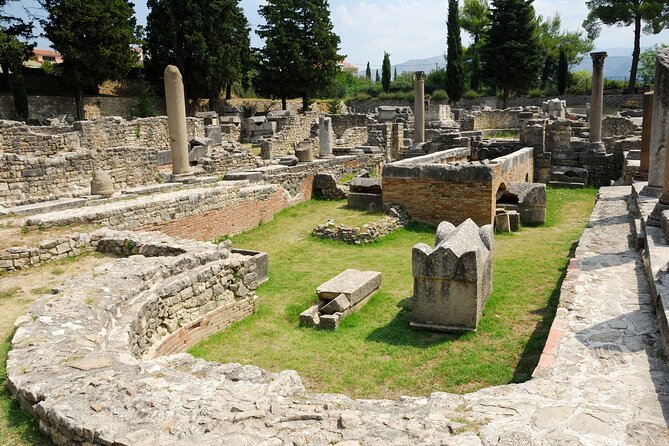
Salona gives you something Split itself cannot: a walk through the remains of a Roman city spread across open ground, with old roads, basilicas, cemeteries, baths, a forum, and an amphitheater. The site once held about 60,000 people before the Avars destroyed it in the sixth century. The private format with guide Ivan keeps the history personal and easy to follow.
I like the tour’s small-group setting, since you can ask questions instead of trying to keep up with a large crowd. I also like the route from Christian burial sites to the amphitheater, which shows how Roman public life and early Christianity met in one place. The main drawback is the admission wording: the title says admission is included, while the site details say the open-air museum ticket costs about 10 euros and is not included. Confirm this before paying.
In This Review
- Key details before you book
- Why ancient Salona makes a strong half-day visit
- Manastirine and Salona’s early Christian story
- Tusculum and the work of Don Frane Bulić
- The bishop’s palace and two lost cathedrals
- Roman baths, bridges, and the working side of town
- Porta Caesarea and the old Roman road
- Forum, temple, and theater at Hram
- The Cemetery of the 16 Sarcophagi
- Kapljuc and the five martyrs
- The Salona amphitheater, the tour’s main finish
- What the private format adds
- Is the $203.50 price good value?
- Practical details for your visit
- Who should book the Salona tour?
- Should you book it?
- FAQ
- Where does the tour begin?
- Where does the tour end?
- How long does the tour last?
- Is the tour private?
- Is the tour offered in English?
- Is admission included?
- What is the price?
- How far in advance is the tour usually booked?
- What happens if bad weather cancels the tour?
Key details before you book
- A private walk through Roman Salona: Only your group takes part, so the pace and questions can be more personal.
- The amphitheater is the finale: The tour saves Salona’s best-known monument for the final 30 minutes.
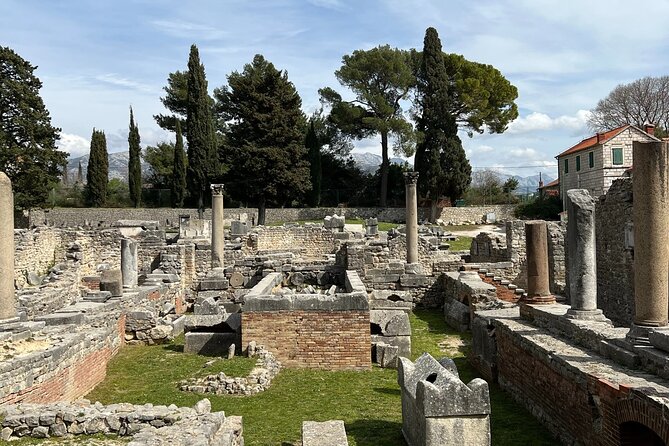
- Christian history is central: Manastirine, Kapljuc, the bishop’s palace, and the cathedral foundations explain Salona’s early Christian importance.
- You see more than one isolated ruin: The route links gates, roads, bridges, baths, cemeteries, temples, and public buildings.
- Plan for open-air walking: Most of the 2.5-hour visit takes place on foot around an archaeological site.
- Check the ticket terms: The supplied details conflict on whether the approximately 10-euro Salona admission is included.
Why ancient Salona makes a strong half-day visit
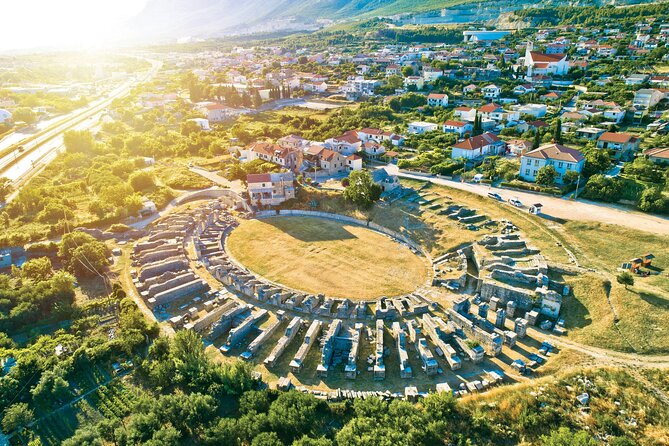
Salona was the Roman capital of Dalmatia and once housed around 60,000 people. That figure matters because the remains can otherwise look scattered at first. You are not visiting a single monument. You are tracing the pieces of a former city.
I like this kind of archaeological visit because the story builds as you walk. A city gate leads to roads. Roads lead to cemeteries, public buildings, and religious sites. The amphitheater then gives the whole place a clear public center, much as the Colosseum helps explain ancient Rome.
The ruins are spread across an open-air museum in Solin, just outside Split. The tour starts and finishes at the main entrance at Ul. don Frane Bulića 58. You should expect steady walking between several stops, with short explanations at each one rather than a long stay at just one building.
The site was destroyed by the Avars in the sixth century, so Salona does not offer a fully intact Roman city. Later stone removal also affected the remains. The amphitheater, in particular, lost much of its stone when Venetians took material for churches in Venice. That damage is part of the site’s story, but it also means you need a guide to help you picture what is missing.
More Entry Tickets in Split
- From Split: Plitvice Lakes Guided Tour with Entry Tickets
★ 4.9 · 2,468 reviews - From Split or Trogir: Plitvice Lakes Tour with Entry Tickets
★ 4.7 · 958 reviews - Split: Game of Thrones Museum Entrance Ticket
★ 3.8 · 385 reviews
Manastirine and Salona’s early Christian story
Manastirine was first used as a Roman necropolis and later became a Christian cemetery. This change gives you an early example of how burial customs and religious life shifted as Christianity gained a place in the Roman world.
The site is linked with St. Domnius, the martyr and patron of Split. He was buried here, adding a direct connection between Salona and the city you may be staying in. I find this especially useful for visitors who know Split mainly through Diocletian’s Palace. Salona helps explain the older religious and civic setting behind the later medieval city.
The stop lasts about 15 minutes. That is enough for an introduction, but not a long independent study of every stone. A private guide can make the short visit count by pointing out what separates a Roman burial ground from a later Christian cemetery.
Tusculum and the work of Don Frane Bulić
Tusculum was built by Don Frane Bulić, a prominent clergyman and archaeologist from Split. He used it as an office and meeting place, and some rooms can be visited.
This is one of the more personal stops because it connects the modern study of Salona with the ancient site itself. Archaeology does not happen by magic. People have to record, protect, interpret, and present the remains. Tusculum gives you a glimpse of that work.
You spend about 15 minutes here. I would treat it as a useful pause between the cemetery and the larger ruins rather than the main reason to book the tour. Its value is in understanding how Salona came to be explored and preserved.
The bishop’s palace and two lost cathedrals
The remains of the bishop’s palace and two cathedrals date from the period when Christians were allowed to worship freely. Today, only foundation walls remain.
Foundations can be easy to overlook, especially after seeing more recognizable monuments. This is where a private explanation earns its keep. You can follow the outline of the buildings and understand their scale, even though the walls and roofs are gone.
The stop lasts about 15 minutes. It also deepens the Christian side of the tour. Manastirine shows burial practice, while this area points to organized religious buildings and a bishop’s role in the city.
A few more Split half-days to weigh up
- Split: Krka Waterfalls Trip with Boat Cruise and Swimming
★ 4.8 · 10,519 reviews - From Split: Krka Waterfalls, Food & Wine Tasting Tour
★ 5.0 · 9,326 reviews - Blue cave, Mamma Mia and Hvar, 5 islands speedboat tour
★ 5.0 · 7,150 reviews - From Split: Krka Waterfalls, Food & Wine Tasting Tour
★ 4.9 · 6,598 reviews
Roman baths, bridges, and the working side of town
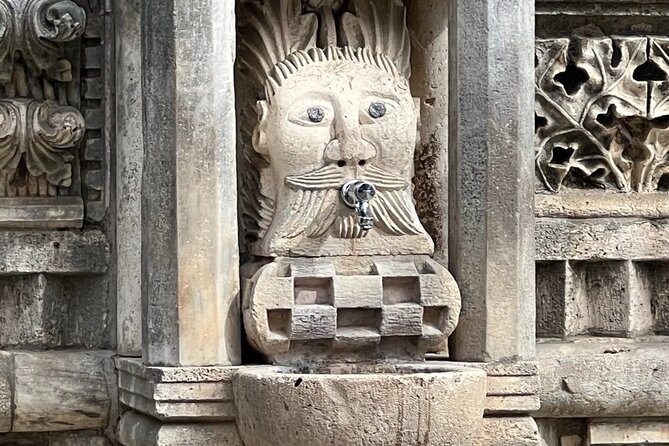
The large urban spa was used for several hundred years. Roman baths were not simply places to wash. They served as social and cultural centers, where people met and spent time in a shared public setting.
The remains here are not presented as a complete bathhouse you can walk through room by room. Still, the site helps you picture ordinary urban life beyond temples and official buildings. I like that the tour includes it because it keeps Salona from becoming a parade of funerary monuments.
Pet mostova means five bridges. These bridges once belonged to an industrial area outside the old city center. The stop gives you a look at the practical edge of Salona, where work and movement supported the main urban area.
Each of these stops takes about 10 minutes. That short timing keeps the tour moving, but you should not expect a long pause at either place. The advantage is coverage. You see several parts of the city in one visit.
Porta Caesarea and the old Roman road
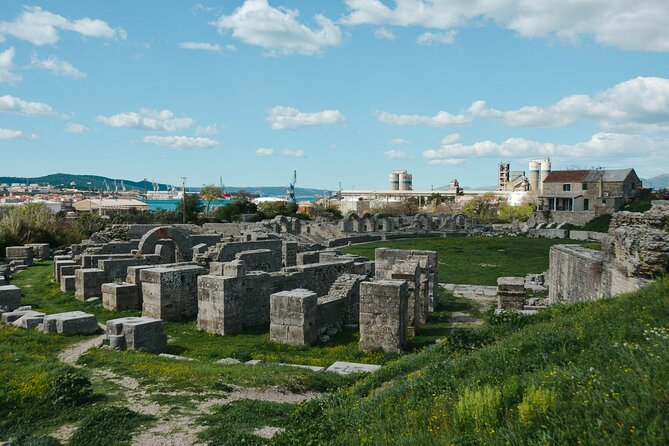
Porta Caesarea was the capital gate in Roman times. The surviving wheel ruts from Roman chariots are the kind of small detail that can turn a wall into a road used by real people.
I always find worn road surfaces more revealing than a bare foundation. They show repeated movement over time. At this gate, the marks help you imagine carts and chariots passing through the entrance, carrying people and goods into the city.
This stop lasts about 10 minutes. It is a quick look, but the guide can place the gate within Salona’s wider plan. You are not just seeing an arch or broken wall. You are standing at a controlled point of entry into a major Roman center.
Forum, temple, and theater at Hram
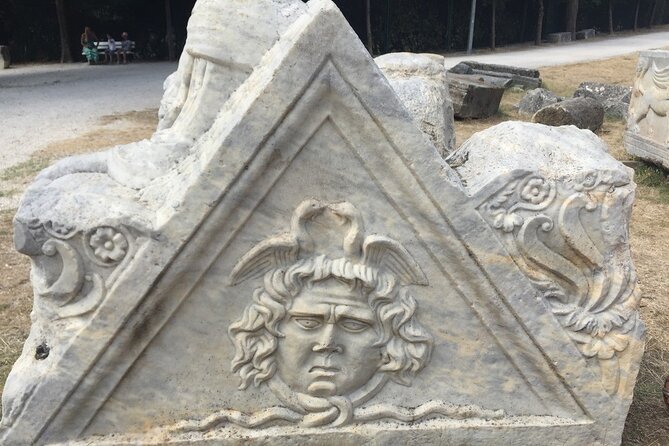
Hram lies in the oldest part of Salona. Here you see remains of the forum, a temple, and an ancient Roman theater.
This is one of the most important stops for understanding Salona as a city rather than a collection of cemeteries. The forum was a public center, while the temple and theater point to religion, civic life, and entertainment. Even in ruined form, the group of buildings suggests how many different activities took place within a compact urban core.
The visit lasts about 10 minutes. The remains are not described as fully restored, so let your guide help you read the outlines and relationships between the structures. If you prefer intact monuments, this part may feel spare. If you enjoy reconstructing a place from its foundations, it is rewarding.
The Cemetery of the 16 Sarcophagi
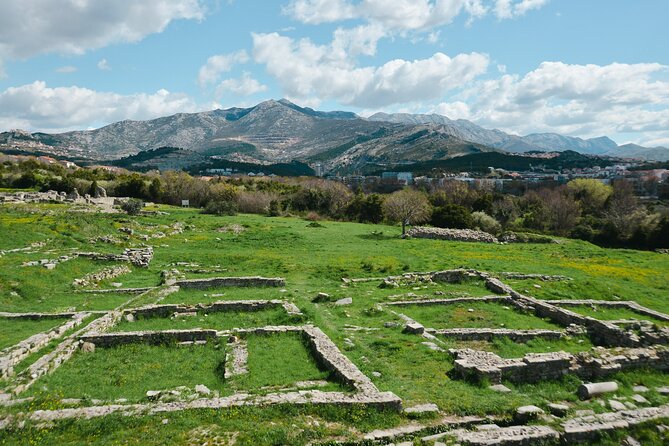
At Ul. don Frane Bulića 91, the road toward the amphitheater passes the Cemetery of the 16 Sarcophagi. Roman cemeteries were placed outside city walls, and this necropolis shows that pattern clearly.
The location beside the road is not accidental. Burial areas often lined approaches to Roman cities, placing the dead along routes used by the living. That detail adds a human scale to the walk. You are following the same general approach that led toward Salona’s public buildings, while seeing how the city marked its edges.
The stop takes about 10 minutes. It works best as part of the larger route, linking the central city to the amphitheater. You should not expect a separate museum-style visit with extensive indoor displays.
Kapljuc and the five martyrs
Kapljuc contains another basilica and necropolis. Five martyrs who died in Salona’s amphitheater during the early fourth century, under Diocletian’s persecution of Christians, were buried here.
This stop brings together two parts of the tour that might otherwise feel separate. The amphitheater was a place of public spectacle, while Kapljuc became a place of Christian remembrance. The short walk between them helps you connect the physical distance and the historical tension.
The stop takes about 10 minutes. It is especially useful if you want more than a standard Roman architecture tour. Salona’s story includes public entertainment, imperial authority, Christian persecution, and later Christian burial sites.
The Salona amphitheater, the tour’s main finish
The amphitheater receives about 30 minutes, making it the longest single stop. It is the natural high point of the visit, and I like the choice to place it at the end. By then, you have seen the road, cemeteries, religious sites, and city center. The arena becomes part of a larger city story.
The building is relatively well preserved despite the removal of much of its stone by the Venetians. That detail is worth remembering as you look at the structure. What remains gives you a sense of the form, while the missing stone shows how ancient ruins were reused long after the Roman period.
The amphitheater is not just a dramatic photo stop. It also links to the five martyrs remembered at Kapljuc. You can consider the building first as a place for public events, then as a site connected with the persecution of Christians.
Thirty minutes should allow time to examine the remains and ask questions. Since this is a private tour, you can use that time to focus on the parts that interest you most, such as construction, public events, or the Christian history tied to the arena.
What the private format adds
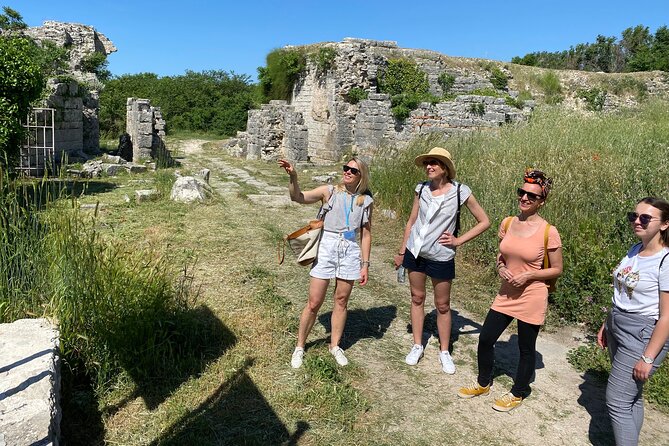
The tour is offered in English and only your group participates. That matters at an archaeological site where the meaning of a low wall or worn stone is not always obvious.
A private guide can also adjust the amount of detail. You might want more time at the amphitheater, or you might be especially interested in St. Domnius, the cemeteries, or Don Frane Bulić. The listed timings are approximate, so the format may allow a more natural conversation than a fixed large-group walk.
A five-star rating and a direct note about Ivan describe him as well informed and pleasant company. That combination is important here. Salona rewards clear explanation, but a friendly guide also makes the long sequence of short stops feel less like a lesson in dates.
The tour lasts about two hours and 30 minutes. That is long enough to cover the major areas without turning the visit into an all-day archaeological study. You should still plan for outdoor walking and comfortable shoes.
Is the $203.50 price good value?
At $203.50 per person, this is not a budget sightseeing stop. The price makes the most sense for people who value a private guide and want Salona explained in English rather than simply entering the ruins alone.
The value improves if your group includes several people, since the private format spreads the cost across the group while keeping the visit exclusive to you. For one person, the price is harder to justify unless personal guiding and detailed questions are high priorities.
There is one important money issue to settle. The booking title says admission is included, but the detailed stop information says the open-air museum entrance is about 10 euros for adults and not included. Ask Split Guide to confirm the current ticket arrangement before booking so you know the real total.
The tour is booked on average 84 days in advance. That suggests you should reserve early if you need a particular date, especially if you are planning around a cruise stop or a fixed Split schedule.
Practical details for your visit
You meet at Salona’s main entrance, Ul. don Frane Bulića 58, in Solin. The tour returns to the same point, so it does not end in central Split or at a different attraction.
The site is near public transportation, and service animals are allowed. Most people can participate, but the route involves walking through an open-air archaeological area. The supplied information does not give a detailed distance or surface description, so ask the provider directly if your group has specific mobility needs.
Mobile tickets are accepted, and the tour is offered in English. Confirmation arrives at booking. The activity requires good weather. If poor weather causes cancellation, you can choose another date or receive a full refund.
Free cancellation is available up to 24 hours before the start time. Changes or cancellations made later are not accepted for a refund, and the cut-off follows local time.
Who should book the Salona tour?
I would choose this tour if you have already seen Split’s main old-town sights and want the Roman story beyond Diocletian’s Palace. It also suits anyone who prefers a guide to explain foundations, burial grounds, and scattered ruins rather than walking through an archaeological site alone.
History fans will get the most from the sequence of stops. The tour covers civic life, industry, baths, roads, temples, Christian buildings, cemeteries, and the amphitheater in one compact visit.
Families and mixed-interest groups may also like the private format because you can ask questions and keep the pace together. The main caution is the price, plus the need to confirm the admission fee. If you want a low-cost, self-guided outing, this is probably more than you need.
Should you book it?
Book this private Salona tour if you want a focused English walk with a personal guide, especially if Ivan is available and your group values conversation over a standard group schedule. The route gives you a fuller picture of Roman and early Christian Salona than a quick look at the amphitheater alone.
I would skip it only if your time or budget is tight, or if you prefer fully restored monuments. Salona is spread out and often survives as foundations and partial structures. For the right visitor, that is the point: you get to read an ancient city piece by piece, with the amphitheater as the final, memorable chapter.
FAQ
Where does the tour begin?
It begins at Salona’s main entrance, Ul. don Frane Bulića 58, 21210 Solin, Croatia.
Where does the tour end?
The tour ends back at the Salona main entrance, the same place where it starts.
How long does the tour last?
The tour lasts approximately two hours and 30 minutes.
Is the tour private?
Yes. Only your group takes part in the activity.
Is the tour offered in English?
Yes. English is the listed language.
Is admission included?
The supplied details are inconsistent. The tour title says admission is included, while the Salona stop states that the adult open-air museum ticket costs about 10 euros and is not included. Confirm this with Split Guide before booking.
What is the price?
The listed price is $203.50 per person.
How far in advance is the tour usually booked?
It is booked an average of 84 days in advance.
What happens if bad weather cancels the tour?
If poor weather causes cancellation, you will be offered another date or a full refund.
Just added around Split
- Kayaking & Zipline Šibenik – Čikola Canyon★ 5.0 · 3 reviews
- Krka National Park & Zipline Šibenik – Čikola Canyon★ 5.0 · 3 reviews
- From Split: Krka National Park & Waterfalls Private Day Trip★ 5.0 · 3 reviews
- Split: Small-Group Half Day Sailing Trip★ 5.0 · 3 reviews
- Rafting River Cetina from Makarska Riviera including transfer★ 5.0 · 3 reviews
- Split and Salona Cultural Heritage Day Tour from Trogir★ 4.0 · 3 reviews
- Split Bike and Wine Experience★ 5.0 · 3 reviews
- Private transfer from Split to Dubrovnik with 2h sightseeing stop in Ston★ 5.0 · 3 reviews
Tickets, compared.
Plitvice Lakes Guided Tour with Entry Tickets
Read our review →From Split or Trogir: Plitvice Lakes Tour with Entry Tickets
Read our review →
Skywalk Tour with a Tuk Tuk – Skip the line ticket
Read our review →
Plitvice Lakes group tour from Split or Trogir (Included: Entry Ticket)
Read our review →
Klis Fortress GOT and Olive Museum Entry Tickets
Read our review →Browse the lists this tour appears in