
Reviewed · WINE TOURS
Private Tour of Split with Food & Wine Tasting
Split’s best sights and flavors meet inside the walls of Diocletian’s Palace, where ancient Roman remains are still part of daily life. You’ll move from palace lanes to the Green Market, then sample burek, ćevapčići, sweets, local wine, and Dalmatian specialties.
I like the private format, which lets your guide adjust the pace and explain the city in a more personal way. I also like the mix of history and food, especially the chance to taste everyday Croatian dishes rather than only sitting down for one formal meal. The main consideration is the price: at $298.86 per person, this makes the most sense if you value one-on-one guiding and a broad tasting menu.
In This Review
- Key points
- Why Diocletian’s Palace makes a strong starting point
- What 90 minutes inside the palace really gives you
- Green Market: a quick taste of local life
- Traditional sweets in Diocletian’s Palace
- Burek in Split’s medieval streets
- Ćevapčići and the story behind the dish
- The 45-minute wine and food tasting
- Is $298.86 per person good value?
- Who will enjoy this Split food tour most?
- Timing, meeting point, and practical details
- Should you book the private Split food tour?
- FAQ
- How long does the private Split food and wine tour last?
- Where does the tour begin and end?
- Is the tour offered in English?
- Is this a private tour?
- Which foods are included?
- Can people under 18 drink the wine?
- Can I cancel for a full refund?
Key points
- Ancient palace, living neighborhood: Diocletian’s Palace is more than an archaeological site. People still live, work, shop, and eat within its walls.
- Six tasting moments: You’ll try market foods, sweets, burek, ćevapčići, two wines, and several Dalmatian dishes.
- A private English-language tour: Your group is the only group taking part, with guides including Dijana and Dinah.
- A useful introduction to Split’s food: The stops cover savory pastries, grilled meat, seafood, cheese, cured ham, sweets, and wine.
- A compact three-hour plan: The tour fits well into a morning or afternoon in Split, though the schedule moves at a steady pace.
- Flexible for younger participants: Guests under 18 receive non-alcoholic drinks instead of wine.
Why Diocletian’s Palace makes a strong starting point
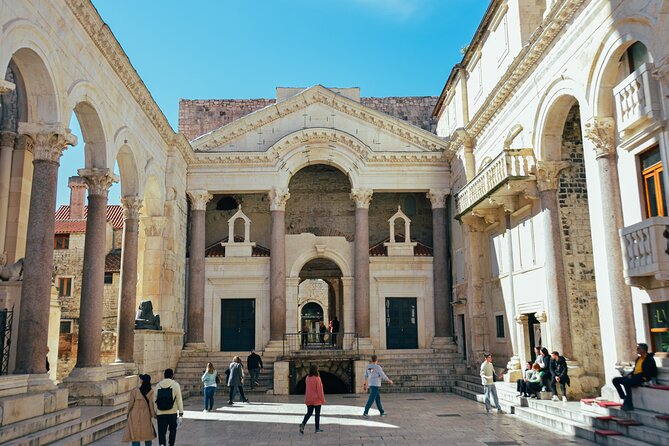
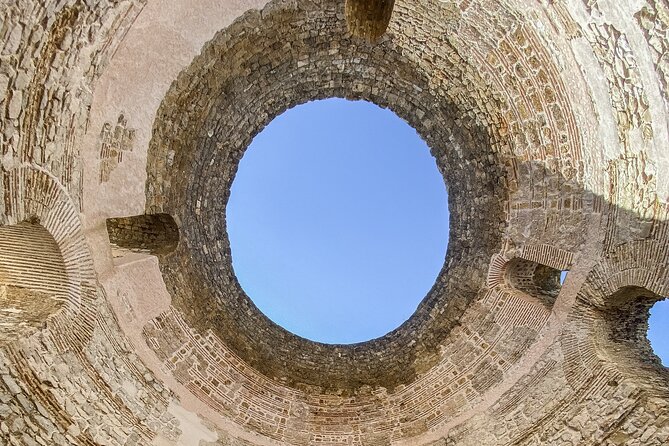
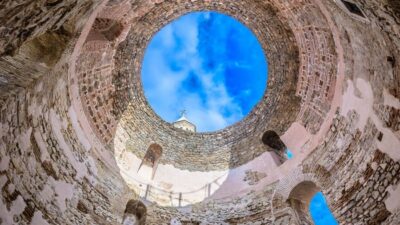
The tour begins at Obala Hrvatskog narodnog preporoda 23, near Split’s waterfront, and heads into the heart of the old city. From there, the focus is Diocletian’s Palace, built more than 1,700 years ago for the Roman emperor Diocletian.
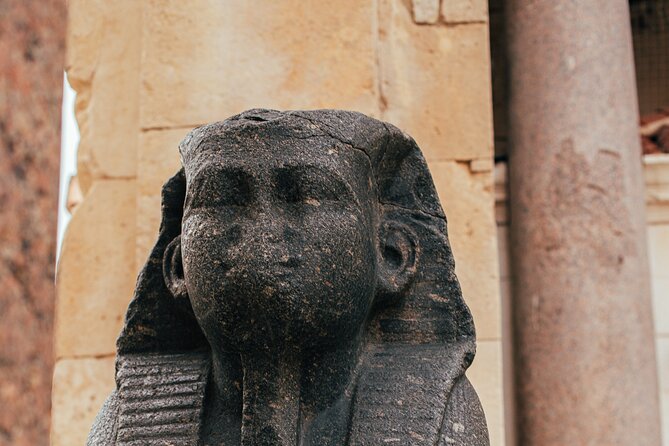
The name can mislead you. This is not one isolated palace building with quiet galleries and velvet ropes. It is a working part of Split, with homes, shops, restaurants, and small workshops set among Roman walls and later medieval streets.
That living quality is the key to the visit. You can look at the stonework and imagine the Roman plan, then turn a corner and find an ordinary café or local business using the same old structure. Your guide can connect those layers in a way that a map or self-guided walk often cannot.
You have about 90 minutes here, which is the longest part of the outing. That gives the guide time to explain Diocletian’s rule, the palace’s changing purpose, and the way Split grew around it. The history is not treated as a separate lecture. It becomes part of the streets you are walking through.
Guides Dijana and Dinah are named in the tour’s guest feedback, and both are praised for bringing Split and Croatia’s past to life. Dinah is also noted for knowing the palace and surrounding neighborhoods thoroughly. Since this is a private tour, you can ask for more detail on the parts that catch your interest instead of following a fixed group script.
More Split wineries worth an afternoon:
- From Split: Krka Waterfalls, Food & Wine Tasting Tour
★ 5.0 · 9,326 reviews - From Split: Krka Waterfalls, Food & Wine Tasting Tour
★ 4.9 · 6,598 reviews - Krka National Park Tour with tour Guide & Wine tasting from Split & Trogir
★ 5.0 · 1,625 reviews
What 90 minutes inside the palace really gives you
Ninety minutes is enough for a solid orientation, but not enough to inspect every corner of the old city. That is a fair trade for a tour that also includes five food-related stops.
I like this balance. You get a proper introduction to the palace without spending the entire three hours on architecture. The food stops then show how Split functions today, not only how it looked under Roman rule.
The old streets can be uneven and crowded, and the route includes several brief stops. Comfortable shoes are sensible. The tour is near public transportation, and most people can take part, but anyone who has trouble walking should consider that historic streets rarely offer a smooth, straight route.
The private setting also matters for families and small groups. You can ask your guide to explain the palace in simpler terms for children, or spend longer on food traditions if everyone in your party is more interested in eating than emperors.
Green Market: a quick taste of local life
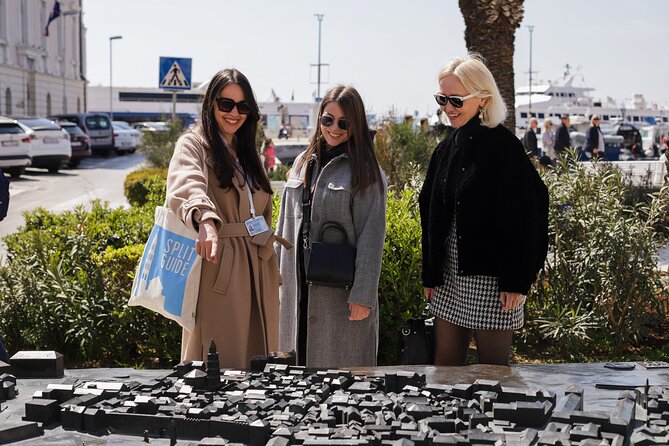
The Green Market receives about 15 minutes. This is a short visit, but it changes the feel of the tour. Instead of seeing food only as prepared dishes, you get a look at the ingredients and products sold in Split.
Here you sample Dalmatian prosciutto, local cheese, and rakija. Prosciutto brings a salty, cured flavor, while the cheese gives you a milder contrast. Rakija, a strong fruit brandy common across the Balkans, is served only to people over 18.
The short timing is both a benefit and a limit. You get a focused introduction without losing too much time, but you will not have a long period to browse stalls or shop. If you want to return later for produce, cheese, or souvenirs, note the market’s location during the tour.
This stop helps explain why the later tastings make sense. Dalmatian cooking often depends on a small set of direct, recognizable ingredients. The experience is less about complicated presentation and more about good produce, cured foods, seafood, cheese, and simple preparation.
Traditional sweets in Diocletian’s Palace
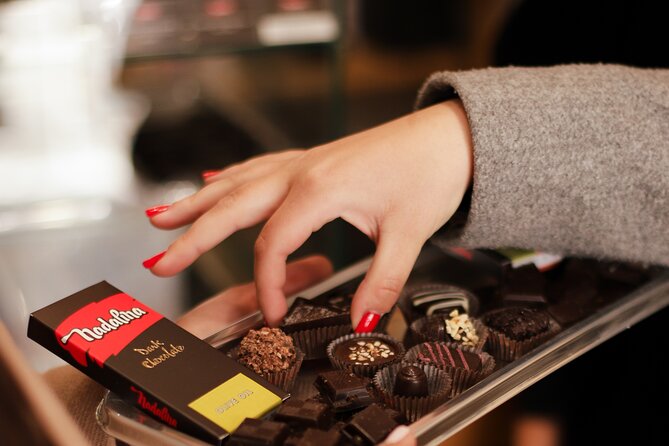
The next stop lasts about 10 minutes and focuses on regional sweets. The exact selection can vary, so you should think of this as a chance to try local confectionery rather than a full dessert course.
That small stop works well after the savory market tasting. It gives you a quick look at another side of the region’s food culture and keeps the route moving through the palace.
I would not book this tour expecting long tastings at every stop. Several food breaks last only 10 minutes or 15 minutes. Their value comes from variety: you sample many foods in different settings, then finish with a longer sit-down tasting.
A few more Split half-days to weigh up
- Split: Krka Waterfalls Trip with Boat Cruise and Swimming
★ 4.8 · 10,519 reviews - Blue cave, Mamma Mia and Hvar, 5 islands speedboat tour
★ 5.0 · 7,150 reviews - Split/Trogir: Blue Cave, Mamma Mia, Hvar and 5 Island Tour
★ 4.6 · 6,320 reviews - Blue Lagoon & 3 Islands Cruise with Lunch from Split
★ 4.5 · 5,756 reviews
Burek in Split’s medieval streets
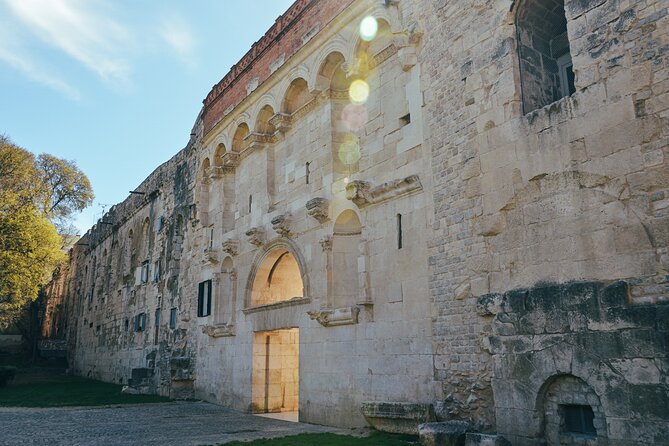
As the route leaves the palace, you stop for burek, a Balkan pastry with fillings that may include meat, cheese, spinach, or potato. This is one of the most practical food stops because burek is a familiar everyday dish, not a special-occasion item created only for tourists.
You choose among different fillings, so this stop can suit different tastes. Meat gives you the most traditional savory option, while cheese, spinach, and potato offer alternatives for those who prefer a lighter or meat-free bite.
The stop lasts around 10 minutes and includes admission. That wording matters less than the format: expect a quick food tasting, not a sit-down meal with table service. If you have dietary restrictions, ask your guide before ordering, since the available fillings and ingredients are not specified.
Burek is also useful context for understanding Split beyond the Roman center. The city’s food reflects centuries of contact among Mediterranean, Balkan, and Ottoman traditions. The dish itself carries that wider regional connection.
Ćevapčići and the story behind the dish
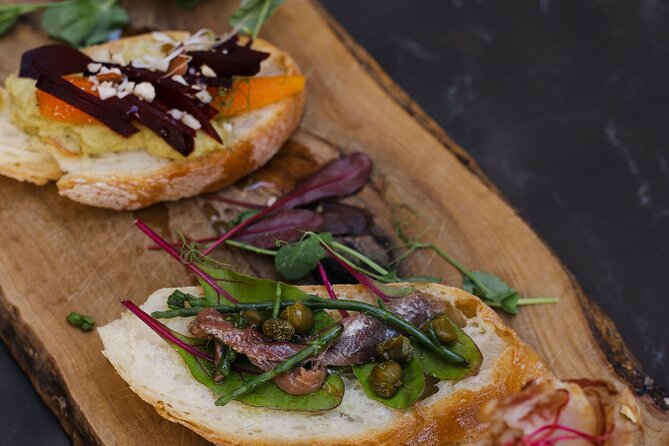
Another short stop introduces ćevapčići, small grilled meat portions related to kebap. The dish has roots connected to Ottoman rule in the Balkans and is linked to the broader movement of cooking traditions across the region.
The historical note makes this more than a quick meat sample. You get a taste of how food crosses borders, changes over time, and becomes part of local identity. The tour connects ćevapčići with hajduks, rebels who adopted the dish during the period of Ottoman occupation.
This is also where the private format can help. You can ask your guide about the difference between ćevapi and ćevapčići, how the dish fits into Balkan cooking, or where to eat it later. The tour specifically includes restaurant suggestions, so take notes if you want to continue exploring after the three hours end.
Again, the timing is short. You will not receive a full lesson in Balkan cuisine, but the stop gives you a clear flavor and a useful piece of cultural background.
The 45-minute wine and food tasting
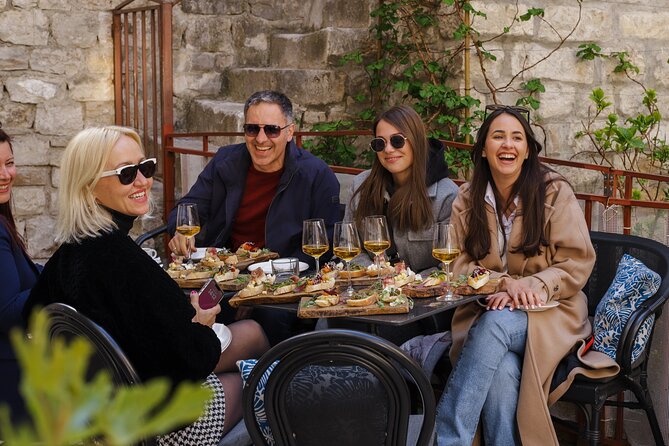
The final tasting is the most substantial food stop. You leave the busiest streets and sit in a restaurant for about 45 minutes, away from the constant movement of the old center.
You taste two high-quality local wines paired with Dalmatian foods. The pairings may include risotto, mussels, hobotnica salad, and other regional dishes. Hobotnica means octopus, so this portion is especially important for anyone hoping to try a classic seafood preparation.
This is where the tour’s food side feels most complete. The earlier stops are quick bites that build range. Here, you have time to sit, compare two wines, and see how local dishes work with them.
The menu includes seafood, so check with your guide if you have allergies, strong dislikes, or dietary limits. The supplied details do not promise vegetarian, vegan, or alcohol-free food pairings, although younger participants receive non-alcoholic drinks instead of wine.
Wine is served only to people over 18. That rule is clear and worth keeping in mind for mixed-age groups. The non-alcoholic option means younger members are not simply left out of the final tasting.
Is $298.86 per person good value?
The listed price is high for a three-hour activity. You are not paying only for food. You are paying for a private guide, a custom pace, historical interpretation, several tasting stops, and a restaurant wine pairing.
For a couple or small group that wants a personal introduction to Split, the cost can be reasonable. A private tour avoids waiting for a larger group and gives you direct access to your guide. If you want a quick overview before exploring alone, that convenience has real value.
The price is harder to justify if you mainly want a cheap meal or a basic walk through the palace. Several food stops are small samples, and the tour does not present itself as a long, full-day food crawl. You should book it for the combination of place, context, and tasting, not for the total volume of food.
The value also depends on how much you use the advice. Restaurant suggestions can help you choose later meals, while the palace orientation can make the rest of your time in Split easier. Ask questions, request local recommendations, and use the private format well.
Who will enjoy this Split food tour most?
I would recommend this experience to first-time visitors who want history and food in one compact outing. It suits couples, families, and groups of friends who prefer a private guide to a large walking tour.
It is also a good match for people who want to try several Croatian and Balkan foods without committing to a single long restaurant meal. You get prosciutto, cheese, rakija, sweets, burek, ćevapčići, wine, seafood, and other Dalmatian dishes in one route.
Food-focused visitors should note the timing. This is a tasting tour with history, not a dedicated culinary workshop. You will learn what you are eating and where it fits, but you should not expect cooking lessons or long discussions at each stop.
The tour can suit younger participants because non-alcoholic drinks replace wine. Anyone with mobility concerns should consider the old palace lanes and medieval streets, though most people can participate and the route is close to public transportation.
Timing, meeting point, and practical details
The activity lasts about three hours and ends back at the starting point. That makes it easy to place before an evening meal, after arriving in Split, or between other plans in the center.
The meeting point is Obala Hrvatskog narodnog preporoda 23, 21000 Split, Croatia. Since the tour stays in the central area, you do not need a separate sightseeing transfer.
Confirmation arrives at booking, and the experience is offered in English. Service animals are allowed. The tour requires good weather, so a cancellation caused by poor conditions results in a different date or a full refund.
You can cancel for a full refund up to 24 hours before the start time. Changes or cancellations inside that 24-hour window are not accepted for a refund. Keep the local time in mind when changing plans.
Should you book the private Split food tour?
Book it if you want a personal palace tour tied to real local food, and if $298.86 per person fits your budget. The strongest feature is the range: Roman history, a local market, everyday Balkan dishes, regional sweets, seafood, and two wines all appear in three hours.
Skip it if you want a long, inexpensive meal or plenty of free time at the market. The schedule is active, and several tastings are brief.
For most first visits, I like the design. It gives you a useful map of Split’s past and present, then leaves you with enough food knowledge to choose your next meal with confidence.
FAQ
How long does the private Split food and wine tour last?
The tour lasts approximately three hours.
Where does the tour begin and end?
It begins at Obala Hrvatskog narodnog preporoda 23 in Split and ends back at the same meeting point.
Is the tour offered in English?
Yes. The experience is offered in English.
Is this a private tour?
Yes. Only your group participates in the activity.
Which foods are included?
The tastings include Dalmatian prosciutto, local cheese, rakija, regional sweets, burek, ćevapčići, two local wines, and Dalmatian dishes such as risotto, mussels, and hobotnica salad.
Can people under 18 drink the wine?
No. Alcohol is served only to people over 18. Younger participants receive non-alcoholic drinks instead.
Can I cancel for a full refund?
Yes. You can cancel at least 24 hours before the experience starts for a full refund. Cancellations or changes made less than 24 hours before the start time are not accepted for a refund.
Just added around Split
- Kayaking & Zipline Šibenik – Čikola Canyon★ 5.0 · 3 reviews
- Krka National Park & Zipline Šibenik – Čikola Canyon★ 5.0 · 3 reviews
- From Split: Krka National Park & Waterfalls Private Day Trip★ 5.0 · 3 reviews
- Split: Small-Group Half Day Sailing Trip★ 5.0 · 3 reviews
- Rafting River Cetina from Makarska Riviera including transfer★ 5.0 · 3 reviews
- Split and Salona Cultural Heritage Day Tour from Trogir★ 4.0 · 3 reviews
- Split Bike and Wine Experience★ 5.0 · 3 reviews
- Private transfer from Split to Dubrovnik with 2h sightseeing stop in Ston★ 5.0 · 3 reviews
Wine Tours, compared.
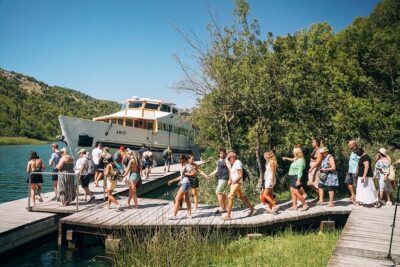
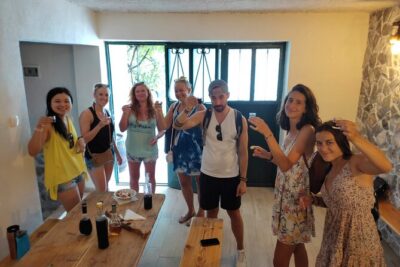
Krka National Park Tour with tour Guide & Wine tasting from Split & Trogir
Read our review →
Krka Waterfalls With Boat Cruise, Wine and Olive Oil
Read our review →
Game of Thrones Tour with Diocletian’s Palace Cellar
Read our review →
Blue Lagoon Tour from Split with Bottled Water and Wine Included
Read our review →Browse the lists this tour appears in