Reviewed · SPLIT TOURS
Experience Split With Local Professional Historian – Small Group
Diocletian’s Palace is not a museum sitting apart from Split. It is the city center, threaded with cafés, shops, homes, churches, and narrow lanes. This tour helps you read that living Roman structure, with Boris, a local historian and former history teacher, explaining how an emperor’s retirement palace became a medieval town.
I especially like the small group limit of 12, which gives you room to ask questions and makes it easier to hear in crowded lanes. The second strong point is Boris’s display book, filled with pictures and 3D reconstructions that show what the palace may have looked like before centuries of change. The main consideration is that the tour is mostly an overview, so visitors wanting lengthy interior visits or a full exploration of Split will need extra time afterward.
In This Review
- Key points before you book
- Why Diocletian’s Palace needs a guide
- Meeting the city at the Golden Gate
- Peristyle: the palace’s great public room
- The cellars and the palace below street level
- Jupiter’s Temple and Roman religion
- Saint Domnius Cathedral and the palace’s later life
- Vestibule and the emperor’s private quarters
- From imperial residence to everyday Split
- Pjaca and the end of the walk
- What Boris adds to the experience
- Price, group size, and practical value
- Who should book this Split walking tour?
- Should you book it?
- FAQ
- How long does the experience last?
- Where does the tour begin?
- Where does the tour end?
- What language is the tour offered in?
- How large is the group?
- Are admission tickets included?
- What happens if the weather is poor?
Key points before you book
- Roman palace and modern city in one walk: You move from the Golden Gate and imperial rooms to working squares, the Riva, cafés, and local recommendations.
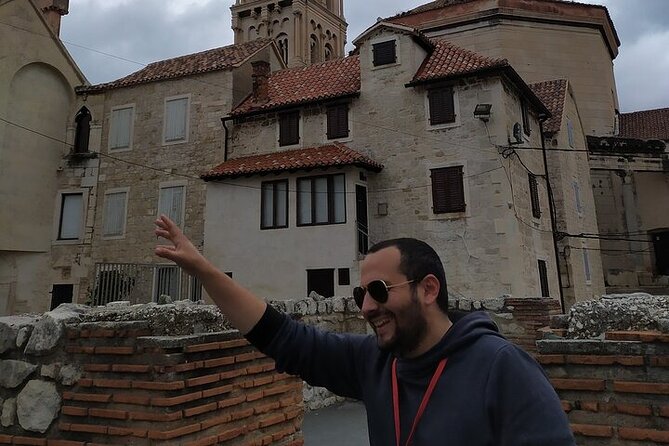
- Boris brings a teacher’s approach: Expect questions, conversation, clear explanations, and personal stories about life in Split.
- 3D images fill in missing pieces: The display book helps you picture vanished walls, altered buildings, and the original purpose of the palace.
- A genuinely small format: The maximum of 12 people makes this more personal than a large walking group.
- Most major sights are viewed from outside: Jupiter’s Temple and Saint Domnius Cathedral are exterior stops, with advice for visiting interiors independently.
- A useful first-day tour: The walk ends at Pjaca, close to places where you can continue sightseeing, eat, or get coffee.
Why Diocletian’s Palace needs a guide
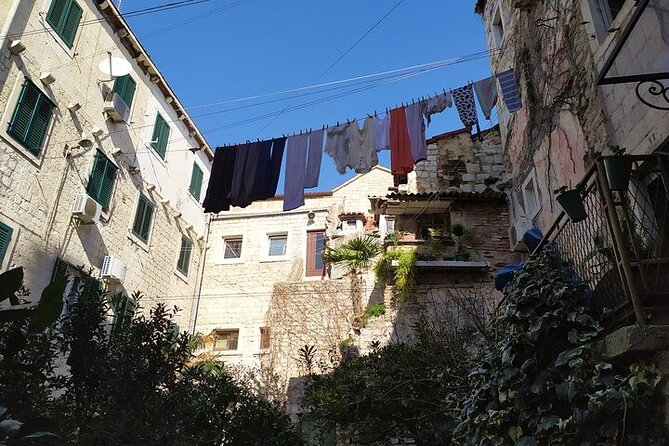
At first glance, Split’s old center can feel like a maze of Roman stone, laundry, restaurant signs, and polished marble. That mixture is precisely what makes it special, but it can also make the palace hard to understand on your own.
The palace was built for Emperor Diocletian, one of Rome’s most successful rulers. He retired here in the early fourth century, and the huge complex combined an imperial residence, religious buildings, ceremonial spaces, and the practical parts of a fortified compound.
The key idea is that this was not simply a palace with a few ruins around it. The modern old city grew inside and around its walls. A guide can point out where imperial power once controlled movement, where religious change altered Roman buildings, and how later residents adapted the structure for ordinary life.
Boris’s approach is especially useful if you enjoy history but do not want a dry lecture. The tour includes questions, discussion, and stories about Split today, along with the past. He also draws on personal and family memories of living in the city, giving you a sense of how the old center functions beyond its monuments.
A few more Split half-days to weigh up
- Split: Krka Waterfalls Trip with Boat Cruise and Swimming
★ 4.8 · 10,519 reviews - From Split: Krka Waterfalls, Food & Wine Tasting Tour
★ 5.0 · 9,326 reviews - Blue cave, Mamma Mia and Hvar, 5 islands speedboat tour
★ 5.0 · 7,150 reviews
Meeting the city at the Golden Gate
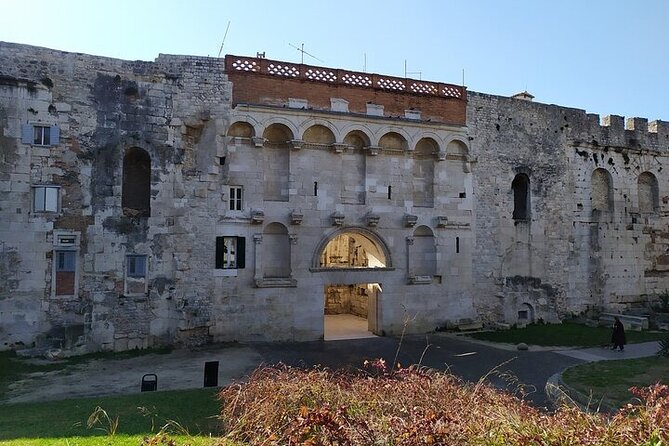
The tour begins at the Golden Gate, the northern entrance to Diocletian’s Palace. It is made of stone, not gold, but the name is memorable and the location is easy to identify.
This is a sensible meeting point because it immediately places you at one of the palace’s main gateways. Boris introduces the history of Split here and explains why the gate mattered. You begin with the palace as a planned imperial complex, rather than jumping straight into disconnected ruins.
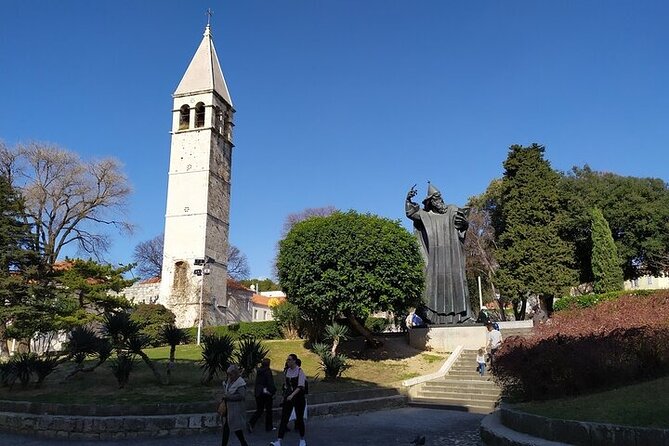
The nearby statue of Gregory of Nin provides the next short stop. Gregory was a medieval bishop, and the monument dedicated to him is one of the best-known sculptures in Split. You hear about the historical figure, the monument, and its sculptor.
This opening section takes about 25 minutes in total. It is a good chance to settle into the group and ask early questions. Boris also helps with photographs during the walk, a small but useful touch when you are trying to frame both the statue and the surrounding gate.
Peristyle: the palace’s great public room
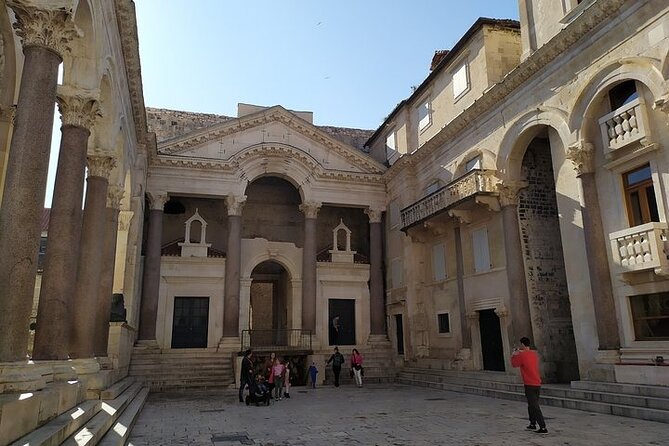
From the Golden Gate, the route moves through the most important parts of Diocletian’s Palace. The Peristyle is the central ceremonial square, and it gives you the clearest sense of how the palace was organized.
Boris explains how the space connected different parts of the complex while also separating the emperor from everyone else. That contrast is important. The Peristyle was a meeting point, but it was also designed to display hierarchy and authority.
Look around as you listen. The surrounding buildings reveal layers of change, including the effects of Christianity on spaces first built for Roman religious and imperial use. The tour does not treat the palace as frozen in the fourth century. Instead, you learn how its buildings shifted purpose as Split changed.
This is one of the places where the 3D images matter most. Stone walls can be difficult to read when upper levels are missing or later structures cover the original design. The visual material gives you a more complete picture, helping you imagine the scale and layout of the imperial complex.
The Peristyle section is scheduled for about 20 minutes, though the actual pace can vary with questions and group interest. If you are visiting in peak season, expect people moving through the square and allow yourself to stay close to Boris.
The cellars and the palace below street level
From the Peristyle, the walk enters the central part of Diocletian’s cellars, also called the palace substructure. These spaces are among the most helpful parts of the tour because they mirror the layout of the private imperial area above.
Boris explains how the cellars were used through different periods and why they matter to Split’s story today. Their role changed over time, like so much else in the palace. The substructure also helps you understand the engineering behind the residence and the relationship between the lower support areas and the rooms above.
The route also includes the Triclinium. This was connected with dining, so the conversation turns to Roman eating habits and the organization of an emperor’s dining room. It is a nice change from broad political history. You get a glimpse of how power worked at the table, not just in temples and courtyards.
The cellars can be a strong part of the tour for anyone who wants practical context. Instead of only hearing dates and names, you learn how the palace was arranged and how its rooms served different purposes. If you prefer a long, slow examination of underground architecture, the 20-minute schedule may feel brief, but it gives you a useful foundation for a later return.
Same coast, a completely different day out:
- From Split: Krka Waterfalls, Food & Wine Tasting Tour
★ 4.9 · 6,598 reviews - Split/Trogir: Blue Cave, Mamma Mia, Hvar and 5 Island Tour
★ 4.6 · 6,320 reviews - Blue Lagoon & 3 Islands Cruise with Lunch from Split
★ 4.5 · 5,756 reviews - Split: Old Town and Diocletian Palace Walking Tour
★ 4.9 · 4,727 reviews
Jupiter’s Temple and Roman religion
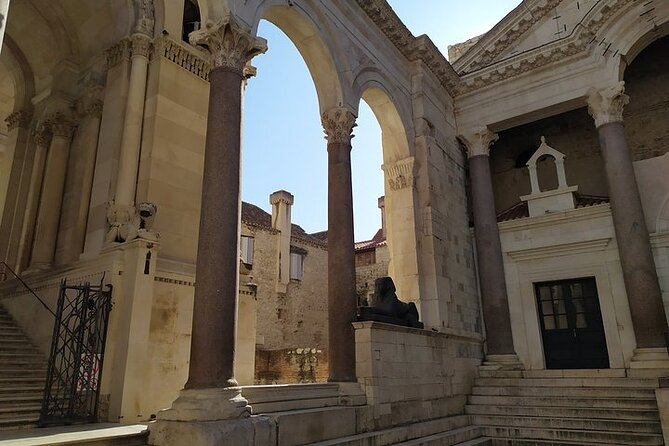
The exterior of Jupiter’s Temple is a short stop, around 10 minutes. Boris uses it to explain the importance of religion in Roman life and why temples were essential parts of imperial residences.
The value here is not simply seeing another ancient doorway. Roman power, ceremony, and religion were closely connected, and the temple helps explain that relationship. You also get a clearer sense of how the palace functioned as both a home for an emperor and a place designed to reinforce his status.
The visit is from outside. If you want to see the interior in greater detail, plan to return independently. Since no admission tickets are included in the experience, you should also check any current entry arrangements before making separate plans.
Saint Domnius Cathedral and the palace’s later life
The Cathedral of Saint Domnius is another exterior stop. Boris points out significant features from the front and explains the story behind the building. He also tells you what to look for if you decide to enter on your own later.
The cathedral is especially important because it shows how later Split adapted an imperial structure. The building occupies what was originally Diocletian’s mausoleum, and the shift from Roman imperial monument to Christian cathedral is one of the clearest examples of the city’s changing identity.
This stop is brief, about 10 minutes, so do not expect a full cathedral visit. I see that as a practical choice for a general walking tour. You get the essential context without spending the whole morning in one building, then can decide if a separate interior visit suits your schedule.
Vestibule and the emperor’s private quarters
The Vestibule was the entrance to Diocletian’s private chambers. Its design reflected the importance of the rooms beyond it, and Boris explains its function and appearance.
This stop helps distinguish the emperor’s private world from the public ceremony of the Peristyle. The palace was carefully arranged to control access, movement, and visibility. Once you understand that, the various courtyards and passageways become easier to read.
The scheduled time is about 10 minutes. That is enough for the main explanation, especially when paired with the reconstructed images. You will not receive an exhaustive architectural survey, but you will understand why this seemingly simple space mattered.
From imperial residence to everyday Split
The walk then leaves the palace core and connects the Roman site to the modern city. At Riva Harbor, Split’s main promenade, Boris explains how the waterfront was built and why it became central to local life.
Riva is a useful contrast to the stone interiors and ancient courtyards. Here, the emphasis shifts toward how residents use the city now. You see Split not only as an archaeological site, but as a place for walking, meeting, and daily routines.
The stop takes about five minutes, so treat it as a short orientation rather than a long waterfront visit. It can help you choose where to return later, especially if you want time by the harbor after the tour.
Fruit’s Square, officially Trg Braće Radić, is smaller and more intimate. Boris explains the reason for its name, the important monument in its center, and the surrounding buildings.
This is the sort of stop that is easy to pass without understanding. A local guide adds meaning to the square’s name and points out details that might otherwise blur into the old town’s general scenery. The visit lasts around 10 minutes.
Pjaca and the end of the walk
The final stop is People’s Square, commonly called Pjaca. From medieval times to today, it has been a central place for city life. Boris talks about the square’s character and nearby buildings, including the old City Hall.
Pjaca is a practical ending point. You finish in a part of town where you can continue walking, stop for a drink, or explore more of Split without arranging another transfer. Boris also suggests other places to see that are not part of this route.
That local advice is one of the tour’s useful extras. Previous participants received suggestions for restaurants, coffee shops, ice cream, shops, and other activities. Those recommendations are based on your interests, so use the final conversation to ask specific questions rather than simply accepting a general list.
The published schedule adds up to roughly two hours. It may run closer to two and a half hours when the group asks questions and the discussion develops, but you should not build a tight connection around that possibility. The route is a walking tour through the old center, so comfortable shoes and a little patience in crowded passages will serve you well.
What Boris adds to the experience
Boris is the central reason to choose this tour instead of simply reading a guidebook plaque at each monument. He has a master’s degree in history, works as a licensed professional guide, and has taught history. His style combines direct explanations with questions and conversation.
That teaching background is useful for families. Children and teenagers are included rather than left to follow silently, and the quiz-like questions give younger members of a group a way to take part. Adults who already know something about Roman history can ask broader questions about Croatia, regional differences, political change, and modern local culture.
You should also expect personal stories. Boris grew up and lives in Split, and his memories of the city add a human layer to the Roman and medieval material. The result is less like walking through a sealed monument and more like learning how a local understands his hometown.
English is the offered language, and the feedback on the tour repeatedly points to clear communication. Still, any history walk depends on your willingness to listen and ask questions. If you want only quick photographs with minimal explanation, this may feel too talkative.
Price, group size, and practical value
At $38.62 per person, this is not the cheapest way to walk around Split, since the old center can be explored for free. The value comes from interpretation, structure, and access to a local historian rather than from admission to a paid attraction.
The group limit of 12 is important. A smaller party makes it easier to hear in narrow streets, ask follow-up questions, and get help with photographs. In quiet periods, the experience may be even smaller, and it has sometimes operated as a private-feeling walk when only a few people booked.
The tour itself does not include admission tickets. The scheduled stops are generally outside views or walking explanations, with entry advice for places you may choose to visit later. Budget separately for any interiors you decide to enter.
Confirmation arrives at booking. Service animals are allowed, public transportation is nearby, and most people can take part. The experience requires good weather and a minimum number of participants. You can cancel for a full refund up to 24 hours before the start time, but late cancellations are not refunded.
Who should book this Split walking tour?
I would choose this for a first visit to Split, especially if you want the old city to make sense before exploring it alone. It also suits history fans, families with school-age children, and anyone who prefers questions and conversation over a memorized speech.
It is a good fit after several days in Croatia, too. Boris can place Split within the wider country and region, so the walk can serve as a useful final look at the city after a longer trip.
You may want another option if your priority is extensive cathedral access, a long visit inside every monument, or a slow photography walk. This tour covers a lot of ground in about two hours, and several stops are short exterior explanations.
Should you book it?
Book it if you want to understand why Diocletian’s Palace is still a city rather than merely a Roman ruin. The combination of Boris’s local background, teacher’s delivery, 3D reconstruction images, and small group format gives you more context than a self-guided stroll.
Keep extra time afterward for the cathedral, palace interiors, shops, and places Boris recommends. The best way to use this experience is as an introduction: take the walk early in your stay, then return to the spots that caught your interest.
FAQ
How long does the experience last?
The tour lasts approximately two hours. It can sometimes run longer when the group has many questions and discussions.
Where does the tour begin?
It begins at the Golden Gate, at Dioklecijanova 7 in Split.
Where does the tour end?
The walk ends at People’s Square, also known as Pjaca Square.
What language is the tour offered in?
The experience is offered in English.
How large is the group?
The maximum group size is 12 travelers.
Are admission tickets included?
No. Admission tickets are not included. Several major stops, including Jupiter’s Temple and Saint Domnius Cathedral, are presented from outside, with advice for visiting interiors independently.
What happens if the weather is poor?
The experience requires good weather. If it is canceled because of poor weather, you will be offered another date or a full refund.
Just added around Split
- Kayaking & Zipline Šibenik – Čikola Canyon★ 5.0 · 3 reviews
- Krka National Park & Zipline Šibenik – Čikola Canyon★ 5.0 · 3 reviews
- From Split: Krka National Park & Waterfalls Private Day Trip★ 5.0 · 3 reviews
- Split: Small-Group Half Day Sailing Trip★ 5.0 · 3 reviews
- Rafting River Cetina from Makarska Riviera including transfer★ 5.0 · 3 reviews
- Split Bike and Wine Experience★ 5.0 · 3 reviews
- Split and Salona Cultural Heritage Day Tour from Trogir★ 4.0 · 3 reviews
- Private transfer from Split to Dubrovnik with 2h sightseeing stop in Ston★ 5.0 · 3 reviews
Split Tours, compared.
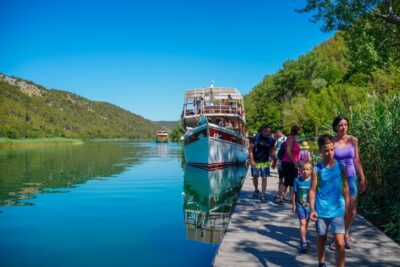
Krka Waterfalls Trip with Boat Cruise and Swimming
Read our review →
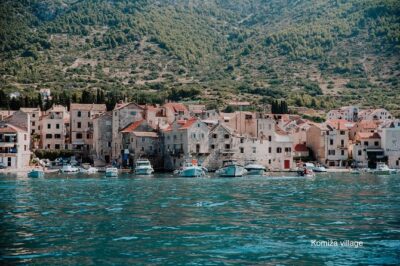
Blue cave, Mamma Mia and Hvar, 5 islands speedboat tour
Read our review →
Blue Cave, Mamma Mia, Hvar and 5 Island Tour
Read our review →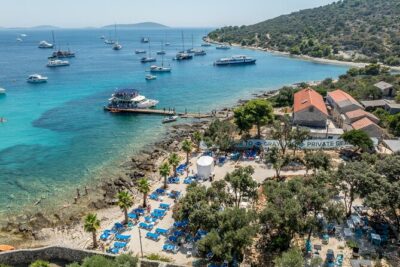
Blue Lagoon & 3 Islands Cruise with Lunch from Split
Read our review →