Reviewed · VIP
Best of Split & Trogir: Private VIP Tour with Local Guide
The clever part of this private tour is that it joins Split’s Roman core with Trogir’s compact medieval streets in one day. You move from Emperor Diocletian’s palace, still woven into daily life, to a Venetian-style town filled with cathedrals, civic buildings, and sea-facing fortifications.
I like the private format because your group gets the guide’s full attention, and I like the local touch reported from Kristina, who adds personal stories and speaks with pride about Dalmatian traditions. The ability to visit Trogir first, as one group did with Andrea, can also help you avoid the heaviest crowds in Split.
The main consideration is cost: at $228.78 per person, this is a serious spend for six hours. Several key interiors, including the palace substructures, Saint Lawrence’s Cathedral, Kamerlengo Fortress, and Čipiko Palace, also charge admission separately.
In This Review
- Key things to know before booking
- Why pairing Split and Trogir makes sense
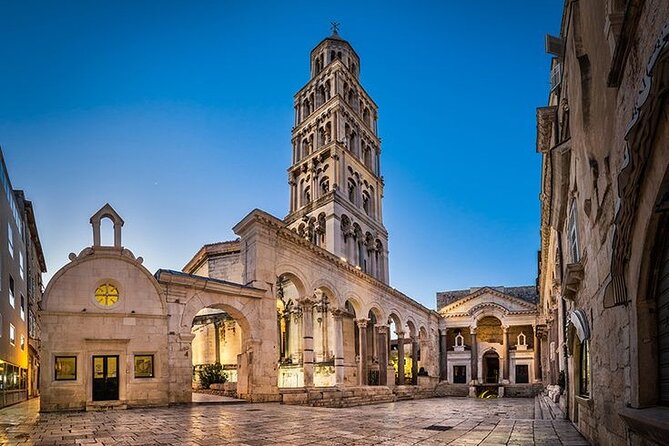
- Starting at the Peristyle, Split’s grand Roman crossroads
- The cathedral, Jupiter’s Temple, and Roman power
- Rubbing the toe of Gregory of Nin
- The palace cellars reveal the building above
- Trogir’s central square and civic life
- Saint Lawrence’s Cathedral and centuries of style
- Kamerlengo Fortress and Trogir’s maritime edge
- The Town Loggia and the Čipiko Palace
- How the private format changes the day
- Is $228.78 per person good value?
- Practical details that affect your decision
- Should you book Best of Split & Trogir?
- FAQ
- How long does the private tour last?
- Is the tour private?
- Is the tour offered in English?
- Is pickup available?
- Are admission tickets included?
- Can I cancel for a full refund?
Key things to know before booking
- Two UNESCO-listed old towns in one outing: Split and Trogir offer very different chapters of Dalmatian history.
- A truly private experience: Only your group participates, so the pace and questions can be more personal.
- Strong local guiding: Kristina and Andrea are named guides associated with the experience, with praise for clear explanations, crowd navigation, and local stories.
- The palace cellars need a separate ticket: This is one of Split’s most important ancient spaces, but entry is not included.
- Trogir rewards close attention: The cathedral, loggia, fortress, and Čipiko Palace are packed into a small area.
- Six hours goes quickly: Expect a brisk overview rather than long, unhurried visits at every stop.
Why pairing Split and Trogir makes sense
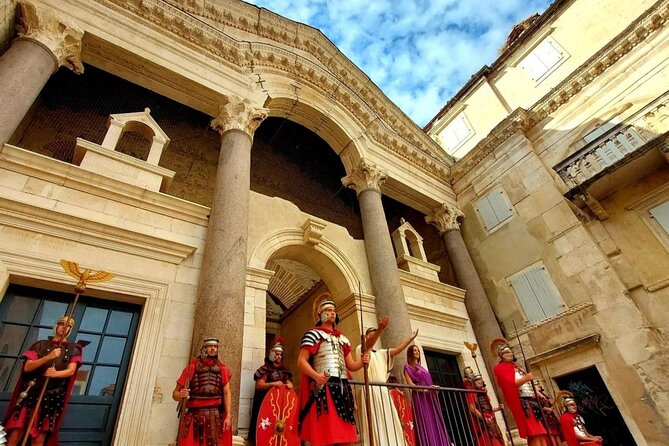
Split and Trogir are close enough to combine, but they feel quite different. Split grew around the retirement palace of Roman Emperor Diocletian. Trogir presents a smaller old town shaped by medieval rule, Venetian influence, noble families, and maritime defenses.
That contrast gives this tour its value. You are not spending six hours looking at similar lanes and churches. Instead, you get a broad picture of the central Dalmatian coast, from a Roman imperial complex to a fortified island town.
The private setting matters here. These old towns can be confusing, with modern life folded into ancient walls. A local guide can explain why a cathedral occupies part of a Roman mausoleum, why a palace courtyard still functions as a public square, and how Trogir’s buildings reflect several centuries of changing architectural taste.
You should still set your expectations properly. The listed stops are generally planned for about 15 minutes each. That is enough for orientation, key details, and photos, but not enough for a slow examination of every carved doorway or church interior.
A few more Split half-days to weigh up
- Split: Krka Waterfalls Trip with Boat Cruise and Swimming
★ 4.8 · 10,519 reviews - From Split: Krka Waterfalls, Food & Wine Tasting Tour
★ 5.0 · 9,326 reviews - Blue cave, Mamma Mia and Hvar, 5 islands speedboat tour
★ 5.0 · 7,150 reviews
Starting at the Peristyle, Split’s grand Roman crossroads
The Peristyle is the natural place to begin in Diocletian’s Palace. It sits where the palace’s main roads crossed and was designed as the ceremonial heart of the imperial complex.
The space is rectangular and framed by a colonnade. Look up and around before following the guide onward. The power of the site is not only in its age. It is in the way the square remains part of Split’s daily life, with people passing through a space once planned for an emperor.
The visit here is listed at about 15 minutes, with no admission charge. That makes it a good first stop, since you can get your bearings without spending extra money.
The Peristyle can also be the most exposed part of the tour. It is an open court, and the pace may feel quick if you want time for photographs. Your private guide can help you focus on the details that matter rather than simply pointing at old stone.
The cathedral, Jupiter’s Temple, and Roman power
The Cathedral of Saint Domnius occupies one of the most unusual buildings in Split. It was consecrated at the turn of the seventh century and is regarded as the oldest Catholic cathedral still in use in its original structure, though its bell tower dates from the twelfth century.
That description helps explain Split’s layered character. A Roman imperial building became a Christian place of worship, and the building continued to serve the city rather than becoming a detached ruin. The tour gives you the context to see that change as part of the city’s story.
Nearby, the Temple of Jupiter adds another piece of the Roman picture. Built between 295 and 305 during the construction of the palace, it was dedicated to Jupiter and sits in the western part of the imperial complex, close to the Peristyle.
These two stops work well together. One shows the persistence of Roman architecture after the empire. The other points directly to the religious world Diocletian’s palace was built to express.
The supplied timing gives each site roughly 15 minutes. If cathedral entry is part of your plan, ask your guide how admission is handled before you arrive, since the listed information does not specify an included ticket for this stop.
Rubbing the toe of Gregory of Nin
The Gregory of Nin statue is one of Split’s most playful sights. Created by Croatian sculptor Ivan Meštrović, the statue reaches 8.5 meters, or about 28 feet, into the air.
The tradition is simple: rub the statue’s toe for good luck. The toe has become smooth and shiny from years of contact, so you can see the custom before anyone explains it.
This stop takes about 15 minutes and is free. It gives the tour a welcome change of pace after the formal Roman and religious sites. You get a local ritual, a famous Croatian sculptural work, and a quick photo opportunity without another admission fee.
Do not expect a long museum-style visit. The value here comes from the story and the setting, not from spending half an hour studying the statue. It is also a useful moment to ask your guide about Meštrović or the place of Gregory of Nin in Croatian culture, if time allows.
Same coast, a completely different day out:
- From Split: Krka Waterfalls, Food & Wine Tasting Tour
★ 4.9 · 6,598 reviews - Split/Trogir: Blue Cave, Mamma Mia, Hvar and 5 Island Tour
★ 4.6 · 6,320 reviews - Blue Lagoon & 3 Islands Cruise with Lunch from Split
★ 4.5 · 5,756 reviews - Split: Old Town and Diocletian Palace Walking Tour
★ 4.9 · 4,727 reviews
The palace cellars reveal the building above
The Substructures of Diocletian’s Palace are among the most useful stops for understanding the palace. These lower halls once supported the emperor’s private apartments and remain one of the best-preserved ancient complexes of their type.
You can think of them as the palace’s foundation and its hidden plan. The shape and arrangement below help explain how the upper imperial residence was organized, even though modern Split now occupies much of the complex.
The cellars are listed for about 15 minutes, with admission not included. That extra ticket is worth considering because this is not just a basement visit. It is one of the places where the scale and engineering of Diocletian’s project become easiest to grasp.
The drawback is the short time. Fifteen minutes may give you the main explanation and a quick look, but you may want to remain longer if ancient construction interests you. Since you are paying separately, confirm how much time the private schedule allows before entering.
Trogir’s central square and civic life
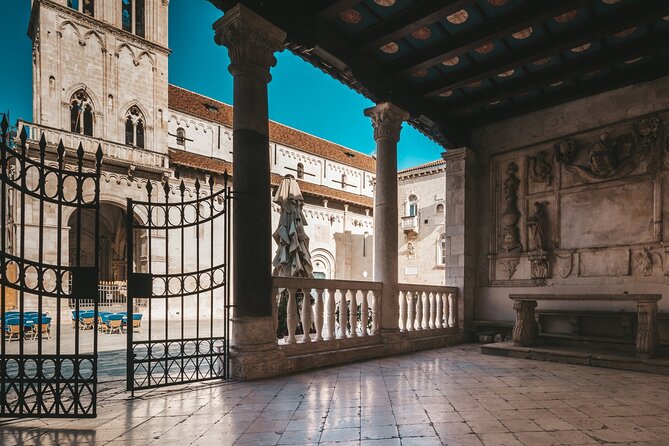
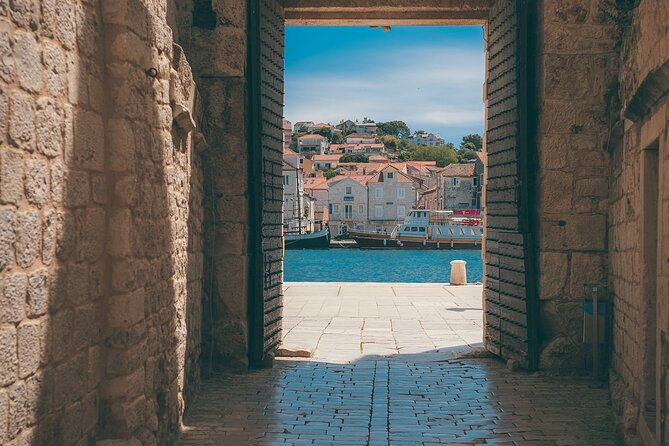
The tour then takes you to Trogir’s Central Square, also called John Paul II Square. This is the main square of the old town, surrounded by important buildings including the Loggia and Clock Tower.
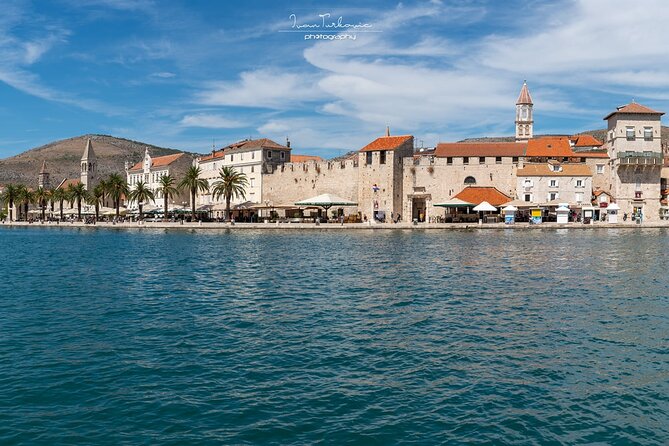
Trogir’s setting and style differ from Split. Its old town has a Venetian character, and its inclusion among UNESCO monuments reflects the quality and continuity of its historic fabric. You can read the town as a place shaped by trade, local government, religion, and defense.
The Loggia once served as a public courtroom and meeting place. Its six pillars have decorated capitals, and the wall includes reliefs, including the Relief of Justice by Nicholas Florentino.
A practical note: during summer, a nearby coffee bar can block a clear view of the pillars. You can still see the relief well, but do not expect an unobstructed look at every architectural detail. This is exactly the kind of small, on-the-ground point a local guide can help you handle.
Saint Lawrence’s Cathedral and centuries of style
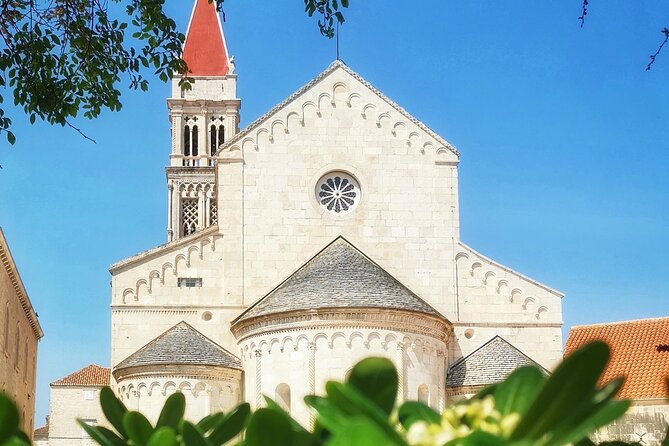
Saint Lawrence’s Cathedral is Trogir’s main monument. It is a three-naved basilica built in Romanesque-Gothic style, but construction lasted for several centuries, so the building shows the changing architectural tastes of Dalmatia.
That long building period is the key to appreciating it. Rather than representing one clean style, the cathedral lets you compare different eras in a single structure. I would pay close attention to the stonework and the way the building fits into the tight central square.
Admission is not included, and the scheduled visit is about 15 minutes. That is enough for a guide-led introduction, but the cathedral may be the place where you most feel the limits of a six-hour tour. If church architecture is a major interest, ask whether you can spend more time here and shorten a less important stop.
Kamerlengo Fortress and Trogir’s maritime edge
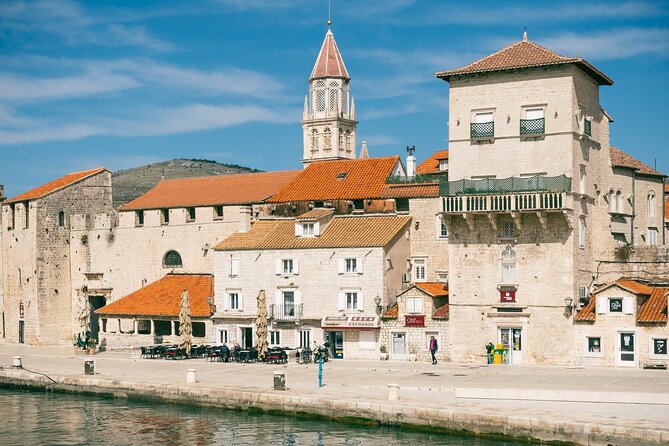
Kamerlengo Fortress is a fifteenth-century coastal fortification built under Venetian rule to protect Trogir from naval attacks. Its position connects the old town to the Adriatic and gives the tour a clear reminder that Trogir was not only a place of palaces and churches.
The fortress offers views toward the old town, marina, and nearby islands. Admission is not included, and the planned visit lasts about 15 minutes.
This stop has two kinds of appeal. History-minded visitors can think about Trogir’s strategic position and Venetian control. Anyone who enjoys a good viewpoint gets a change from narrow streets and enclosed interiors.
The short timing may be enough for a look from the outside, a quick climb or visit if open, and photographs. Do not assume the ticket or extended fortress access is part of the $228.78 price. The supplied details specifically list admission as not included.
The Town Loggia and the Čipiko Palace
The Town Loggia was Trogir’s public meeting place in medieval times. Important decisions were announced there, and legal matters were discussed. It gives you a glimpse of civic life and local self-government, not just aristocratic display.
That distinction matters. Trogir’s history is easier to understand when you look at both public spaces and private palaces. The loggia served the community, while the nearby Čipiko Palace reflects the influence of one powerful family.
The Čipiko Palace is Trogir’s largest residential palace and an example of Gothic-Renaissance architecture. It belonged to the Čipiko family and offers a direct look at the wealth and status of Trogir’s noble class.
Admission to the palace is not included. The listed timing again gives about 15 minutes, so treat this as a focused exterior or introductory visit unless your guide confirms interior access and enough time for it.
Taken together, these stops create a useful sequence: public square, court and meeting place, religious center, military defense, and noble residence. You see how a small Adriatic town was run, protected, worshipped in, and occupied by its leading families.
How the private format changes the day
This is a private tour, so only your group participates. That is a major difference from a large walking tour, especially in old towns where streets and courtyards can feel tight.
You can ask for clarification without waiting for a whole busload of people. You may also be able to adjust the emphasis, though the published schedule remains fairly full. Pickup is offered, and the tour is conducted in English.
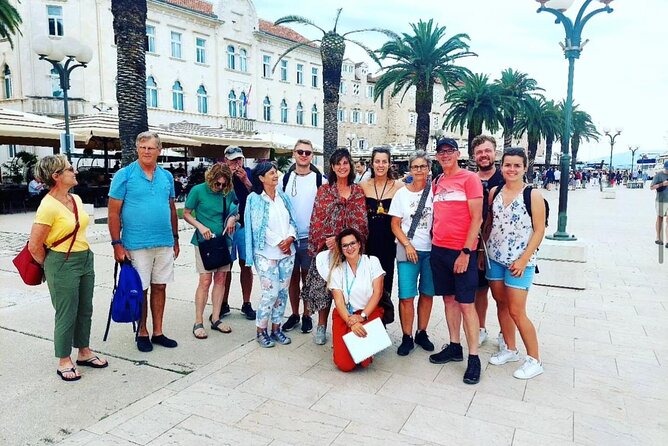
The guides associated with this experience include Kristina and Andrea. Kristina is described as easy to understand, warm, and proud of keeping local traditions alive, with personal stories that add a human side to the history. Andrea is praised for clear explanations and for navigating crowds smoothly, with one group visiting Trogir first.
Those details point to the strongest part of the experience: guiding. The stones in Split and Trogir are impressive on their own, but the difference between seeing them and understanding them often comes down to how well the guide connects them.
Is $228.78 per person good value?
The price is high for a six-hour outing. You are paying for a private guide, pickup availability, and a focused combination of two major historic towns, not simply for entry to monuments.
For two people, the cost adds up quickly. For a larger group, the private format may make more financial sense if the price changes through a group discount. The exact discount is not provided, so check the total for your party before booking.
The value is strongest if you want explanation and efficiency. You avoid arranging separate visits to Split and Trogir, and you get a guide who can connect Roman, medieval, Venetian, religious, and civic history.
The value is weaker if you prefer to wander alone or spend an hour inside one cathedral. The 15-minute blocks are designed for coverage. Admission to several major sites is extra, so budget for those tickets as well.
This tour is best for first-time visitors who want a strong overview, families or friends who prefer their own group, and anyone who wants help making sense of Split’s unusual mix of ancient and modern life. It is less suited to someone seeking a slow photography day or a specialist architectural tour.
Practical details that affect your decision
Confirmation is provided when you book. Free cancellation is available if you cancel at least 24 hours before the local start time. Cancellations or changes made inside that window are not accepted for a refund.
Service animals are allowed, and the tour is near public transportation. Most people can participate, but the supplied information does not give detailed notes about steps, surfaces, or interior access, so ask the provider if your group has specific mobility needs.
The experience is offered in English. Since pickup is offered but the pickup point and transport details are not specified, confirm those arrangements before the day begins.
Because the tour is often booked far ahead, with an average booking lead time of 172 days, early planning is sensible if you need a particular date. That long lead time also suggests you should not wait until the last minute during a busy season.
Should you book Best of Split & Trogir?
I would book it if you want one well-organized day covering the essential sights of both towns, and if a private guide is worth paying for. The combination of Peristyle, Jupiter’s Temple, the palace cellars, Trogir’s cathedral, fortress, loggia, and palace gives you a strong first look at central Dalmatia.
Book with care if your priority is long interior visits. Ask in advance about the order of Split and Trogir, since visiting Trogir first may help with crowd levels, and confirm which entrance fees you want to add.
The strongest reason to choose this experience is the guide. Kristina’s local stories and Andrea’s crowd navigation add practical value that a map cannot provide. If you want context, private attention, and a broad six-hour introduction, this is a sound choice. If you want maximum free time, the schedule may feel too packed for the price.
FAQ
How long does the private tour last?
The tour lasts approximately six hours.
Is the tour private?
Yes. Only your group participates in the activity.
Is the tour offered in English?
Yes. The experience is offered in English.
Is pickup available?
Yes. Pickup is offered, though the provided details do not specify the exact pickup locations or transport arrangements.
Are admission tickets included?
Not for every attraction. Admission is listed as not included for Diocletian’s Palace Substructures, Saint Lawrence’s Cathedral, Kamerlengo Fortress, and Čipiko Palace. The Peristyle, Gregory of Nin Statue, Central Square in Trogir, and Town Loggia are listed with free admission.
Can I cancel for a full refund?
Yes, if you cancel at least 24 hours before the experience’s local start time. Cancellations or changes made less than 24 hours before the start are not accepted for a refund.
Just added around Split
- Kayaking & Zipline Šibenik – Čikola Canyon★ 5.0 · 3 reviews
- Krka National Park & Zipline Šibenik – Čikola Canyon★ 5.0 · 3 reviews
- Split: Small-Group Half Day Sailing Trip★ 5.0 · 3 reviews
- Rafting River Cetina from Makarska Riviera including transfer★ 5.0 · 3 reviews
- From Split: Krka National Park & Waterfalls Private Day Trip★ 5.0 · 3 reviews
- Split Bike and Wine Experience★ 5.0 · 3 reviews
- Split and Salona Cultural Heritage Day Tour from Trogir★ 4.0 · 3 reviews
- Krka Waterfalls, Lake Cruise & Skradin★ 5.0 · 3 reviews
VIP, compared.

Luxury Blue Cave, Hvar and Vis Boat Tour from Split and Brac
Read our review →
Blue Cave & Hvar, 5 Islands Speedboat with Luxury Seats in Shade
Read our review →


Private Luxury Boat tour for 12 from Split, Brac, Trogir, Hvar
Read our review →
Luxury Boat – Blue Cave From Split Island-Hopping Full-Day Cruise, Hvar, Vis
Read our review →